
Colubridae
Boomslang
VenomousDispholidus typus
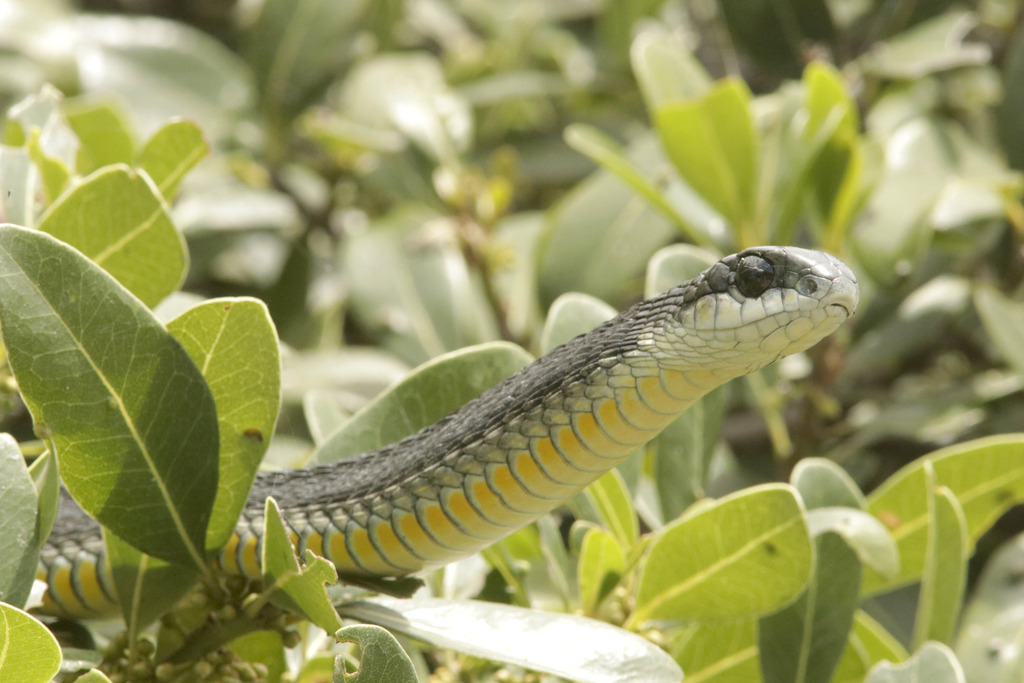
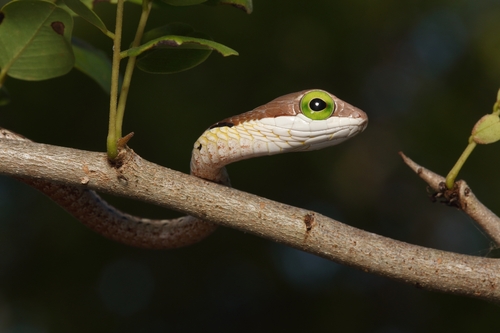
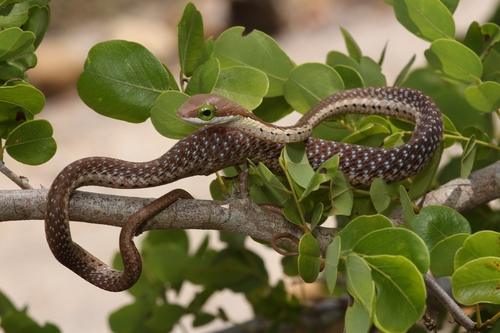
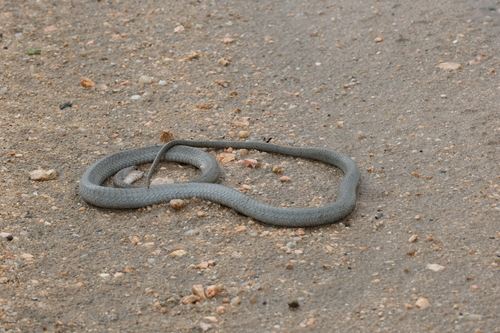
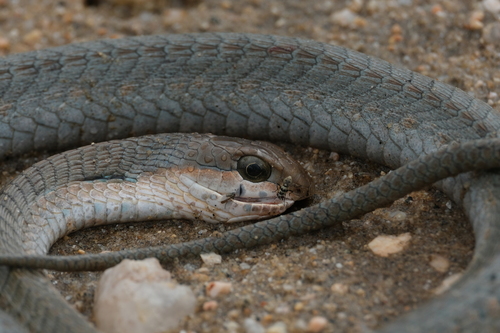
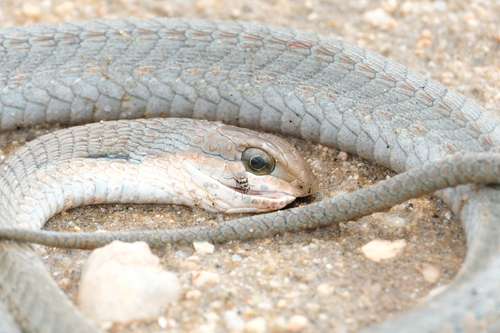
6 photographs of the Boomslang. © Ryan van Huyssteen.
The Boomslang (Dispholidus typus) is a venomous snake in the Colubridae family, recorded in 39 countries.
If you are bitten
This is a venomous snake. Treat any bite as a medical emergency: stay calm, keep the bitten limb still and roughly level with the heart, remove rings and tight clothing, and get to emergency care immediately. Do not apply a tourniquet, cut the wound, apply ice, or try to suck out venom. Call your local emergency number or poison center.
- Family
- Colubridae
- Danger
- high
About the Boomslang
The boomslang ( or ; Dispholidus typus) is a highly venomous snake in the family Colubridae. The species is native to Sub-Saharan Africa.
Etymology
Its common name means "tree snake" in Dutch and Afrikaans – boom meaning "tree", and slang meaning "snake". In Afrikaans, the name is pronounced [ˈbuəmslaŋ].
Taxonomy
The boomslang is a colubrid snake within the subfamily Colubrinae. It belongs to the genus Dispholidus, which contains two other species, D. pembae and D. punctatus.
The boomslang is thought to be closely related to members of the genera Thelotornis, Thrasops, Rhamnophis, and Xyelodontophis, with which it forms the taxonomic tribe Dispholidini.
Close relationships can be shown in the cladogram below:
Subspecies
Two subspecies are recognised, including the nominotypical subspecies.
D. t. kivuensis Laurent, 1955
D. t. typus (A. Smith, 1828)
The trinomial authority in parentheses for D. t. typus indicates that the subspecies was originally described in a genus other than Dispholidus.
Description
The average adult boomslang is 100–160 centimetres (3.3–5.2 ft) in total length (including tail). Some exceed 183 centimetres (6.00 ft). The eyes are exceptionally large, and the head has a characteristic egg-like shape. Colouration is highly variable. Males are light green with black or blue scale edges, but adult females may be brown demonstrating sexual dimorphism.
Weight varies from 175 to 510 g (0.386 to 1.124 lb), with an average weight of 299.4 g (0.660 lb).
In this species, the head is distinct from the neck and the canthus rostralis is distinct. The pupil of the very large eye is round. The boomslang has excellent eyesight and often moves its head from side to side to get a better view of objects directly in front. The maxillary teeth are small anteriorly, seven or eight in number, followed by three very large, grooved fangs situated below each eye. The mandibular teeth are subequal. The body is slightly compressed. The dorsal scales, which are arranged in 19 or 21 rows, are very narrow, oblique, strongly keeled, with apical pits. The tail is long, and the subcaudal scales are paired. Ventral scales are 164–201; the anal plate is divided; and the subcaudals are 91–131.
Geographic range
The boomslang is endemic to Sub-Saharan Africa, from The Gambia, Guinea, Senegal and most of Western Africa (including Benin, Cameroon, Ghana, Nigeria, Togo) through Central and Eastern Africa (Democratic Republic of the Congo, western Ethiopia, Kenya, South Sudan, Tanzania, Uganda). It is found across much of Southern Africa, in a wide array of habitats, with some of the species' densest populations being in Angola, Botswana, Eswatini, Malawi, Mozambique, Namibia, South Africa, Zambia and Zimbabwe.
Habitat
Adapted from Wikipedia, available under CC BY-SA.
Local and regional names
The Boomslang is known by these names across the regions where it lives:
- Czech
- bojga africká
- Danish
- Afrikansk Gifttræsnog
- German
- Afrikanische Baumschlange, Grüne Boomslang
- Polish
- dysfolid drzewny
- Russian
- Африканский бумсланг, Бумсланг
Frequently asked: Boomslang
- Is the Boomslang venomous?
- Yes. The Boomslang (Dispholidus typus) is venomous and belongs to the Colubridae family (boomslang). Its bite is considered high risk to people. Treat any bite as a medical emergency.
- Is the Boomslang poisonous?
- Snakes are venomous, not poisonous. "Poisonous" means harmful to eat or touch; "venomous" means injecting toxins through a bite. The Boomslang is venomous, delivering venom through a bite.
- Is the Boomslang dangerous?
- This is a venomous snake. Treat any bite as a medical emergency: stay calm, keep the bitten limb still and roughly level with the heart, remove rings and tight clothing, and get to emergency care immediately. Do not apply a tourniquet, cut the wound, apply ice, or try to suck out venom. Call your local emergency number or poison center.
- Where does the Boomslang live?
- The Boomslang has verified records in 39 countries, including South Africa, Zimbabwe, Zambia. See the distribution section below for its full range.
- What does the Boomslang eat?
- D. typus is diurnal and almost exclusively arboreal. It is reclusive, and moves from branch to branch when pursued by anything too large to eat. Its diet includes chameleons and other arboreal lizards, frogs, and occasionally small mammals, birds, and eggs from nesting birds and reptiles, all of which it swallows whole. The boomslang will also feed on other snakes, including cannibalising members of its own species. During cool weather, the boomslang brumates for short periods, often curling up inside the enclosed nest of a weaverbird.
- Why is it called the Boomslang?
- Its common name means "tree snake" in Dutch and Afrikaans – boom meaning "tree", and slang meaning "snake". In Afrikaans, the name is pronounced [ˈbuəmslaŋ].
If you are bitten by the Boomslang
Do
- Get away from the snake and stay calm. Most bites worsen when people panic or try again to handle the snake.
- Call 911 or Poison Control (1-800-222-1222) right away. Antivenom works best when given early.
- Note the time of the bite and, from a safe distance, the snake's color and pattern, a phone photo is enough. Do not chase it.
- Keep the bitten limb still and at roughly heart level. Sit or lie down and limit movement.
- Remove rings, watches, and tight clothing near the bite before swelling starts.
- Gently wash the bite with soap and water and cover it with a clean, dry dressing.
Do not
- Do not cut the wound or try to suck out the venom.
- Do not apply a tourniquet or ice.
- Do not drink alcohol or caffeine.
- Do not take aspirin or ibuprofen, they can worsen bleeding. Acetaminophen is safer for pain.
- Do not try to catch or kill the snake. A dead snake can still bite by reflex.
First-aid guidance adapted from the U.S. Centers for Disease Control and Prevention (CDC NIOSH), Venomous Snakes. Educational only; always follow the instructions of emergency responders.
Where it is found
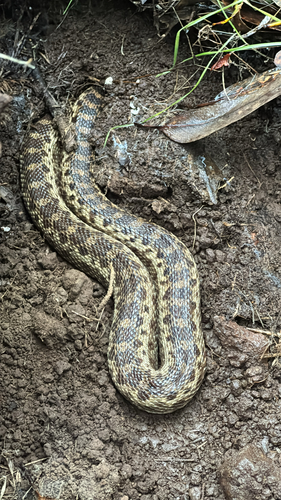
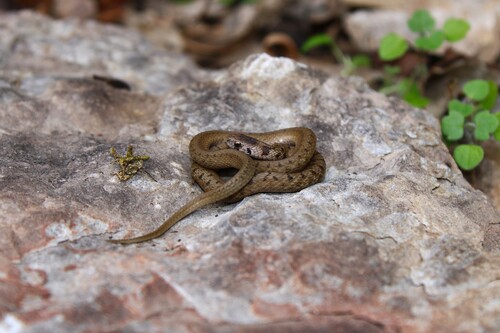
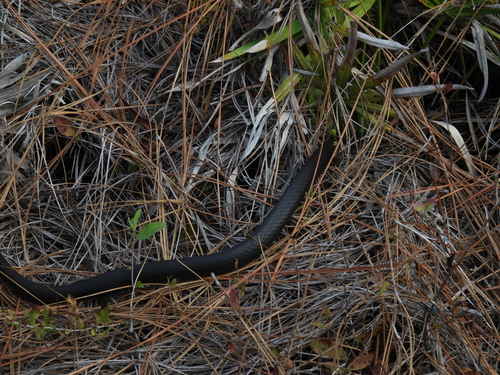
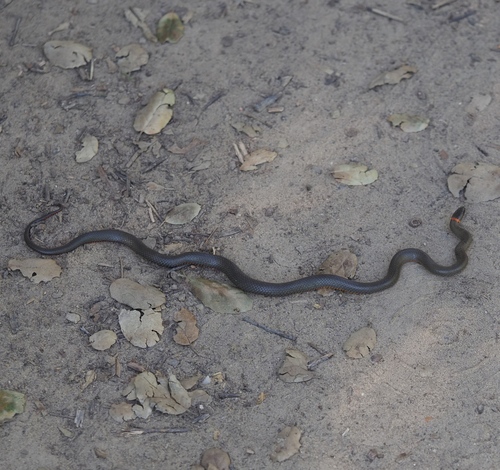
More Colubridae snakes
Classification
How scientists group this snake, from the broadest category down to the exact species. Each step narrows to its closest relatives.
- OrderThe broad group of scaled reptiles: all snakes and lizards
- Squamata
- FamilyA group of related snakes that share key traits
- Colubridae
- GenusA close-knit group of very similar species
- Dispholidus
- SpeciesThis exact snake, named in the two-part scientific name
- Dispholidus typus
Keep learning
- Are Snakes Dangerous? The Real Risk, in PerspectiveMost snakes are harmless and avoid people. Here is the honest picture of snakebite risk worldwide and how to lower your own.
- Snakebite First Aid: What to Do (and What Never to Do)A clear, CDC-based guide to snakebite first aid: the steps that help, the popular myths that hurt, and how to tell a serious bite from a minor one.
- Venomous vs Nonvenomous: How to Tell the DifferenceThe folk rules for telling venomous snakes apart, where each one fails, and why location-based identification beats guessing by sight.
- What to Do If You Find a SnakeFound a snake at home or on a trail? Here is how to stay calm, give it space, identify it safely, and know when to call a professional.
Distribution from GBIF & iNaturalist. Venom status per CDC. Background: Wikipedia. Informational only. Never handle a snake to identify it.