
Garter / Ribbon snake
Common Garter Snake
HarmlessThamnophis sirtalis
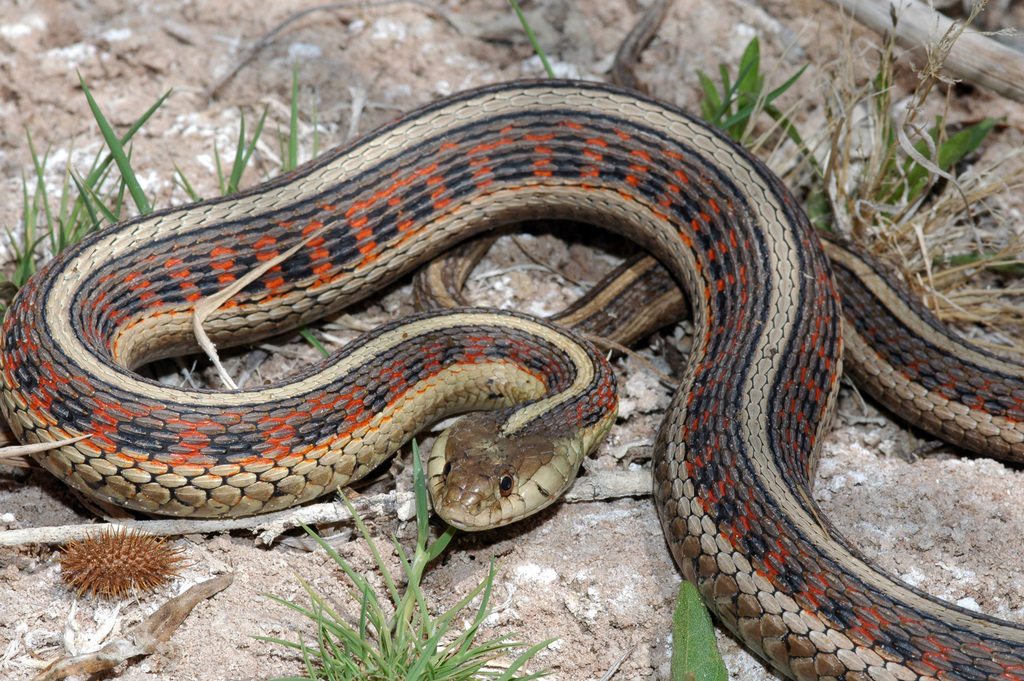
The Common Garter Snake (Thamnophis sirtalis) is a non-venomous snake in the Colubridae family, recorded in 7 countries.
- Also called
- Garter / Ribbon snake
- Family
- Colubridae
- Size
- Slender, 1.5–3 ft.
- Habitat
- Almost anywhere with moisture — gardens, fields, wetlands, and streamsides.
- Behavior
- Harmless and active by day; may release musk if handled. The most commonly seen snakes across most of the U.S.
- Identify
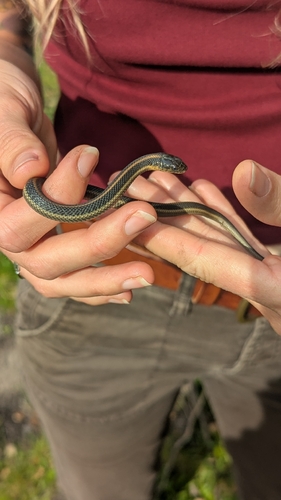
- Slender body with three light stripes running the length of a darker back.
About the Common Garter Snake
The common garter snake (Thamnophis sirtalis) is a species of snake in the subfamily Natricinae of the family Colubridae. The species is indigenous to North America and found widely across the continent. There are several recognized subspecies. Most common garter snakes have a pattern of yellow stripes on a black, brown or green background, and their average total length (including tail) is about 55 cm (22 in), with a maximum total length of about 137 cm (54 in). The average body mass is 150 g (5.3 oz). The common garter snake is the state reptile of Massachusetts.
Taxonomy and etymology
The subspecific name fitchi is in honor of the American herpetologist Henry Sheldon Fitch.
The subspecific name pickeringii is in honor of the American naturalist Charles E. Pickering.
Subspecies
Current scientific classification recognizes 12 subspecies (ordered by date):
A trinomial authority in parentheses indicates that the subspecies was originally described in a genus other than Thamnophis.
Anatomy and description
Common garter snakes are thin snakes. Few grow over about 4 ft (1.2 m) long, and most stay smaller. Most have longitudinal stripes in many different colors. Common garter snakes come in a wide range of colors, including green, blue, yellow, gold, red, orange, brown, and black.
Venom
Garter snakes have a mild venom in their saliva, which may be toxic to the amphibians and other small animals that they prey upon. For humans, a bite is not dangerous, and many handlers can attest to garter snakes gently biting in protest when held or restrained; these bites do not often break the skin, given the garter snake's smaller size, but may cause slight itching, burning, and/or swelling at the location of the bite. However, it is more likely that, prior to expending their energy through biting, garter snakes will secrete a foul-smelling fluid ("musk", "musking", "skunking") from postanal glands.
Common garter snakes are resistant to naturally occurring poisons in their prey, such as that of the American toad and rough-skinned newt, the latter of which can kill a human if ingested. Garter snakes (in addition to their own mildly venomous saliva) have the ability to retain poisons from their consumed amphibian prey, thus making them poisonous and deterring any would-be predators.
The common garter snake uses toxicity for both offense and defense. On the offensive side, the snake's venom can be toxic to some of its smaller prey, such as mice and other rodents. On the defensive side, the snake uses its resistance to toxicity to provide an important antipredator capability. A study on the evolutionary development of resistance of tetrodotoxin compared two populations of Thamnophis and then tested inside a population of T. sirtalis. Those that were exposed to and lived in the same environment as the newts (Taricha granulosa) or rough-skinned newt, that produce tetrodotoxin when eaten were more immune to the toxin (see figure).It seems that the two species were in an evolutionary arms race.
Adapted from Wikipedia, available under CC BY-SA.
Frequently asked: Common Garter Snake
- Is the Common Garter Snake venomous?
- No. The Common Garter Snake (Thamnophis sirtalis) is non-venomous and is not considered dangerous to humans. Like most snakes, it will retreat rather than bite when given the chance.
- Is the Common Garter Snake poisonous?
- Snakes are venomous, not poisonous. "Poisonous" means harmful to eat or touch; "venomous" means injecting toxins through a bite. The Common Garter Snake is neither poisonous nor venomous.
- Is the Common Garter Snake dangerous?
- The Common Garter Snake is not dangerous to humans. It has no medically significant venom and bites only defensively if cornered or handled.
- Where does the Common Garter Snake live?
- The Common Garter Snake has verified records in 7 countries, including United States of America, Canada, Mexico. See the distribution section below for its full range.
- How do I identify the Common Garter Snake?
- Slender body with three light stripes running the length of a darker back.
- How big does the Common Garter Snake get?
- Slender, 1.5–3 ft.
- Why is it called the Common Garter Snake?
- The subspecific name fitchi is in honor of the American herpetologist Henry Sheldon Fitch. The subspecific name pickeringii is in honor of the American naturalist Charles E. Pickering.
Where it is found
By U.S. state
More Colubridae snakes
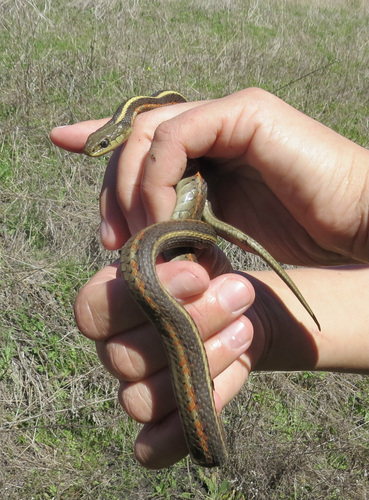 Western Terrestrial Garter SnakeThamnophis elegans
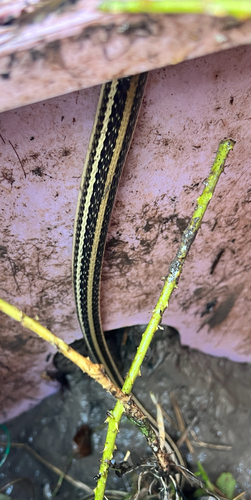 Western Ribbon SnakeThamnophis proximus
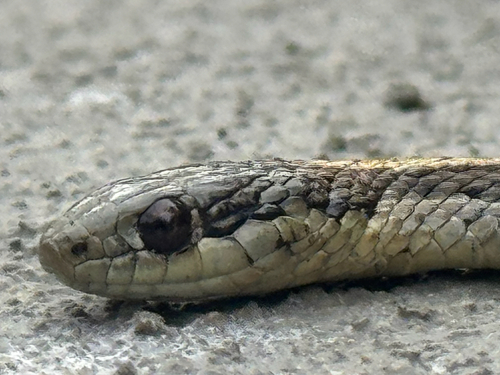 Northwestern Garter SnakeThamnophis ordinoides
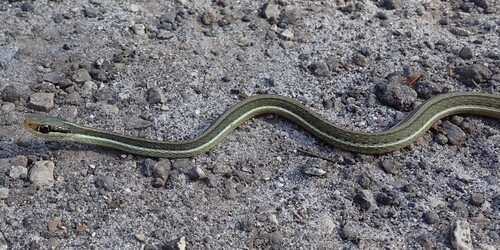 Common Ribbon SnakeThamnophis saurita
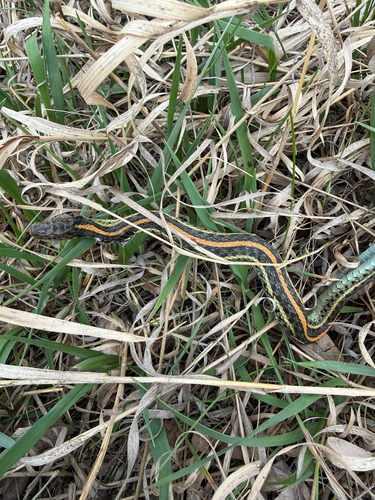 Plains Garter SnakeThamnophis radix
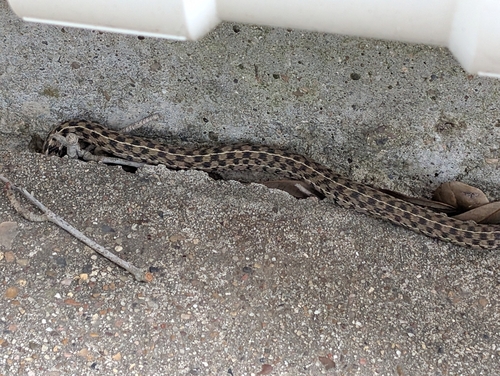 Checkered Garter SnakeThamnophis marcianus
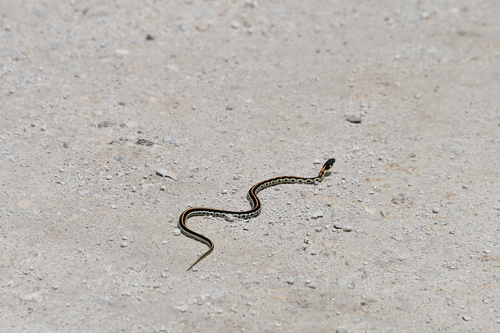 Black-necked Garter SnakeThamnophis cyrtopsis
 Aquatic Garter SnakeThamnophis atratus
Classification
How scientists group this snake, from the broadest category down to the exact species. Each step narrows to its closest relatives.
- OrderThe broad group of scaled reptiles: all snakes and lizards
- Squamata
- FamilyA group of related snakes that share key traits
- Colubridae
- GenusA close-knit group of very similar species
- Thamnophis
- SpeciesThis exact snake, named in the two-part scientific name
- Thamnophis sirtalis
Keep learning
- What to Do If You Find a SnakeFound a snake at home or on a trail? Here is how to stay calm, give it space, identify it safely, and know when to call a professional.
- Venomous vs Nonvenomous: How to Tell the DifferenceThe folk rules for telling venomous snakes apart, where each one fails, and why location-based identification beats guessing by sight.
- What Is a Snake? Anatomy and the BasicsA clear overview of what makes a snake a snake: limbless body plan, anatomy, evolution from lizards, species diversity, and why they are ectothermic.
- How to Keep Snakes Out of Your Yard and HomeA practical guide to keeping snakes out of your yard and home using habitat changes that work, plus what to skip and what to do if one shows up.
Distribution from GBIF & iNaturalist. Venom status per CDC. Background: Wikipedia. Informational only. Never handle a snake to identify it.