
Gophersnake / Bullsnake
Gopher Snake
HarmlessPituophis catenifer
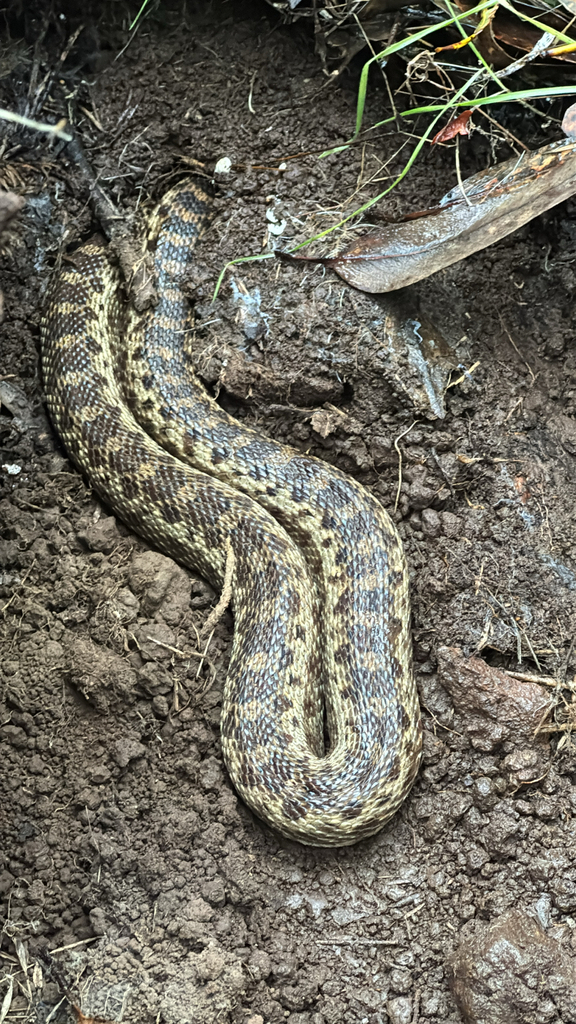
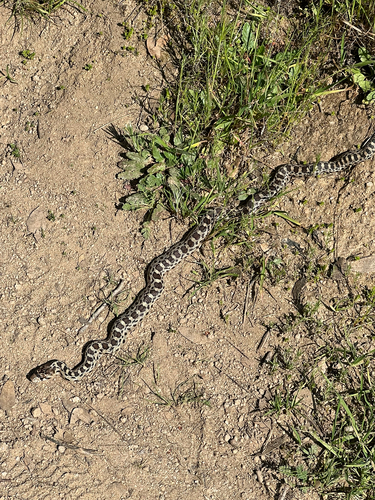
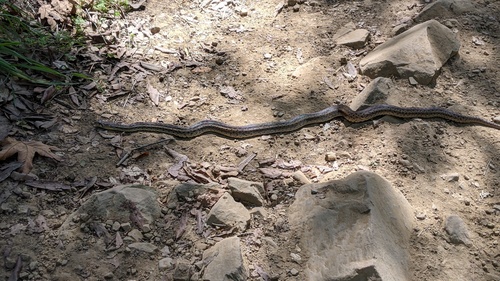
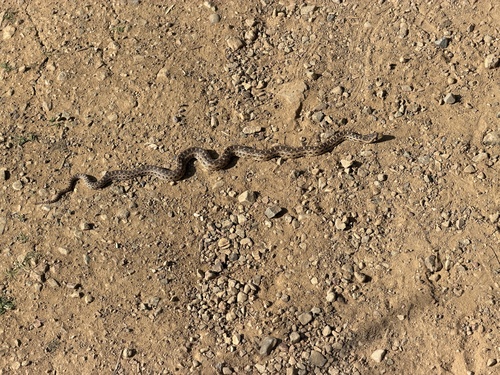
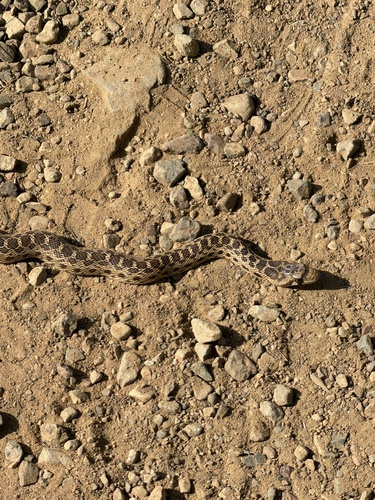
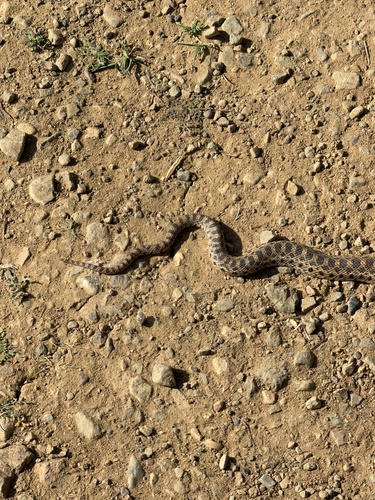
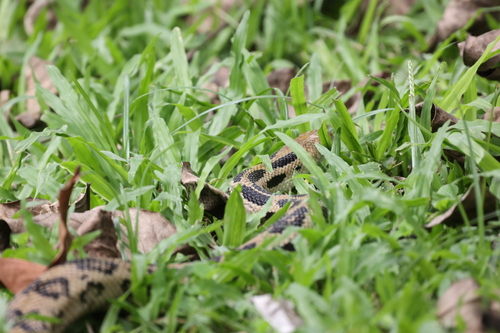
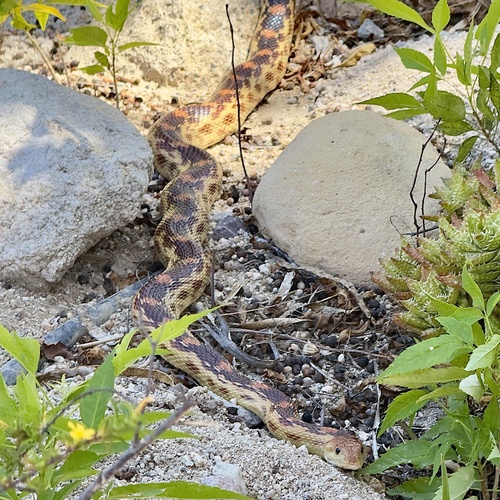
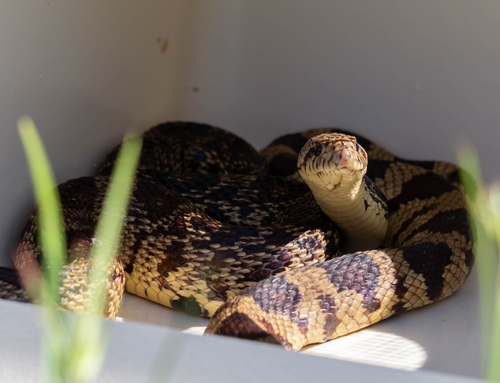
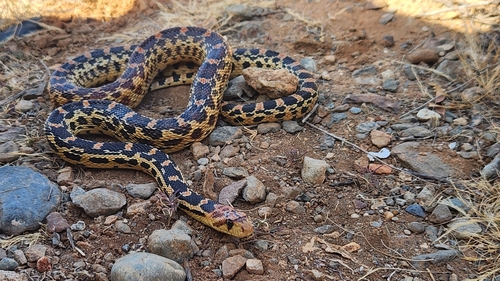
6 photographs of the Gopher Snake. © harrii.
The Gopher Snake (Pituophis catenifer) is a non-venomous snake in the Colubridae family, recorded in 3 countries.
- Also called
- Gophersnake / Bullsnake
- Family
- Colubridae
- Size
- Large, 4–7 ft.
- Habitat
- Grasslands, deserts, and farmland.
- Behavior
- Loud hissers that mimic rattlesnakes by vibrating the tail; valuable rodent predators, but harmless.
- Identify
- Large, blotched, with a slightly pointed snout and keeled scales — no rattle.
About the Gopher Snake
Pituophis catenifer is a species of nonvenomous colubrid snake endemic to North America. Nine subspecies are currently recognized, including the nominotypical subspecies, P. c. catenifer, described here.
Etymology
The specific name, catenifer, is Latin for "chain-bearing", referring to the dorsal color pattern.
Description
Adult gopher snakes are typically 36-84 in (91–213 cm) in length, when fully mature. Dorsally, gopher snakes are yellowish or a light, sandy brown, with a series of large, dark brown or black markings and smaller, darker spots along the sides. Ventrally, they are a lighter yellowish, either uniformly or with brown markings. They also come in several morphs, depending on the subspecies.
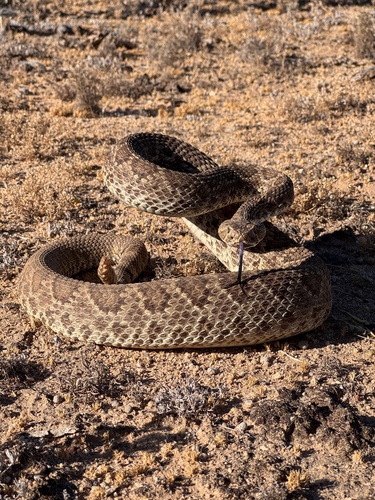
This snake is often mistaken for the prairie rattlesnake (Crotalus viridus), but can be easily distinguished from a rattlesnake by the lack of a tail rattle, no black-and-white banding on its tail, and the shape of its head, which is narrower than a rattlesnake's. Additionally, rattlesnakes (and indeed most vipers) possess a large venom gland located behind each eye, giving their heads a much rounder, more angular shape, as opposed to the more cylindrical, slender head shape of a gopher snake or other colubrid.
Behavior
The gopher snake has a unique defensive mechanism, in which it puffs up its body and curls itself into the classic strike pose of a rattlesnake, but rather than delivering an open-mouthed strike, the gopher snake often strikes with a closed mouth, using its blunt nose to warn off possible predators. Additionally, gopher snakes vibrate their tails in a manner similar to rattlesnakes. One paper found that gopher snakes on islands lacking rattlesnakes vibrate their tails for shorter times than gopher snakes in mainland California, which is home to numerous rattlesnake species. This suggests that gopher snake-tail vibration may in fact be rattlesnake mimicry, since the behavior appears to be breaking down in areas without rattlesnakes, perhaps because predators on these islands have no reason to evolve to avoid tail-vibrating snakes (rattlesnakes are venomous, gopher snakes are not).
Life expectancy
Wild gopher snakes typically live 12 to 15 years, but the oldest captive recorded lived over 33 years.
Common names
Common names for this species, or its several subspecies, are: Pacific gopher snake, Henry snake, coast gopher snake, bullsnake, Churchill's bullsnake, Oregon bullsnake, Pacific pine snake, western bullsnake, western gopher snake, Sonoran gopher snake, western pine snake, great basin gopher snake, blow snake, and yellow gopher snake.
Subspecies
As of 2022, nearly unanimous agreement exists on the recognition of six subspecies, occurring from southern Canada, the continental United States, and Mexico. However, no full agreement is found among taxonomists on the status of populations from Baja California and some offshore islands; the Cape gopher snake (Pituophis catenifer vertebralis) and central Baja Californian gopher snake (P. catenifer bimaris) are recognized, by some sources, as a single species (with no subspecies vertebralis). Some other sources, alternatively, consider it a species with two subspecies: P. v. vertebralis and P. v. bimaris. Other subspecies, including the Coronado Island gopher snake (P. catenifer coronalis) and San Martin Island gopher snake (P. catenifer fulginatus) are of questionable validity.
Adapted from Wikipedia, available under CC BY-SA.
Frequently asked: Gopher Snake
- Is the Gopher Snake venomous?
- No. The Gopher Snake (Pituophis catenifer) is non-venomous and is not considered dangerous to humans. Like most snakes, it will retreat rather than bite when given the chance.
- Is the Gopher Snake poisonous?
- Snakes are venomous, not poisonous. "Poisonous" means harmful to eat or touch; "venomous" means injecting toxins through a bite. The Gopher Snake is neither poisonous nor venomous.
- Is the Gopher Snake dangerous?
- The Gopher Snake is not dangerous to humans. It has no medically significant venom and bites only defensively if cornered or handled.
- Where does the Gopher Snake live?
- The Gopher Snake has verified records in 3 countries, including United States of America, Mexico, Canada. See the distribution section below for its full range.
- How do I identify the Gopher Snake?
- Large, blotched, with a slightly pointed snout and keeled scales — no rattle.
- How big does the Gopher Snake get?
- Large, 4–7 ft.
- Why is it called the Gopher Snake?
- The specific name, catenifer, is Latin for "chain-bearing", referring to the dorsal color pattern.
Where it is found
Snakes it is confused with
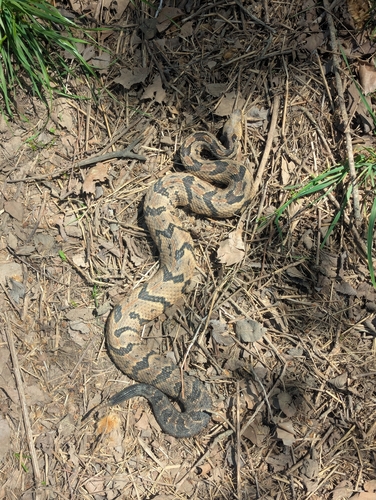
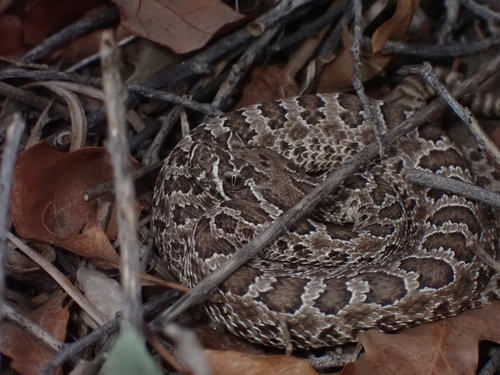
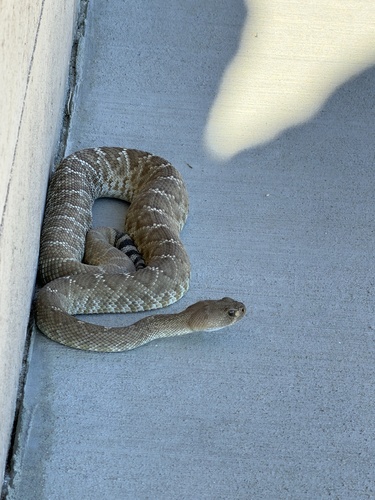
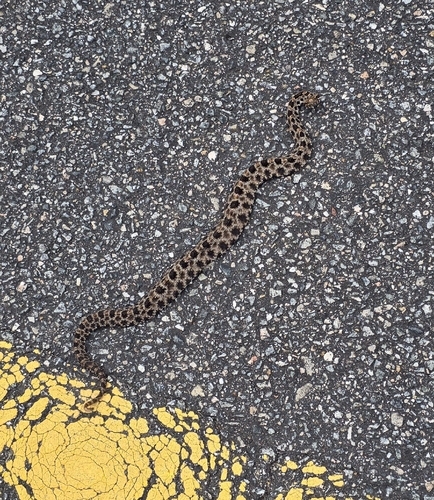
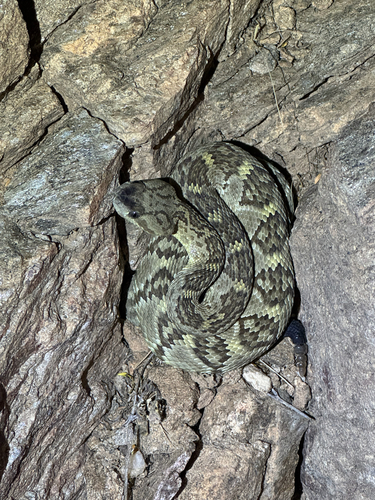
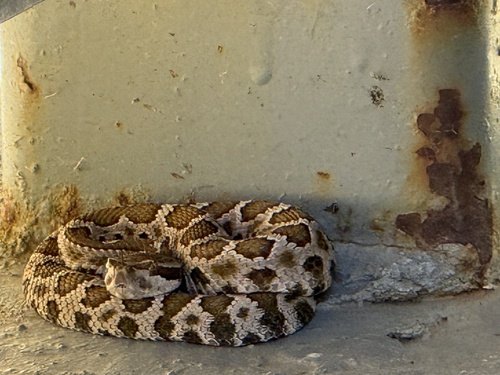 Western RattlesnakeVenomous
Gophersnakes and bullsnakes mimic rattlesnakes by hissing and vibrating the tail, but they are harmless and have no rattle.
Gopher Snake vs Western Rattlesnake→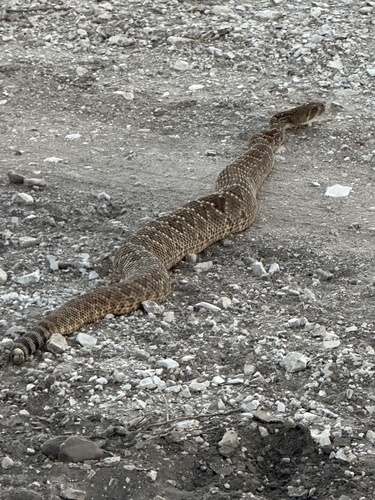
More Colubridae snakes
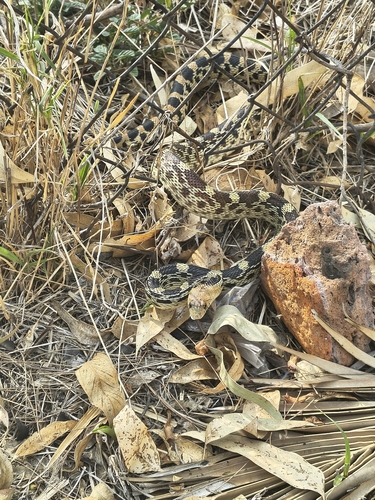 Mexican Bull SnakePituophis deppei
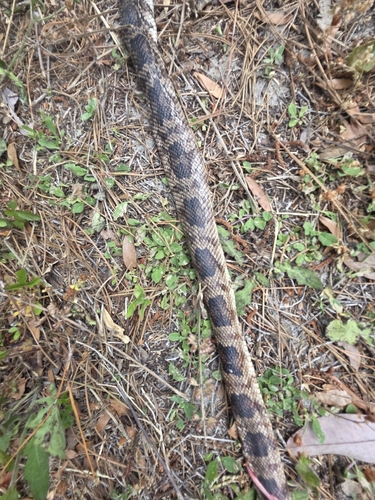 Pine SnakePituophis melanoleucus
 Middle American Gopher SnakePituophis lineaticollis
 Cape Gopher SnakePituophis vertebralis
 Louisiana PinesnakePituophis ruthveni
 Cedros Gopher SnakePituophis insulanus
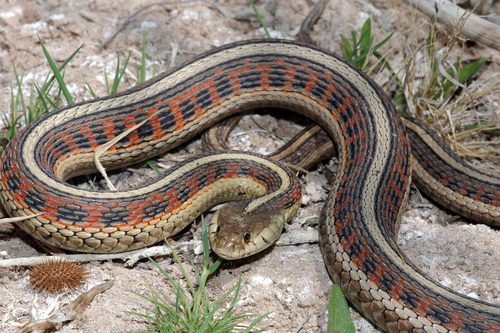 Common Garter SnakeThamnophis sirtalis
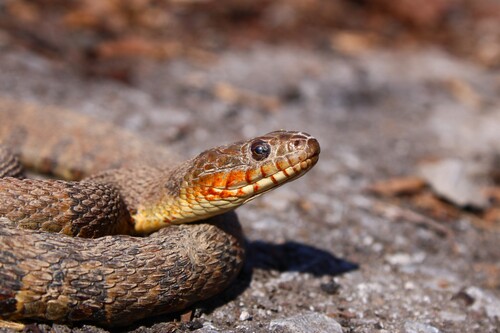 Common WatersnakeNerodia sipedon
Classification
How scientists group this snake, from the broadest category down to the exact species. Each step narrows to its closest relatives.
- OrderThe broad group of scaled reptiles: all snakes and lizards
- Squamata
- FamilyA group of related snakes that share key traits
- Colubridae
- GenusA close-knit group of very similar species
- Pituophis
- SpeciesThis exact snake, named in the two-part scientific name
- Pituophis catenifer
Keep learning
- What to Do If You Find a SnakeFound a snake at home or on a trail? Here is how to stay calm, give it space, identify it safely, and know when to call a professional.
- Venomous vs Nonvenomous: How to Tell the DifferenceThe folk rules for telling venomous snakes apart, where each one fails, and why location-based identification beats guessing by sight.
- What Is a Snake? Anatomy and the BasicsA clear overview of what makes a snake a snake: limbless body plan, anatomy, evolution from lizards, species diversity, and why they are ectothermic.
- How to Keep Snakes Out of Your Yard and HomeA practical guide to keeping snakes out of your yard and home using habitat changes that work, plus what to skip and what to do if one shows up.
Distribution from GBIF & iNaturalist. Venom status per CDC. Background: Wikipedia. Informational only. Never handle a snake to identify it.