
Genus · Colubridae
Dispholidus
The genus Dispholidus contains a single species. It is venomous.
About boomslang
A large, big-eyed tree snake of sub-Saharan Africa with rear fangs and dangerously potent venom.
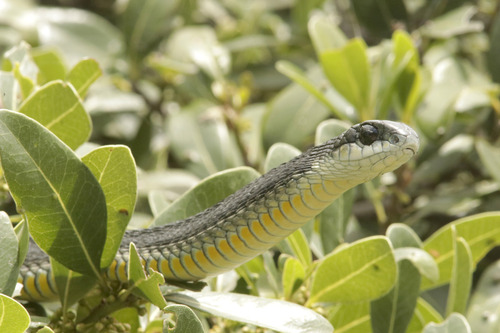
Dispholidus is a small genus in the family Colubridae, the largest snake family. For most of its history the genus held a single famous species, the boomslang (Dispholidus typus), an arboreal snake found across much of sub-Saharan Africa. The name boomslang comes from Afrikaans for tree snake, and that is exactly where it lives, in woodland, savanna, and bush country where it hunts among the branches. It is a rear-fanged colubrid, meaning its enlarged, venom-conducting fangs sit toward the back of the upper jaw rather than at the front like a cobra or viper.
Boomslangs are recognized by a short, blunt head with very large eyes, slender bodies, and strongly keeled scales. Coloration is highly variable and often differs between sexes and regions, ranging from bright green to brown, gray, or nearly black, which makes color alone unreliable for identification. They are diurnal and largely arboreal, gliding through vegetation in search of chameleons, other lizards, frogs, birds, and eggs. Like many colubrids they lay eggs rather than giving live birth.
Despite a generally shy, retiring nature, the boomslang is one of the most medically significant rear-fanged snakes in the world. Its venom is a potent hemotoxin that disrupts blood clotting, and symptoms can be delayed for many hours, which has caused victims to underestimate a bite. This is not a snake to handle, approach, or test. If anyone is bitten or suspects a bite, treat it as a medical emergency and seek professional care immediately, contacting local emergency services, and in the United States Poison Control at 1-800-222-1222. Antivenom and clinical monitoring are the domain of trained medical providers, not field first aid.
Dispholidus belongs to the Colubridae family (Colubrids). The largest snake family, and the one most snakes you meet belong to. Typically round pupils, a head only slightly wider than the neck, and no heat-sensing facial pit or rattle. Scales may be smooth and glossy or keeled and matte depending on the species.
Danger: Almost all colubrids are harmless. A small number are rear-fanged with medically significant venom, the boomslang and the twig (vine) snakes of Africa being the dangerous exceptions. Most colubrids will flee or bluff rather than bite.
All species (1)
Keep learning
- Venomous vs Nonvenomous: How to Tell the DifferenceThe folk rules for telling venomous snakes apart, where each one fails, and why location-based identification beats guessing by sight.
- Are Snakes Dangerous? The Real Risk, in PerspectiveMost snakes are harmless and avoid people. Here is the honest picture of snakebite risk worldwide and how to lower your own.
- Snake Venom Explained: How It Works and WhyWhat snake venom actually is, why it evolved, the main venom types, fang delivery, how antivenom works, and why ranking the most venomous snake is hard.
- How Snakes Move, Hunt, and EatHow snakes move without legs, hunt as ambushers or active foragers, kill by constriction or venom, and swallow prey wider than their head.