
Ringneck snake
Ring-necked Snake
HarmlessDiadophis punctatus
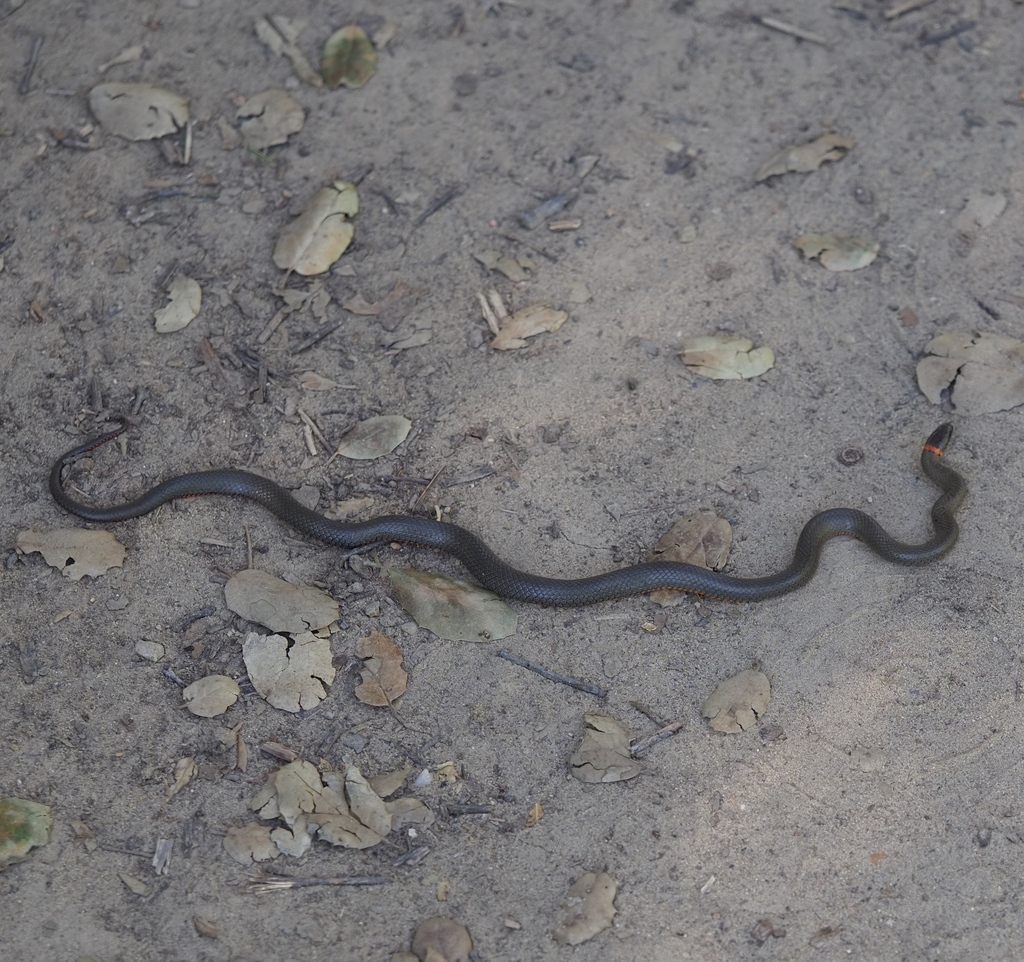
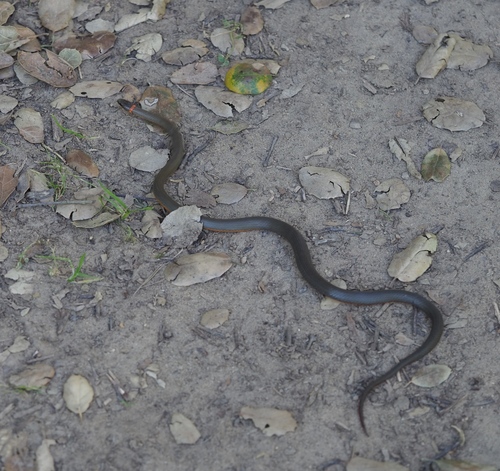
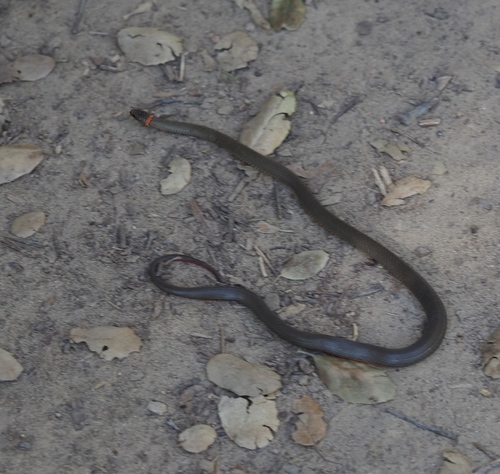
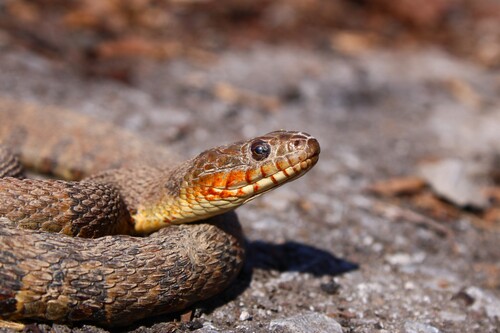
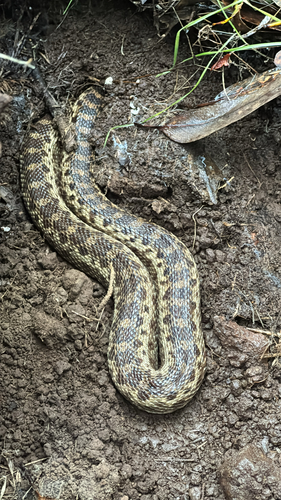
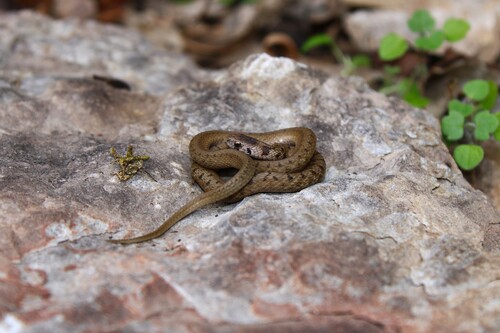
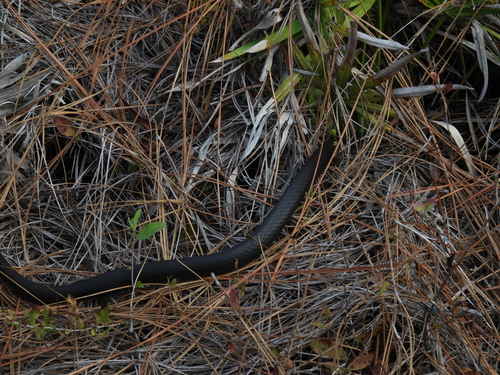
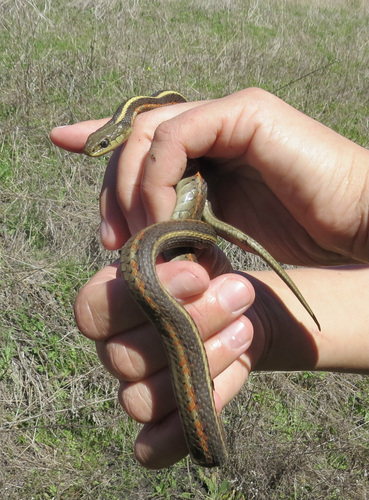
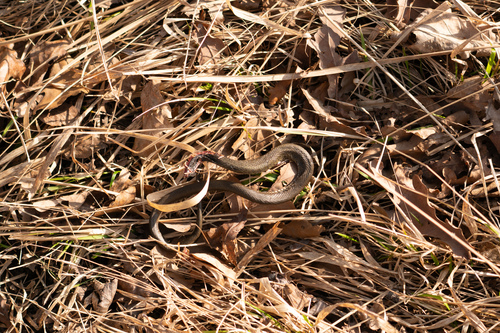
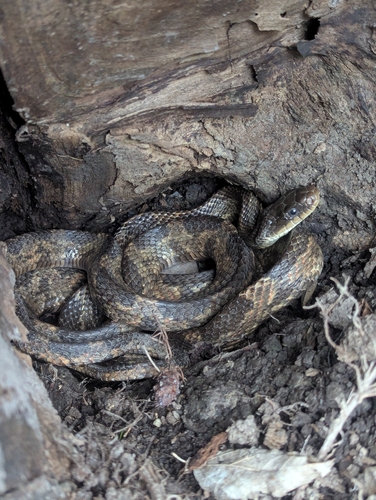
3 photographs of the Ring-necked Snake. © Aiver.
The Ring-necked Snake (Diadophis punctatus) is a non-venomous snake in the Colubridae family, recorded in 9 countries.
- Also called
- Ringneck snake
- Family
- Colubridae
- Size
- Small, 10–15 in.
- Habitat
- Woodlands, gardens, and under logs and rocks.
- Behavior
- Secretive; curl the tail to flash a bright belly when alarmed.
- Identify
- Dark gray body with a distinct yellow-orange neck ring and bright belly.
About the Ring-necked Snake
Diadophis punctatus, commonly known as the ring-necked snake or ringneck snake, is a small, harmless species of colubrid snake found throughout much of the United States, as well as south in Central Mexico and as far north as Quebec, Canada. Ring-necked snakes are generally fossorial and somewhat secretive, by nature, and, as a nocturnal species, are rarely seen during the daytime. These snakes are believed to be fairly abundant throughout most of their range, though no scientific evaluation supports this hypothesis. Scientific research is lacking for the species, despite their apparently common status, and more in-depth investigations are greatly needed. It is the only species within the genus Diadophis and, currently, 14 subspecies are identified, though many herpetologists question the morphologically based classifications.
The ring-necked snake is perhaps best known for its unique defensive posture: when threatened, it curls its tail into a tight coil, partially rolls onto its back, and shows its bright red-orange underside and ventral surface. In nature, vivid coloration on an animal generally serves as a warning to others that it is not afraid of delivering a dose of venom, or that it is poisonous if eaten; this "false warning" coloration is a form of mimicry, a survival adaptation in which a non-venomous species (i.e., the ring-necked snake) has evolved brighter coloration, similar to truly venomous species, and used it to their advantage. Another example is seen in certain milksnakes and kingsnakes (Lampropeltis sp.) which have red, yellow, white or black stripes, an adaptation meant to confuse predators by visually mimicking the venomous coral snakes (Elapidae) which share much of their range.
Description
Ring-necked snakes are fairly similar in morphology throughout much of their distribution.
Its dorsal coloration is solid olive, brown, bluish-gray to smoky black, broken only by a distinct yellow, red, or yellow-orange neck band. A few populations in New Mexico, Utah, and other distinct locations do not have the distinctive neck band. In another population throughout the Coastal Plains across the United States, the rings around their neck are often incomplete. Additionally, individuals may have reduced or partially colored neck bands that are hard to distinguish; coloration may also be more of a cream color rather than bright orange or red. Head coloration tends to be slightly darker than the rest of the body, with tendencies to be blacker than grey or olive. Ventrally, the snakes exhibit a yellow-orange to red coloration broken by crescent-shaped black spots along the margins. Some individuals lack the distinct ventral coloration, but typically retain the black spotting. Rarely do individuals lack both the ventral and neck band coloration, so the use of those two characteristics is the simplest way to distinguish the species.
Adapted from Wikipedia, available under CC BY-SA.
Frequently asked: Ring-necked Snake
- Is the Ring-necked Snake venomous?
- No. The Ring-necked Snake (Diadophis punctatus) is non-venomous and is not considered dangerous to humans. Like most snakes, it will retreat rather than bite when given the chance.
- Is the Ring-necked Snake poisonous?
- Snakes are venomous, not poisonous. "Poisonous" means harmful to eat or touch; "venomous" means injecting toxins through a bite. The Ring-necked Snake is neither poisonous nor venomous.
- Is the Ring-necked Snake dangerous?
- The Ring-necked Snake is not dangerous to humans. It has no medically significant venom and bites only defensively if cornered or handled.
- Where does the Ring-necked Snake live?
- The Ring-necked Snake has verified records in 9 countries, including United States of America, Canada, Mexico. See the distribution section below for its full range.
- How do I identify the Ring-necked Snake?
- Dark gray body with a distinct yellow-orange neck ring and bright belly.
- How big does the Ring-necked Snake get?
- Small, 10–15 in.
- What does the Ring-necked Snake eat?
- The diet of the ring-necked snake consists primarily of smaller salamanders, earthworms, and slugs, but they also sometimes eat lizards, frogs, and some juvenile snakes of other species. The frequency at which prey species are chosen is dependent on their availability within the habitat. Michigan populations of the Eastern Ring-necked Snake (Diadophis punctatus edwardsii) feed almost exclusively on red-backed salamanders. Ring-necked snakes use a combination of constriction and envenomation to secure their prey.
Where it is found
By U.S. state
More Colubridae snakes
Classification
How scientists group this snake, from the broadest category down to the exact species. Each step narrows to its closest relatives.
- OrderThe broad group of scaled reptiles: all snakes and lizards
- Squamata
- FamilyA group of related snakes that share key traits
- Colubridae
- GenusA close-knit group of very similar species
- Diadophis
- SpeciesThis exact snake, named in the two-part scientific name
- Diadophis punctatus
Keep learning
- What to Do If You Find a SnakeFound a snake at home or on a trail? Here is how to stay calm, give it space, identify it safely, and know when to call a professional.
- Venomous vs Nonvenomous: How to Tell the DifferenceThe folk rules for telling venomous snakes apart, where each one fails, and why location-based identification beats guessing by sight.
- What Is a Snake? Anatomy and the BasicsA clear overview of what makes a snake a snake: limbless body plan, anatomy, evolution from lizards, species diversity, and why they are ectothermic.
- How to Keep Snakes Out of Your Yard and HomeA practical guide to keeping snakes out of your yard and home using habitat changes that work, plus what to skip and what to do if one shows up.
Distribution from GBIF & iNaturalist. Venom status per CDC. Background: Wikipedia. Informational only. Never handle a snake to identify it.