
Viperidae
Puff Adder
VenomousBitis arietans
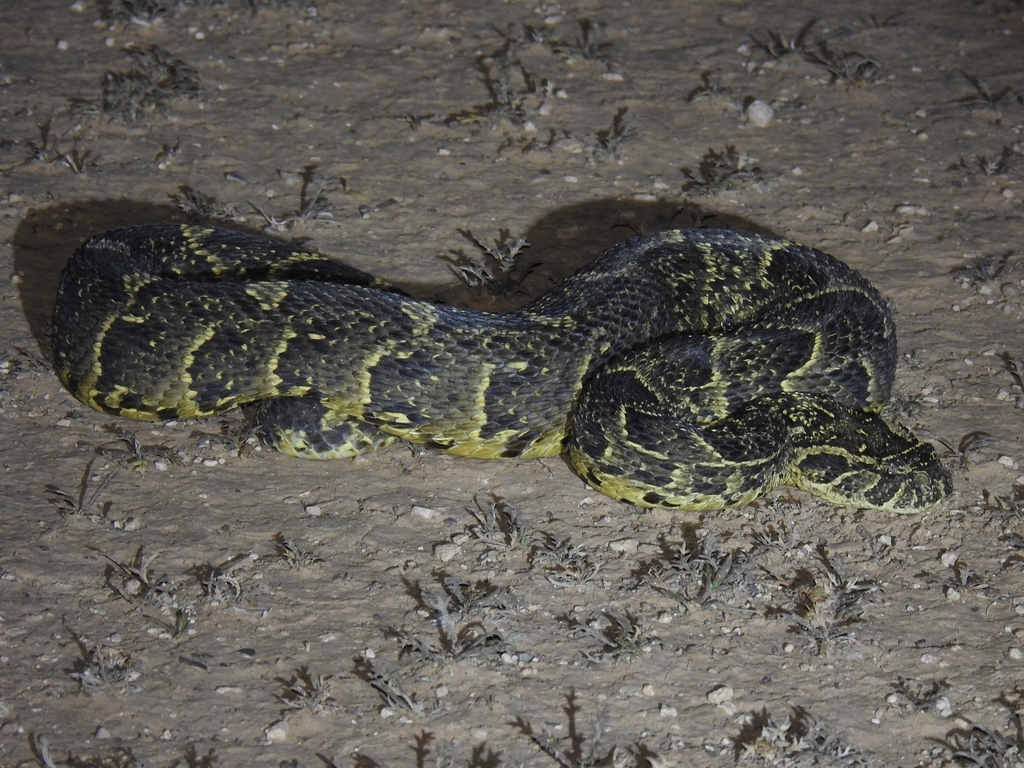
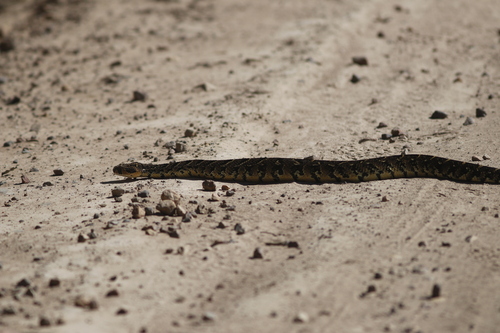
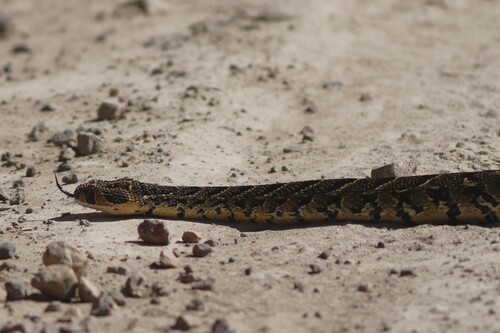
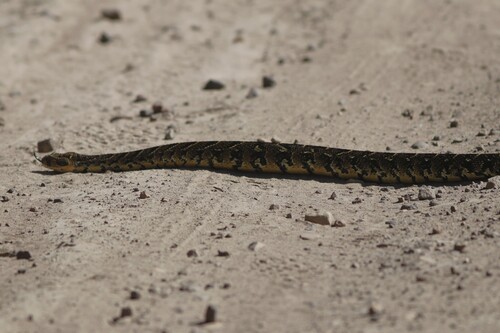
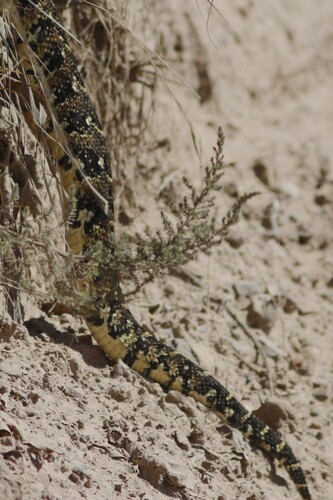
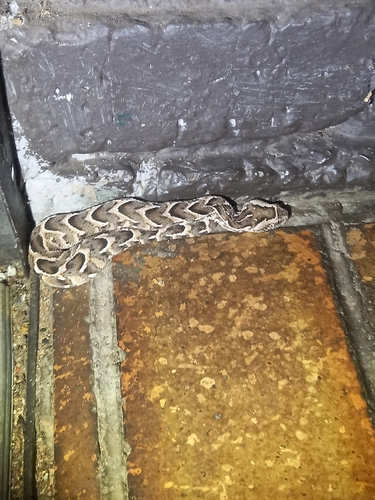
6 photographs of the Puff Adder. © Diego Rubolini.
The Puff Adder (Bitis arietans) is a venomous snake in the Viperidae family, recorded in 42 countries.
If you are bitten
This is a venomous snake. Treat any bite as a medical emergency: stay calm, keep the bitten limb still and roughly level with the heart, remove rings and tight clothing, and get to emergency care immediately. Do not apply a tourniquet, cut the wound, apply ice, or try to suck out venom. Call your local emergency number or poison center.
- Family
- Viperidae
- Danger
- high
About the Puff Adder
The puff adder (Bitis arietans) is a highly venomous viper species found in savannahs and grasslands from Morocco and western Arabia throughout Africa except for the Sahara and rainforest regions. It is responsible for causing the most snakebite fatalities in Africa owing to various factors, such as its wide distribution, frequent occurrence in highly populated regions, and aggressive disposition. Like all other vipers, it is venomous. Two subspecies are currently recognized, including the nominate subspecies described here.
The species is commonly known as the puff adder, African puff adder, or common puff adder.
Taxonomy
German naturalist Blasius Merrem described Bitis arietans in 1820. The specific name arietans means "striking violently" and is derived from the Latin arieto. The type locality given is "Promontorio bonae spei " (Cape of Good Hope), South Africa.
Subspecies
Description
The puff adder's usual size is about 1.0 m (39.3 in) in total length (body and tail) and very stout. Large specimens of 190 cm (75 in) total length, weighing over 6.0 kg (13.2 lb) and with a girth of 40 cm (16 in) have been reported. Specimens from Saudi Arabia are not as large, usually no more than 80 cm (31 in) in total length. Males are usually larger than females and have relatively longer tails.
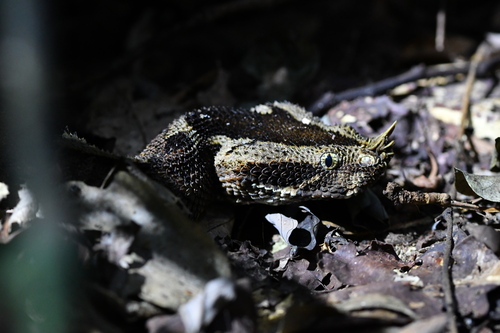
The color pattern varies geographically. The head has two well-marked dark bands – one on the crown and the other between the eyes. On the sides of the head, two oblique, dark bands or bars run from the eye to the supralabials. Below, the head is yellowish white with scattered dark blotches. Iris color ranges from gold to silver-gray. Dorsally, the ground color varies from straw yellow, to light brown, to orange or reddish brown. This is overlaid with a pattern of 18–22 backwardly directed, dark brown to black bands that extend down the back and tail. Usually, these bands are roughly chevron-shaped, but may be more U-shaped in some areas. They also form two to six light-and-dark cross-bands on the tail. Some populations are heavily flecked with brown and black, often obscuring other coloration, giving the animal a dusty-brown or blackish appearance. The belly is yellow or white, with a few scattered dark spots. Newborn young have golden head markings with pinkish to reddish ventral plates toward the lateral edges.
One unusual specimen, described by Branch and Farrell (1988), from Summer Pride, East London, in South Africa, was striped. The pattern consisted of a narrow (one scale wide), pale yellowish stripe that ran from the crown of the head to the tip of the tail.
Generally, though, these are relatively dull-looking snakes, except for male specimens from highland East Africa and the Western Cape province of South Africa, that usually have a striking yellow-and-black color pattern.
Adapted from Wikipedia, available under CC BY-SA.
Local and regional names
The Puff Adder is known by these names across the regions where it lives:
- Arabic
- Lafâa Mo-nareb
- Chinese
- 鼓腹巨蝰
- Czech
- zmije útočná
- Danish
- Almindelig Puffadder
- Dutch
- Gewone Pofadder, Pofadder
- Finnish
- Puffadderi
- French
- Vipère heurtante, Vipère hébraϊque
- German
- Gemeine Puffotter, Puffotter
- Hungarian
- puffogó vipera
- Italian
- Vipera soffiante
- Japanese
- パフアダー
- Polish
- żmija sykliwa
- Portuguese
- Víbora-comum, biúta, buta, riúta, surucucu, víbora-aríete, víbora-de-aríete
- Russian
- Шумящая гадюка
- Spanish
- Monarub, Víbora Bufadora
- Swahili
- bafe, kifutu, moma
- Turkish
- Şişen engerek
- Ukrainian
- Гадюка шумляча
- Zulu
- isibululu
Frequently asked: Puff Adder
- Is the Puff Adder venomous?
- Yes. The Puff Adder (Bitis arietans) is venomous and belongs to the Viperidae family (viper). Its bite is considered high risk to people. Treat any bite as a medical emergency.
- Is the Puff Adder poisonous?
- Snakes are venomous, not poisonous. "Poisonous" means harmful to eat or touch; "venomous" means injecting toxins through a bite. The Puff Adder is venomous, delivering venom through a bite.
- Is the Puff Adder dangerous?
- This is a venomous snake. Treat any bite as a medical emergency: stay calm, keep the bitten limb still and roughly level with the heart, remove rings and tight clothing, and get to emergency care immediately. Do not apply a tourniquet, cut the wound, apply ice, or try to suck out venom. Call your local emergency number or poison center.
- Where does the Puff Adder live?
- The Puff Adder has verified records in 42 countries, including South Africa, Zambia, Kenya. See the distribution section below for its full range.
- What does the Puff Adder eat?
- Mostly nocturnal, the puff adder rarely forages actively, preferring, instead, to ambush prey as it happens by. Its prey includes mammals (rodents [Aethomys sp., Arvicanthis sp., Mastomys sp., Otomys sp., Rattus sp., Rhabdomys pumilio, and Saccostomus campestris] and even occasionally small deer), birds, amphibians (such as Schismaderma carens), lizards, other snakes, and tortoises.
If you are bitten by the Puff Adder
Do
- Get away from the snake and stay calm. Most bites worsen when people panic or try again to handle the snake.
- Call 911 or Poison Control (1-800-222-1222) right away. Antivenom works best when given early.
- Note the time of the bite and, from a safe distance, the snake's color and pattern, a phone photo is enough. Do not chase it.
- Keep the bitten limb still and at roughly heart level. Sit or lie down and limit movement.
- Remove rings, watches, and tight clothing near the bite before swelling starts.
- Gently wash the bite with soap and water and cover it with a clean, dry dressing.
Do not
- Do not cut the wound or try to suck out the venom.
- Do not apply a tourniquet or ice.
- Do not drink alcohol or caffeine.
- Do not take aspirin or ibuprofen, they can worsen bleeding. Acetaminophen is safer for pain.
- Do not try to catch or kill the snake. A dead snake can still bite by reflex.
First-aid guidance adapted from the U.S. Centers for Disease Control and Prevention (CDC NIOSH), Venomous Snakes. Educational only; always follow the instructions of emergency responders.
Where it is found
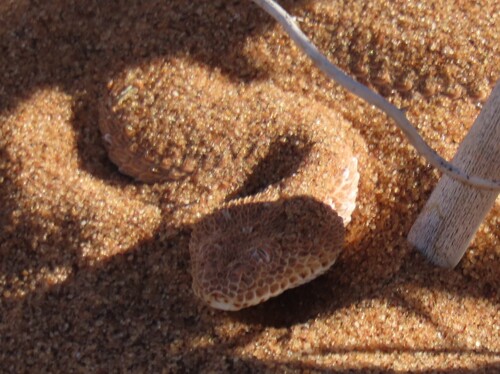
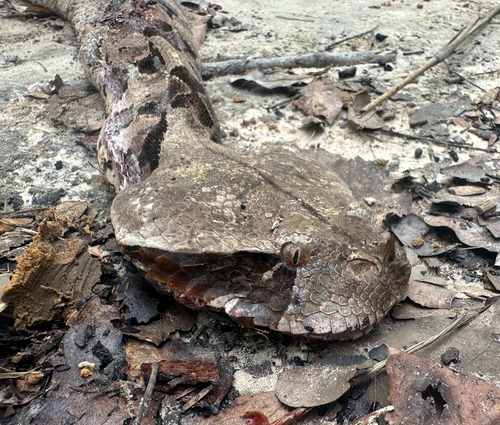
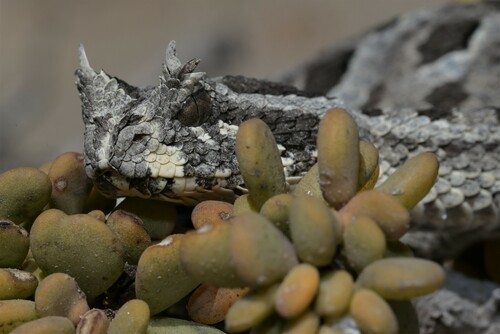
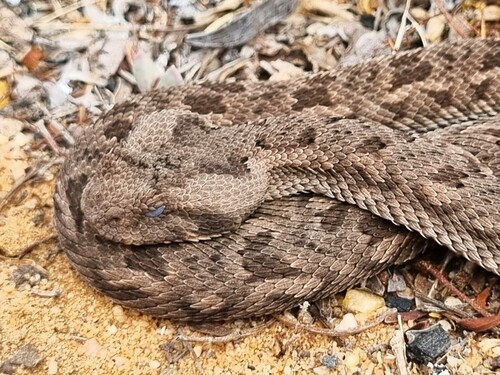
More Viperidae snakes
Classification
How scientists group this snake, from the broadest category down to the exact species. Each step narrows to its closest relatives.
Keep learning
- Are Snakes Dangerous? The Real Risk, in PerspectiveMost snakes are harmless and avoid people. Here is the honest picture of snakebite risk worldwide and how to lower your own.
- Snakebite First Aid: What to Do (and What Never to Do)A clear, CDC-based guide to snakebite first aid: the steps that help, the popular myths that hurt, and how to tell a serious bite from a minor one.
- Venomous vs Nonvenomous: How to Tell the DifferenceThe folk rules for telling venomous snakes apart, where each one fails, and why location-based identification beats guessing by sight.
- What to Do If You Find a SnakeFound a snake at home or on a trail? Here is how to stay calm, give it space, identify it safely, and know when to call a professional.
Distribution from GBIF & iNaturalist. Venom status per CDC. Background: Wikipedia. Informational only. Never handle a snake to identify it.