
Viperidae
Rhinoceros Viper
VenomousBitis nasicornis
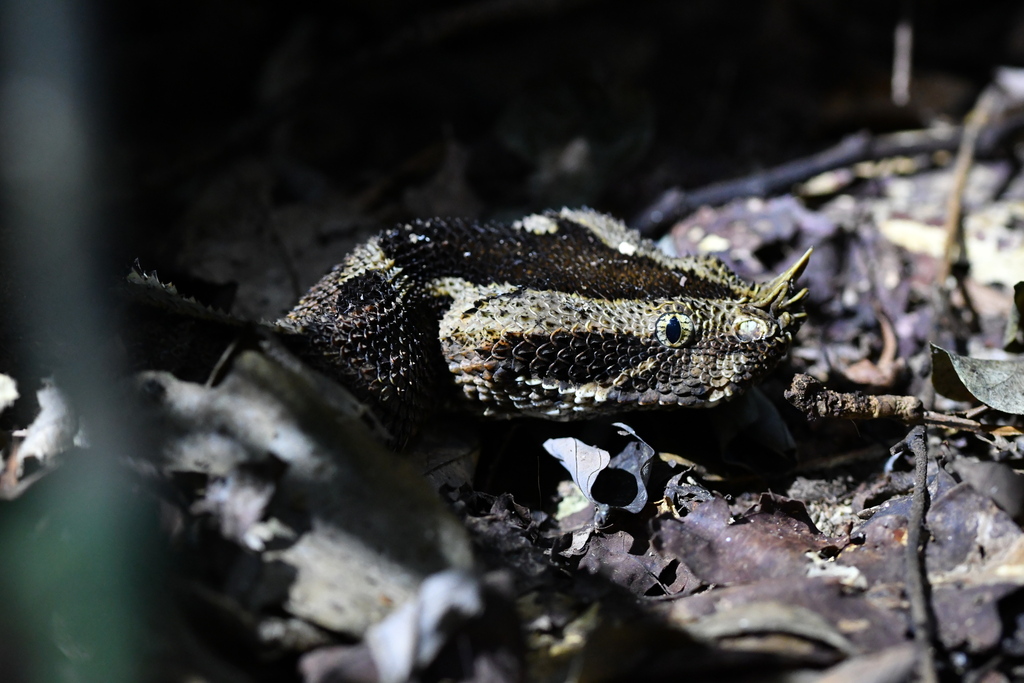
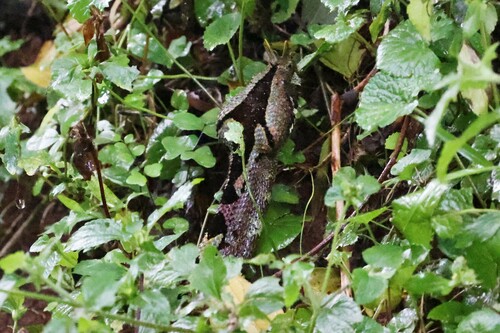
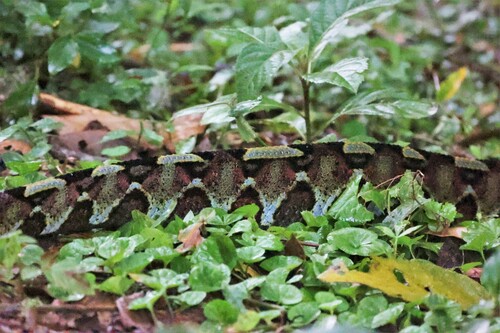
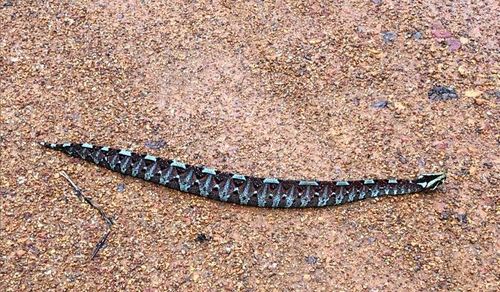
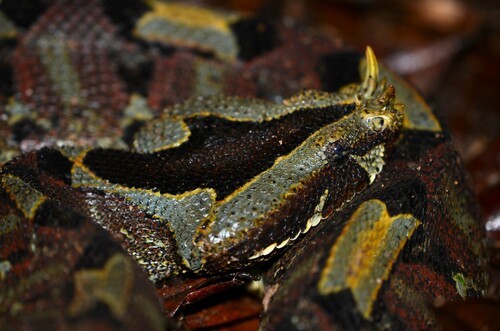
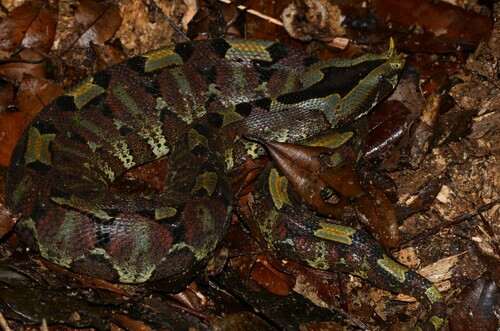
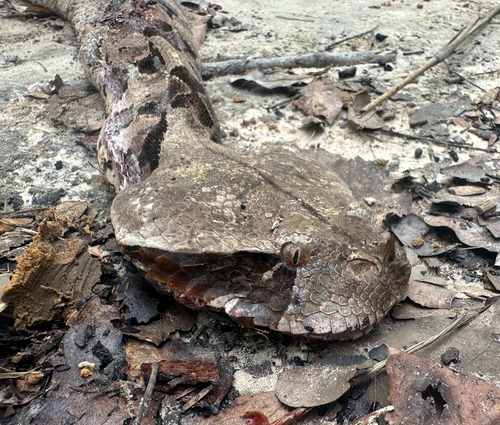
6 photographs of the Rhinoceros Viper. © Justin Philbois.
The Rhinoceros Viper (Bitis nasicornis) is a venomous snake in the Viperidae family, recorded in 24 countries.
If you are bitten
This is a venomous snake. Treat any bite as a medical emergency: stay calm, keep the bitten limb still and roughly level with the heart, remove rings and tight clothing, and get to emergency care immediately. Do not apply a tourniquet, cut the wound, apply ice, or try to suck out venom. Call your local emergency number or poison center.
- Family
- Viperidae
- Danger
- high
About the Rhinoceros Viper
Bitis nasicornis is a viper species belonging to the genus Bitis, part of a subfamily known as "puff-adders", found in the forests of West and Central Africa. This large viper is known for its striking coloration and prominent nasal "horns". No subspecies are currently recognized. Its common names include butterfly viper, rhinoceros viper, river jack and many more (see section: common names). Like all other vipers, it is venomous.
Common names
Its common and historical names include butterfly viper, rhinoceros viper, river jack, rhinoceros horned viper, horned puff adder and rhinoceros puff adder. Americo-Liberians apparently call adult "puff-adders", such as the B. nasicornis, but also the B. gabonica (gaboon viper), cassava snakes.
Historically this species was referred to as the rhinoceros viper (for example German: Nashornviper, French: Vipère rhinocéros) but this introduced confusion after the reclassification of the closely related species Bitis rhinoceros. The common name butterfly viper is therefore more distinct and preferred to avoid confusion.
The name "horned puff adder" (in relation to the viper subfamily "puff adders", today synonymous with the genus Bitis) is also a historical name for Bitis caudalis (horned adder) and can cause confusion. Interestingly the dutch name for Bitis nasicornis is "rhinoceros puff adder" (Dutch: neushoornpofadder), while Bitis caudalis (horned adder) is named "horned puff adder" (Dutch: gehoornde pofadder).
Description
Large and stout, it ranges in total length (body + tail) from 72 to 107 cm (about 28 to 42 inches). Spawls et al. (2004) mentioned a maximum total length of 120 cm (47 in), but admitted this is exceptional, quoting an average total length of 60–90 cm (about 24–35 inches). Explorer Harry Johnston (1858 – 1927) mentions in his book 'Liberia' (1906) that adult "puff-adders" of the species B. nasicornis and B. gabonica (gaboon viper) grow to "between four and five feet" (about 120 to 150 cm) in Liberia. He also states that: "in case of the horned puff-adder, the young when born are a foot long" (~30 cm), which is 20 to 65 percent longer than the average birth length given by Spawls et al. (2004): 18–25 cm (7–10 in). Females grow larger than males.
The head is narrow, flat, triangular and relatively small compared to the rest of the body. The neck is thin. It has a distinctive set of two or three horn-like scales on the end of the nose, the front pair of which may be quite long. The eyes are small and set well forward. The fangs are not large: rarely more than 1.5 cm (0.59 in) long.
Midbody there are 31–43 dorsal scale rows. These are so rough and heavily keeled that they sometimes inflict cuts on handlers when the snakes struggle. There are 117–140 ventral scales and the anal scale is single. Mallow et al. (2003) reported the subcaudals number 16–32, with males having a higher count (25–30) than females (16–19). Spawls et al. (2004) stated there are 12–32 subcaudals, paired, and males have the higher numbers of them.
Adapted from Wikipedia, available under CC BY-SA.
Local and regional names
The Rhinoceros Viper is known by these names across the regions where it lives:
- Bulgarian
- носорога усойница
- Chinese
- 犀噝蝰
- Czech
- zmije nosorohá, zmije pobřežní
- Danish
- Næsehorns-puffadder, Næsehornspuffadder
- Dutch
- Neushoornpofadder
- English
- African Nose-horned Adder
- French
- Vipère rhinoceros, Vipère rhinocéros, Vipère à cornes
- German
- Nashornviper
- Hungarian
- orrszarvú-puffogóvipera
- Italian
- Vipera rinoceronte
- Japanese
- ライノセラスアダー
- Polish
- żmija rogatonosa
- Portuguese
- Víbora-rinoceronte
- Russian
- Африканская гадюка-носорог, Гадюка-носорог
- Spanish
- Víbora Rinoceronte
- Swedish
- Noshornspuffadder, Noshornspufform
- Ukrainian
- Гадюка-носоріг
Frequently asked: Rhinoceros Viper
- Is the Rhinoceros Viper venomous?
- Yes. The Rhinoceros Viper (Bitis nasicornis) is venomous and belongs to the Viperidae family (viper). Its bite is considered high risk to people. Treat any bite as a medical emergency.
- Is the Rhinoceros Viper poisonous?
- Snakes are venomous, not poisonous. "Poisonous" means harmful to eat or touch; "venomous" means injecting toxins through a bite. The Rhinoceros Viper is venomous, delivering venom through a bite.
- Is the Rhinoceros Viper dangerous?
- This is a venomous snake. Treat any bite as a medical emergency: stay calm, keep the bitten limb still and roughly level with the heart, remove rings and tight clothing, and get to emergency care immediately. Do not apply a tourniquet, cut the wound, apply ice, or try to suck out venom. Call your local emergency number or poison center.
- Where does the Rhinoceros Viper live?
- The Rhinoceros Viper has verified records in 24 countries, including Congo, Democratic Republic of the, Cameroon, Benin. See the distribution section below for its full range.
- What does the Rhinoceros Viper eat?
- Preferring to hunt by ambush, it probably spends much of its life motionless, waiting for prey to wander by. Froesch (1967) described a captive specimen that would hardly ever leave its hide box, even when hungry, and once waited for three days for a live mouse to enter its hide box before striking. Feeding mainly on small mammals, but in wetland habitats, it is also known to take toads, frogs and even fish. One long-term captive specimen, regularly fed killed mice and frogs, always held on to its prey for several minutes after a strike before swallowing.
- Why is it called the Rhinoceros Viper?
- Its common and historical names include butterfly viper, rhinoceros viper, river jack, rhinoceros horned viper, horned puff adder and rhinoceros puff adder. Americo-Liberians apparently call adult "puff-adders", such as the B. nasicornis, but also the B. gabonica (gaboon viper), cassava snakes. Historically this species was referred to as the rhinoceros viper (for example German: Nashornviper, French: Vipère rhinocéros) but this introduced confusion after the reclassification of the closely related species Bitis rhinoceros.
If you are bitten by the Rhinoceros Viper
Do
- Get away from the snake and stay calm. Most bites worsen when people panic or try again to handle the snake.
- Call 911 or Poison Control (1-800-222-1222) right away. Antivenom works best when given early.
- Note the time of the bite and, from a safe distance, the snake's color and pattern, a phone photo is enough. Do not chase it.
- Keep the bitten limb still and at roughly heart level. Sit or lie down and limit movement.
- Remove rings, watches, and tight clothing near the bite before swelling starts.
- Gently wash the bite with soap and water and cover it with a clean, dry dressing.
Do not
- Do not cut the wound or try to suck out the venom.
- Do not apply a tourniquet or ice.
- Do not drink alcohol or caffeine.
- Do not take aspirin or ibuprofen, they can worsen bleeding. Acetaminophen is safer for pain.
- Do not try to catch or kill the snake. A dead snake can still bite by reflex.
First-aid guidance adapted from the U.S. Centers for Disease Control and Prevention (CDC NIOSH), Venomous Snakes. Educational only; always follow the instructions of emergency responders.
Where it is found
More Viperidae snakes
Classification
How scientists group this snake, from the broadest category down to the exact species. Each step narrows to its closest relatives.
Keep learning
- Are Snakes Dangerous? The Real Risk, in PerspectiveMost snakes are harmless and avoid people. Here is the honest picture of snakebite risk worldwide and how to lower your own.
- Snakebite First Aid: What to Do (and What Never to Do)A clear, CDC-based guide to snakebite first aid: the steps that help, the popular myths that hurt, and how to tell a serious bite from a minor one.
- Venomous vs Nonvenomous: How to Tell the DifferenceThe folk rules for telling venomous snakes apart, where each one fails, and why location-based identification beats guessing by sight.
- What to Do If You Find a SnakeFound a snake at home or on a trail? Here is how to stay calm, give it space, identify it safely, and know when to call a professional.
Distribution from GBIF & iNaturalist. Venom status per CDC. Background: Wikipedia. Informational only. Never handle a snake to identify it.