
Viperidae
Peringuey's Adder
VenomousBitis peringueyi
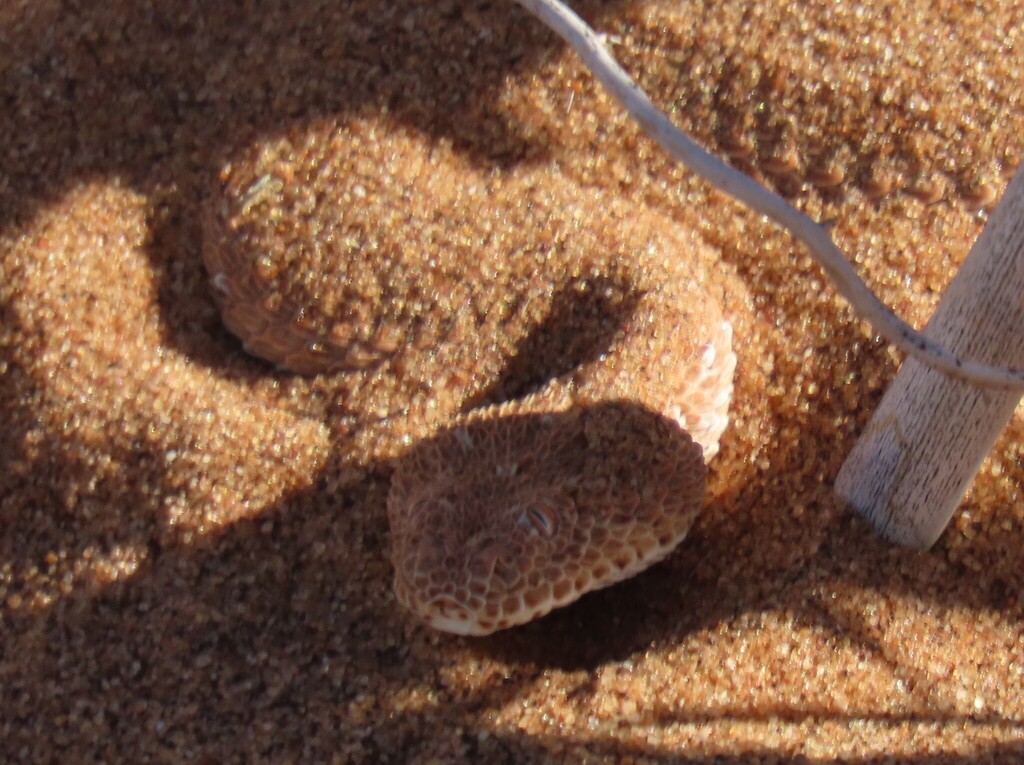
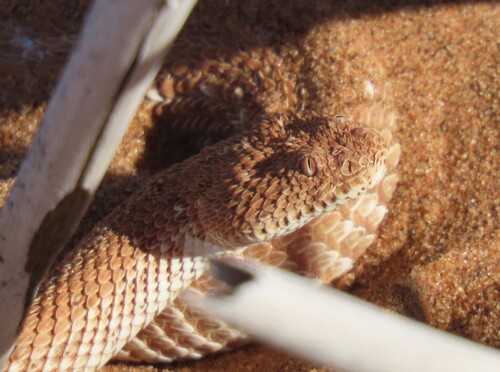
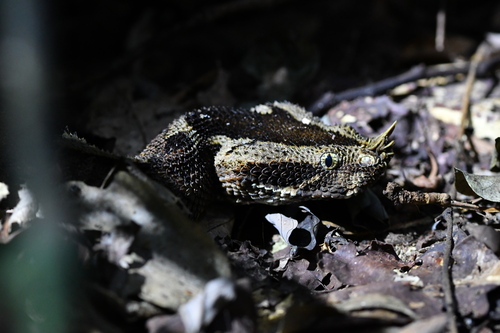
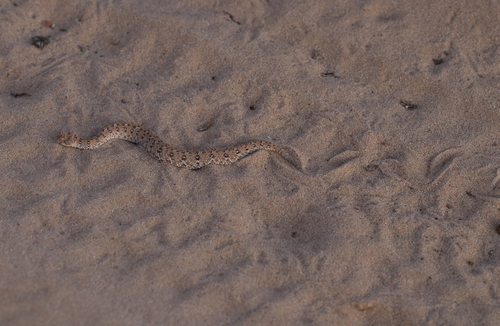
2 photographs of the Peringuey's Adder. © Nogga_Eugene.
The Peringuey's Adder (Bitis peringueyi) is a venomous snake in the Viperidae family, recorded in 3 countries.
If you are bitten
This is a venomous snake. Treat any bite as a medical emergency: stay calm, keep the bitten limb still and roughly level with the heart, remove rings and tight clothing, and get to emergency care immediately. Do not apply a tourniquet, cut the wound, apply ice, or try to suck out venom. Call your local emergency number or poison center.
- Family
- Viperidae
- Danger
- high
About the Peringuey's Adder
Bitis peringueyi, also known as the Peringuey's adder, Peringuey's desert adder or desert sidewinding adder, is a viper species found in Namibia and southern Angola. No subspecies are currently recognized.
Description
Bitis peringueyi is a small snake with an average total length (including tail) of 20–25 cm (8–10 in), its maximum recorded total length is 32 cm (13 in).
The head is short and flat with eyes located on top of the head. The head is covered with strongly keeled scales, the smallest of which are located anteriorly. The eyes are separated by six to 9 scales, while each eye is surrounded by 10-13 scales. Two to four scales separate the suborbitals from the supralabials. The latter number 10-14, the sublabials 10-13. The one pair of chin shields contact the first two to four sublabials.
The dorsal scales number 23-31 at midbody and 21-27 anteriorly. All are strongly keeled, except those bordering the ventral scales are large and smooth. The ventrals number 117-144. The 15-30 subcaudals are usually keeled, particularly towards the tip. The anal plate is single.
The color pattern consists of a pale buff, chestnut brown to orange-brown, or sandy-grayish ground color, overlaid with three longitudinal series of faint, elongate, gray to dark spots. The body is also stippled with an irregular pattern of pale and dark spots. The belly is usually whitish or dirty yellow. The tail is generally tan, but in 25% of specimens, it is black.
Common names
Common names for B. peringueyi include Peringuey's adder, Peringuey's desert adder, sidewinding adder, Namib dwarf sand adder, dwarf puff adder, Namib desert sidewinding adder, dwarf sand adder, Namib dwarf adder, and Namib desert viper.
Etymology
This adder, B. peringueyi, was named after Louis Péringuey, the South African entomologist and museum director.
Geographic range
Bitis peringueyi is found in the Namib from southern Angola to Lüderitz, Namibia. Also seen in the Fish River Canyon. They are also found in areas of the Sahara desert and tend to live near sand dunes.
The type locality is given as "Damaraland, 10 miles east of Walfisch Bay" [Namibia].
Behavior
An ambush hunter, B. peringueyi buries itself just beneath the surface of the sand with only its eyes and the tip of its tail exposed. Its skull represents a sharp shape to cut through the sand. Its skull is sharp to penetrate the sand around it. (individuals with black tail-tips employ caudal luring). When prey happens by, it is seized and envenomated.
Feeding
The diet of B. peringueyi includes the lizards Meroles, and the barking gecko Ptenopus. Aporosaura lizards have high water contents and are important sources of water for these snakes.
Adapted from Wikipedia, available under CC BY-SA.
Local and regional names
The Peringuey's Adder is known by these names across the regions where it lives:
- Afrikaans
- Namibduinadder
- Chinese
- 侏噝蝰
- Czech
- zmije zakrslá
- Danish
- Namibisk Dværghugorm
- English
- Dwarf Puff Adder, Peringuey's desert adder, Side-winding Adder
- German
- Namibviper, Zwergpuffotter
- Hungarian
- namíbiai puffogóvipera
- Italian
- Vipera del deserto di Peringuey, Vipera di Peringuey
- Japanese
- ペリングウェイアダー
- Russian
- Карликовая африканская гадюка
Frequently asked: Peringuey's Adder
- Is the Peringuey's Adder venomous?
- Yes. The Peringuey's Adder (Bitis peringueyi) is venomous and belongs to the Viperidae family (viper). Its bite is considered high risk to people. Treat any bite as a medical emergency.
- Is the Peringuey's Adder poisonous?
- Snakes are venomous, not poisonous. "Poisonous" means harmful to eat or touch; "venomous" means injecting toxins through a bite. The Peringuey's Adder is venomous, delivering venom through a bite.
- Is the Peringuey's Adder dangerous?
- This is a venomous snake. Treat any bite as a medical emergency: stay calm, keep the bitten limb still and roughly level with the heart, remove rings and tight clothing, and get to emergency care immediately. Do not apply a tourniquet, cut the wound, apply ice, or try to suck out venom. Call your local emergency number or poison center.
- Where does the Peringuey's Adder live?
- The Peringuey's Adder has verified records in 3 countries, including Namibia, Angola, South Africa. See the distribution section below for its full range.
- What does the Peringuey's Adder eat?
- The diet of B. peringueyi includes the lizards Meroles, and the barking gecko Ptenopus. Aporosaura lizards have high water contents and are important sources of water for these snakes.
- Why is it called the Peringuey's Adder?
- Common names for B. peringueyi include Peringuey's adder, Peringuey's desert adder, sidewinding adder, Namib dwarf sand adder, dwarf puff adder, Namib desert sidewinding adder, dwarf sand adder, Namib dwarf adder, and Namib desert viper.
If you are bitten by the Peringuey's Adder
Do
- Get away from the snake and stay calm. Most bites worsen when people panic or try again to handle the snake.
- Call 911 or Poison Control (1-800-222-1222) right away. Antivenom works best when given early.
- Note the time of the bite and, from a safe distance, the snake's color and pattern, a phone photo is enough. Do not chase it.
- Keep the bitten limb still and at roughly heart level. Sit or lie down and limit movement.
- Remove rings, watches, and tight clothing near the bite before swelling starts.
- Gently wash the bite with soap and water and cover it with a clean, dry dressing.
Do not
- Do not cut the wound or try to suck out the venom.
- Do not apply a tourniquet or ice.
- Do not drink alcohol or caffeine.
- Do not take aspirin or ibuprofen, they can worsen bleeding. Acetaminophen is safer for pain.
- Do not try to catch or kill the snake. A dead snake can still bite by reflex.
First-aid guidance adapted from the U.S. Centers for Disease Control and Prevention (CDC NIOSH), Venomous Snakes. Educational only; always follow the instructions of emergency responders.
Where it is found
More Viperidae snakes
Classification
How scientists group this snake, from the broadest category down to the exact species. Each step narrows to its closest relatives.
Keep learning
- Are Snakes Dangerous? The Real Risk, in PerspectiveMost snakes are harmless and avoid people. Here is the honest picture of snakebite risk worldwide and how to lower your own.
- Snakebite First Aid: What to Do (and What Never to Do)A clear, CDC-based guide to snakebite first aid: the steps that help, the popular myths that hurt, and how to tell a serious bite from a minor one.
- Venomous vs Nonvenomous: How to Tell the DifferenceThe folk rules for telling venomous snakes apart, where each one fails, and why location-based identification beats guessing by sight.
- What to Do If You Find a SnakeFound a snake at home or on a trail? Here is how to stay calm, give it space, identify it safely, and know when to call a professional.
Distribution from GBIF & iNaturalist. Venom status per CDC. Background: Wikipedia. Informational only. Never handle a snake to identify it.