
Viperidae
Gaboon Viper
VenomousBitis gabonica
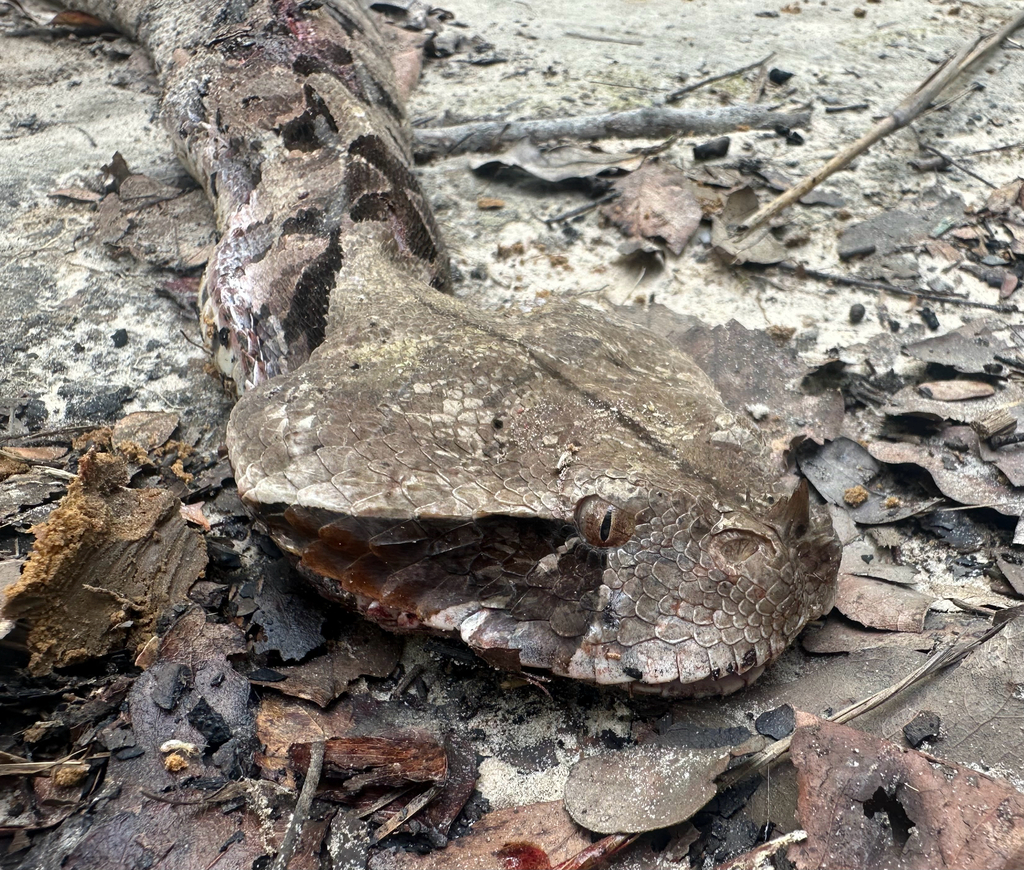
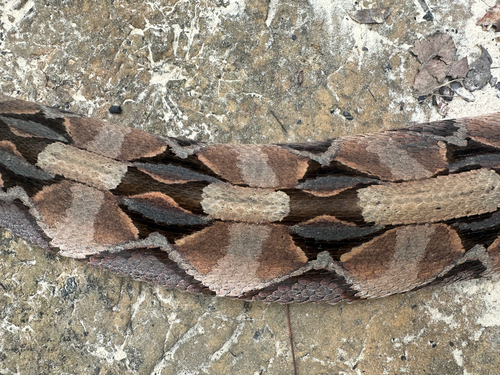
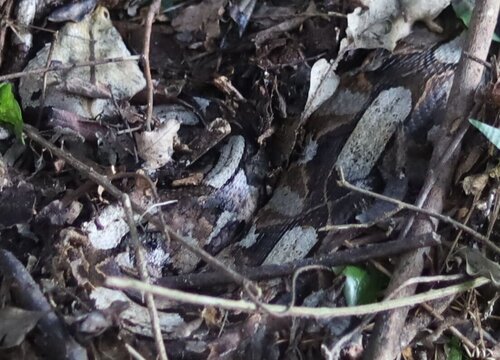
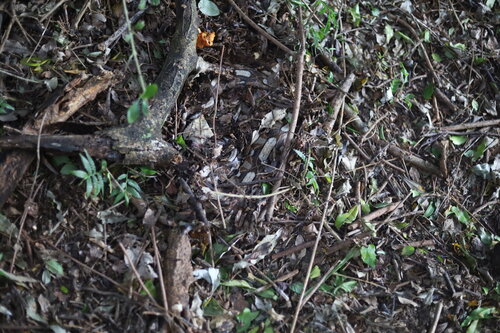
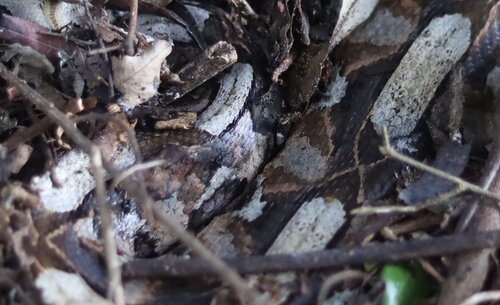
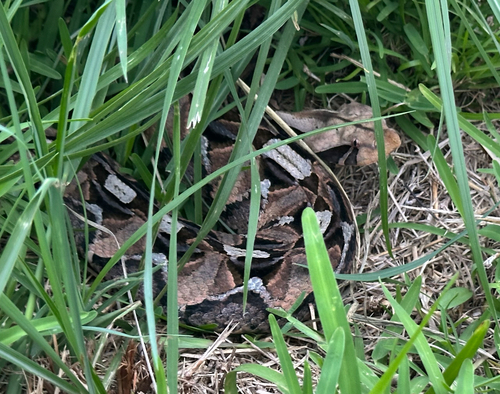
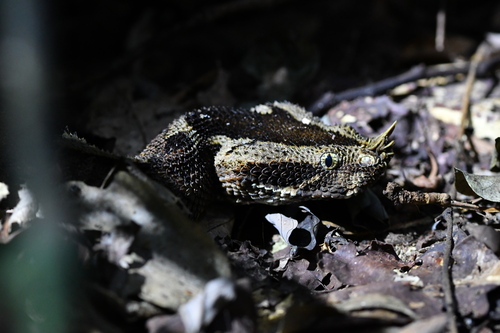
6 photographs of the Gaboon Viper. © Robert Taylor.
The Gaboon Viper (Bitis gabonica) is a venomous snake in the Viperidae family, recorded in 27 countries.
If you are bitten
This is a venomous snake. Treat any bite as a medical emergency: stay calm, keep the bitten limb still and roughly level with the heart, remove rings and tight clothing, and get to emergency care immediately. Do not apply a tourniquet, cut the wound, apply ice, or try to suck out venom. Call your local emergency number or poison center.
- Family
- Viperidae
- Danger
- high
About the Gaboon Viper
The Gaboon viper (Bitis gabonica), also called the Gaboon adder, is a large and highly venomous species of viper found in the rainforests and savannas of sub-Saharan Africa. It is the largest member of the genus Bitis. Like all other vipers, it is venomous, and it has the longest fangs of any venomous snake – up to 2 inches (5.1 cm) in length – and the highest venom yield of any snake. No subspecies are recognized.
Taxonomy
The Gaboon viper was described in 1854 as Echidna gabonica.
Lenk et al. (1999) discovered genetic differences between the two conventionally recognized subspecies of B. g. gabonica and B. g. rhinoceros. According to their research, these two subspecies are as genetically different from each other as they are from B. nasicornis. Consequently, they regard the western form as a separate species, B. rhinoceros.
The snake's common names include Gaboon viper, butterfly adder, forest puff adder, whisper, swampjack, and Gaboon adder.
Originally a name given by the Portuguese, Gabon (Gabão) refers to the estuary on which the town of Libreville was built, in Gabon, and to a narrow strip of territory on either bank of this arm of the sea. As of 1909, Gaboon referred to the northern portion of French Congo, south of the equator and lying between the Atlantic Ocean and 12°E longitude.
Description
Adults are typically 125–155 cm (4.10–5.09 ft) in total length (body and tail). The maximum total length of this species is often cited as 205 cm (81 in) for a specimen collected in Sierra Leone, but individuals from this locale are now reclassified as Bitis rhinoceros. The sexes may be distinguished by the length of the tail in relation to the total length of the body: around 12% for males and 6% for females. Adults, especially females, are very heavy and stout. One female measured at 174 cm (69 in) in total length, a head width of 12 cm (4.7 in), a width or circumference of 37 cm (15 in), and a weight of 8.5 kg (19 lb).
In their description of B. gabonica, Spawls et al. (2004) give a total length of 80–130 cm (31.5–51 in), with a maximum total length of 175 cm (69 in), saying the species may possibly grow larger still. They acknowledge reports of specimens over 1.8 m (5.9 ft), or even over 2 m (6.6 ft) in total length, but claim no evidence supports this. A large specimen of 1.8 m (5.9 ft) total length, caught in 1973, was found to have weighed 11.3 kg (25 lb) with an empty stomach. It is the heaviest venomous snake in Africa and one of the heaviest in the world along with the king cobra and eastern diamondback rattlesnake.
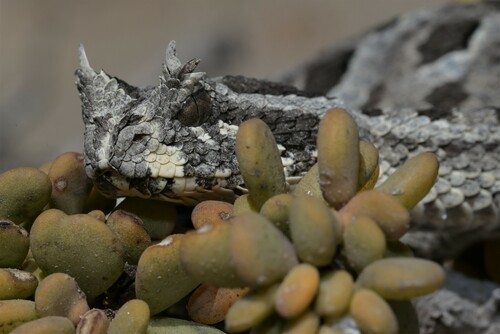
The head is large and triangular, while the neck is greatly narrowed, only about one-third the width of the head. A pair of "horns" is present between the raised nostrils—tiny in B. gabonica. The eyes are large and moveable, set well forward, and surrounded by 15–21 circumorbital scales. The species has 12–16 interocular scales across the top of the head. Four or five scale rows separate the suboculars and the supralabials, with 13–18 supralabials and 16–22 sublabials. The fangs may reach a length of 55 mm (2.2 in), the longest of any venomous snake.
Adapted from Wikipedia, available under CC BY-SA.
Local and regional names
The Gaboon Viper is known by these names across the regions where it lives:
- Afrikaans
- Gaboenadder, Skoenlapperadder
- Chinese
- 加彭噝蝰
- Czech
- zmije gabunská
- Danish
- Østlig Gabonhugorm
- English
- Gaboon Adder
- French
- Vipère du Gabon
- German
- Gabunviper
- Hungarian
- gaboni vipera
- Italian
- Vipera del Gabon
- Japanese
- ガボンアダー
- Polish
- Żmija gabońska
- Portuguese
- Víbora-do-gabão
- Russian
- Габонская гадюка
- Spanish
- Víbora de Gabón
- Thai
- งูกาบูน
- Turkish
- Gabon engereği
Frequently asked: Gaboon Viper
- Is the Gaboon Viper venomous?
- Yes. The Gaboon Viper (Bitis gabonica) is venomous and belongs to the Viperidae family (viper). Its bite is considered high risk to people. Treat any bite as a medical emergency.
- Is the Gaboon Viper poisonous?
- Snakes are venomous, not poisonous. "Poisonous" means harmful to eat or touch; "venomous" means injecting toxins through a bite. The Gaboon Viper is venomous, delivering venom through a bite.
- Is the Gaboon Viper dangerous?
- This is a venomous snake. Treat any bite as a medical emergency: stay calm, keep the bitten limb still and roughly level with the heart, remove rings and tight clothing, and get to emergency care immediately. Do not apply a tourniquet, cut the wound, apply ice, or try to suck out venom. Call your local emergency number or poison center.
- Where does the Gaboon Viper live?
- The Gaboon Viper has verified records in 27 countries, including Zambia, South Africa, Congo, Democratic Republic of the. See the distribution section below for its full range.
- What does the Gaboon Viper eat?
- Because of their large, heavy body size, the adults have no trouble eating prey as large as fully grown rabbits. When prey happens by, they strike from any angle. They can quickly reposition their fangs if they happen to miss or strike an unsuitable area of their prey. Once they
If you are bitten by the Gaboon Viper
Do
- Get away from the snake and stay calm. Most bites worsen when people panic or try again to handle the snake.
- Call 911 or Poison Control (1-800-222-1222) right away. Antivenom works best when given early.
- Note the time of the bite and, from a safe distance, the snake's color and pattern, a phone photo is enough. Do not chase it.
- Keep the bitten limb still and at roughly heart level. Sit or lie down and limit movement.
- Remove rings, watches, and tight clothing near the bite before swelling starts.
- Gently wash the bite with soap and water and cover it with a clean, dry dressing.
Do not
- Do not cut the wound or try to suck out the venom.
- Do not apply a tourniquet or ice.
- Do not drink alcohol or caffeine.
- Do not take aspirin or ibuprofen, they can worsen bleeding. Acetaminophen is safer for pain.
- Do not try to catch or kill the snake. A dead snake can still bite by reflex.
First-aid guidance adapted from the U.S. Centers for Disease Control and Prevention (CDC NIOSH), Venomous Snakes. Educational only; always follow the instructions of emergency responders.
Where it is found
More Viperidae snakes
Classification
How scientists group this snake, from the broadest category down to the exact species. Each step narrows to its closest relatives.
Keep learning
- Are Snakes Dangerous? The Real Risk, in PerspectiveMost snakes are harmless and avoid people. Here is the honest picture of snakebite risk worldwide and how to lower your own.
- Snakebite First Aid: What to Do (and What Never to Do)A clear, CDC-based guide to snakebite first aid: the steps that help, the popular myths that hurt, and how to tell a serious bite from a minor one.
- Venomous vs Nonvenomous: How to Tell the DifferenceThe folk rules for telling venomous snakes apart, where each one fails, and why location-based identification beats guessing by sight.
- What to Do If You Find a SnakeFound a snake at home or on a trail? Here is how to stay calm, give it space, identify it safely, and know when to call a professional.
Distribution from GBIF & iNaturalist. Venom status per CDC. Background: Wikipedia. Informational only. Never handle a snake to identify it.