
Psammophiidae
Western Montpellier Snake
HarmlessMalpolon monspessulanus
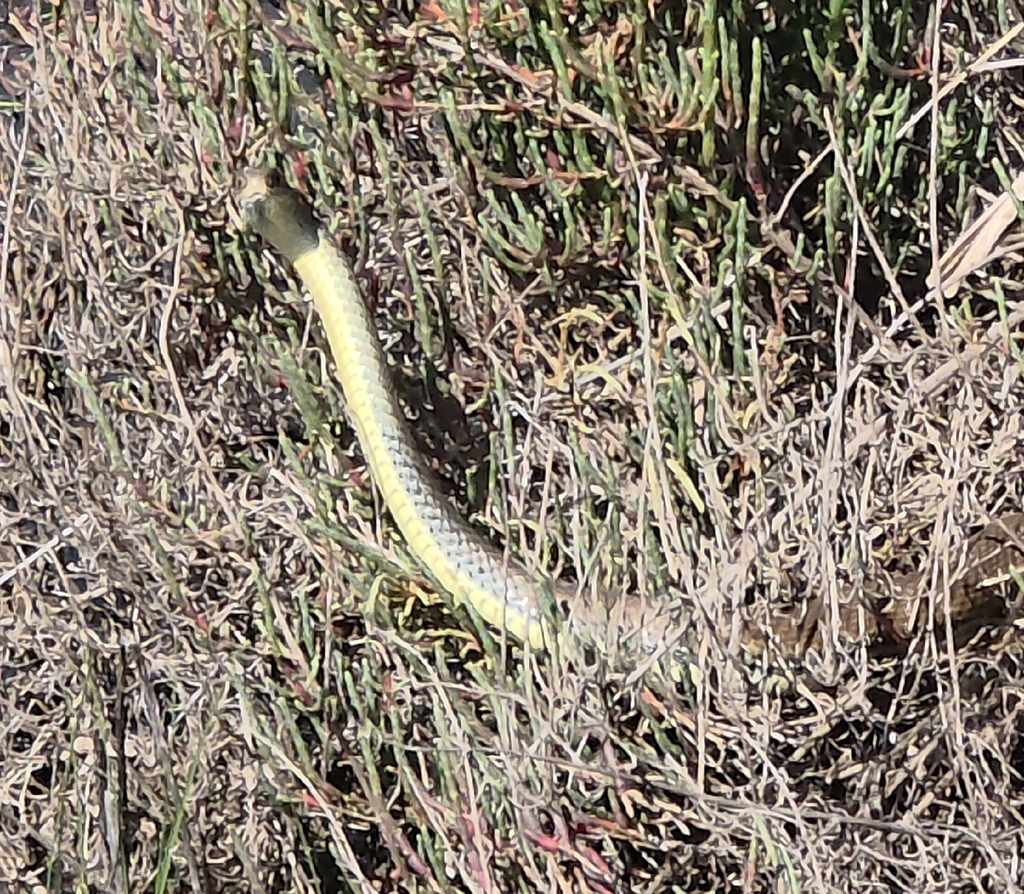
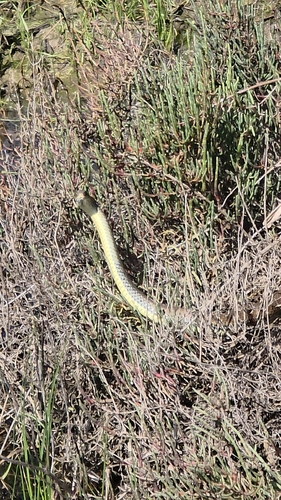
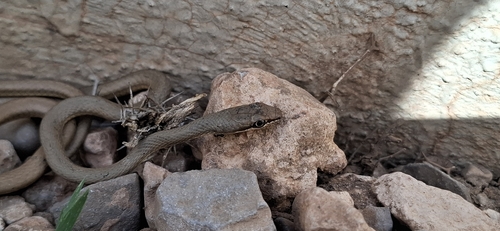
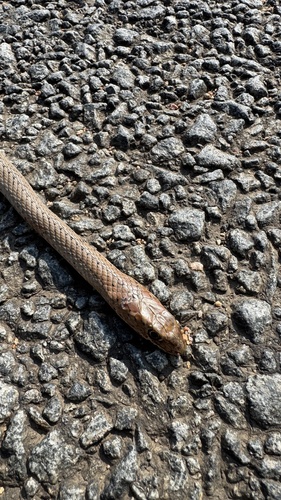
2 photographs of the Western Montpellier Snake. © Jordi Casanovas.
The Western Montpellier Snake (Malpolon monspessulanus) is a rear-fanged, mildly venomous snake in the Psammophiidae family, recorded in 37 countries.
- Family
- Psammophiidae
About the Western Montpellier Snake
Malpolon monspessulanus, commonly known as the Montpellier snake, is a species of mildly venomous rear-fanged snake.
Geographic range
It is very common in Spain, Portugal and Northwest Africa, being also present in the southern Mediterranean coast of France and the western regions of the Middle East. The snake's specific name, monspessulanus, is a Latinized form of Montpellier, a city in southern France.
Description
It is up to 2.55 metres (8 ft) long and may weigh up to 2 kilograms (4 lb).
Behavior and diet
It is active during the day and mainly feeds on lizards.
Venom
Although it is venomous, only a few cases of envenomation of humans are known, one of which occurred when a finger was inserted into the snake's mouth. The Montpellier snake is not a dangerous snake for humans. The rear fangs reduce the possibility of venom injection, and the venom is of low toxicity. Venom injections are possible in bites of big individuals. The venom is not very dangerous; symptomatic treatment suffices to treat an envenomation. The unthreatening nature of the snake, along with its relatively mild persecution by man, has made it one of the most common species throughout its range, even in areas occupied by humans.
Evolution
Genetic evidence suggests that the species originated in the Maghreb, migrating into southwestern Europe between 83,000 and 168,000 years ago and into southeastern Europe and western Asia at an earlier time. It is most closely related to the North African and Arabian species Malpolon moilensis and to a fossil species from the Pliocene of Spain, Malpolon mlynarskii, with which it forms the genus Malpolon. Malpolon has a good fossil record, dating back to the Pliocene in both southwestern Europe and northern Africa, but many of the fossils are isolated vertebrae, which are difficult to assign to species.
Subspecies
There are three major subspecies of M. monspessulanus throughout its Mediterranean range. There is a deep genetic divergence between the western subspecies, M. m. monspessulanus, and the two eastern subspecies, M. m. insignitus and M. m. fuscus, leading to a proposal to recognize the eastern form as a distinct species, M. insignitus. These two groups are estimated to have split about 3.5 to 6 million years ago. A fourth subspecies, M. m. saharatlanticus, was described in 2006.
M. m. monspessulanus
M. m. monspessulanus occurs in southwestern Europe (Spain, Portugal, southern France and northwestern Italy) and the western Maghreb, where it is found in Morocco and coastal Algeria, east to Algiers. On the mid-body, there are usually 19 dorsal scale rows and a dark 'saddle' on the foreparts is present in males. M. m. monspessulanus possesses a single median process on its basioccipital bone that forms a strong spur, directed backwards; in the two eastern subspecies, two processes or indistinct hardened pieces of bones are present. There is little genetic or morphological differentiation between North African and European populations, suggesting a recent arrival in Europe.
M. m. fuscus
Adapted from Wikipedia, available under CC BY-SA.
Frequently asked: Western Montpellier Snake
- Is the Western Montpellier Snake venomous?
- The Western Montpellier Snake (Malpolon monspessulanus) is rear-fanged and only mildly venomous. It is not considered dangerous to humans (its venom is weak and its fangs sit at the back of the mouth) but a bite can cause local swelling or irritation, so it should not be handled.
- Is the Western Montpellier Snake poisonous?
- Snakes are venomous, not poisonous. "Poisonous" means harmful to eat or touch; "venomous" means injecting toxins through a bite. The Western Montpellier Snake is neither poisonous nor venomous.
- Is the Western Montpellier Snake dangerous?
- The Western Montpellier Snake is not dangerous to humans. It has no medically significant venom and bites only defensively if cornered or handled.
- Where does the Western Montpellier Snake live?
- The Western Montpellier Snake has verified records in 37 countries, including France, Spain, Portugal. See the distribution section below for its full range.
- What does the Western Montpellier Snake eat?
- It is active during the day and mainly feeds on lizards.
Where it is found
More Psammophiidae snakes
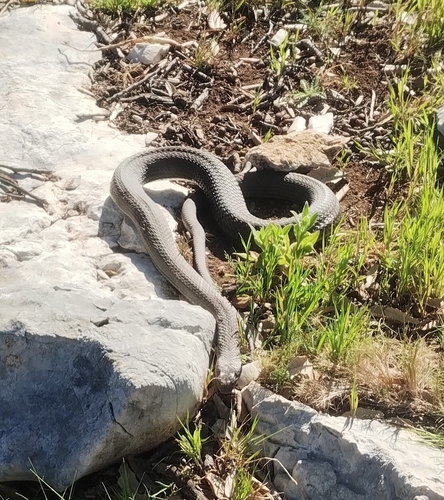 Eastern Montpellier SnakeMalpolon insignitus
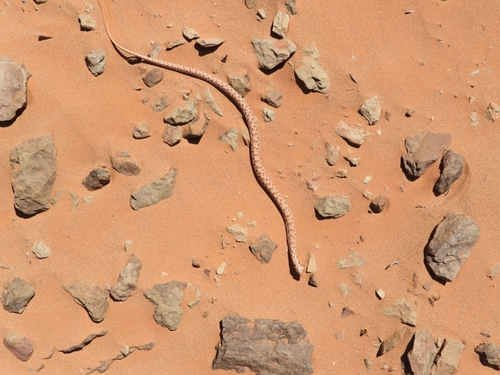 Moila SnakeMalpolon moilensis
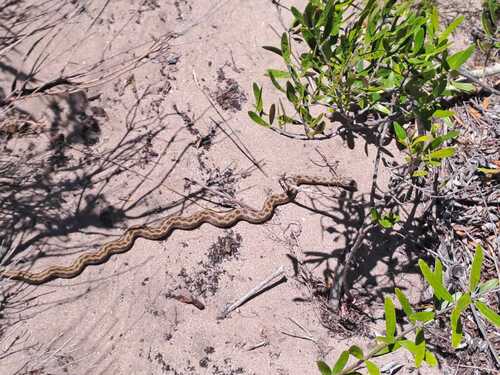 Rhombic SkaapstekerPsammophylax rhombeatus
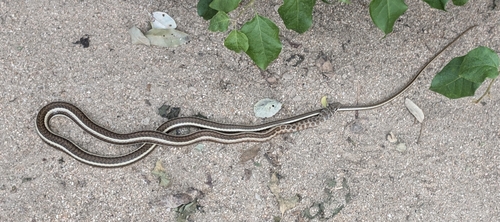 Stripe-bellied Sand SnakePsammophis subtaeniatus
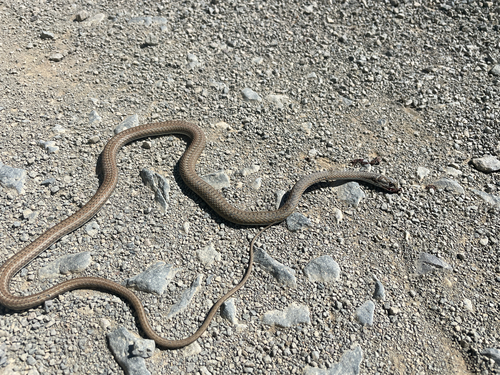 Karoo Sand SnakePsammophis notostictus
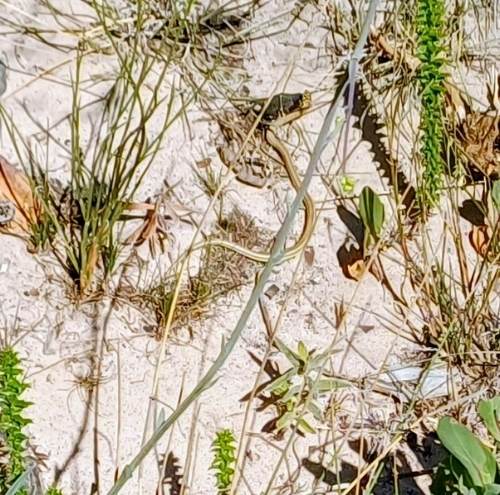 Cross-marked Sand SnakePsammophis crucifer
 Forskal Sand SnakePsammophis schokari
 Olive Whip SnakePsammophis mossambicus
Classification
How scientists group this snake, from the broadest category down to the exact species. Each step narrows to its closest relatives.
- OrderThe broad group of scaled reptiles: all snakes and lizards
- Squamata
- FamilyA group of related snakes that share key traits
- Psammophiidae
- GenusA close-knit group of very similar species
- Malpolon
- SpeciesThis exact snake, named in the two-part scientific name
- Malpolon monspessulanus
Keep learning
- What to Do If You Find a SnakeFound a snake at home or on a trail? Here is how to stay calm, give it space, identify it safely, and know when to call a professional.
- Venomous vs Nonvenomous: How to Tell the DifferenceThe folk rules for telling venomous snakes apart, where each one fails, and why location-based identification beats guessing by sight.
- What Is a Snake? Anatomy and the BasicsA clear overview of what makes a snake a snake: limbless body plan, anatomy, evolution from lizards, species diversity, and why they are ectothermic.
- How to Keep Snakes Out of Your Yard and HomeA practical guide to keeping snakes out of your yard and home using habitat changes that work, plus what to skip and what to do if one shows up.
Distribution from GBIF & iNaturalist. Venom status per CDC. Background: Wikipedia. Informational only. Never handle a snake to identify it.