
Pythonidae
Indian Python
HarmlessPython molurus
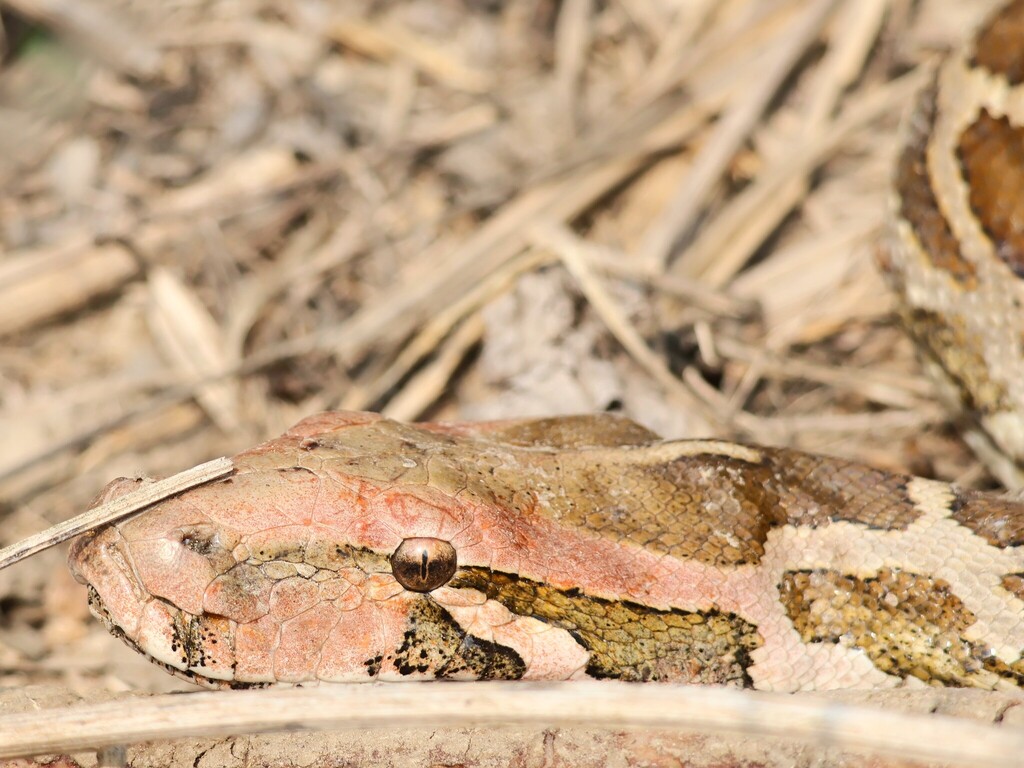
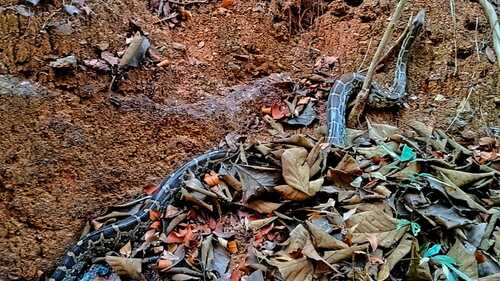
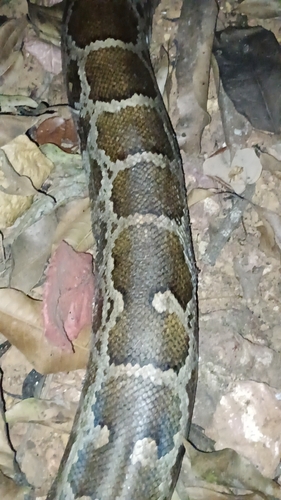
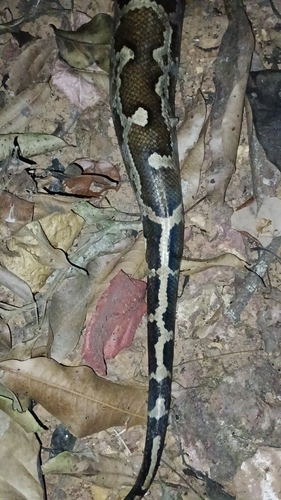
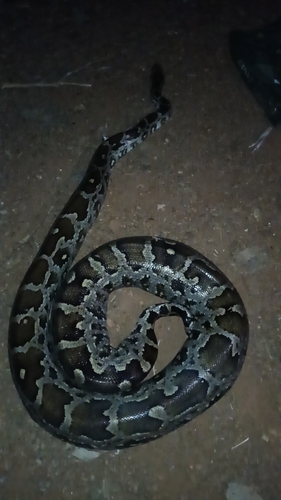
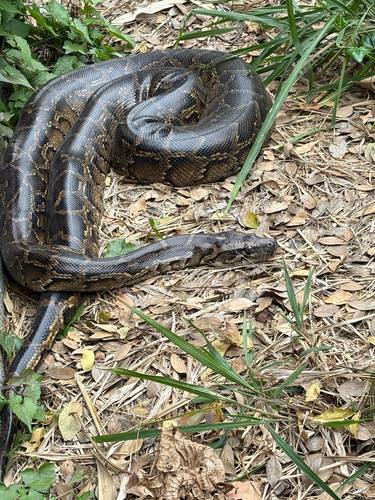
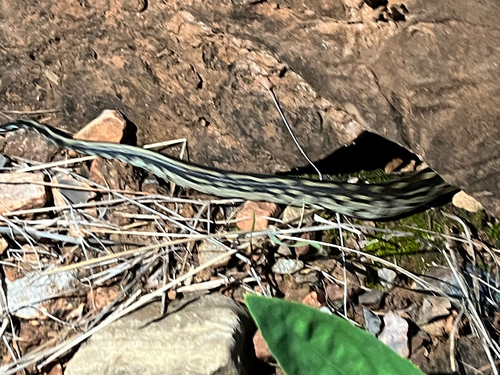
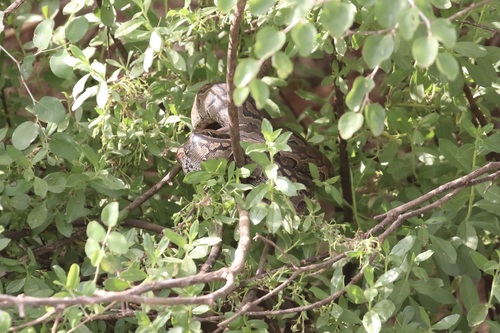
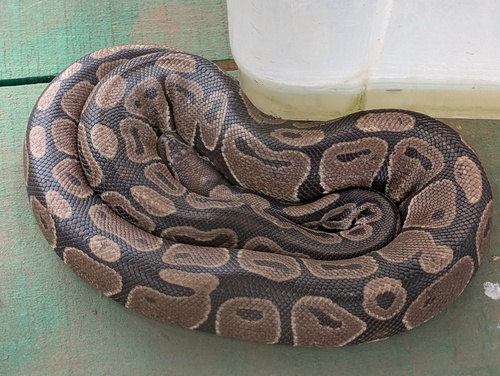
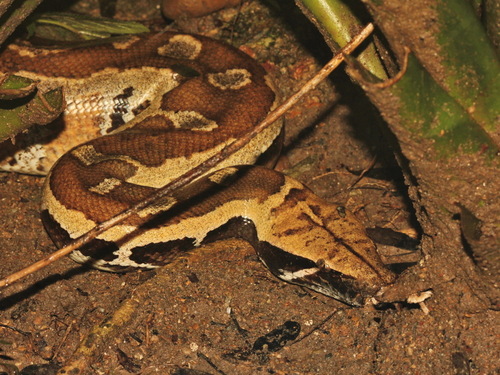
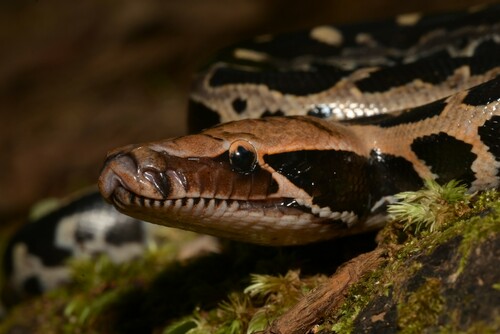
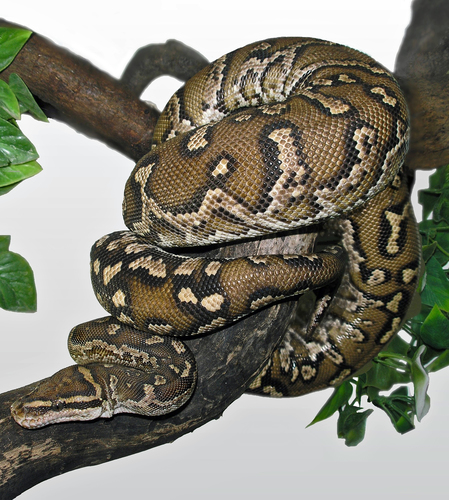
5 photographs of the Indian Python. © Daniel Z.
The Indian Python (Python molurus) is a non-venomous snake in the Pythonidae family, recorded in 32 countries.
- Family
- Pythonidae
About the Indian Python
The Indian python (Python molurus) is a large python species native to tropical and subtropical regions of the Indian subcontinent and Southeast Asia. It is also known by the common names black-tailed python, Indian rock python, and Asian rock python. Although smaller than its close relative the Burmese python, it is still among the largest snakes in the world. It is generally lighter colored than the Burmese python and reaches usually 3 m (9 ft 10 in). Like all pythons, it is nonvenomous.
Description
The rock python's color pattern is whitish or yellowish with the blotched patterns varying from tan to dark brown shades. This varies with terrain and habitat. Specimens from the hill forests of Western Ghats and Assam are darker, while those from the Deccan Plateau and Eastern Ghats are usually lighter. All pythons are non-venomous.
The nominate subspecies occurring in India typically grows to 3 m (9 ft 10 in). This value is supported by a 1990 study in Keoladeo National Park, where 25% of the python population was 2.7–3.3 m (8 ft 10 in – 10 ft 10 in) long. Two individuals even measured nearly 3.6 m (11 ft 10 in).
Because of confusion with the Burmese python, exaggerations, and stretched skins in the past, the maximum length of this subspecies is difficult to tell. The longest scientifically recorded specimen, collected in Pakistan, was 4.6 m (15 ft 1 in) long and weighed 52 kg (114 lb 10 oz). In Pakistan, Indian pythons commonly reach a length of 2.4–3.0 m (7 ft 10 in – 9 ft 10 in).
The Indian python differs from the Burmese python (Python bivittatus) in the following ways:
the presence of light "eyes" in the centers of spots located on the sides of the trunk
reddish or pinkish color of light stripes on the sides of the head
a diamond-shaped spot on the head blurred in the front part
usually lighter in color, dominated by brown, reddish-brown, yellowish-brown and grayish-brown tones
usually prefers a drier, more arid environment, unlike P. bivittatus, which inhabits moist, meadow environments
Distribution and habitat
The Indian python occurs in nearly all of the Indian subcontinent south of the Himalayas, including southern Nepal and Bhutan, Sri Lanka, southeastern Pakistan, Bangladesh, and probably in northern Myanmar. It lives in a wide range of habitats, including grasslands, swamps, marshes, rocky foothills, woodlands, open forest, and river valleys. It needs a reliable source of water. It hides in abandoned mammal burrows, hollow trees, dense water reeds, and mangrove thickets.
Behavior
Lethargic and slow moving even in their native habitat, they exhibit timidity and rarely try to attack even when attacked. Locomotion is usually with the body moving in a straight line, by "walking on its ribs". They are excellent swimmers and are quite at home in water. They can be wholly submerged in water for many minutes if necessary, but usually prefer to remain near the bank.
Feeding
Adapted from Wikipedia, available under CC BY-SA.
Frequently asked: Indian Python
- Is the Indian Python venomous?
- No. The Indian Python (Python molurus) is non-venomous and is not considered dangerous to humans. Like most snakes, it will retreat rather than bite when given the chance.
- Is the Indian Python poisonous?
- Snakes are venomous, not poisonous. "Poisonous" means harmful to eat or touch; "venomous" means injecting toxins through a bite. The Indian Python is neither poisonous nor venomous.
- Is the Indian Python dangerous?
- The Indian Python is not dangerous to humans. It has no medically significant venom and bites only defensively if cornered or handled.
- Where does the Indian Python live?
- The Indian Python has verified records in 32 countries, including India, Sri Lanka, Thailand. See the distribution section below for its full range.
- What does the Indian Python eat?
- Like all snakes, Indian pythons are strict carnivores and feed on mammals, birds, reptiles, and amphibians indiscriminately, but seem to prefer mammals. Roused to activity on sighting prey, the snake advances with a quivering tail and lunges with an open mouth. Live prey is constricted and killed. One or two coils are used to hold it in a tight grip. The prey, unable to breathe, succumbs and is subsequently swallowed head first. After a heavy meal, they are disinclined to move. If forced to, hard parts of the meal may tear through the body.
Where it is found
More Pythonidae snakes

Classification
How scientists group this snake, from the broadest category down to the exact species. Each step narrows to its closest relatives.
- OrderThe broad group of scaled reptiles: all snakes and lizards
- Squamata
- FamilyA group of related snakes that share key traits
- Pythonidae
- GenusA close-knit group of very similar species
- Python
- SpeciesThis exact snake, named in the two-part scientific name
- Python molurus
Keep learning
- What to Do If You Find a SnakeFound a snake at home or on a trail? Here is how to stay calm, give it space, identify it safely, and know when to call a professional.
- Venomous vs Nonvenomous: How to Tell the DifferenceThe folk rules for telling venomous snakes apart, where each one fails, and why location-based identification beats guessing by sight.
- What Is a Snake? Anatomy and the BasicsA clear overview of what makes a snake a snake: limbless body plan, anatomy, evolution from lizards, species diversity, and why they are ectothermic.
- How to Keep Snakes Out of Your Yard and HomeA practical guide to keeping snakes out of your yard and home using habitat changes that work, plus what to skip and what to do if one shows up.
Distribution from GBIF & iNaturalist. Venom status per CDC. Background: Wikipedia. Informational only. Never handle a snake to identify it.