
Pythonidae
African Rock Python
HarmlessPython sebae
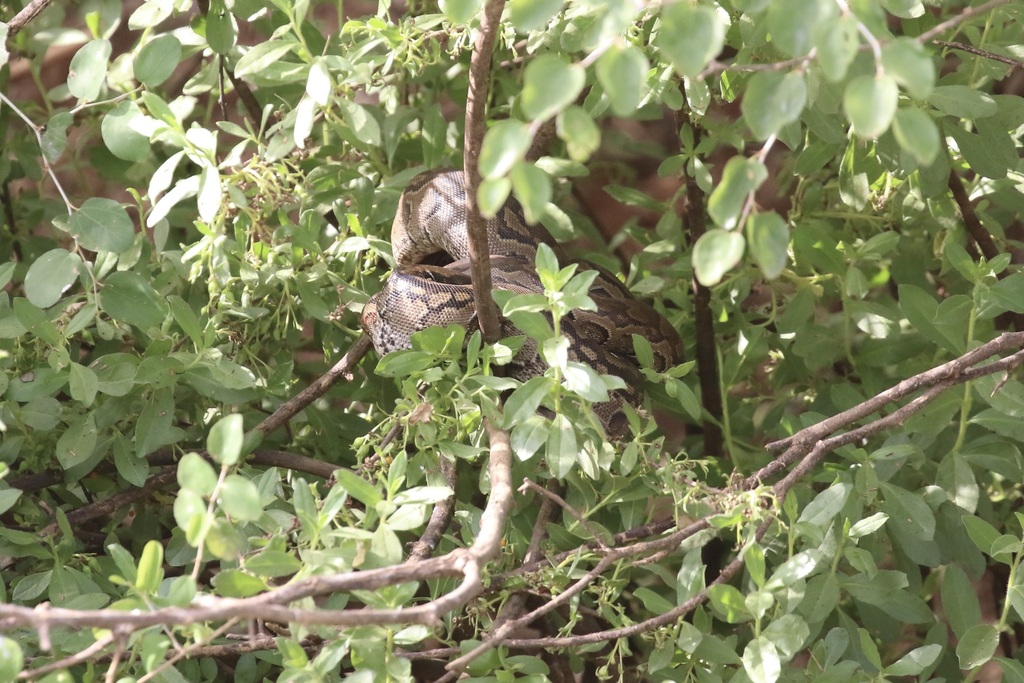
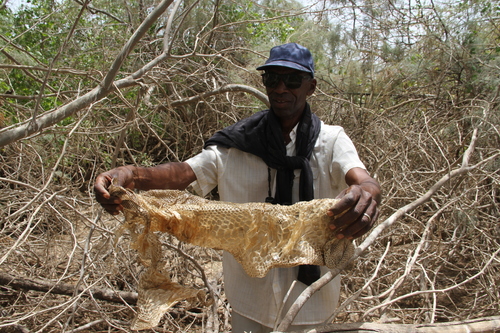
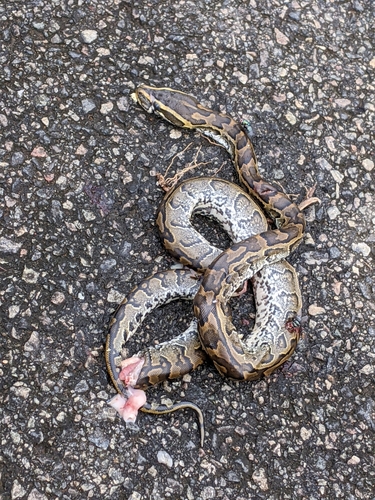
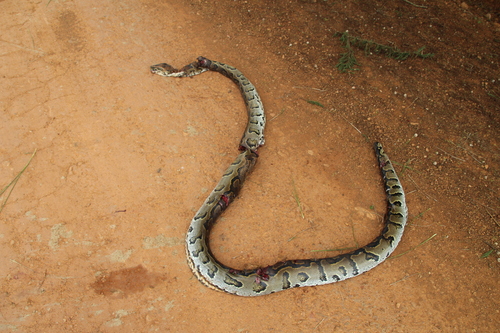
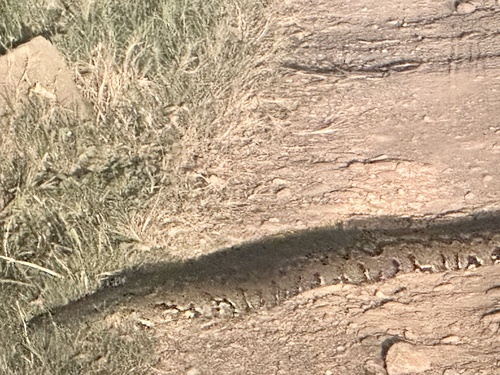
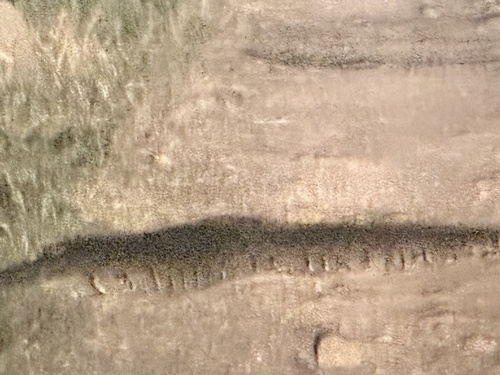
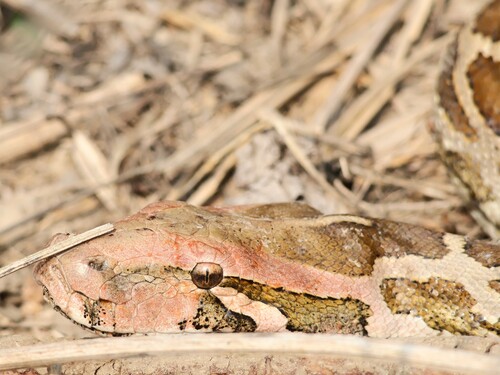
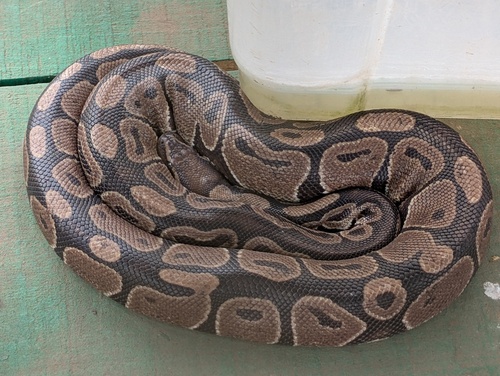
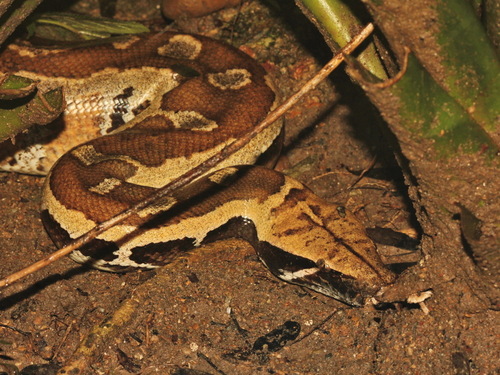
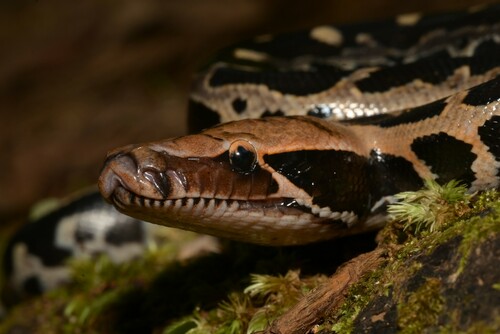
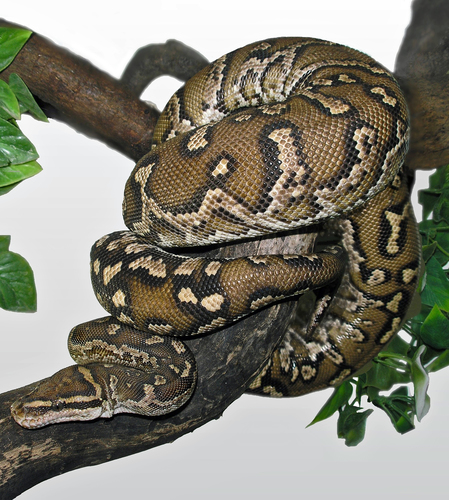
6 photographs of the African Rock Python. © Susan Murphy.
The African Rock Python (Python sebae) is a non-venomous snake in the Pythonidae family.
The African rock python is a very large, nonvenomous constrictor native to sub-Saharan Africa, from Senegal east to Ethiopia and Somalia and south to northern Angola and northern Tanzania, and it has also been found in the Florida Everglades. It has no venom, but it is Africa's largest snake and a big adult can be dangerous, so keep your distance.
- Family
- Pythonidae
How to identify the African Rock Python
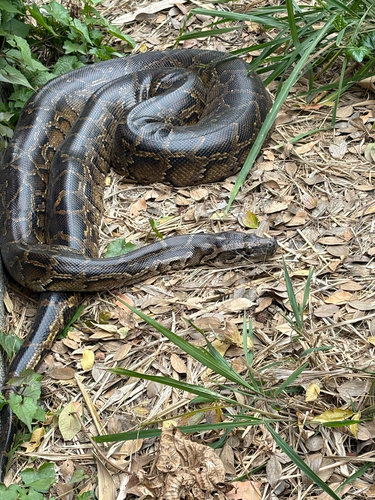
Look for a very thick, heavy snake with irregular brown, olive, chestnut and yellow blotches that often merge into a broad stripe. Then check the head for a dark brown spear-head mark on top and a triangular mark under the eye.
- Size
- Adults usually measure 3 to 3.5 m (about 10 to 11.5 ft) and are heavily built, and exceptional specimens can pass 6 m (20 ft).
- Pattern
- The body is covered with brown, olive, chestnut and yellow blotches that often join into a broad, irregular stripe.
- Head
- The triangular head has a dark brown spear-head shape on top outlined in buffy yellow, with two light lines running from the nose over the eye to the back of the head.
- Under the eye
- A distinctive triangular marking, the subocular mark, sits just below the eye.
- Lips
- The scales around the lips carry heat-sensitive pits, used to find warm-blooded prey even in the dark.
- Belly
- The body markings fade to white on the underside.
- Spurs
- Small pelvic spurs, remnants of hind limbs, are visible near the vent.
Have a photo? Identify it from your photo and location.
Is the African Rock Python dangerous?
Not venomous
It has no venom, but it is one of the largest snakes in the world and a big individual is strong enough to overpower a person, particularly a child. Fatal attacks are exceptionally rare, though a few have been documented, including a 3-year-old killed in 1999 by an escaped pet in Illinois.
If you find one
- Back away slowly and give the snake plenty of room; never try to touch, handle or restrain it.
- Keep children and pets well away and watch where the snake goes from a safe distance.
- Contact your local wildlife authorities to report it, especially if you see one in Florida, and if you are unsure what snake it is, treat it as venomous.
Habitat and behavior
- Habitat
- It lives in a wide range of habitats, including forest, savanna, grassland, semidesert and rocky country. It is most often found near permanent water such as swamps, lakes and rivers, and it adapts to disturbed land around settlements, especially cane fields.
- Behavior
- It ambushes and constricts prey, tightening its coils each time the victim breathes out. The species is widely feared, and while documented attacks on people are exceptionally rare, a large adult is powerful and its many sharp, backward-curved teeth can deliver a serious bite if it is cornered or handled.
- Diet
- It eats mammals, birds and reptiles including small antelope, jackals, hares, hyraxes, monkeys, waterbirds, monitor lizards, fish and even crocodiles.
- When active
- It becomes dormant during the dry season, and its heat-sensing lip pits let it hunt warm-blooded prey in the dark.
Further reading: African Rock Python on Wikipedia.
Frequently asked: African Rock Python
- Is the African rock python venomous?
- No. The African rock python is nonvenomous and kills its prey by constriction. Death of the prey is thought to come from cardiac arrest rather than crushing.
- How big does the African rock python get?
- Adults typically measure 3 to 3.5 m (about 10 to 11.5 ft) and can weigh 55 to 65 kg (121 to 143 lb) or more. Reports of specimens over 6 m (19 ft 8 in) are considered reliable, and it may be the second heaviest living snake.
- Can an African rock python kill a human?
- It is possible but exceptionally rare. Only a few deaths are well substantiated, including a child killed by an escaped pet in Illinois in 1999, and there are no reports of a person being eaten. Any large python should be treated with caution and given plenty of space.
- Are there African rock pythons in Florida?
- Yes, the species has been found in the Florida Everglades. Feral rock pythons were noted there in the 1990s, one was found in 2009, and there is concern it could become established as an invasive species alongside the Burmese python.
- Is the African Rock Python poisonous?
- Snakes are venomous, not poisonous. "Poisonous" means harmful to eat or touch; "venomous" means injecting toxins through a bite. The African Rock Python is neither poisonous nor venomous.
- Is the African Rock Python dangerous?
- The African Rock Python is not dangerous to humans. It has no medically significant venom and bites only defensively if cornered or handled.
- What does the African Rock Python eat?
- Like all pythons, the Central African rock python is non-venomous and kills by constriction. After gripping the prey, it coils around it, tightening its coils every time the victim breathes out. Death is thought to be caused by cardiac arrest rather than by asphyxiation or crushing. The Central African rock python feeds on small antelope, jackals, hares, hyraxes, monkeys, waterbirds, monitor lizards, fish, and crocodiles. In March 2017, a 3.9-m (12-ft 10-in) African rock python was filmed eating a large adult male spotted hyena weighing 70 kg (150 lb).
More Pythonidae snakes

Classification
How scientists group this snake, from the broadest category down to the exact species. Each step narrows to its closest relatives.
- OrderThe broad group of scaled reptiles: all snakes and lizards
- Squamata
- FamilyA group of related snakes that share key traits
- Pythonidae
- GenusA close-knit group of very similar species
- Python
- SpeciesThis exact snake, named in the two-part scientific name
- Python sebae
Keep learning
- What to Do If You Find a SnakeFound a snake at home or on a trail? Here is how to stay calm, give it space, identify it safely, and know when to call a professional.
- Venomous vs Nonvenomous: How to Tell the DifferenceThe folk rules for telling venomous snakes apart, where each one fails, and why location-based identification beats guessing by sight.
- What Is a Snake? Snake Facts, Body Plan and How They Differ From LizardsA clear overview of what makes a snake a snake: limbless body plan, anatomy, evolution from lizards, species diversity, and why they are ectothermic.
- How to Keep Snakes Out of Your Yard and HomeA practical guide to keeping snakes out of your yard and home using habitat changes that work, plus what to skip and what to do if one shows up.
Distribution from GBIF & iNaturalist. Venom status per CDC. Background: Wikipedia. Informational only. Never handle a snake to identify it.