
Elapidae
Yellow-lipped Sea Krait
VenomousLaticauda colubrina
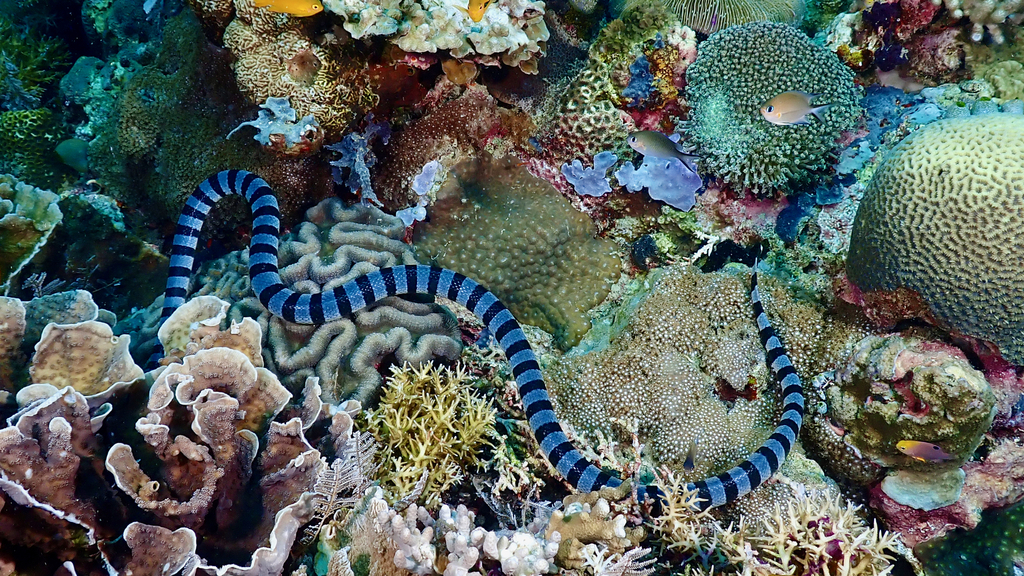
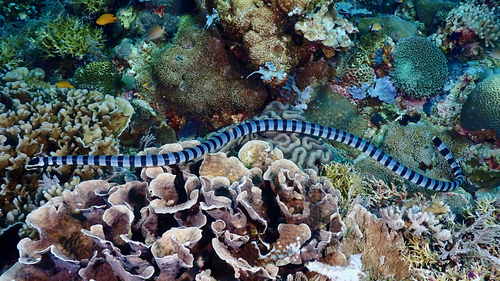
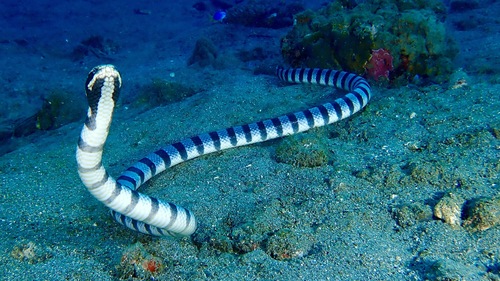
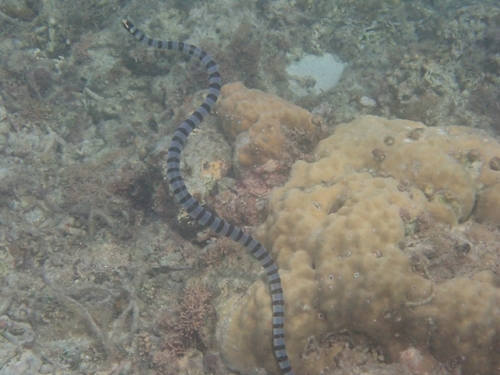
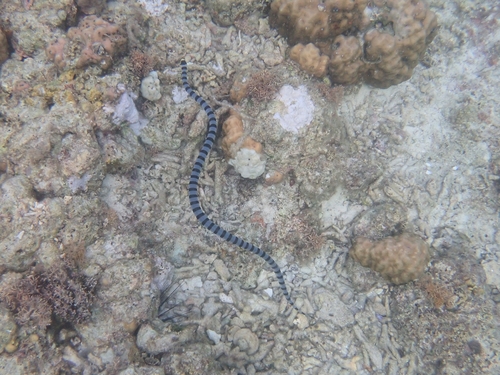
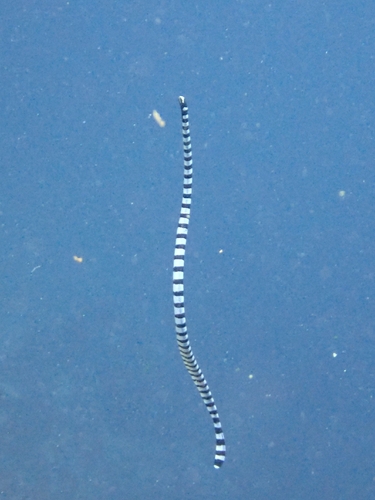
6 photographs of the Yellow-lipped Sea Krait. © Chris Spain.
The Yellow-lipped Sea Krait (Laticauda colubrina) is a venomous snake in the Elapidae family, recorded in 30 countries.
If you are bitten
This is a venomous snake. Treat any bite as a medical emergency: stay calm, keep the bitten limb still and roughly level with the heart, remove rings and tight clothing, and get to emergency care immediately. Do not apply a tourniquet, cut the wound, apply ice, or try to suck out venom. Call your local emergency number or poison center.
- Family
- Elapidae
- Danger
- high
About the Yellow-lipped Sea Krait
The yellow-lipped sea krait (Laticauda colubrina), also known as the banded sea krait or colubrine sea krait, is a species of highly venomous snake found in tropical Indo-Pacific oceanic waters. The snake has distinctive black stripes and a yellow snout, with a paddle-like tail for use in swimming.
It spends much of its time under water to hunt, but returns to land to digest, rest, and reproduce. It has very potent neurotoxic venom, which it uses to prey on eels and small fish. Because of its affinity to land, the yellow-lipped sea krait often encounters humans, but the snake is not aggressive and only attacks when feeling threatened.
Description
The head of a yellow-lipped sea krait is black, with lateral nostrils and an undivided rostral scale. The upper lip and snout are characteristically colored yellow, and the yellow color extends backward on each side of the head above the eye to the temporal scales.
The body of the snake is subcylindrical, and is taller than it is wide. Its upper surface is typically a shade of blueish gray, while the belly is yellowish, with wide ventral scales that stretch from a third to more than half of the width of the body. Black rings of about uniform width are present throughout the length of the snake, but the rings narrow or are interrupted at the belly. The midbody is covered with 21 to 25 longitudinal rows of imbricated (overlapping) dorsal scales. The dorsal and lateral scales can be used to differentiate between this species and the similar yellow-lipped New Caledonian sea krait, which typically has fewer rows of scales and scales that narrow or fail to meet (versus the yellow-lipped sea krait's ventrally meeting dark bands). The tail of the snake is paddle-shaped and adapted to swimming.
On average, the total length of a male is 875 mm (2 ft 10.4 in) long, with a 13 cm (5.1 in) long tail. Females are significantly larger, with an average total length of 1.42 m (4 ft 8 in) and a tail length of 145 mm (5.7 in).
Distribution and habitat
The yellow-lipped sea krait is widespread throughout the eastern Indian Ocean and Western Pacific. It can be found from the eastern coast of India, along the coast of the Bay of Bengal in Bangladesh, Myanmar, and other parts of Southeast Asia, to the Malay Archipelago and to some parts of southern China, Taiwan, and the Ryukyu Islands of Japan. The species is also common near Fiji and other Pacific islands within its range. Vagrant individuals have been recorded in Australia, New Caledonia, and New Zealand. Six specimens have been found around the North Island of New Zealand between 1880 and 2005, suspected to have come from populations based in Fiji and Tonga. It is the most common sea krait identified in New Zealand, and second-most seen sea snake after the yellow-bellied sea snake - common enough to be considered a native species, protected under the Wildlife Act 1953.
Venom
Adapted from Wikipedia, available under CC BY-SA.
Local and regional names
The Yellow-lipped Sea Krait is known by these names across the regions where it lives:
- Chinese
- 蓝灰扁尾海蛇, 藍灰扁尾海蛇, 黃唇青斑海蛇
- Czech
- vlnožil užovkový
- Danish
- Gullæbet havkrait
- English
- Banded Sea Krait, Banded Sea Krait/Yellow-lipped Sea Krait/Amphibious Sea Snake, Banded Seakrait, Colubrine Sea Krait, Columbrine Sea Krait
- French
- Plature couleuvrin, Tricot rayé jaune
- German
- Gelblippen-Seeschlange, Nattern-Plattschwanz
- Italian
- Krait di mare bocca gialla, Serpente di mare bocca gialla
- Japanese
- アオマダラウミヘビ
- Khmer
- ពស់ក្រាយសមុទ្រ
- Polish
- wiosłogon żmijowaty
- Portuguese
- Serpente-marinha-de-faixas
- Russian
- Желтогубый плоскохвост, Ужевидный морской крайт
- Spanish
- Culebra del Mar Bandeada, Serpiente marina bandeada
- Thai
- งูสมิงทะเลปากเหลือง
Frequently asked: Yellow-lipped Sea Krait
- Is the Yellow-lipped Sea Krait venomous?
- Yes. The Yellow-lipped Sea Krait (Laticauda colubrina) is venomous and belongs to the Elapidae family (cobra, mamba, coral or sea snake). Its bite is considered high risk to people. Treat any bite as a medical emergency.
- Is the Yellow-lipped Sea Krait poisonous?
- Snakes are venomous, not poisonous. "Poisonous" means harmful to eat or touch; "venomous" means injecting toxins through a bite. The Yellow-lipped Sea Krait is venomous, delivering venom through a bite.
- Is the Yellow-lipped Sea Krait dangerous?
- This is a venomous snake. Treat any bite as a medical emergency: stay calm, keep the bitten limb still and roughly level with the heart, remove rings and tight clothing, and get to emergency care immediately. Do not apply a tourniquet, cut the wound, apply ice, or try to suck out venom. Call your local emergency number or poison center.
- Where does the Yellow-lipped Sea Krait live?
- The Yellow-lipped Sea Krait has verified records in 30 countries, including Philippines, Indonesia, Fiji. See the distribution section below for its full range.
- What does the Yellow-lipped Sea Krait eat?
- Hunting is often performed alone, but L. colubrina kraits may also do so in large numbers in the company of hunting parties of giant trevally and goatfish. This cooperative hunting technique is similar to that of the moray eel, with the yellow-lipped sea kraits flushing out prey from narrow crevices and holes, and the trevally and goatfish feeding on fleeing prey. While probing crevices with their heads, yellow-lipped sea kraits are unable to observe approaching predators and can be vulnerable.
If you are bitten by the Yellow-lipped Sea Krait
Do
- Get away from the snake and stay calm. Most bites worsen when people panic or try again to handle the snake.
- Call 911 or Poison Control (1-800-222-1222) right away. Antivenom works best when given early.
- Note the time of the bite and, from a safe distance, the snake's color and pattern, a phone photo is enough. Do not chase it.
- Keep the bitten limb still and at roughly heart level. Sit or lie down and limit movement.
- Remove rings, watches, and tight clothing near the bite before swelling starts.
- Gently wash the bite with soap and water and cover it with a clean, dry dressing.
Do not
- Do not cut the wound or try to suck out the venom.
- Do not apply a tourniquet or ice.
- Do not drink alcohol or caffeine.
- Do not take aspirin or ibuprofen, they can worsen bleeding. Acetaminophen is safer for pain.
- Do not try to catch or kill the snake. A dead snake can still bite by reflex.
First-aid guidance adapted from the U.S. Centers for Disease Control and Prevention (CDC NIOSH), Venomous Snakes. Educational only; always follow the instructions of emergency responders.
Where it is found
More Elapidae snakes
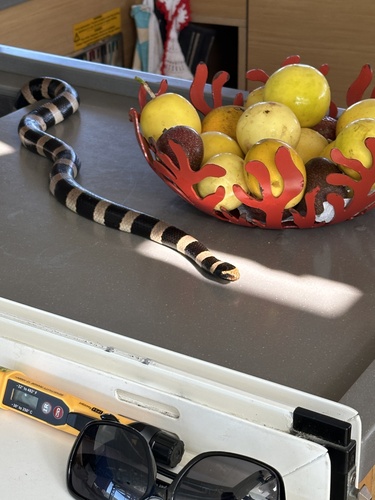 New Caledonian Sea KraitLaticauda saintgironsi
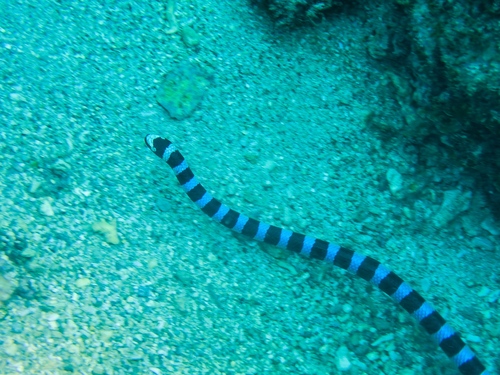 Blue-lipped Sea KraitLaticauda laticaudata
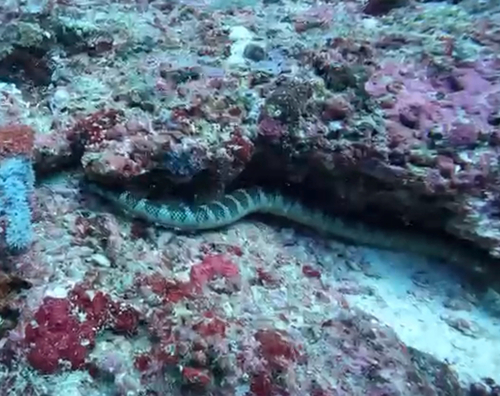 Chinese Sea KraitLaticauda semifasciata
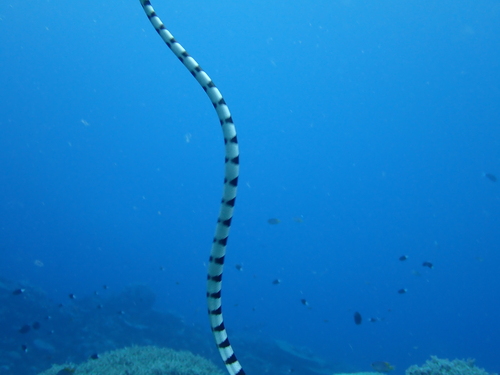 Dwarf Sea KraitLaticauda frontalis
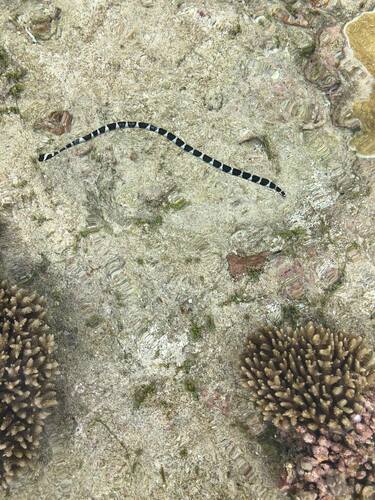 Katuali Sea KraitLaticauda schistorhynchus
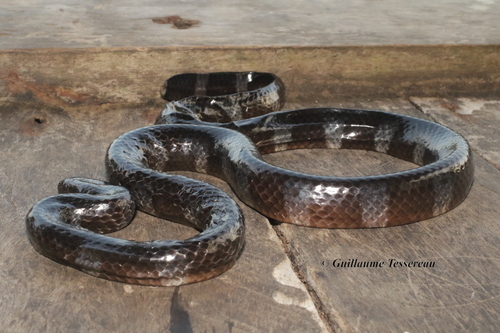 Rennell Island Sea KraitLaticauda crockeri
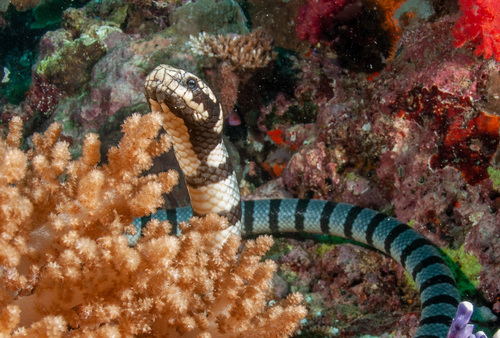 Flat-tailed Sea KraitLaticauda guineai
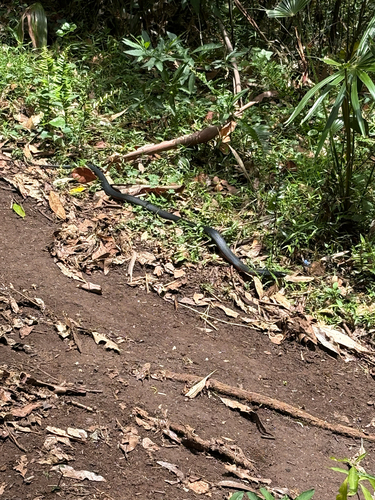 Red-bellied Black SnakePseudechis porphyriacus
Classification
How scientists group this snake, from the broadest category down to the exact species. Each step narrows to its closest relatives.
Keep learning
- Are Snakes Dangerous? The Real Risk, in PerspectiveMost snakes are harmless and avoid people. Here is the honest picture of snakebite risk worldwide and how to lower your own.
- Snakebite First Aid: What to Do (and What Never to Do)A clear, CDC-based guide to snakebite first aid: the steps that help, the popular myths that hurt, and how to tell a serious bite from a minor one.
- Venomous vs Nonvenomous: How to Tell the DifferenceThe folk rules for telling venomous snakes apart, where each one fails, and why location-based identification beats guessing by sight.
- What to Do If You Find a SnakeFound a snake at home or on a trail? Here is how to stay calm, give it space, identify it safely, and know when to call a professional.
Distribution from GBIF & iNaturalist. Venom status per CDC. Background: Wikipedia. Informational only. Never handle a snake to identify it.