
Elapidae
Blue-lipped Sea Krait
VenomousLaticauda laticaudata
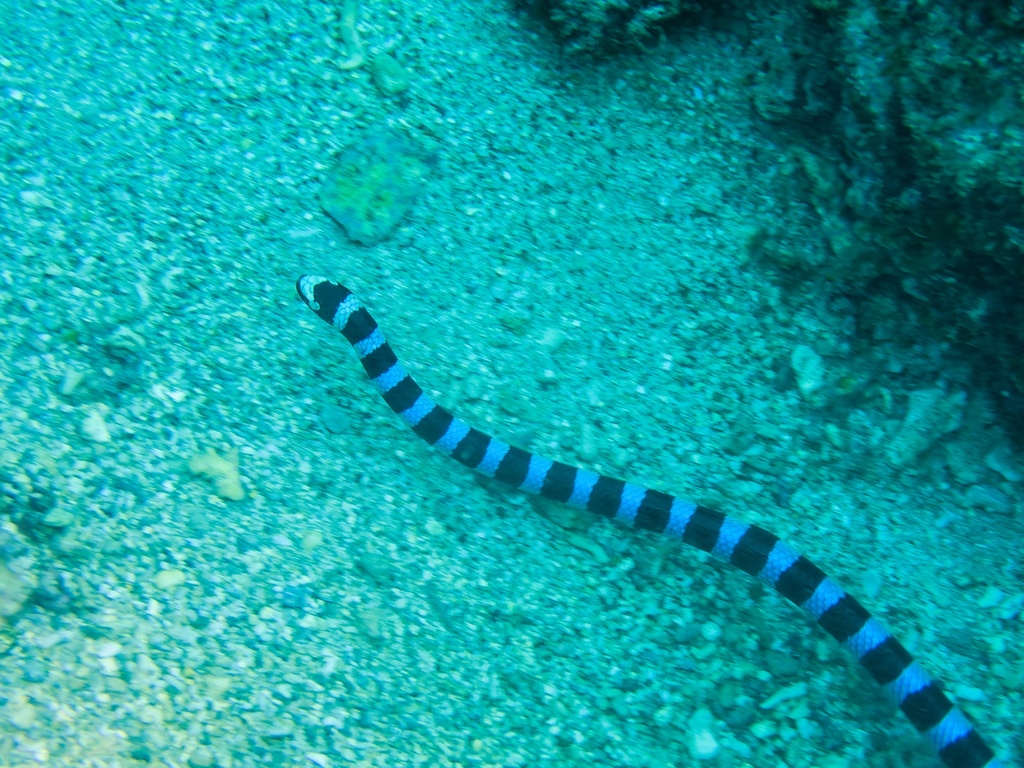
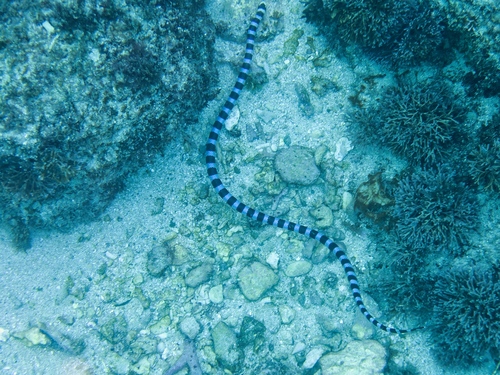
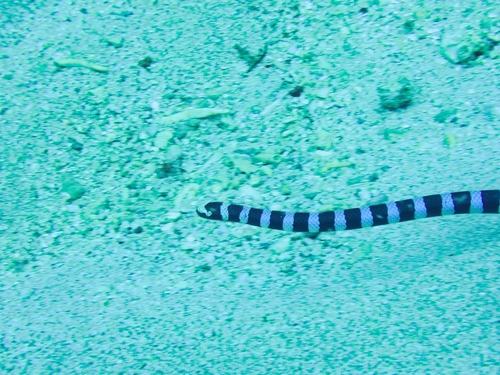
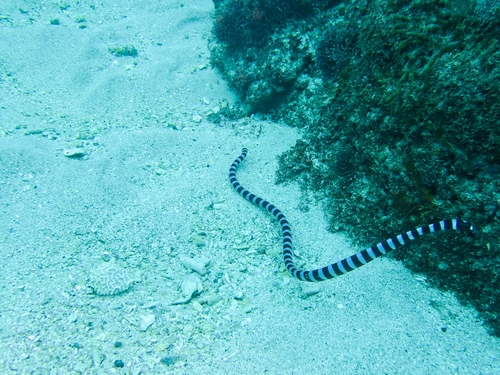
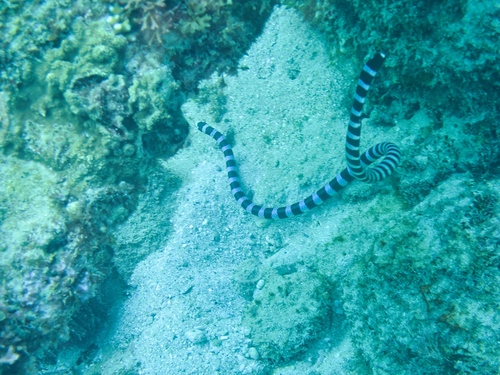
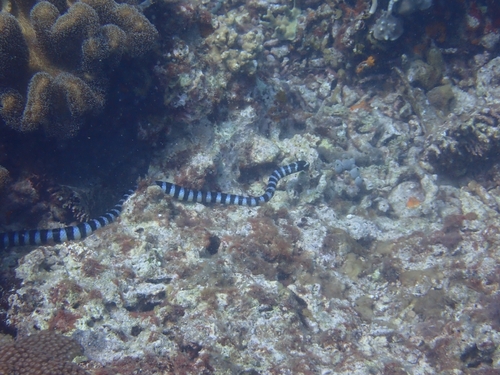
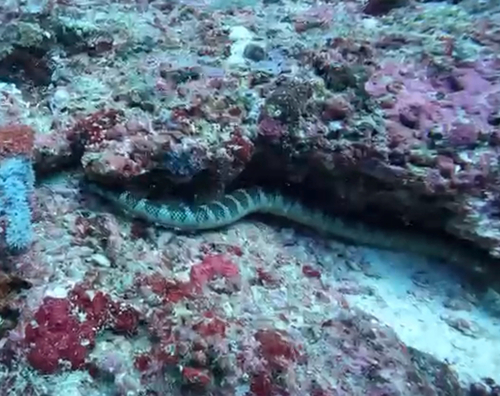
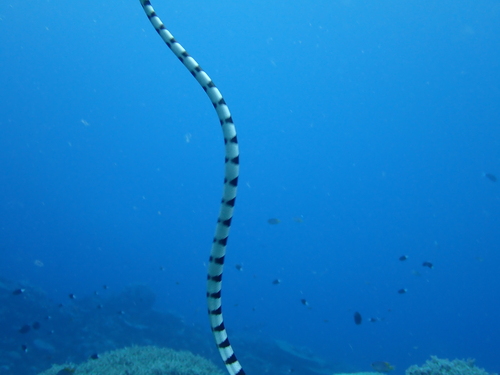
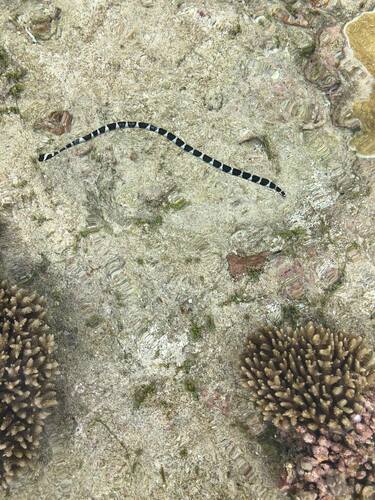
6 photographs of the Blue-lipped Sea Krait. © Jay Paroline.
The Blue-lipped Sea Krait (Laticauda laticaudata) is a venomous snake in the Elapidae family, recorded in 24 countries.
If you are bitten
This is a venomous snake. Treat any bite as a medical emergency: stay calm, keep the bitten limb still and roughly level with the heart, remove rings and tight clothing, and get to emergency care immediately. Do not apply a tourniquet, cut the wound, apply ice, or try to suck out venom. Call your local emergency number or poison center.
- Family
- Elapidae
- Danger
- high
About the Blue-lipped Sea Krait
The blue-lipped sea krait (Laticauda laticaudata), also known as the blue-banded sea krait or common sea krait, is a species of venomous sea snake in the subfamily Laticaudinae of the family Elapidae. It is found in the Indian and Western Pacific Oceans.
Taxonomy
The blue-lipped sea krait was one of the many species originally described by Carl Linnaeus in his landmark 1758 10th edition of Systema Naturae, where it was given the binomial name Coluber laticaudatus. There are two subspecies, Laticauda laticaudata laticaudata and Laticauda laticaudata affinis.
Description
Ventral scales of this snake are large, one-third to more than one-half the width of the body; the nostrils are lateral; nasal scales are separated by internasals; 19 longitudinal rows of imbricate scales are found at midbody; no azygous prefrontal shield is present; rostral scales are undivided; ventrals number 225–243; subcaudals number 38–47 in males, females have 30–35 (ventral and subcaudal counts after Smith 1943:443). The upper lip is dark brown. Total length varies with sex: males are 910 mm (36 in), females are 1,070 mm (42 in); tail lengths are similar: 110 mm (4.3 in). The 19 rows of scales and the dark brown upper lip can be used to differentiate the blue-lipped sea krait from other Laticauda species.
Distribution and habitat
This species is found in the Indian and Western Pacific Oceans: Bay of Bengal (Bangladesh, East India, Andaman & Nicobar Islands, Sri Lanka, Myanmar, Thailand), coasts of Malay Peninsula to Indonesia, Timor-Leste, New Guinea, the Philippines, off the coasts of Fujian and Taiwan, Japan, Polynesia, Melanesia, Solomon Islands, New Caledonia, Palau, Vanuatu, Fiji, and Australia (Queensland). One specimen was found in Devonport, New Zealand in 2011 and again in January 2025, however it died shortly after being taken to Kelly Tarlton's Sea Life Aquarium.
The blue-lipped sea snake is spread all over the west pacific, making it known as the common sea krait. Sea kraits forage in reefs and return to land to digest their prey, mate, slough, and lay their eggs. Sea krait experience rapid temperature shifts when going from water to land. They'll often mitigate these effects by seeking shelter from direct sunlight.
Special features
This snake is known to warm up in wedge-tailed shearwater burrows.
Adapted from Wikipedia, available under CC BY-SA.
Local and regional names
The Blue-lipped Sea Krait is known by these names across the regions where it lives:
- Bengali
- নীলমুখো কেউটে
- Chinese
- 扁尾海蛇, 黑唇青斑海蛇
- Czech
- vlnožil ploský
- Danish
- Blålæbet Havkrait
- Dutch
- Gewone platstaart
- English
- Black-banded Sea Krait, Blackbanded Sea Krait, Blue-banded Sea Krait, Brown-Lipped Sea Krait, Black-Banded Sea Krait, Brown-lipped Sea Krait, Common Sea Krait, brown lipped sea krait
- French
- Plature A Bandes, Plature à bandes, Plature à queue large , Tricot rayé bleu, Tricot rayé à lèvres sombres, Plature à bandes, Tricot rayé bleu, Tricot rayé à lèvres sombres
- German
- Gewöhnlicher Plattschwanz
- Italian
- Krait di mare bocca blu, Serpente di mare bocca blu
- Japanese
- ヒロオウミヘビ
- Korean
- 좁은띠큰바다뱀
- Russian
- Кольчатый плоскохвост, Обыкновенный морской крайт
- Thai
- งูสมิงทะเลปากดำ
- Ukrainian
- Морський крайт звичайний
Frequently asked: Blue-lipped Sea Krait
- Is the Blue-lipped Sea Krait venomous?
- Yes. The Blue-lipped Sea Krait (Laticauda laticaudata) is venomous and belongs to the Elapidae family (cobra, mamba, coral or sea snake). Its bite is considered high risk to people. Treat any bite as a medical emergency.
- Is the Blue-lipped Sea Krait poisonous?
- Snakes are venomous, not poisonous. "Poisonous" means harmful to eat or touch; "venomous" means injecting toxins through a bite. The Blue-lipped Sea Krait is venomous, delivering venom through a bite.
- Is the Blue-lipped Sea Krait dangerous?
- This is a venomous snake. Treat any bite as a medical emergency: stay calm, keep the bitten limb still and roughly level with the heart, remove rings and tight clothing, and get to emergency care immediately. Do not apply a tourniquet, cut the wound, apply ice, or try to suck out venom. Call your local emergency number or poison center.
- Where does the Blue-lipped Sea Krait live?
- The Blue-lipped Sea Krait has verified records in 24 countries, including New Caledonia, Japan, Chinese Taipei. See the distribution section below for its full range.
If you are bitten by the Blue-lipped Sea Krait
Do
- Get away from the snake and stay calm. Most bites worsen when people panic or try again to handle the snake.
- Call 911 or Poison Control (1-800-222-1222) right away. Antivenom works best when given early.
- Note the time of the bite and, from a safe distance, the snake's color and pattern, a phone photo is enough. Do not chase it.
- Keep the bitten limb still and at roughly heart level. Sit or lie down and limit movement.
- Remove rings, watches, and tight clothing near the bite before swelling starts.
- Gently wash the bite with soap and water and cover it with a clean, dry dressing.
Do not
- Do not cut the wound or try to suck out the venom.
- Do not apply a tourniquet or ice.
- Do not drink alcohol or caffeine.
- Do not take aspirin or ibuprofen, they can worsen bleeding. Acetaminophen is safer for pain.
- Do not try to catch or kill the snake. A dead snake can still bite by reflex.
First-aid guidance adapted from the U.S. Centers for Disease Control and Prevention (CDC NIOSH), Venomous Snakes. Educational only; always follow the instructions of emergency responders.
Where it is found
More Elapidae snakes
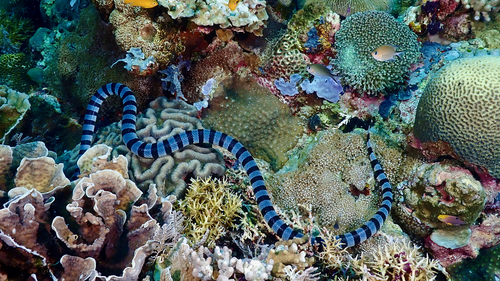 Yellow-lipped Sea KraitLaticauda colubrina
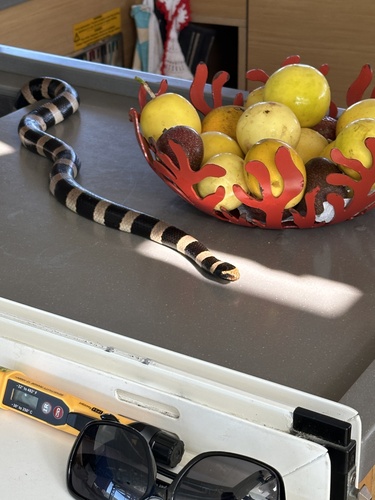 New Caledonian Sea KraitLaticauda saintgironsi
 Chinese Sea KraitLaticauda semifasciata
 Dwarf Sea KraitLaticauda frontalis
 Katuali Sea KraitLaticauda schistorhynchus
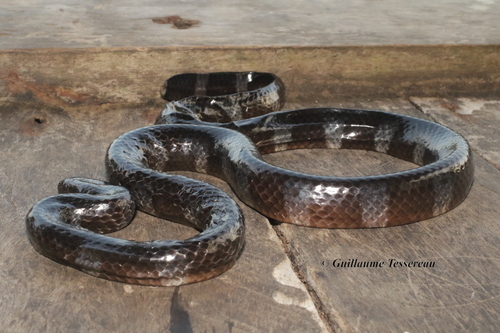 Rennell Island Sea KraitLaticauda crockeri
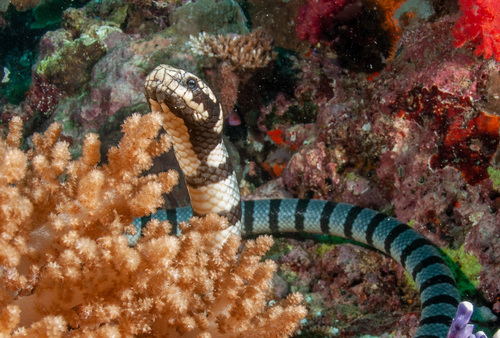 Flat-tailed Sea KraitLaticauda guineai
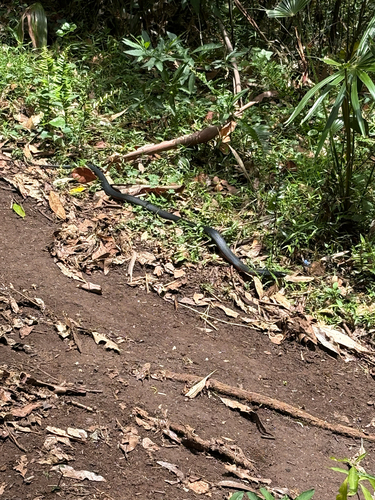 Red-bellied Black SnakePseudechis porphyriacus
Classification
How scientists group this snake, from the broadest category down to the exact species. Each step narrows to its closest relatives.
Keep learning
- Are Snakes Dangerous? The Real Risk, in PerspectiveMost snakes are harmless and avoid people. Here is the honest picture of snakebite risk worldwide and how to lower your own.
- Snakebite First Aid: What to Do (and What Never to Do)A clear, CDC-based guide to snakebite first aid: the steps that help, the popular myths that hurt, and how to tell a serious bite from a minor one.
- Venomous vs Nonvenomous: How to Tell the DifferenceThe folk rules for telling venomous snakes apart, where each one fails, and why location-based identification beats guessing by sight.
- What to Do If You Find a SnakeFound a snake at home or on a trail? Here is how to stay calm, give it space, identify it safely, and know when to call a professional.
Distribution from GBIF & iNaturalist. Venom status per CDC. Background: Wikipedia. Informational only. Never handle a snake to identify it.