
Colubridae
Egg-eating Snake
HarmlessDasypeltis scabra
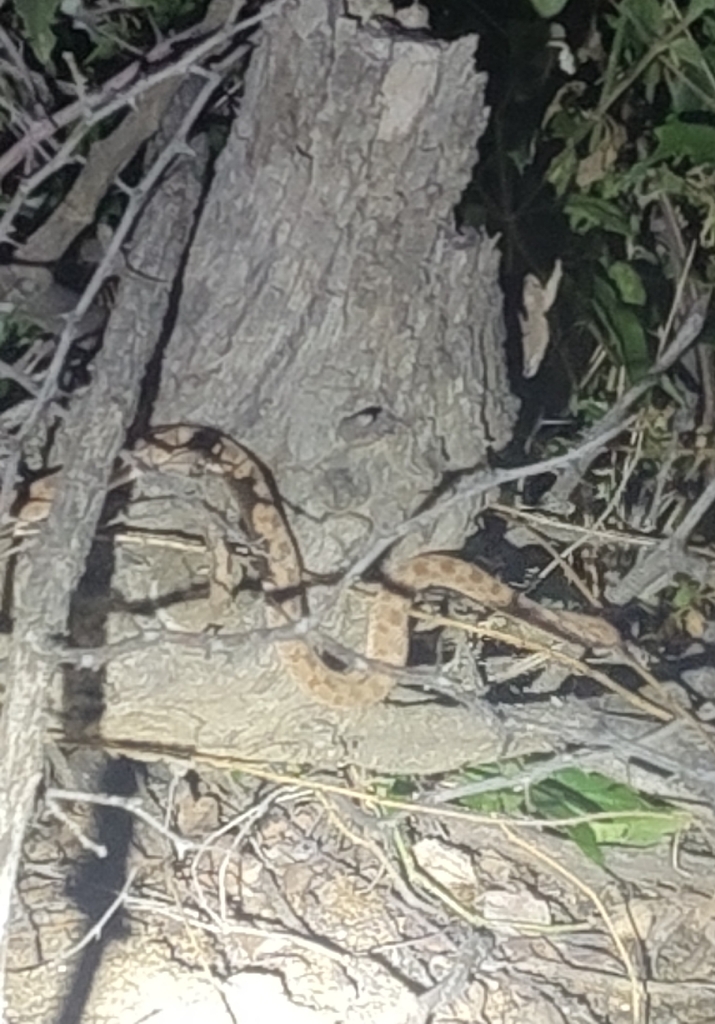
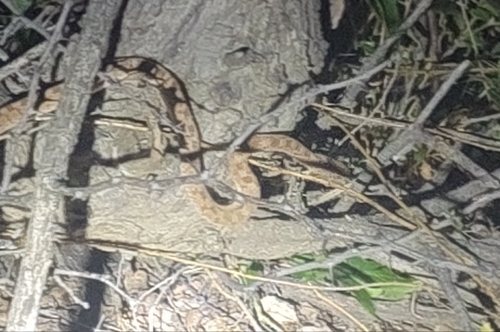
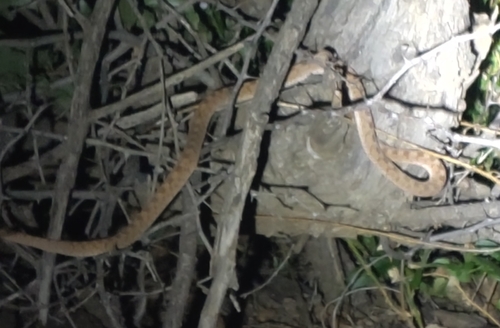
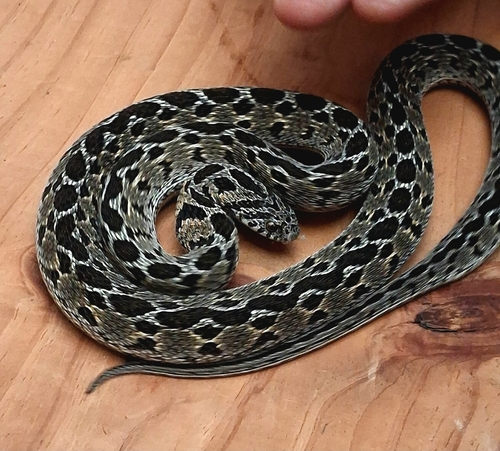
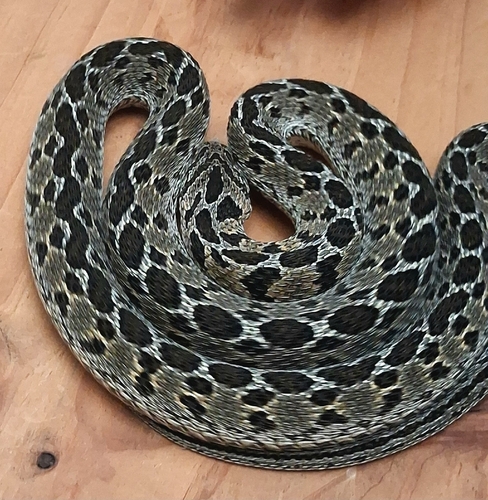
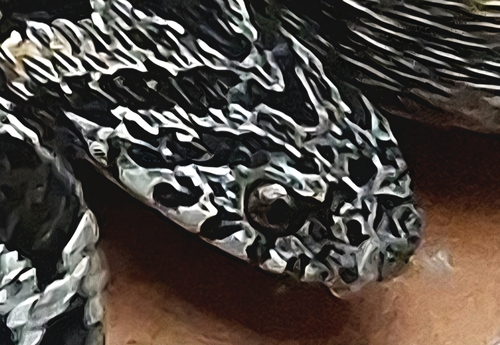
6 photographs of the Egg-eating Snake. © le0p0ld_d.
The Egg-eating Snake (Dasypeltis scabra) is a non-venomous snake in the Colubridae family, recorded in 41 countries.
- Family
- Colubridae
About the Egg-eating Snake
Dasypeltis scabra, also known commonly as the common egg eater, the egg-eating snake, and the rhombic egg eater, is a species of snake in the family Colubridae. The species is endemic to Africa.
Geographic range
D. scabra is found in sub-Saharan Africa.
Description
D. scabra grows to a total length (tail included) of 40–46 inches (100–120 cm), and has almost toothless jaws. Dorsally, it has a series of rhomboidal dark brown spots on a lighter background. There is an alternating series of brown spots on each side and a distinct V-shaped mark at the back of the neck. Ventrally it is yellowish, either uniform or with dark dots.
Mimicry
It has been suggested that non-venomous D. scabra is a mimic of venomous Echis carinatus, the saw-scaled viper, which it strongly resembles.
Typical specimens of D. scabra even more closely resemble Causus rhombeatus, the rhombic night adder. The colouration of E. carinatus generally tends to be more reddish and brown, instead of shades of grey and black; and the V-shaped mark on its head is more patchy than in the other two species.
C. rhombeatus is not as slim as D. scabra, and its dorsal scales, unusual among viperids, are at most slightly keeled, whereas D. scabra scales not only are keeled, but in some parts of the body are finely saw-toothed so that, when an alarmed snake rubs them against each other, they emit a threatening hissing sound. The species does not hiss in the usual manner at all. Both species typically have well-defined V-shaped markings on the head and neck, but in C. rhombeatus the marking extends forward on the head, whereas in D. scabra it is mainly on the neck.
Furthermore, the two species also may be distinguished by the shape of the pupil of the eye. Snakes of the genus Dasypeltis have vertically slit pupils, whereas snakes of the genus Causus have round pupils. However, in dim light the vertical pupils expand till they are rounded, so this is not necessarily a reliable criterion for distinguishing the species.
Habitat
D. scabra can be found in a variety of habitats, at altitudes from sea level to 2,600 m (8,500 ft). It is not found in closed-canopy forests nor in true deserts, but does inhabit most ecosystems between these extremes.
Behavior
The rhombic egg eater is nocturnal. Although mainly terrestrial, it is a good climber and is known to scale rock outcroppings and climb trees to raid birds' nests.
Diet
D. scabra feeds exclusively on eggs. The lining of the mouth has small, parallel ridges, very similar to human fingerprints, which aid in grasping the shell of an egg. Once swallowed, the egg is punctured by specialized vertebral hypapophyses which extend into the esophagus. The shell is then regurgitated in one piece, and its contents passed along to the stomach.
Defense
Adapted from Wikipedia, available under CC BY-SA.
Frequently asked: Egg-eating Snake
- Is the Egg-eating Snake venomous?
- No. The Egg-eating Snake (Dasypeltis scabra) is non-venomous and is not considered dangerous to humans. Like most snakes, it will retreat rather than bite when given the chance.
- Is the Egg-eating Snake poisonous?
- Snakes are venomous, not poisonous. "Poisonous" means harmful to eat or touch; "venomous" means injecting toxins through a bite. The Egg-eating Snake is neither poisonous nor venomous.
- Is the Egg-eating Snake dangerous?
- The Egg-eating Snake is not dangerous to humans. It has no medically significant venom and bites only defensively if cornered or handled.
- Where does the Egg-eating Snake live?
- The Egg-eating Snake has verified records in 41 countries, including South Africa, Congo, Democratic Republic of the, Zambia. See the distribution section below for its full range.
- What does the Egg-eating Snake eat?
- D. scabra feeds exclusively on eggs. The lining of the mouth has small, parallel ridges, very similar to human fingerprints, which aid in grasping the shell of an egg. Once swallowed, the egg is punctured by specialized vertebral hypapophyses which extend into the esophagus. The shell is then regurgitated in one piece, and its contents passed along to the stomach.
Where it is found
More Colubridae snakes
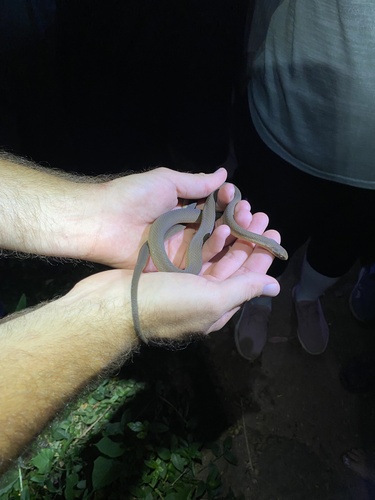 Southern Brown Egg EaterDasypeltis inornata
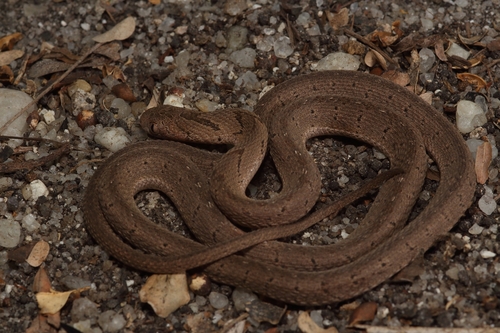 East African Egg EaterDasypeltis medici
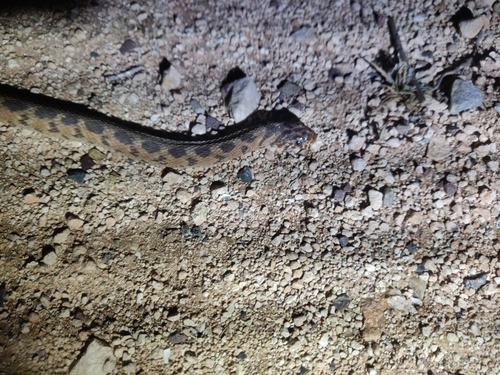 Sahel Egg EaterDasypeltis sahelensis
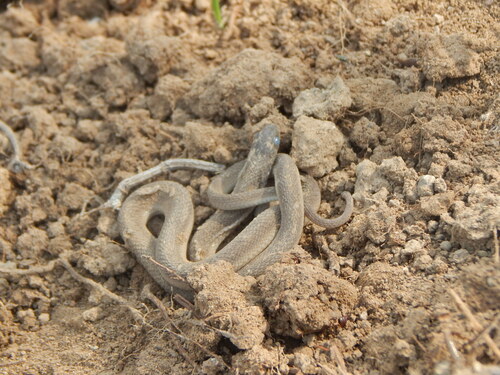 Montane Egg-eaterDasypeltis atra
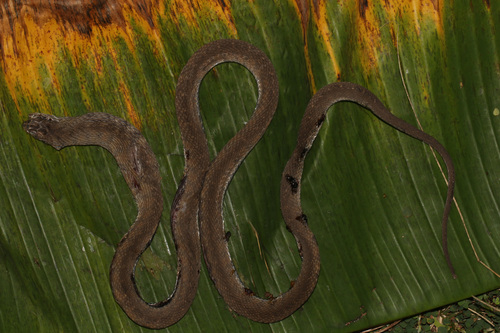 Central African Egg-eating SnakeDasypeltis fasciata
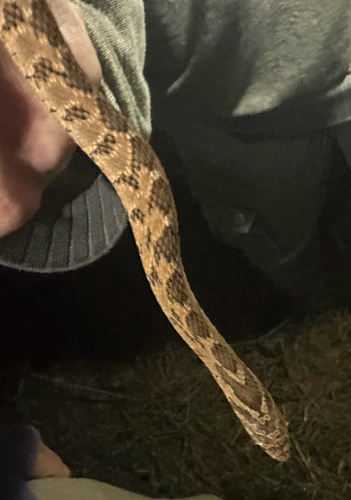 Confusing Egg EaterDasypeltis confusa
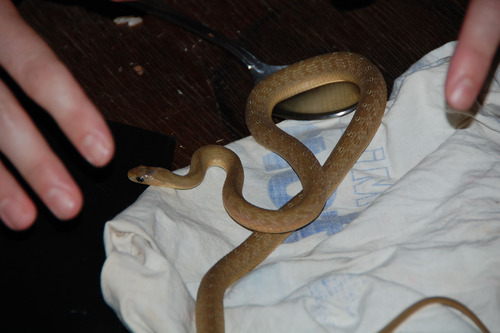 Gans’ Egg EaterDasypeltis gansi
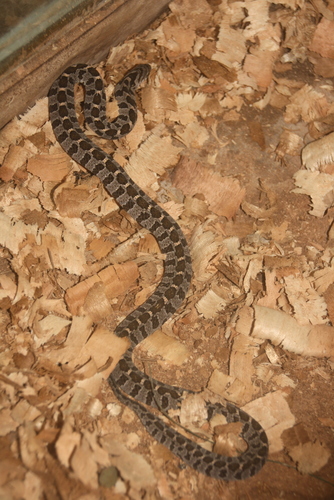 Dasypeltis parascabraDasypeltis parascabra
Classification
How scientists group this snake, from the broadest category down to the exact species. Each step narrows to its closest relatives.
- OrderThe broad group of scaled reptiles: all snakes and lizards
- Squamata
- FamilyA group of related snakes that share key traits
- Colubridae
- GenusA close-knit group of very similar species
- Dasypeltis
- SpeciesThis exact snake, named in the two-part scientific name
- Dasypeltis scabra
Keep learning
- What to Do If You Find a SnakeFound a snake at home or on a trail? Here is how to stay calm, give it space, identify it safely, and know when to call a professional.
- Venomous vs Nonvenomous: How to Tell the DifferenceThe folk rules for telling venomous snakes apart, where each one fails, and why location-based identification beats guessing by sight.
- What Is a Snake? Anatomy and the BasicsA clear overview of what makes a snake a snake: limbless body plan, anatomy, evolution from lizards, species diversity, and why they are ectothermic.
- How to Keep Snakes Out of Your Yard and HomeA practical guide to keeping snakes out of your yard and home using habitat changes that work, plus what to skip and what to do if one shows up.
Distribution from GBIF & iNaturalist. Venom status per CDC. Background: Wikipedia. Informational only. Never handle a snake to identify it.