
Colubridae
Indochinese Long-nosed Whipsnake
HarmlessAhaetulla fusca
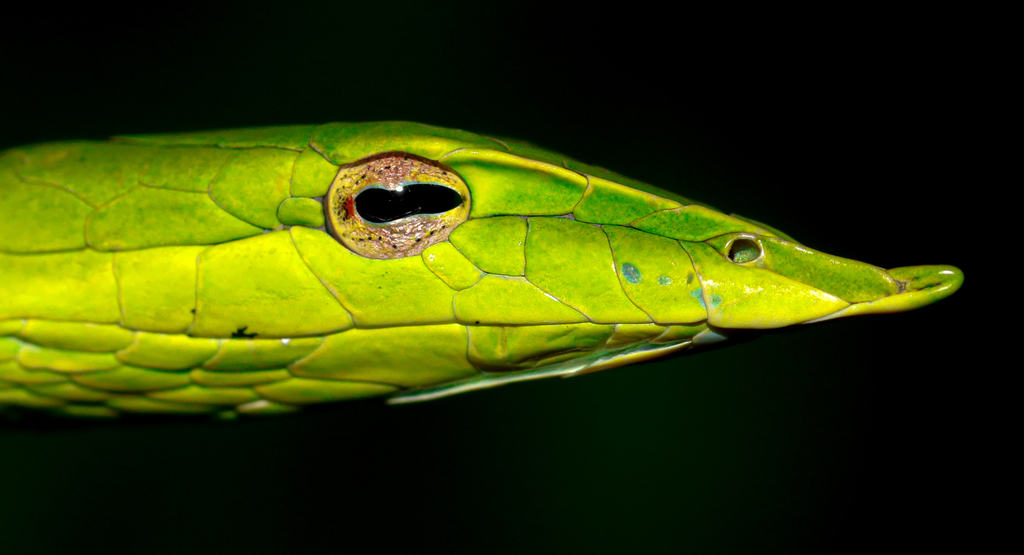
The Indochinese Long-nosed Whipsnake (Ahaetulla fusca) is a rear-fanged, mildly venomous snake in the Colubridae family, recorded in 22 countries.
The Indochinese Long-nosed Whipsnake (Ahaetulla fusca), also called the Indochinese long-nosed vine snake, is a slender, bright green tree snake of mainland Southeast Asia, found from Myanmar and Thailand to Cambodia and southern Vietnam. It is a rear-fanged, mildly venomous snake: bites are rarely medically significant but can cause local symptoms, so it should never be handled.
- Family
- Colubridae
How to identify the Indochinese Long-nosed Whipsnake
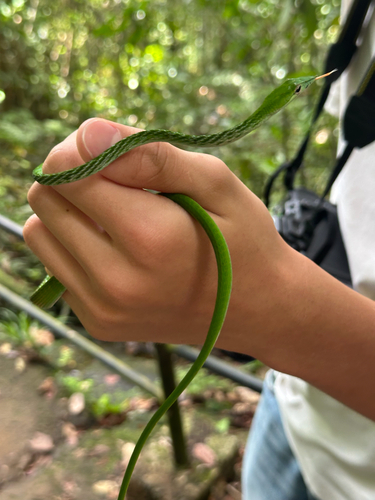
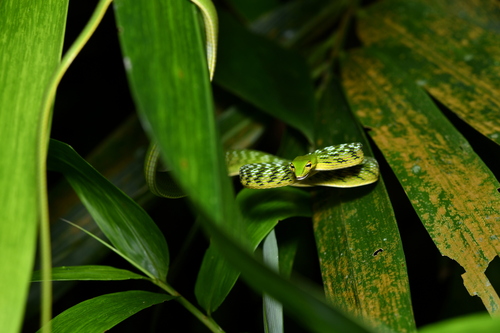
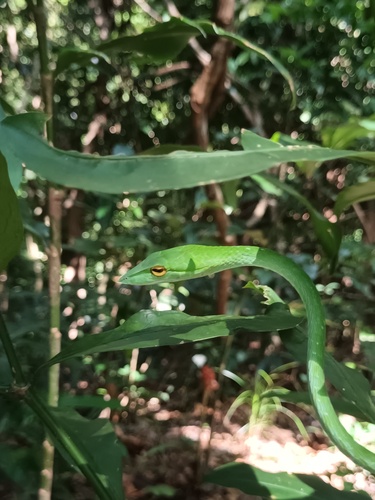
Look for a very thin, emerald green snake with a long, pointed snout and horizontal, keyhole-shaped pupils, usually stretched through branches or shrubs. Its whip-thin body and sharply pointed head set it apart from almost any other snake.
- Head
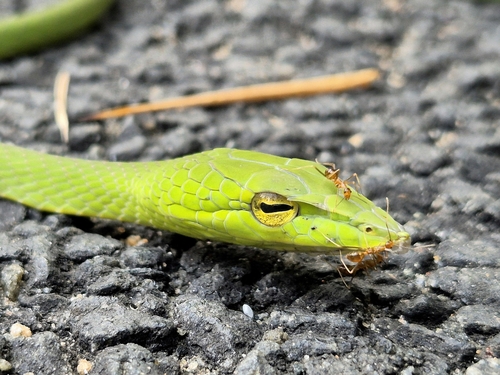
- The head is long and pointed, with a distinctly elongated snout that is sometimes slightly upturned at the tip.
- Eyes
- The pupils are horizontal rather than round or vertical, giving the eye a keyhole look.
- Color
- The body is emerald green above and lighter on the belly.
- Skin between scales
- When the body stretches or inflates, black and white skin shows between the scales.
- Body
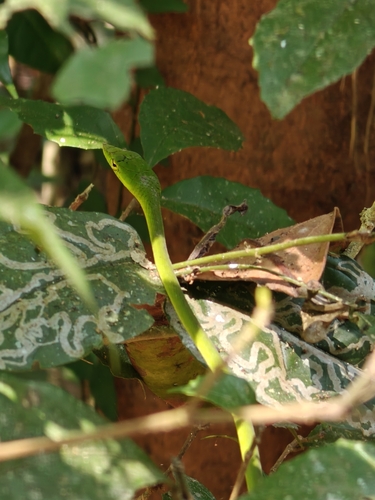
- The body is extremely slender and vine-like, built for moving through vegetation.
- Tail
- The long tail is prehensile and can grip branches.
- Size
- Adults can reach up to 2 meters in length, though much of that is thin body and tail.
Have a photo? Identify it from your photo and location.
Is the Indochinese Long-nosed Whipsnake dangerous?
Mildly venomous
This is a rear-fanged, mildly venomous snake whose bites are rarely medically significant, but they can cause local pain, swelling or bleeding. Most bites happen when people try to catch or handle it.
If bitten: Stay calm, keep still, remove rings or tight items near the bite, and get emergency care by calling your local emergency number. Do not use a tourniquet, cut the wound, apply suction or use ice.
If you find one
- Keep at least two meters away and do not try to touch or move the snake.
- Check branches and shrubs at head height before reaching in, since it rests in vegetation.
- If one is in or near a house, keep people and pets away and call a local wildlife or snake removal service.
Habitat and behavior
- Habitat
- It mainly lives in lowland dry forests. It also adapts well to disturbed and altered habitats, so it can turn up in gardens, plantations and scrub near people.
- Behavior
- It spends most of its time in trees and shrubs, where its color and shape make it hard to spot among leaves and vines. When threatened it may inflate its forebody to show the black and white skin between its scales and may strike, so give it space even if it stays still.
- Diet
- It feeds mainly on small lizards and frogs, which it hunts among vegetation.
- When active
- It is active during the day.
Further reading: Indochinese Long-nosed Whipsnake on Wikipedia.
Frequently asked: Indochinese Long-nosed Whipsnake
- Is the Indochinese Long-nosed Whipsnake venomous?
- Yes, it is rear-fanged and mildly venomous. Bites are rarely medically significant but can cause local symptoms, so it should never be handled. Seek medical care after any bite.
- How do I tell this snake from a green pit viper?
- This species is extremely thin with a long, pointed snout and horizontal pupils. Green pit vipers are stout with a broad triangular head and a short snout, and they are dangerously venomous. If you are unsure, keep your distance and treat the snake as venomous.
- Where does the Indochinese Long-nosed Whipsnake live?
- It is found from Myanmar and Thailand to Cambodia and southern Vietnam. It prefers lowland dry forests but also does well in disturbed habitats near people.
- How big does it get?
- Adults can grow up to 2 meters long. Because the body is so slender, it often looks smaller and is easy to mistake for a vine.
- Is the Indochinese Long-nosed Whipsnake poisonous?
- Snakes are venomous, not poisonous. "Poisonous" means harmful to eat or touch; "venomous" means injecting toxins through a bite. The Indochinese Long-nosed Whipsnake is neither poisonous nor venomous.
- Is the Indochinese Long-nosed Whipsnake dangerous?
- The Indochinese Long-nosed Whipsnake is not dangerous to humans. It has no medically significant venom and bites only defensively if cornered or handled.
Where it is found
More Colubridae snakes
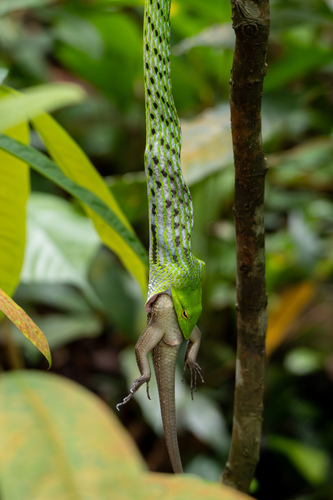 Oriental WhipsnakeAhaetulla prasina
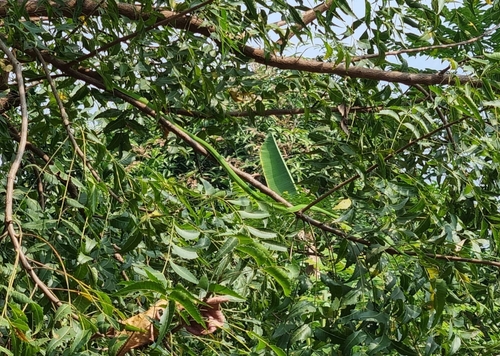 Indian Vine SnakeAhaetulla oxyrhynca
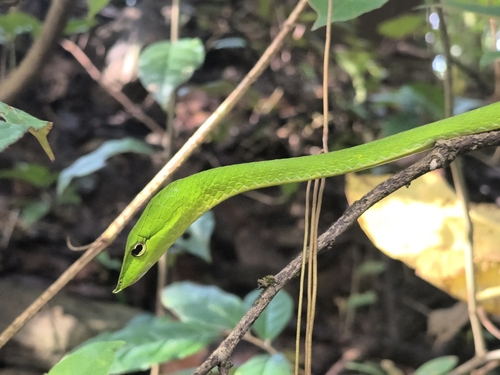 Northern Western Ghats Vine SnakeAhaetulla borealis
 Long-nosed WhipsnakeAhaetulla nasuta
 Malayan WhipsnakeAhaetulla mycterizans
 Farnsworth's Vine SnakeAhaetulla farnsworthi
 Malabar Vine SnakeAhaetulla malabarica
 Wall's Vine SnakeAhaetulla isabellina
Classification
How scientists group this snake, from the broadest category down to the exact species. Each step narrows to its closest relatives.
- OrderThe broad group of scaled reptiles: all snakes and lizards
- Squamata
- FamilyA group of related snakes that share key traits
- Colubridae
- GenusA close-knit group of very similar species
- Ahaetulla
- SpeciesThis exact snake, named in the two-part scientific name
- Ahaetulla fusca
Keep learning
- What to Do If You Find a SnakeFound a snake at home or on a trail? Here is how to stay calm, give it space, identify it safely, and know when to call a professional.
- Venomous vs Nonvenomous: How to Tell the DifferenceThe folk rules for telling venomous snakes apart, where each one fails, and why location-based identification beats guessing by sight.
- What Is a Snake? Snake Facts, Body Plan and How They Differ From LizardsA clear overview of what makes a snake a snake: limbless body plan, anatomy, evolution from lizards, species diversity, and why they are ectothermic.
- How to Keep Snakes Out of Your Yard and HomeA practical guide to keeping snakes out of your yard and home using habitat changes that work, plus what to skip and what to do if one shows up.
Distribution from GBIF & iNaturalist. Venom status per CDC. Background: Wikipedia. Informational only. Never handle a snake to identify it.