
Colubridae
Long-nosed Whipsnake
HarmlessAhaetulla nasuta
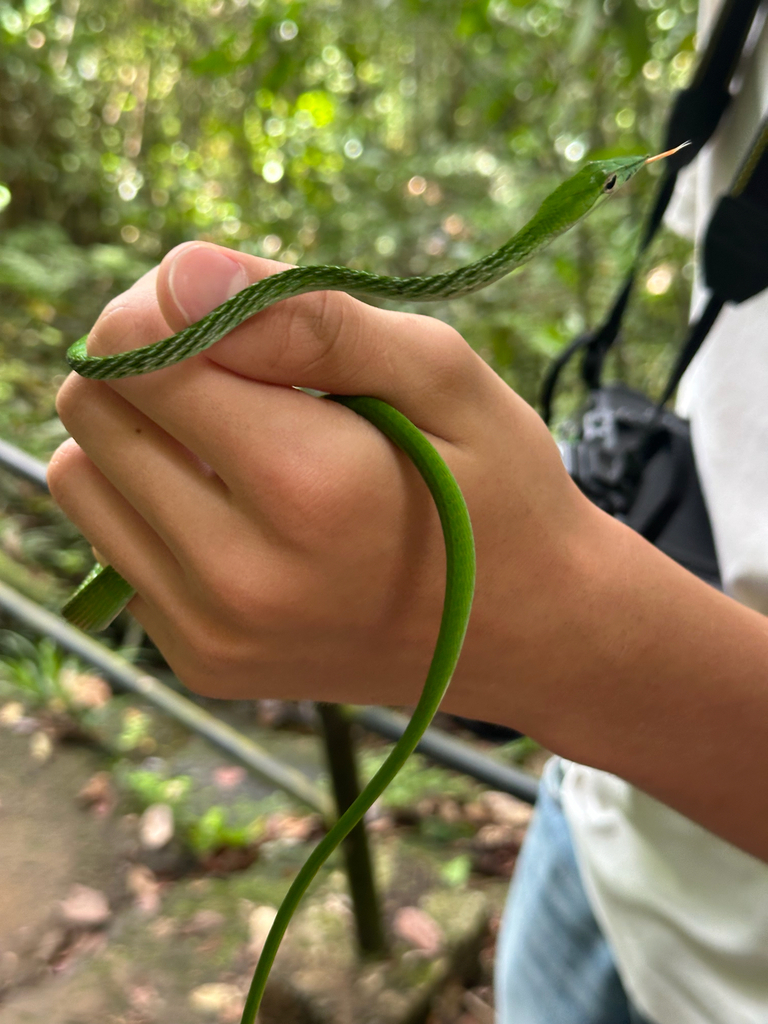
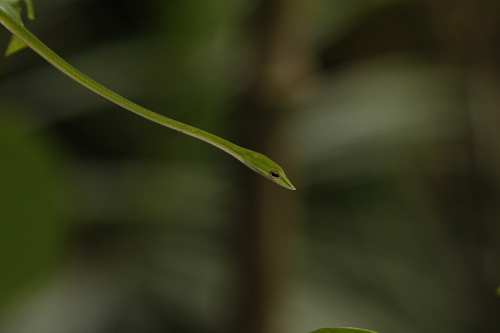
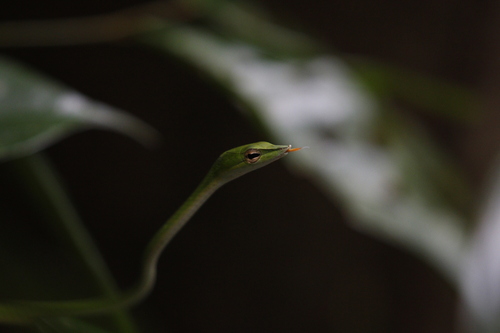
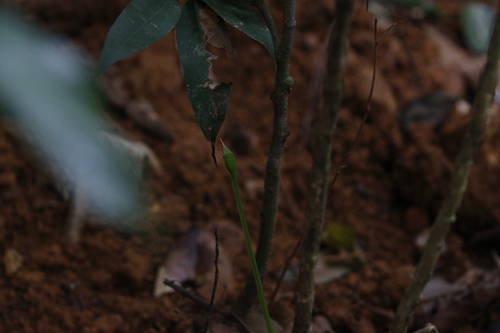
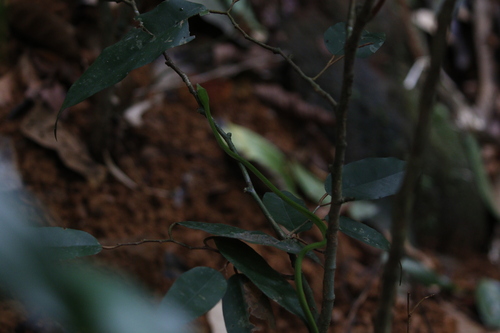
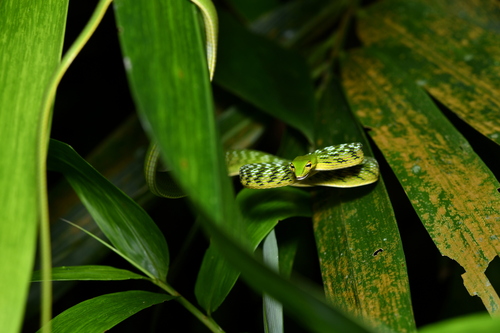
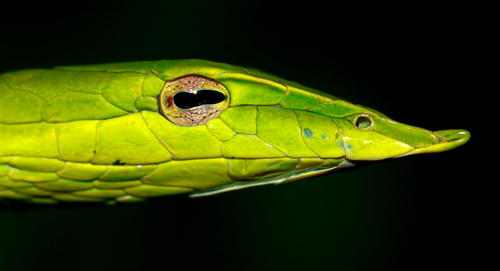
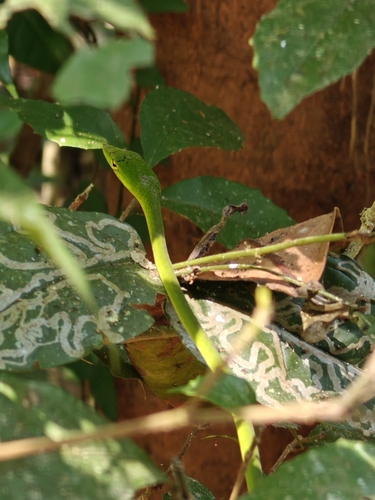
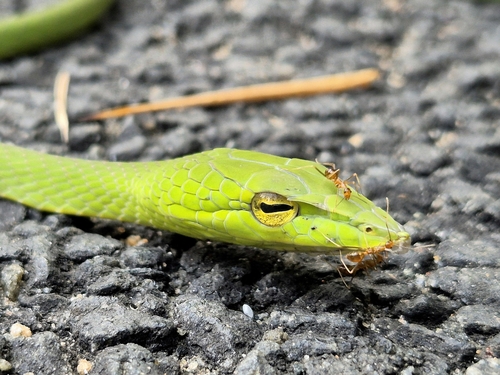
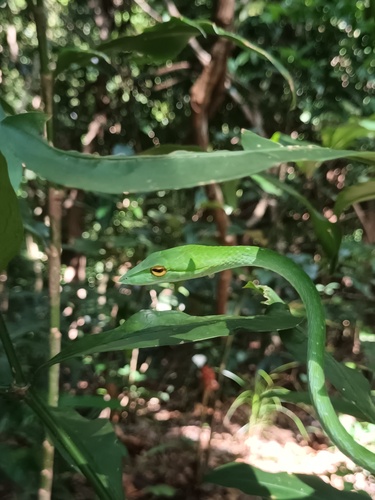
5 photographs of the Long-nosed Whipsnake. © Aleksandr Gromov.
The Long-nosed Whipsnake (Ahaetulla nasuta) is a rear-fanged, mildly venomous snake in the Colubridae family, recorded in 15 countries.
- Family
- Colubridae
About the Long-nosed Whipsnake
Ahaetulla nasuta, also known as Sri Lankan green vine snake, long-nosed whip snake, and long-nosed tree snake, is a venomous, slender green tree snake endemic to Sri Lanka. It was previously known as the common green vine snake and was widely distributed across India and South East Asia, until a 2020 study split them into several different species, restricting Ahaetulla nasuta just to the Sri Lankan population.
Etymology
The genus name Ahaetulla comes from the Sri Lankan Sinhalese words ahaetulla/ahata gulla/as gulla, meaning "eye plucker" or "eye picker", because of the belief that they pluck out the eyes of humans, as first reported by the Portuguese traveler João Ribeiro in 1685. The species name nasuta is Latin for "of the nose", in reference to its elongated snout.
Vernacular names
The Sinhala name "Aheatulla" or "eye-plucker" forms the taxonic genus name. In Tamil, it is known as pachai paambu. In Kannada, it is known as Hasiru Haavu.
Sinhala: ඇහැටුල්ලා (Pronounced: Aheatulla)
Tamil: பச்சை பாம்பு
Kannada: ಹಸಿರು ಹಾವು
Marathi: हरणटोळ (Pronounced: Harantol)
West Bengal: লাউডগা (Pronounced: Laudoga)
In Western internet culture, the vine snake has occasionally been humorously nicknamed as the "judgmental shoelace", due to their long, slender bodies and the horizontal shape of their pupils resembling a person narrowing their eyes in a captious expression.
Distribution and taxonomy
Due to longstanding confusion over the taxonomy of A. nasuta, the species was once thought to have a large range from Sri Lanka to peninsular India, including the Western Ghats, along with a disjunct population in Southeast Asia. Recent phylogenetic studies have since found the species to be paraphyletic, and in need of taxonomic revision.
A 2017 study reclassified the former subspecies Ahaetulla nasuta anomala as a distinct species, Ahaetulla anomala, although a 2020 study later found A. anomala to be possibly conspecific with Ahaetulla oxyrhyncha.
The cladogram below from a 2019 study shows Ahaetulla nasuta as paraphyletic:
A 2020 phylogenetic study reaffirmed the paraphyletic nature of A. nasuta, and found it to actually comprise a species complex, with the "true" A. nasuta (from which the species was originally described) being restricted to the wet zone of Sri Lanka (including the Sri Lanka lowland and montane rainforests). Four populations from the Western Ghats of India that were formerly grouped with A. nasuta were split into the species A. borealis, A. farnsworthi, A. isabellina, and A. malabarica. The large-bodied form from lowland peninsular India (and possibly the dry zone of the northern portion of Sri Lanka), which was also formerly grouped with A. nasuta, was found to actually be A. oxyrhyncha, and is actually more closely allied with A. pulverulenta and A. sahyadrensis than A. nasuta. Finally, the disjunct population in Southeast Asia was assigned to an as-of-yet undescribed species, tentatively referred to as Ahaetulla cf. fusca, and is a sister species to Ahaetulla laudankia.
Distribution and habitat
Adapted from Wikipedia, available under CC BY-SA.
Frequently asked: Long-nosed Whipsnake
- Is the Long-nosed Whipsnake venomous?
- The Long-nosed Whipsnake (Ahaetulla nasuta) is rear-fanged and only mildly venomous. It is not considered dangerous to humans (its venom is weak and its fangs sit at the back of the mouth) but a bite can cause local swelling or irritation, so it should not be handled.
- Is the Long-nosed Whipsnake poisonous?
- Snakes are venomous, not poisonous. "Poisonous" means harmful to eat or touch; "venomous" means injecting toxins through a bite. The Long-nosed Whipsnake is neither poisonous nor venomous.
- Is the Long-nosed Whipsnake dangerous?
- The Long-nosed Whipsnake is not dangerous to humans. It has no medically significant venom and bites only defensively if cornered or handled.
- Where does the Long-nosed Whipsnake live?
- The Long-nosed Whipsnake has verified records in 15 countries, including Sri Lanka, India, Myanmar. See the distribution section below for its full range.
- Why is it called the Long-nosed Whipsnake?
- The genus name Ahaetulla comes from the Sri Lankan Sinhalese words ahaetulla/ahata gulla/as gulla, meaning "eye plucker" or "eye picker", because of the belief that they pluck out the eyes of humans, as first reported by the Portuguese traveler João Ribeiro in 1685. The species name nasuta is Latin for "of the nose", in reference to its elongated snout.
Where it is found
More Colubridae snakes
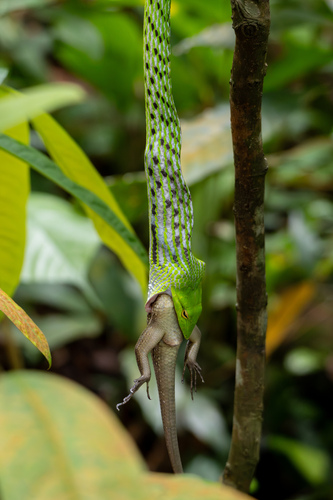 Oriental WhipsnakeAhaetulla prasina
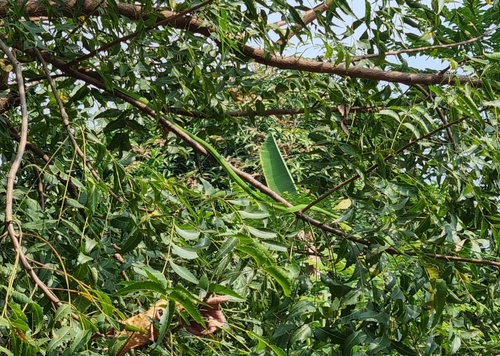 Indian Vine SnakeAhaetulla oxyrhynca
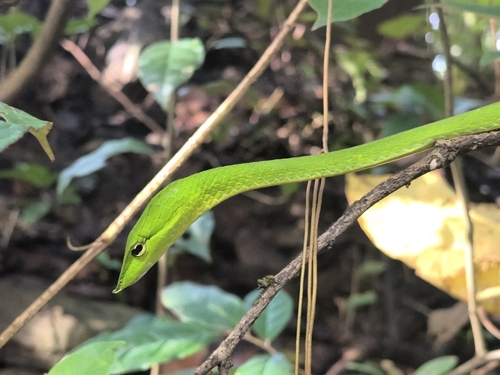 Northern Western Ghats Vine SnakeAhaetulla borealis
 Malayan WhipsnakeAhaetulla mycterizans
 Indochinese Long-nosed WhipsnakeAhaetulla fusca
 Farnsworth's Vine SnakeAhaetulla farnsworthi
 Malabar Vine SnakeAhaetulla malabarica
 Wall's Vine SnakeAhaetulla isabellina
Classification
How scientists group this snake, from the broadest category down to the exact species. Each step narrows to its closest relatives.
- OrderThe broad group of scaled reptiles: all snakes and lizards
- Squamata
- FamilyA group of related snakes that share key traits
- Colubridae
- GenusA close-knit group of very similar species
- Ahaetulla
- SpeciesThis exact snake, named in the two-part scientific name
- Ahaetulla nasuta
Keep learning
- What to Do If You Find a SnakeFound a snake at home or on a trail? Here is how to stay calm, give it space, identify it safely, and know when to call a professional.
- Venomous vs Nonvenomous: How to Tell the DifferenceThe folk rules for telling venomous snakes apart, where each one fails, and why location-based identification beats guessing by sight.
- What Is a Snake? Anatomy and the BasicsA clear overview of what makes a snake a snake: limbless body plan, anatomy, evolution from lizards, species diversity, and why they are ectothermic.
- How to Keep Snakes Out of Your Yard and HomeA practical guide to keeping snakes out of your yard and home using habitat changes that work, plus what to skip and what to do if one shows up.
Distribution from GBIF & iNaturalist. Venom status per CDC. Background: Wikipedia. Informational only. Never handle a snake to identify it.