
Elapidae
Black Mamba
VenomousDendroaspis polylepis
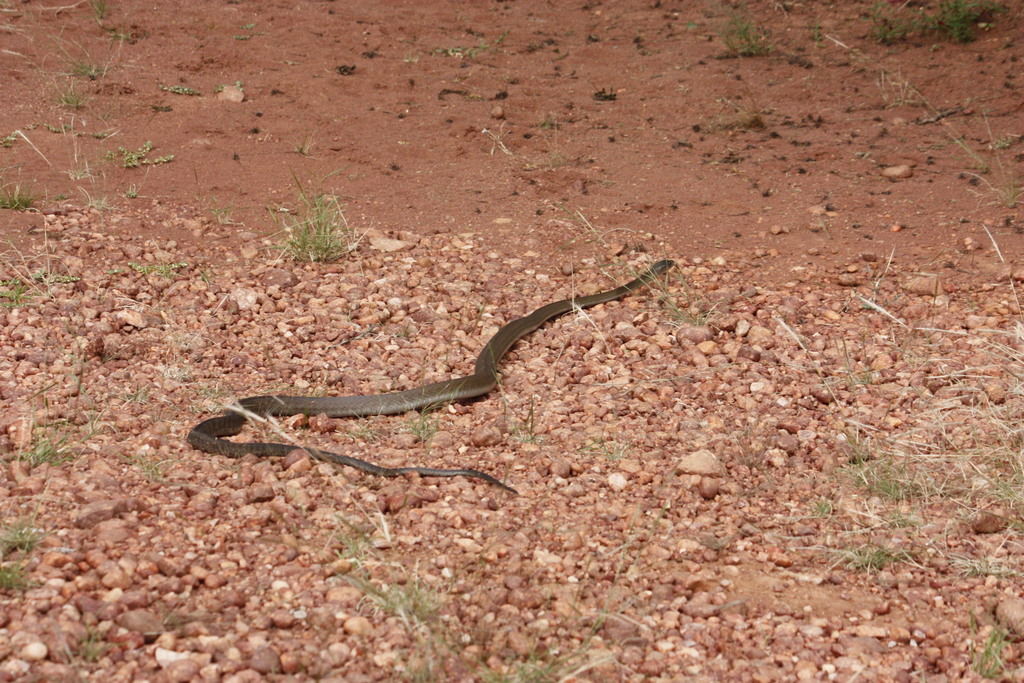
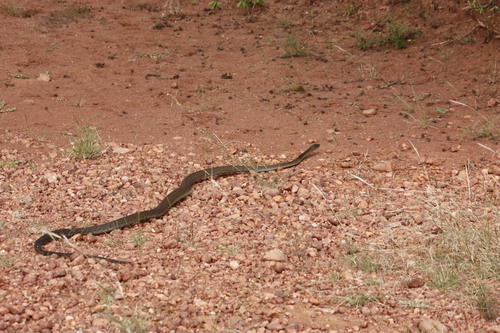
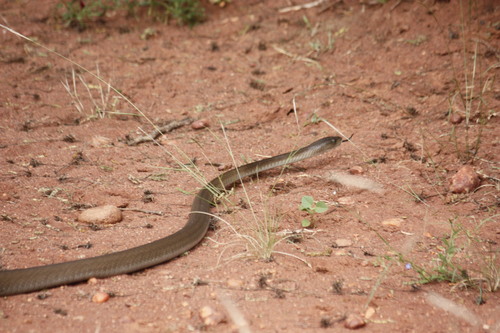
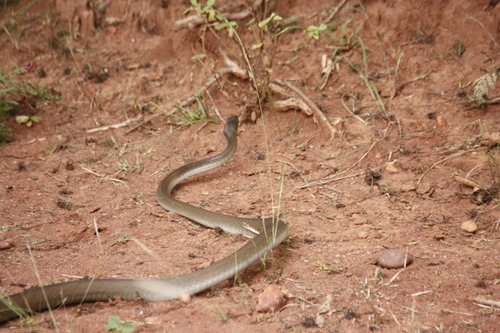
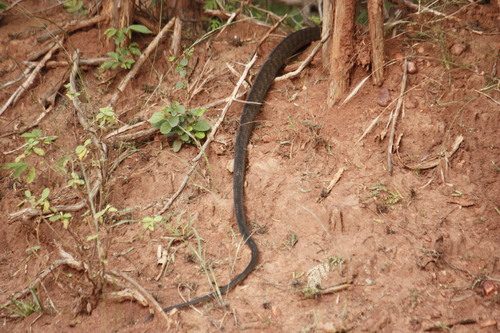
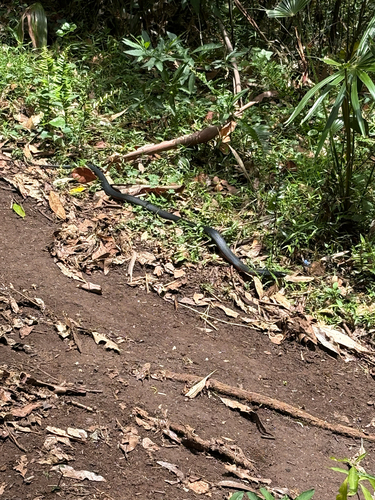
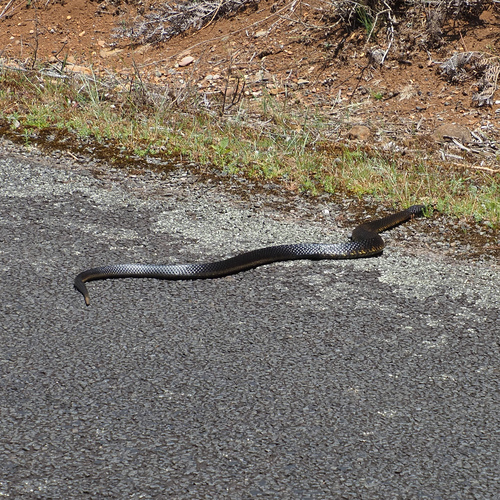
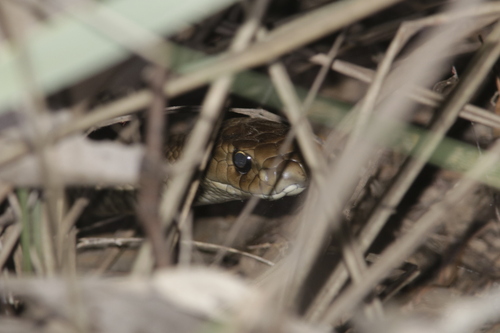
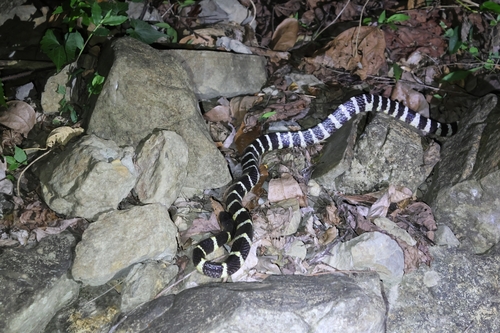
5 photographs of the Black Mamba. © Kelly Abram.
The Black Mamba (Dendroaspis polylepis) is a venomous snake in the Elapidae family, recorded in 25 countries.
If you are bitten
This is a venomous snake. Treat any bite as a medical emergency: stay calm, keep the bitten limb still and roughly level with the heart, remove rings and tight clothing, and get to emergency care immediately. Do not apply a tourniquet, cut the wound, apply ice, or try to suck out venom. Call your local emergency number or poison center.
- Family
- Elapidae
- Danger
- high
About the Black Mamba
The black mamba (Dendroaspis polylepis) is a species of highly venomous snake belonging to the family Elapidae. It is native to parts of sub-Saharan Africa. First formally described by Albert Günther in 1864, it is the second-longest venomous snake after the king cobra; mature specimens generally exceed 2 m (6 ft 7 in) and commonly grow to 3 m (9.8 ft). Specimens of 4.3 to 4.5 m (14 to 15 ft) have been reported. It varies in colour from grey to dark brown. Juvenile black mambas tend to be more pale in colour than adults, and darken with age. Despite the common name, the black mamba is not black; the colour name describes rather the inside of its mouth, which it displays when feeling threatened.
The species is both terrestrial (ground-living) and arboreal (tree-living); it inhabits savannah, woodland, rocky slopes and in some regions, dense forest. It is diurnal and is known to prey on birds and small mammals. Over suitable surfaces, it can move at speeds up to 16 km/h (10 mph) for short distances. Adult black mambas have few natural predators.
In a threat display, the black mamba usually opens its inky-black mouth, spreads its narrow neck-flap and sometimes hisses. It is capable of striking at considerable range and may deliver a series of bites in rapid succession. Its venom is primarily composed of neurotoxins that often induce symptoms within ten minutes, and is frequently fatal unless antivenom is administered. Despite its reputation as a formidable and highly aggressive species, the black mamba attacks humans only if it is threatened or cornered. It is rated as least concern on the International Union for Conservation of Nature (IUCN)'s Red List of Threatened Species.
Taxonomy
The first formal description of the black mamba was made in 1864 by German-born British zoologist Albert Günther. A single specimen was one of many species of snake collected by John Kirk, a naturalist who accompanied David Livingstone on the 1858–1864 Second Zambesi expedition. This specimen is the holotype and is housed in the Natural History Museum, London. The generic name of the species is derived from the Ancient Greek words dendron (δένδρον), "tree", and aspis (ἀσπίς) "asp", and the specific epithet polylepis is derived from the Ancient Greek poly (πολύ) meaning "many" and lepis (λεπίς) meaning "scale". The term "mamba" is derived from the Zulu word "imamba". In Tanzania, a local Ngindo name is ndemalunyayo ("grass-cutter") because it supposedly clips grass.
In 1873, German naturalist Wilhelm Peters described Dendraspis antinorii from a specimen in the museum of Genoa that had been collected by Italian explorer Orazio Antinori in what is now northern Eritrea. This was subsequently regarded as a subspecies and is no longer held to be distinct. In 1896, Belgian-British zoologist George Albert Boulenger combined the species Dendroaspis polylepis as a whole with the eastern green mamba (Dendroaspis angusticeps), a lumping diagnosis that remained in force until 1946 when South African herpetologist Vivian FitzSimons again split them into separate species. A 2016 genetic analysis showed the black and eastern green mambas are each other's closest relatives, and are more distantly related to Jameson's mamba (Dendroaspis jamesoni), as shown in the cladogram below.
Description
Adapted from Wikipedia, available under CC BY-SA.
Local and regional names
The Black Mamba is known by these names across the regions where it lives:
- Afrikaans
- Swartmamba
- Chinese
- 黑曼巴蛇
- Czech
- mamba černá
- Danish
- Sort Mamba
- Dutch
- Zwarte Mamba
- English
- Black Current, Common Black Mamba, Ethiopian Black Mamba
- Finnish
- Mustamamba
- French
- Mamba Noir
- German
- Schwarze Mamba
- Hungarian
- fekete mamba
- Indonesian
- Mamba hitam
- Italian
- Mamba nero, Serpente dei sette passi
- Japanese
- ブラックマンバ
- Polish
- mamba czarna
- Portuguese
- Mamba-preta
- Russian
- Чёрная мамба
- Spanish
- Mamba Negra
- Swahili
- koboko
- Thai
- งูแบล็คแมมบา, งูแบล็คแมมบ้า
- Turkish
- Kara mamba
- Ukrainian
- Мамба чорна
Frequently asked: Black Mamba
- Is the Black Mamba venomous?
- Yes. The Black Mamba (Dendroaspis polylepis) is venomous and belongs to the Elapidae family (cobra, mamba, coral or sea snake). Its bite is considered high risk to people. Treat any bite as a medical emergency.
- Is the Black Mamba poisonous?
- Snakes are venomous, not poisonous. "Poisonous" means harmful to eat or touch; "venomous" means injecting toxins through a bite. The Black Mamba is venomous, delivering venom through a bite.
- Is the Black Mamba dangerous?
- This is a venomous snake. Treat any bite as a medical emergency: stay calm, keep the bitten limb still and roughly level with the heart, remove rings and tight clothing, and get to emergency care immediately. Do not apply a tourniquet, cut the wound, apply ice, or try to suck out venom. Call your local emergency number or poison center.
- Where does the Black Mamba live?
- The Black Mamba has verified records in 25 countries, including South Africa, Zambia, Zimbabwe. See the distribution section below for its full range.
If you are bitten by the Black Mamba
Do
- Get away from the snake and stay calm. Most bites worsen when people panic or try again to handle the snake.
- Call 911 or Poison Control (1-800-222-1222) right away. Antivenom works best when given early.
- Note the time of the bite and, from a safe distance, the snake's color and pattern, a phone photo is enough. Do not chase it.
- Keep the bitten limb still and at roughly heart level. Sit or lie down and limit movement.
- Remove rings, watches, and tight clothing near the bite before swelling starts.
- Gently wash the bite with soap and water and cover it with a clean, dry dressing.
Do not
- Do not cut the wound or try to suck out the venom.
- Do not apply a tourniquet or ice.
- Do not drink alcohol or caffeine.
- Do not take aspirin or ibuprofen, they can worsen bleeding. Acetaminophen is safer for pain.
- Do not try to catch or kill the snake. A dead snake can still bite by reflex.
First-aid guidance adapted from the U.S. Centers for Disease Control and Prevention (CDC NIOSH), Venomous Snakes. Educational only; always follow the instructions of emergency responders.
Where it is found
More Elapidae snakes
Classification
How scientists group this snake, from the broadest category down to the exact species. Each step narrows to its closest relatives.
- OrderThe broad group of scaled reptiles: all snakes and lizards
- Squamata
- FamilyA group of related snakes that share key traits
- Elapidae
- GenusA close-knit group of very similar species
- Dendroaspis
- SpeciesThis exact snake, named in the two-part scientific name
- Dendroaspis polylepis
Keep learning
- Are Snakes Dangerous? The Real Risk, in PerspectiveMost snakes are harmless and avoid people. Here is the honest picture of snakebite risk worldwide and how to lower your own.
- Snakebite First Aid: What to Do (and What Never to Do)A clear, CDC-based guide to snakebite first aid: the steps that help, the popular myths that hurt, and how to tell a serious bite from a minor one.
- Venomous vs Nonvenomous: How to Tell the DifferenceThe folk rules for telling venomous snakes apart, where each one fails, and why location-based identification beats guessing by sight.
- What to Do If You Find a SnakeFound a snake at home or on a trail? Here is how to stay calm, give it space, identify it safely, and know when to call a professional.
Distribution from GBIF & iNaturalist. Venom status per CDC. Background: Wikipedia. Informational only. Never handle a snake to identify it.