
Elapidae
Eastern Green Mamba
VenomousDendroaspis angusticeps
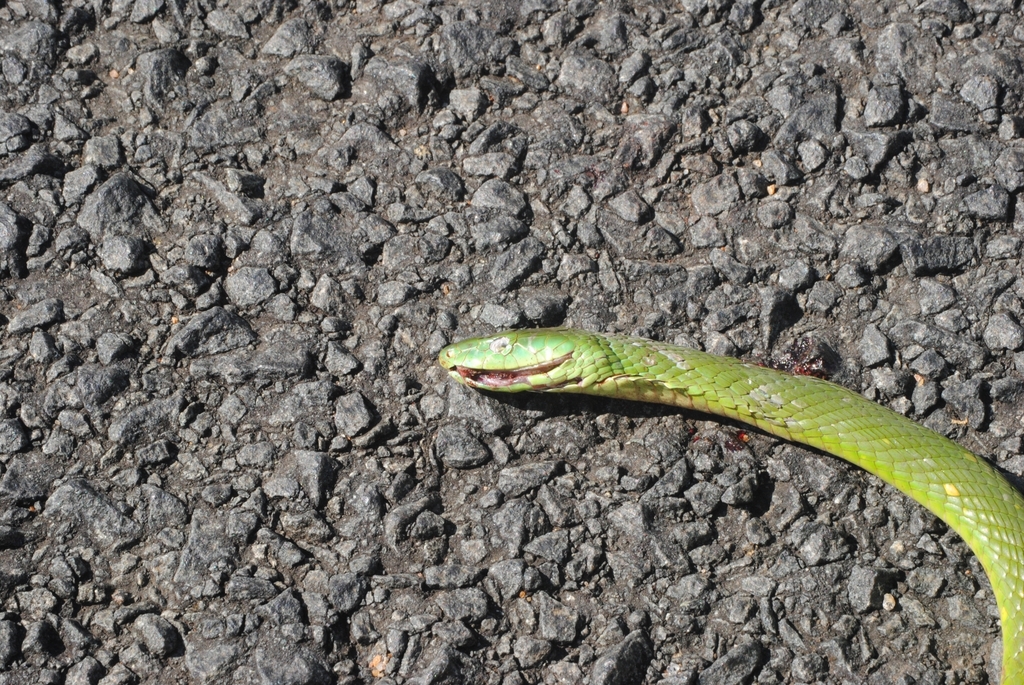
The Eastern Green Mamba (Dendroaspis angusticeps) is a venomous snake in the Elapidae family, recorded in 20 countries.
If you are bitten
This is a venomous snake. Treat any bite as a medical emergency: stay calm, keep the bitten limb still and roughly level with the heart, remove rings and tight clothing, and get to emergency care immediately. Do not apply a tourniquet, cut the wound, apply ice, or try to suck out venom. Call your local emergency number or poison center.
- Family
- Elapidae
- Danger
- high
About the Eastern Green Mamba
The eastern green mamba (Dendroaspis angusticeps) is a highly venomous snake species of the mamba genus Dendroaspis native to the coastal regions of southern East Africa. Described by Scottish surgeon and zoologist Andrew Smith in 1849, it has a slender build with a bright green back and green-yellow ventral scales. Adult females average around 2 metres (6 ft 7 in) in length, and males are slightly smaller.
In spite of common urban legends and misconceptions labeling the eastern green mamba an aggressive, fast-moving "people-chaser", it is in fact a shy and elusive species that remains hidden in the trees, and is rarely seen. This seclusion is usually attributed to its arboreal habitat and green colouration, which acts as effective camouflage in its natural environment. Even with its deadly venom, the green mamba has to protect itself from predators, including birds of prey and other snakes, such as cobras. It has been observed engaging in ambush predation, a trait seen among many Viperidae species, contrary to the active hunting style typical of other Elapidae snakes. It preys on arboreal and winged animals, such as birds and their chicks and eggs, bats, and arboreal rodents such as mice, rats, and gerbils.
Eastern green mamba venom consists of both neurotoxins and cardiotoxins. Symptoms of envenomation include swelling of the immediate bite-wound area, dizziness, vertigo and nausea, accompanied by dehydration, labored breathing and difficult swallowing. This eventually will develop into arrhythmia and convulsions—all progressing to respiratory paralysis, which results in a fatal lack of oxygen to the brain. Bites that are severe if not immediately treated on-site can quickly prove deadly.
Taxonomy
The eastern green mamba was first described as Naja angusticeps by Andrew Smith, a Scottish surgeon and zoologist, in 1849, who reported it from Natal and east to Maputo Bay. The specific name angusticeps is derived from the Latin word angustus, "narrow", and ceps, an abbreviated form of caput ("head") when used in a compound word. The German-British zoologist Albert Günther described Dendroaspis intermedius from the Zambezi River in northern Mozambique in 1865. This was subsequently synonymised with D. angusticeps.
In 1896, the Belgian-British zoologist George Albert Boulenger combined the species Dendroaspis angusticeps with the black mamba (Dendroaspis polylepis), a lumping diagnosis that remained in force until 1946, when the South African herpetologist Vivian FitzSimons published a paper after examining approximately 50 eastern green mamba and 85 black mamba specimens. He concluded that the differences in build, scalation, colouration and behaviour warranted splitting them into separate species. The British biologist Arthur Loveridge augmented FitzSimons' work with material from outside South Africa, noting some overlap in scalation but supporting the separation. A 2016 genetic analysis showed the eastern green and black mambas are each others' closest relatives, their common ancestor diverging from a lineage that gave rise to Jameson's mamba (Dendroaspis jamesoni) and the western green mamba (Dendroaspis viridis), as shown in the cladogram below.
Adapted from Wikipedia, available under CC BY-SA.
Local and regional names
The Eastern Green Mamba is known by these names across the regions where it lives:
- Afrikaans
- Groenmamba
- Chinese
- 東部綠曼巴蛇
- Danish
- Sydlig Grøn Mamba
- Dutch
- Smalkopmamba
- English
- East African Green Mamba, Green Mamba
- French
- Mamba vert de l'Est
- German
- Blattgrüne Mamba, Gewöhnliche Mamba, Schmalkopf-Mamba
- Hungarian
- keleti zöld mamba
- Italian
- Mamba verde orientale
- Japanese
- ヒガシグリーンマンバ
- Portuguese
- Mamba-verde-oriental
- Russian
- Узкоголовая мамба
- Thai
- งูกรีนแมมบ้าตะวันออก, งูแมมบาเขียว
- Zulu
- iMamba eluhlaza
Frequently asked: Eastern Green Mamba
- Is the Eastern Green Mamba venomous?
- Yes. The Eastern Green Mamba (Dendroaspis angusticeps) is venomous and belongs to the Elapidae family (cobra, mamba, coral or sea snake). Its bite is considered high risk to people. Treat any bite as a medical emergency.
- Is the Eastern Green Mamba poisonous?
- Snakes are venomous, not poisonous. "Poisonous" means harmful to eat or touch; "venomous" means injecting toxins through a bite. The Eastern Green Mamba is venomous, delivering venom through a bite.
- Is the Eastern Green Mamba dangerous?
- This is a venomous snake. Treat any bite as a medical emergency: stay calm, keep the bitten limb still and roughly level with the heart, remove rings and tight clothing, and get to emergency care immediately. Do not apply a tourniquet, cut the wound, apply ice, or try to suck out venom. Call your local emergency number or poison center.
- Where does the Eastern Green Mamba live?
- The Eastern Green Mamba has verified records in 20 countries, including South Africa, Tanzania, United Republic of, Kenya. See the distribution section below for its full range.
If you are bitten by the Eastern Green Mamba
Do
- Get away from the snake and stay calm. Most bites worsen when people panic or try again to handle the snake.
- Call 911 or Poison Control (1-800-222-1222) right away. Antivenom works best when given early.
- Note the time of the bite and, from a safe distance, the snake's color and pattern, a phone photo is enough. Do not chase it.
- Keep the bitten limb still and at roughly heart level. Sit or lie down and limit movement.
- Remove rings, watches, and tight clothing near the bite before swelling starts.
- Gently wash the bite with soap and water and cover it with a clean, dry dressing.
Do not
- Do not cut the wound or try to suck out the venom.
- Do not apply a tourniquet or ice.
- Do not drink alcohol or caffeine.
- Do not take aspirin or ibuprofen, they can worsen bleeding. Acetaminophen is safer for pain.
- Do not try to catch or kill the snake. A dead snake can still bite by reflex.
First-aid guidance adapted from the U.S. Centers for Disease Control and Prevention (CDC NIOSH), Venomous Snakes. Educational only; always follow the instructions of emergency responders.
Where it is found
More Elapidae snakes
Classification
How scientists group this snake, from the broadest category down to the exact species. Each step narrows to its closest relatives.
- OrderThe broad group of scaled reptiles: all snakes and lizards
- Squamata
- FamilyA group of related snakes that share key traits
- Elapidae
- GenusA close-knit group of very similar species
- Dendroaspis
- SpeciesThis exact snake, named in the two-part scientific name
- Dendroaspis angusticeps
Keep learning
- Are Snakes Dangerous? The Real Risk, in PerspectiveMost snakes are harmless and avoid people. Here is the honest picture of snakebite risk worldwide and how to lower your own.
- Snakebite First Aid: What to Do (and What Never to Do)A clear, CDC-based guide to snakebite first aid: the steps that help, the popular myths that hurt, and how to tell a serious bite from a minor one.
- Venomous vs Nonvenomous: How to Tell the DifferenceThe folk rules for telling venomous snakes apart, where each one fails, and why location-based identification beats guessing by sight.
- What to Do If You Find a SnakeFound a snake at home or on a trail? Here is how to stay calm, give it space, identify it safely, and know when to call a professional.
Distribution from GBIF & iNaturalist. Venom status per CDC. Background: Wikipedia. Informational only. Never handle a snake to identify it.