
Elapidae
Eastern Brown Snake
VenomousPseudonaja textilis
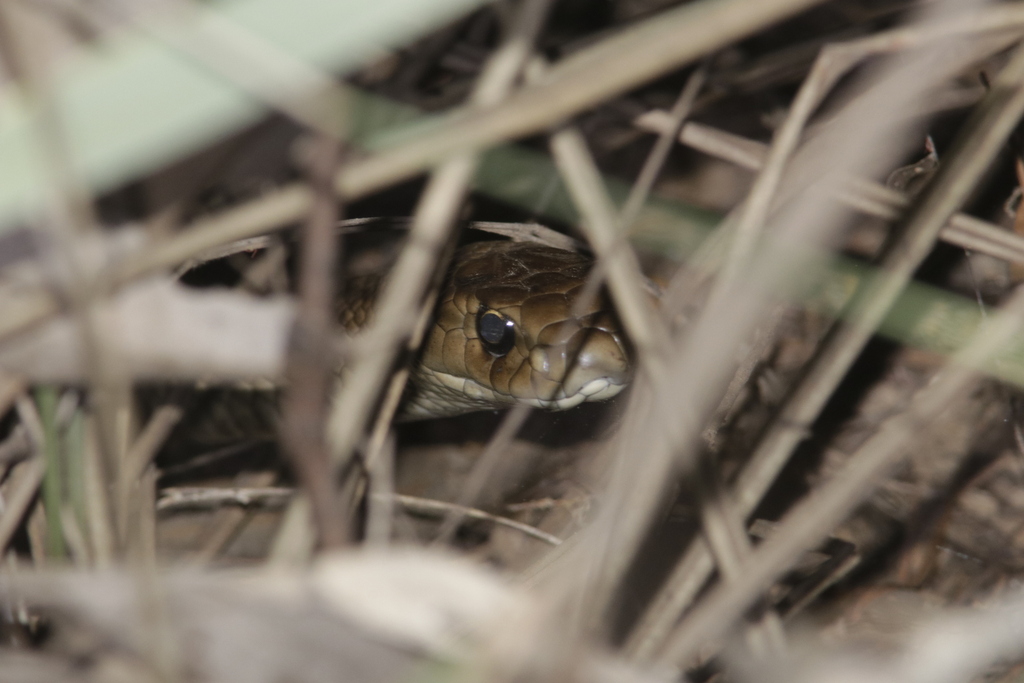
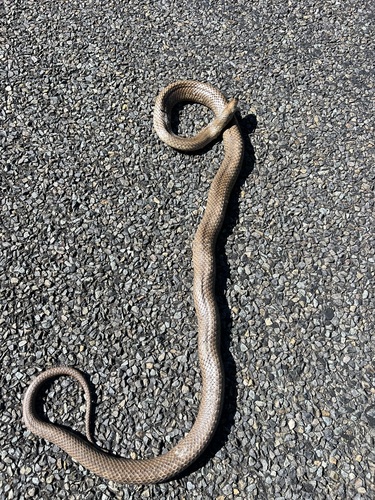
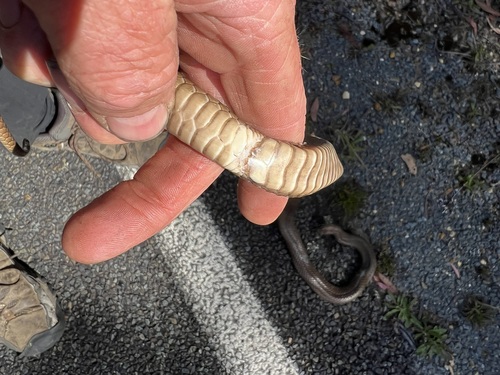
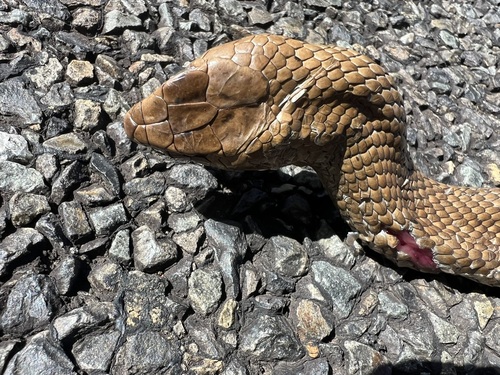
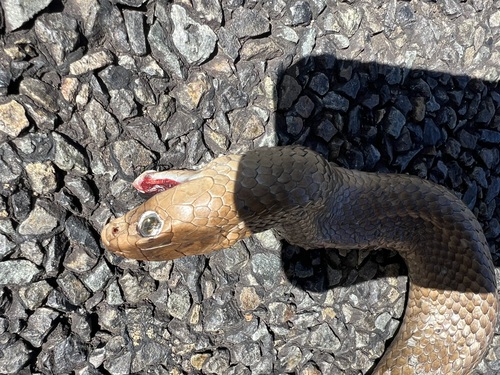
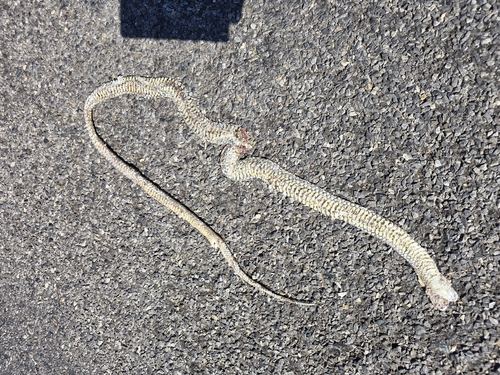
6 photographs of the Eastern Brown Snake. © Ryan van Huyssteen.
The Eastern Brown Snake (Pseudonaja textilis) is a venomous snake in the Elapidae family, recorded in 2 countries.
If you are bitten
This is a venomous snake. Treat any bite as a medical emergency: stay calm, keep the bitten limb still and roughly level with the heart, remove rings and tight clothing, and get to emergency care immediately. Do not apply a tourniquet, cut the wound, apply ice, or try to suck out venom. Call your local emergency number or poison center.
- Family
- Elapidae
- Danger
- high
About the Eastern Brown Snake
The eastern brown snake (Pseudonaja textilis), often referred to as the common brown snake, is a species of extremely venomous snake in the family Elapidae. The species is native to eastern and central Australia and southern New Guinea. It was first described by André Marie Constant Duméril, Gabriel Bibron, and Auguste Duméril in 1854. The adult eastern brown snake has a slender build and can grow to 2 m (7 ft) in length. The colour of its surface ranges from pale brown to black, while its underside is pale cream-yellow, often with orange or grey splotches. The eastern brown snake is found in most habitats except dense forests, often in farmland and on the outskirts of urban areas, as such places are populated by its main prey, the house mouse. The species is oviparous. The International Union for Conservation of Nature classifies the snake as a least-concern species, though its status in New Guinea is unclear.
It is considered the world's second-most venomous land snake after the inland taipan (Oxyuranus microlepidotus), based on its LD50 value (subcutaneous) in mice. The main effects of its venom are on the circulatory system: coagulopathy, haemorrhage (bleeding), cardiovascular collapse, and cardiac arrest. One of the main components of the venom is the prothrombinase complex pseutarin-C, which breaks down prothrombin.
Taxonomy
John White, the surgeon-general of the First Fleet to New South Wales, wrote, A Journal of a Voyage to New South Wales in 1790, which described many Australian animal species for the first time. In it, he reported a snake that fits the description of the eastern brown snake, but did not name it. French zoologists André Marie Constant Duméril, Gabriel Bibron, and Auguste Duméril were the first to describe the species in 1854. They gave it the binomial name Furina textilis – furine tricotée (knitted furin) in French – from a specimen collected in October 1846 by Jules Verreaux, remarking that the fine-meshed pattern on the snake's body reminded him of fine stockings, which was the inspiration for the name. Due to differences in appearance, different specimens of the eastern brown snake were categorised as different species in the early 19th century. German herpetologist Johann Gustav Fischer described it as Pseudoelaps superciliosus in 1856, from a specimen collected from Sydney. German-British zoologist Albert Günther described the species as Demansia annulata in 1858. Italian naturalist Giorgio Jan named Pseudoelaps sordellii and Pseudoelaps kubingii in 1859.
Gerard Krefft, curator of the Australian Museum, reclassified Duméril, Bibron, and Duméril's species in the genus Pseudonaia [sic] in 1862 after collecting multiple specimens and establishing that the markings of young snakes faded as they grew into adult brown snakes. He concluded the original description was based on an immature specimen and sent an adult to Günther, who catalogued it under the new name the same year when cataloguing new species of snakes in the British Museum's collection. After examining all specimens, Günther concluded that Furina textilis and Diemansia annulata were named for young specimens and Pseudoelaps superciliosus, P. sordelli, and P. kubingii were named for adults, and all represented the same species, which he called Diemenia superciliosa. Belgian-British naturalist George Albert Boulenger called it Diemenia textilis in 1896, acknowledging Duméril, Bibron, and Duméril's name as having priority. In subsequent literature, it was known as Demansia textilis as Diemenia was regarded as an alternate spelling of Demansia.
Adapted from Wikipedia, available under CC BY-SA.
Local and regional names
The Eastern Brown Snake is known by these names across the regions where it lives:
- Chinese
- 東部擬眼鏡蛇
- Czech
- pakobra východní
- Danish
- Sydaustralsk Brunslange
- English
- Common Brown Snake, New Guinea Brownsnake
- French
- Serpent brun
- German
- Gewöhnliche Braunschlange
- Hungarian
- textilmintás barnakígyó
- Italian
- Serpente bruno orientale
- Japanese
- トウブブラウンスネーク
- Portuguese
- Serpente-marrom-oriental
- Russian
- Сетчатая Коричневая Змея
Frequently asked: Eastern Brown Snake
- Is the Eastern Brown Snake venomous?
- Yes. The Eastern Brown Snake (Pseudonaja textilis) is venomous and belongs to the Elapidae family (cobra, mamba, coral or sea snake). Its bite is considered high risk to people. Treat any bite as a medical emergency.
- Is the Eastern Brown Snake poisonous?
- Snakes are venomous, not poisonous. "Poisonous" means harmful to eat or touch; "venomous" means injecting toxins through a bite. The Eastern Brown Snake is venomous, delivering venom through a bite.
- Is the Eastern Brown Snake dangerous?
- This is a venomous snake. Treat any bite as a medical emergency: stay calm, keep the bitten limb still and roughly level with the heart, remove rings and tight clothing, and get to emergency care immediately. Do not apply a tourniquet, cut the wound, apply ice, or try to suck out venom. Call your local emergency number or poison center.
- Where does the Eastern Brown Snake live?
- The Eastern Brown Snake has verified records in 2 countries, including Australia, Papua New Guinea. See the distribution section below for its full range.
If you are bitten by the Eastern Brown Snake
Do
- Get away from the snake and stay calm. Most bites worsen when people panic or try again to handle the snake.
- Call 911 or Poison Control (1-800-222-1222) right away. Antivenom works best when given early.
- Note the time of the bite and, from a safe distance, the snake's color and pattern, a phone photo is enough. Do not chase it.
- Keep the bitten limb still and at roughly heart level. Sit or lie down and limit movement.
- Remove rings, watches, and tight clothing near the bite before swelling starts.
- Gently wash the bite with soap and water and cover it with a clean, dry dressing.
Do not
- Do not cut the wound or try to suck out the venom.
- Do not apply a tourniquet or ice.
- Do not drink alcohol or caffeine.
- Do not take aspirin or ibuprofen, they can worsen bleeding. Acetaminophen is safer for pain.
- Do not try to catch or kill the snake. A dead snake can still bite by reflex.
First-aid guidance adapted from the U.S. Centers for Disease Control and Prevention (CDC NIOSH), Venomous Snakes. Educational only; always follow the instructions of emergency responders.
Where it is found
More Elapidae snakes
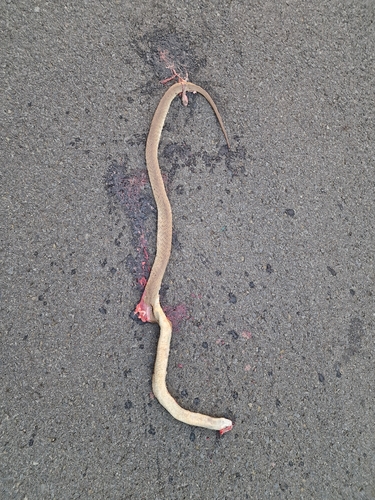 DugitePseudonaja affinis
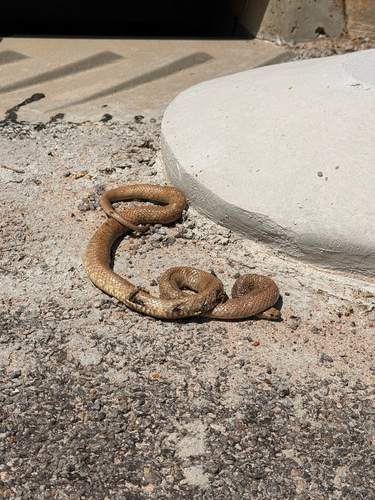 Western Brown SnakePseudonaja mengdeni
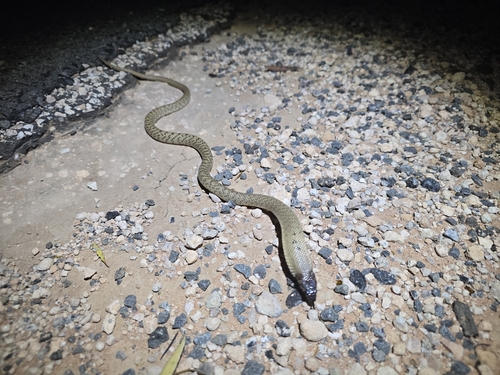 Strap-Snouted Brown SnakePseudonaja aspidorhyncha
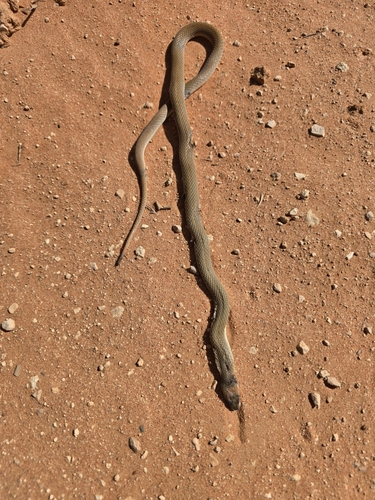 Ringed Brown SnakePseudonaja modesta
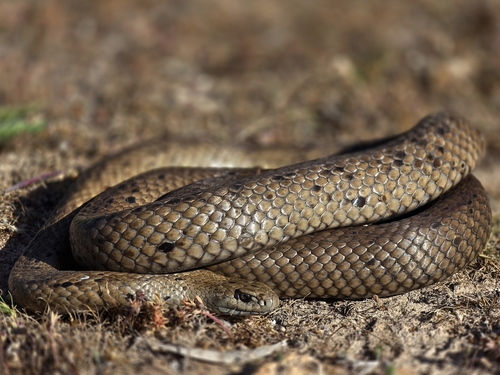 Peninsula Brown SnakePseudonaja inframacula
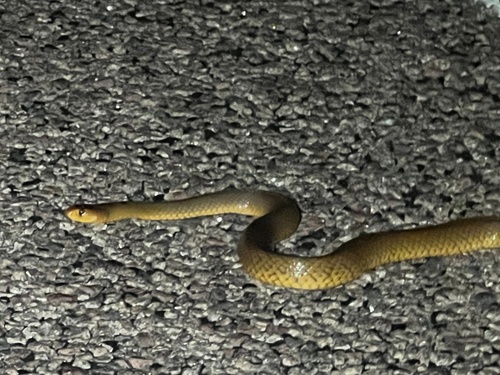 Northern Brown SnakePseudonaja nuchalis
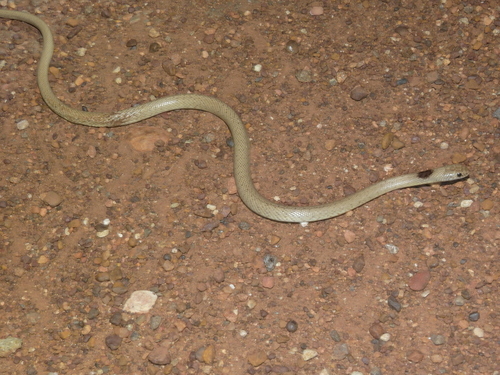 Speckled Brown SnakePseudonaja guttata
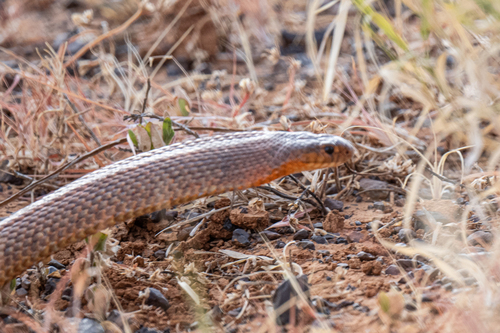 Ingram's Brown SnakePseudonaja ingrami
Classification
How scientists group this snake, from the broadest category down to the exact species. Each step narrows to its closest relatives.
- OrderThe broad group of scaled reptiles: all snakes and lizards
- Squamata
- FamilyA group of related snakes that share key traits
- Elapidae
- GenusA close-knit group of very similar species
- Pseudonaja
- SpeciesThis exact snake, named in the two-part scientific name
- Pseudonaja textilis
Keep learning
- Are Snakes Dangerous? The Real Risk, in PerspectiveMost snakes are harmless and avoid people. Here is the honest picture of snakebite risk worldwide and how to lower your own.
- Snakebite First Aid: What to Do (and What Never to Do)A clear, CDC-based guide to snakebite first aid: the steps that help, the popular myths that hurt, and how to tell a serious bite from a minor one.
- Venomous vs Nonvenomous: How to Tell the DifferenceThe folk rules for telling venomous snakes apart, where each one fails, and why location-based identification beats guessing by sight.
- What to Do If You Find a SnakeFound a snake at home or on a trail? Here is how to stay calm, give it space, identify it safely, and know when to call a professional.
Distribution from GBIF & iNaturalist. Venom status per CDC. Background: Wikipedia. Informational only. Never handle a snake to identify it.