
Colubridae
Balkan Whip Snake
HarmlessHierophis gemonensis
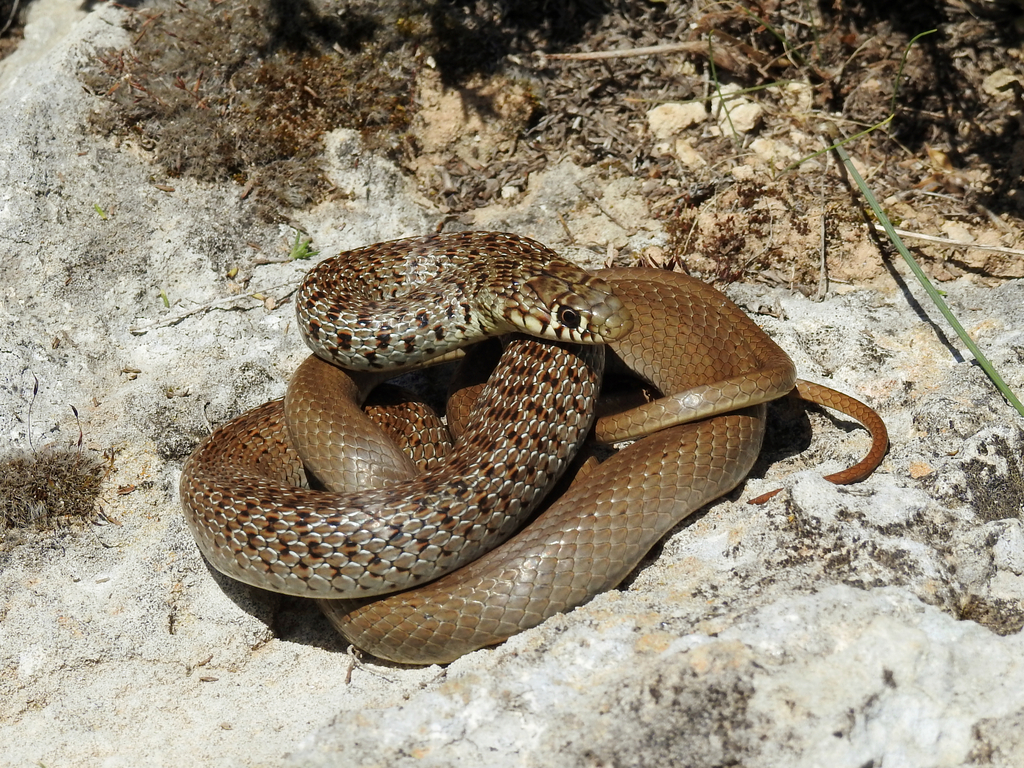
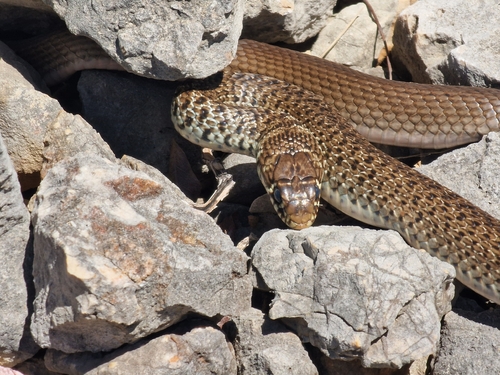
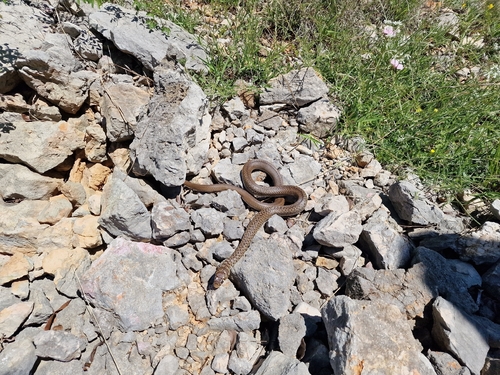
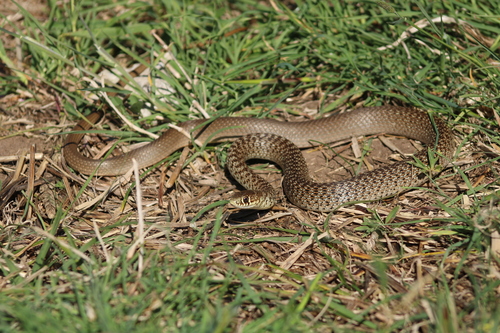
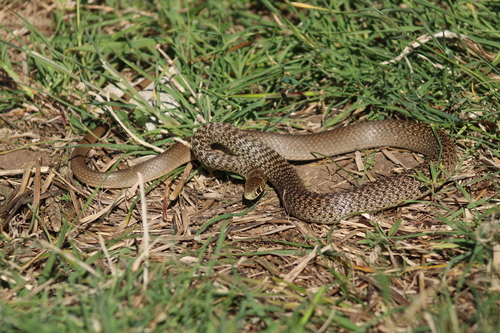
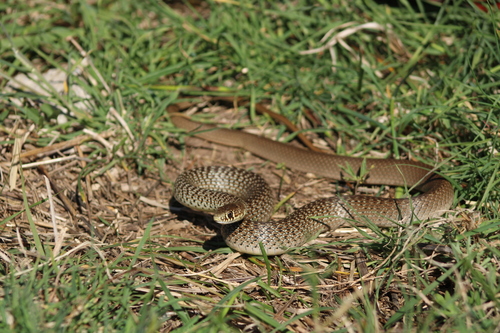
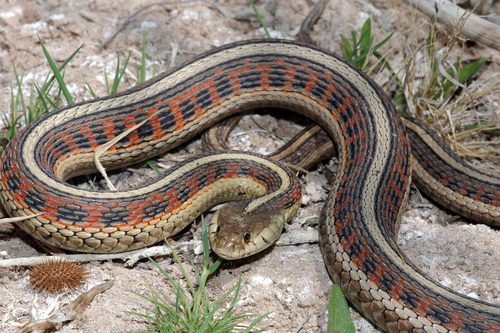
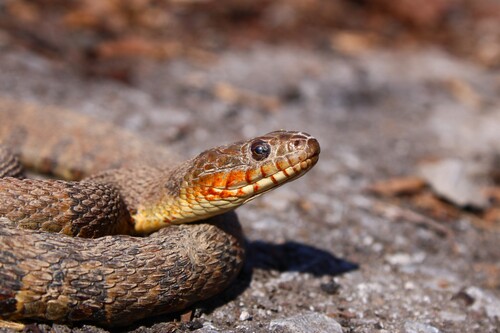
6 photographs of the Balkan Whip Snake. © Kseniia Marianna Prondzynska.
The Balkan Whip Snake (Hierophis gemonensis) is a non-venomous snake in the Colubridae family, recorded in 21 countries.
- Family
- Colubridae
About the Balkan Whip Snake
The Balkan whip snake (Hierophis gemonensis, formerly known as Coluber gemonensis) is a species of snake in the family Colubridae. It is found in Italy, Greece (including the Greek islands) and most of the Balkan countries (specifically in Albania, Bosnia and Herzegovina, Croatia, North Macedonia, Serbia and Slovenia) where its natural habitats are Mediterranean-type shrubby vegetation, pastureland, plantations and rural gardens. It is threatened by habitat loss in parts of its range but overall is assessed by the IUCN as being of "least concern".
Description
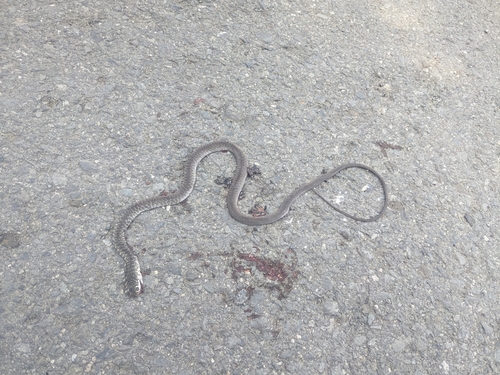
The Balkan whip snake is a slender snake with smooth scales usually under a metre (yard) long but exceptionally reaching 130 cm (50 ins). The head is fairly distinct from the body and has prominent eyes with round pupils. The head and front of the body are olive-grey or yellowish-brown with dark spots separated by paler areas which may form irregular bars. There are often small white specks on some of the scales. Further back the dark spots are usually arranged in longitudinal lines giving a striped effect. The underparts are whitish or pale yellow, with some spotting on the sides of the neck and sometimes elsewhere. There are usually 19 dorsal scales around the mid-body, 160 to 187 belly scales and 80 to 116 pairs of under-tail scales.
Distribution and habitat
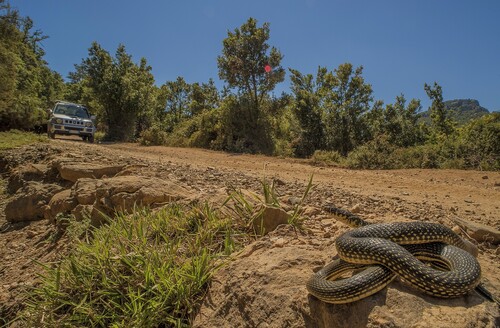
The Balkan whip snake is found in extreme northeastern Italy, the former Yugoslavia, Albania and mainland Greece as well as many offshore islands. It is also present on Crete, the Ionian Islands, Euboea, Kythera and Karpathos. Its typical habitat is stony areas, scree, scrub, open woodland, road banks and ruins.
Behaviour
The Balkan whip snake is a diurnal, ground-dwelling species though it does sometimes clamber through low vegetation. It is fast and agile and feeds on lizards, large insects such as grasshoppers, nestling birds, and small mammals. Females lay clutches of four to ten oval eggs measuring about 30 by 17 mm (1.2 by 0.7 in). It hibernates in winter in such places as rock fissures, animal burrows or outbuildings and sometimes several snakes will share a hibernating site.
Conservation status
The Balkan whip snake has a wide range and is common within much of its range. The species has been subject to some loss of habitat due to agriculture, fire and pollution. However, the International Union for Conservation of Nature has assessed it as being of "least concern".
Adapted from Wikipedia, available under CC BY-SA.
Frequently asked: Balkan Whip Snake
- Is the Balkan Whip Snake venomous?
- No. The Balkan Whip Snake (Hierophis gemonensis) is non-venomous and is not considered dangerous to humans. Like most snakes, it will retreat rather than bite when given the chance.
- Is the Balkan Whip Snake poisonous?
- Snakes are venomous, not poisonous. "Poisonous" means harmful to eat or touch; "venomous" means injecting toxins through a bite. The Balkan Whip Snake is neither poisonous nor venomous.
- Is the Balkan Whip Snake dangerous?
- The Balkan Whip Snake is not dangerous to humans. It has no medically significant venom and bites only defensively if cornered or handled.
- Where does the Balkan Whip Snake live?
- The Balkan Whip Snake has verified records in 21 countries, including Croatia, Greece, Montenegro. See the distribution section below for its full range.
Where it is found
More Colubridae snakes
Classification
How scientists group this snake, from the broadest category down to the exact species. Each step narrows to its closest relatives.
- OrderThe broad group of scaled reptiles: all snakes and lizards
- Squamata
- FamilyA group of related snakes that share key traits
- Colubridae
- GenusA close-knit group of very similar species
- Hierophis
- SpeciesThis exact snake, named in the two-part scientific name
- Hierophis gemonensis
Keep learning
- What to Do If You Find a SnakeFound a snake at home or on a trail? Here is how to stay calm, give it space, identify it safely, and know when to call a professional.
- Venomous vs Nonvenomous: How to Tell the DifferenceThe folk rules for telling venomous snakes apart, where each one fails, and why location-based identification beats guessing by sight.
- What Is a Snake? Anatomy and the BasicsA clear overview of what makes a snake a snake: limbless body plan, anatomy, evolution from lizards, species diversity, and why they are ectothermic.
- How to Keep Snakes Out of Your Yard and HomeA practical guide to keeping snakes out of your yard and home using habitat changes that work, plus what to skip and what to do if one shows up.
Distribution from GBIF & iNaturalist. Venom status per CDC. Background: Wikipedia. Informational only. Never handle a snake to identify it.