
Colubridae
Cyprus Whip Snake
HarmlessHierophis cypriensis
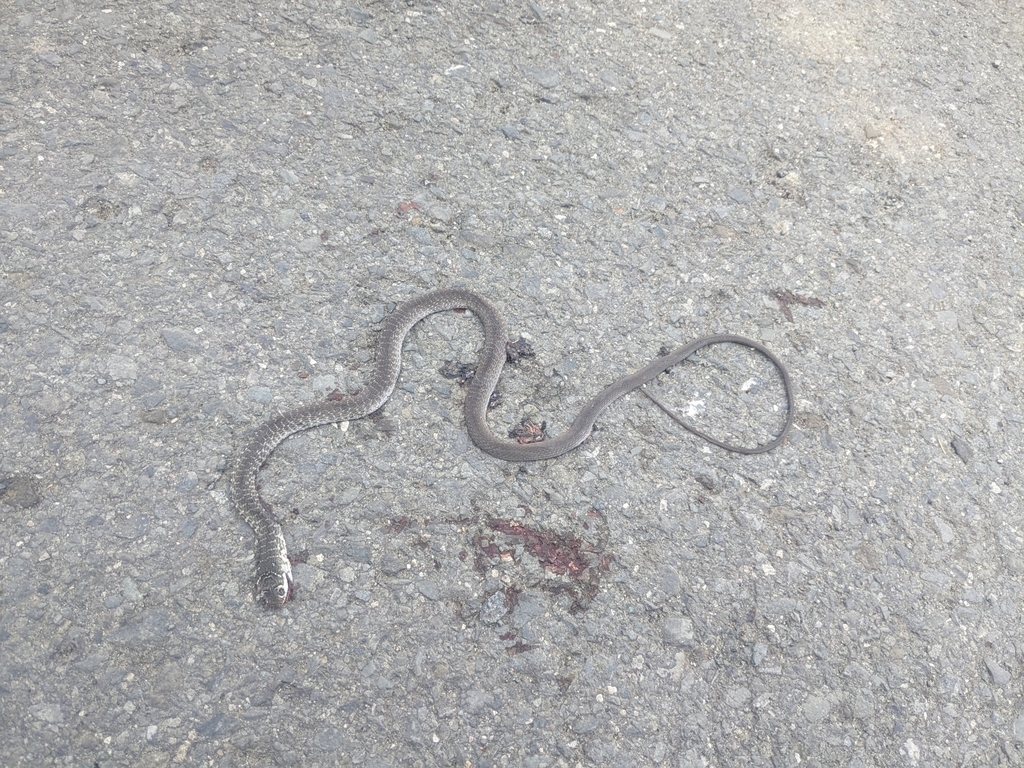
The Cyprus Whip Snake (Hierophis cypriensis) is a non-venomous snake in the Colubridae family, recorded in 1 country.
- Family
- Colubridae
About the Cyprus Whip Snake
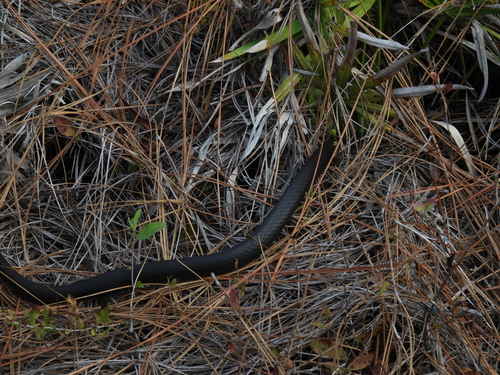
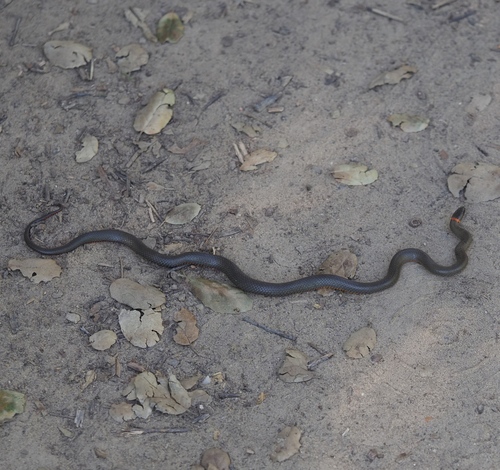
The Cyprus whip snake (Hierophis cypriensis) is a species of snake in the family Colubridae. It is endemic to Cyprus. It is not a large snake and normally grows to lengths of 70 to 90 cm. The body can be black, grey-brown, or olive-green, with a pale yellow, dirty grey, or cream belly. The top of the head is dark with small pale markings and two vertical white lines in front of and behind the eye. The front half of the body has thin white crosswise stripes that disappear towards the back, while the last third of the body and the tail are solidly dark. It is found widely in the Troodos Mountains and their foothills, most commonly at elevations of between 700 and 800 metres. It prefers cool, humid microhabitats in areas with dense scrub, bushes, or forest, especially along streams or rivers.
The whip snake eats small animals like lizards, amphibians, insects, and other snakes. It is thought to reproduce by laying eggs. It is listed as being near-threatened on the IUCN Red List. It has a fairly restricted range which is declining in size and habitat quality. Despite being found widely in its range, it is not a common species and is said to be becoming "increasingly endangered", with a declining population. Threats to the species include water pollution caused by the spraying of pesticide, logging, road construction, and persecution by humans.
Taxonomy
The Cyprus whip snake has no subspecies.
Description
It is not a large snake, normally growing to lengths of 70 to 90 cm, with a maximum recorded length of 116.5 cm. It is an elegant and slim snake with a distinct, elongated head. The body can be black, grey-brown, or olive-green, with a pale yellow, dirty grey, or cream belly. The top of the head is dark with small pale markings and two vertical white lines in front of and behind the eye. The front half of the body has thin white crosswise stripes that disappear towards the back, while the last third of the body and the tail are solidly dark. Older snakes are entirely dark with a few remnant pale markings. The eyes are large and the pupils have golden or orange edges.
Distribution and habitat
The Cyprus whip snake is endemic to Cyprus, where it is found widely in the Troodos Mountains, including the foothills. It has been found at elevations of 50 to 1800 metres above sea level, with most records being from between 700 and 800 metres. Reports of the species from lowlands are thought to be misidentifications. The species is probably restricted to the Troodos, although some small populations may also occur in the Kyrenia Mountains. It prefers cool, humid microhabitats in areas with dense scrub, bushes, or forest, especially along streams or rivers. The species' preference for streams is due to Cyprus's generally arid habitat. Other habitats the species has been recorded in are grassland near roads road and very dry habitat with phrygana scrub and scattered pine trees.
Ecology
Adapted from Wikipedia, available under CC BY-SA.
Frequently asked: Cyprus Whip Snake
- Is the Cyprus Whip Snake venomous?
- No. The Cyprus Whip Snake (Hierophis cypriensis) is non-venomous and is not considered dangerous to humans. Like most snakes, it will retreat rather than bite when given the chance.
- Is the Cyprus Whip Snake poisonous?
- Snakes are venomous, not poisonous. "Poisonous" means harmful to eat or touch; "venomous" means injecting toxins through a bite. The Cyprus Whip Snake is neither poisonous nor venomous.
- Is the Cyprus Whip Snake dangerous?
- The Cyprus Whip Snake is not dangerous to humans. It has no medically significant venom and bites only defensively if cornered or handled.
- Where does the Cyprus Whip Snake live?
- The Cyprus Whip Snake has verified records in 1 country, including Cyprus. See the distribution section below for its full range.
Where it is found
More Colubridae snakes
Classification
How scientists group this snake, from the broadest category down to the exact species. Each step narrows to its closest relatives.
- OrderThe broad group of scaled reptiles: all snakes and lizards
- Squamata
- FamilyA group of related snakes that share key traits
- Colubridae
- GenusA close-knit group of very similar species
- Hierophis
- SpeciesThis exact snake, named in the two-part scientific name
- Hierophis cypriensis
Keep learning
- What to Do If You Find a SnakeFound a snake at home or on a trail? Here is how to stay calm, give it space, identify it safely, and know when to call a professional.
- Venomous vs Nonvenomous: How to Tell the DifferenceThe folk rules for telling venomous snakes apart, where each one fails, and why location-based identification beats guessing by sight.
- What Is a Snake? Anatomy and the BasicsA clear overview of what makes a snake a snake: limbless body plan, anatomy, evolution from lizards, species diversity, and why they are ectothermic.
- How to Keep Snakes Out of Your Yard and HomeA practical guide to keeping snakes out of your yard and home using habitat changes that work, plus what to skip and what to do if one shows up.
Distribution from GBIF & iNaturalist. Venom status per CDC. Background: Wikipedia. Informational only. Never handle a snake to identify it.