
Colubridae
Oriental Rat Snake
HarmlessPtyas mucosa
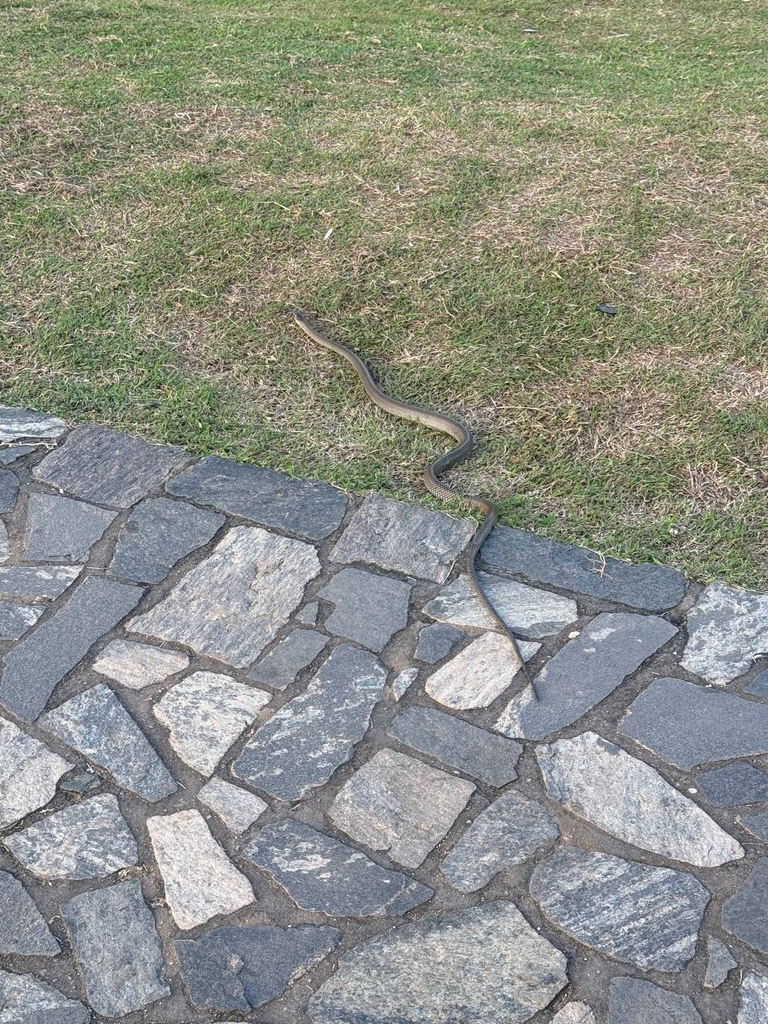
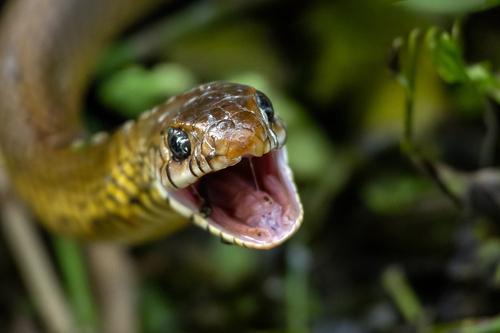
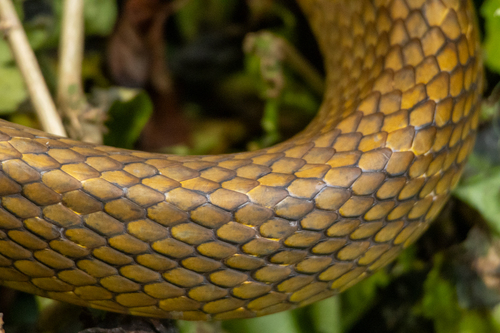
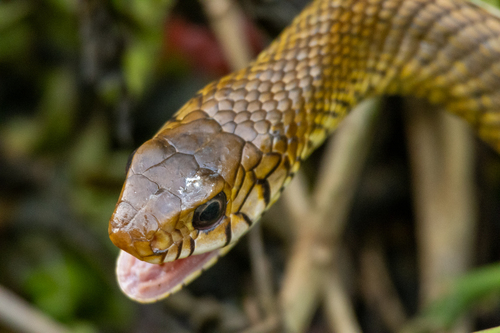
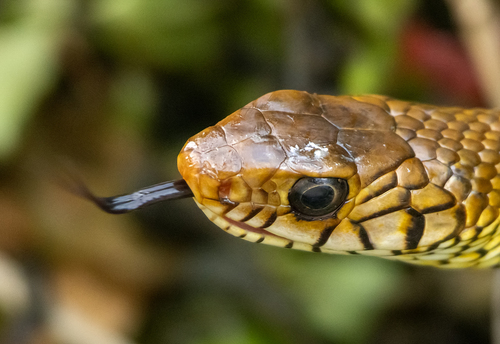
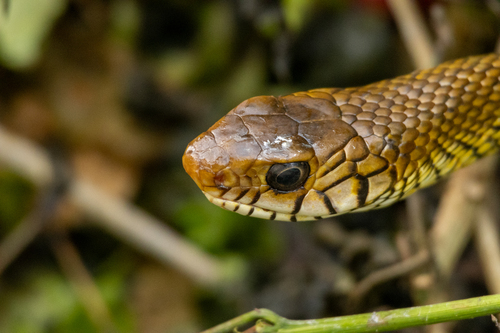
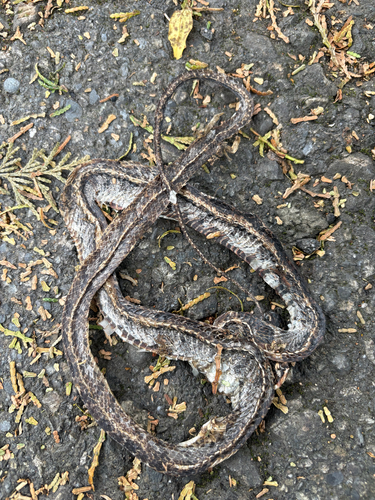
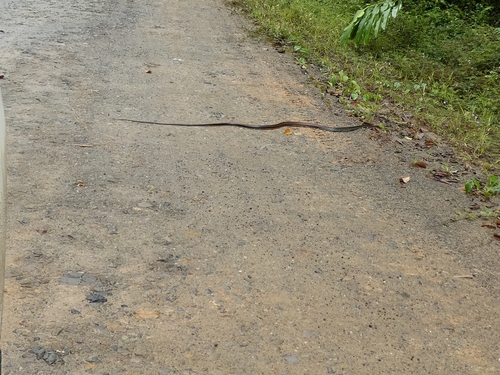
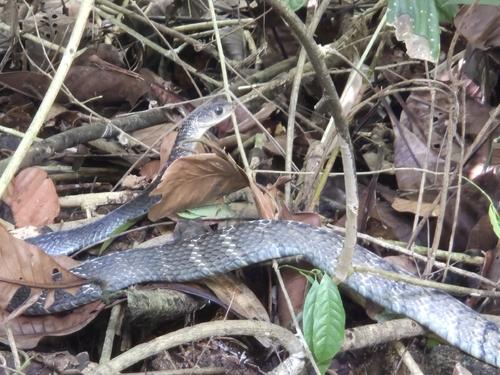
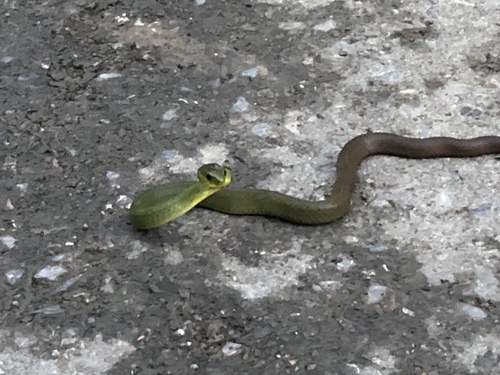
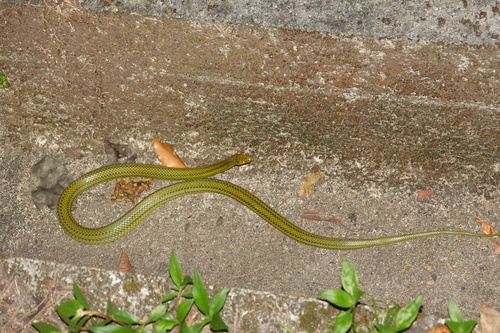
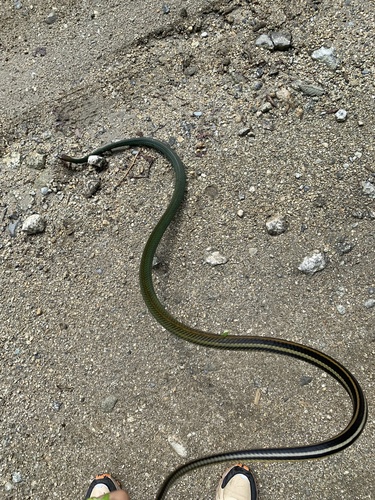
6 photographs of the Oriental Rat Snake. © Aleksandr Gromov.
The Oriental Rat Snake (Ptyas mucosa) is a non-venomous snake in the Colubridae family, recorded in 26 countries.
- Family
- Colubridae
About the Oriental Rat Snake
Ptyas mucosa, commonly known as the Oriental rat snake, or Indian rat snake, is a common non-venomous species of colubrid snake found in parts of South and Southeast Asia. These are large snakes. Typical mature total length is around 1.5 to 1.95 m (4 ft 11 in to 6 ft 5 in) though some exceed 2 m (6 ft 7 in). The record length for this species was 3.7 m (12 ft 2 in), second only to their cousin Ptyas carinata among living colubrid snakes. Despite their large size, oriental ratsnakes are usually quite slender with even a specimen of 2 m (6 ft 7 in) commonly measuring 4 to 6 cm (1.6 to 2.4 in) only around in diameter. Furthermore, the average weight of ratsnakes caught in Java was around 877 to 940 g (1.933 to 2.072 lb), though larger males of over 2.3 m (7 ft 7 in) (which average mildly larger of the two sexes in the species) may easily weigh over 2.5 kg (5.5 lb). Their color varies from pale browns in dry regions to nearly black in moist forest areas. Rat snakes are diurnal, semi-arboreal, non-venomous, and fast-moving. Rat snakes eat a variety of prey and are frequently found in urban areas where rodents thrive.
Etymology
The International Code for Zoological Nomenclature (ICZN) directs that the grammatical gender of any given species name should follow logically from the gender of its associated genus name. As Ptyas is a feminine word form (from πτυάς, a Greek word for a venom-spitting snake), the proper form of the species name is mucosa (a Late Latin word meaning "slimy"). Reference materials older than 2004 often show the masculine form, mucosus, and the CITES list continues to list the species this way.
Distribution
Found in Afghanistan, Bangladesh, Myanmar, Cambodia, China (Zhejiang, Hubei, Jiangxi, Fujian, Guangdong, Hainan, Guangxi, Yunnan, Tibet, Hong Kong), Taiwan, India (including Andaman and Nicobar Islands), Sri Lanka, Indonesia (Sumatra, Java, Bali), Iran, Laos, West Malaysia, Nepal, Myanmar, Pakistan (Sindh area), Thailand, Turkmenistan and Vietnam.
Description
Description from Boulenger's Fauna of British India: Reptilia and Batrachia volume of 1890:
Snout obtuse, slightly projecting; eye large; rostral a little broader than deep, visible from above; suture between the internasals shorter than that between the prefrontals; frontal as long as its distance from the end of the snout, as long as the parietals or slightly shorter; usually three loreals; one large preocular, with a small subocular below; two postoculars; temporals 2+2; 8 Upper labials, fourth and fifth entering the eye; 5 Lower labials in contact with the anterior chin shields, which are shorter than the posterior; the latter in contact anteriorly. Dorsal scales in 17 rows at midbody, more or less strongly keeled on the posterior part of the body. Ventrals 190–208; anal divided; subcaudals 95–135, divided. Brown above, frequently with more or less distinct black crossbands on the posterior part of the body and on the tail; young usually with light crossbands on the front half of the body. Lower surface yellowish; the posterior ventral and the caudal shields may be edged with black.
Adapted from Wikipedia, available under CC BY-SA.
Frequently asked: Oriental Rat Snake
- Is the Oriental Rat Snake venomous?
- No. The Oriental Rat Snake (Ptyas mucosa) is non-venomous and is not considered dangerous to humans. Like most snakes, it will retreat rather than bite when given the chance.
- Is the Oriental Rat Snake poisonous?
- Snakes are venomous, not poisonous. "Poisonous" means harmful to eat or touch; "venomous" means injecting toxins through a bite. The Oriental Rat Snake is neither poisonous nor venomous.
- Is the Oriental Rat Snake dangerous?
- The Oriental Rat Snake is not dangerous to humans. It has no medically significant venom and bites only defensively if cornered or handled.
- Where does the Oriental Rat Snake live?
- The Oriental Rat Snake has verified records in 26 countries, including India, Chinese Taipei, Sri Lanka. See the distribution section below for its full range.
- Why is it called the Oriental Rat Snake?
- The International Code for Zoological Nomenclature (ICZN) directs that the grammatical gender of any given species name should follow logically from the gender of its associated genus name. As Ptyas is a feminine word form (from πτυάς, a Greek word for a venom-spitting snake), the proper form of the species name is mucosa (a Late Latin word meaning "slimy"). Reference materials older than 2004 often show the masculine form, mucosus, and the CITES list continues to list the species this way.
Where it is found
More Colubridae snakes
Classification
How scientists group this snake, from the broadest category down to the exact species. Each step narrows to its closest relatives.
- OrderThe broad group of scaled reptiles: all snakes and lizards
- Squamata
- FamilyA group of related snakes that share key traits
- Colubridae
- GenusA close-knit group of very similar species
- Ptyas
- SpeciesThis exact snake, named in the two-part scientific name
- Ptyas mucosa
Keep learning
- What to Do If You Find a SnakeFound a snake at home or on a trail? Here is how to stay calm, give it space, identify it safely, and know when to call a professional.
- Venomous vs Nonvenomous: How to Tell the DifferenceThe folk rules for telling venomous snakes apart, where each one fails, and why location-based identification beats guessing by sight.
- What Is a Snake? Anatomy and the BasicsA clear overview of what makes a snake a snake: limbless body plan, anatomy, evolution from lizards, species diversity, and why they are ectothermic.
- How to Keep Snakes Out of Your Yard and HomeA practical guide to keeping snakes out of your yard and home using habitat changes that work, plus what to skip and what to do if one shows up.
Distribution from GBIF & iNaturalist. Venom status per CDC. Background: Wikipedia. Informational only. Never handle a snake to identify it.