
Colubridae
Cat Snake
HarmlessTelescopus fallax
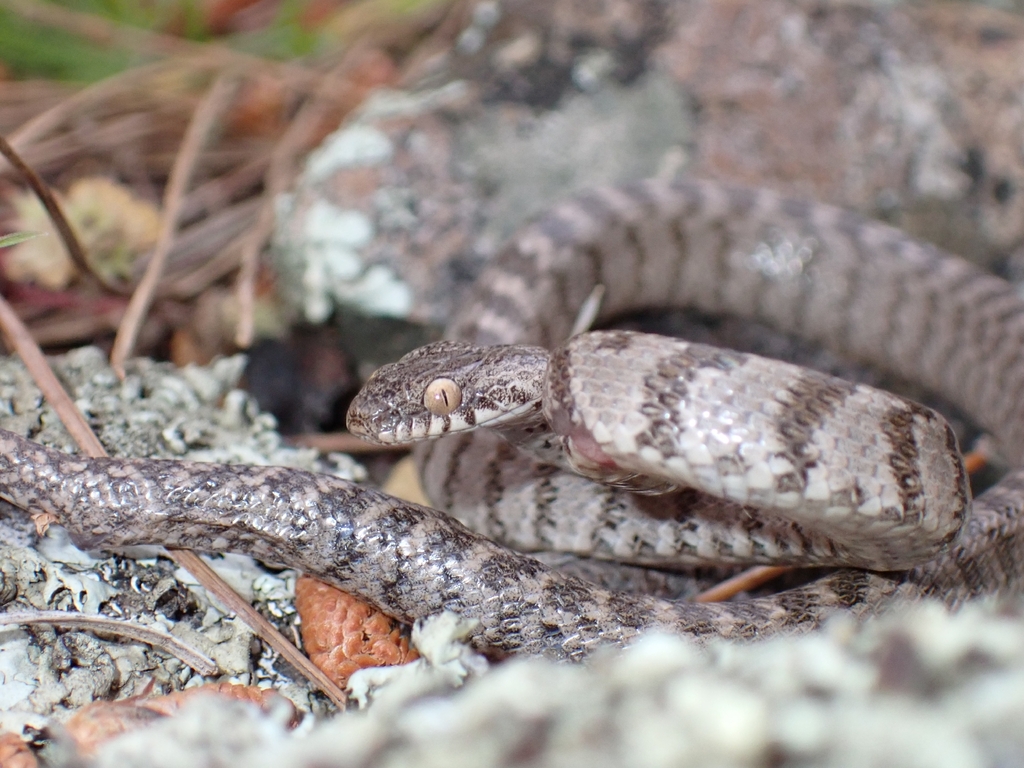
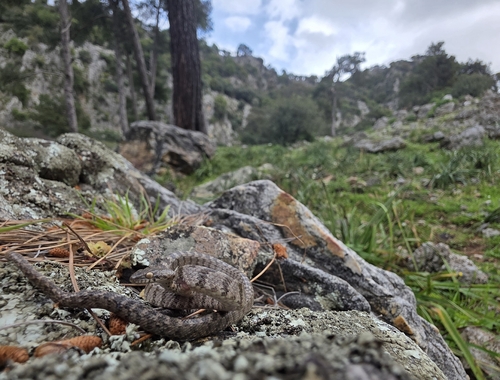
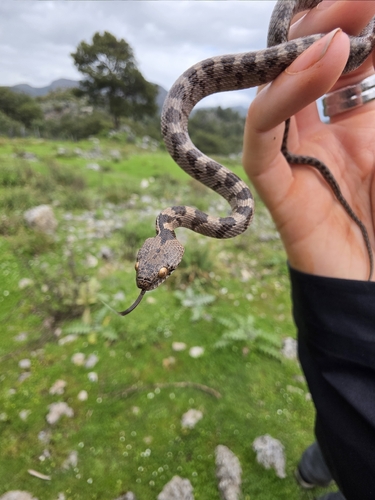
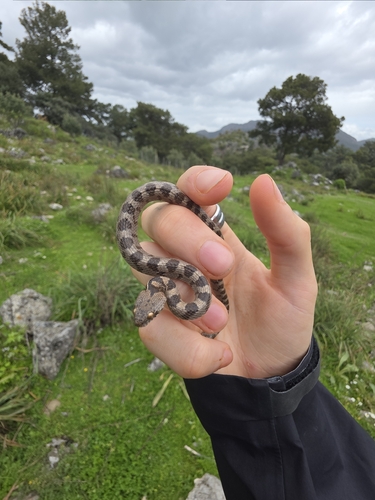
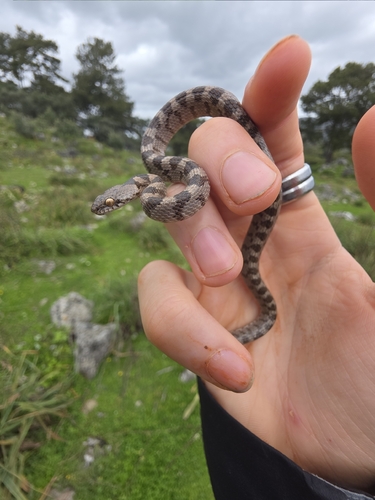
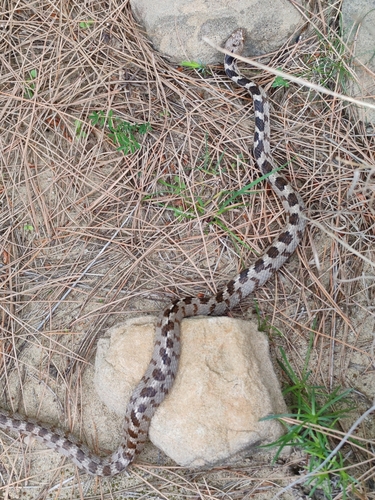
6 photographs of the Cat Snake. © Oscar Hopgood.
The Cat Snake (Telescopus fallax) is a rear-fanged, mildly venomous snake in the Colubridae family, recorded in 25 countries.
- Family
- Colubridae
About the Cat Snake
The European cat snake (Telescopus fallax), or the Mediterranean cat snake, is a species of venomous snake belonging to the family Colubridae. This species is found in Southeastern Europe and Western Asia.
Taxonomy
The European cat snake was first formally described as Tarbophis fallax in 1831 by the German naturalist Friedrich Ludwig Fleischmann with its type locality given as Dalmatia and Istria. Fitzinger had named Coluber fallax in 1826, which referred to this species, but this name is a nomen nudum. This species is now classified in the genus Telescopus which belongs to the subfamily Colubrinae of the family Colubridae.
Distribution
The European cat snake is found in is southeastern Europe from the extreme northeastern part of Italy southwards along Adriatic coast of the Balkans to Albania, Northern Macedonia, Greece and southern Bulgaria. It can also be found on some Mediterranean islands such as Malta, Crete and Cyprus. In Western Asia its range extends from ranges from Turkey south to Israel, east to Iraq and Iran and north into the Caucasus Mountains as far as southern Russia. It was first recorded in Malta in 1894 and was thought to be an introduced species but recent studies have indicated it is native to the archipelago.
Ecology and Biology
The European cat snake is venomous, but because it is rear-fanged (i.e. its fangs are located at the back of the upper jaw), its venom is not very effective against humans. Its venom can still be injected when biting if a body part is deep enough to attempt to swallow. It feeds mainly on geckos, lizards, and other snakes.
The species can be found in open and scrubby country including beaches and open woodlands. The species also inhabits mountainous areas.
European cat snakes can reach a length of up to 100 cm.
Subspecies
5 subspecies are currently recognized.
Telescopus fallax cyprianus (Barbour & Amaral, 1927) - Cyprus
Telescopus fallax fallax (Fleischmann, 1831) - Northeastern Italy, Greece (Paros, Mykonos, Antiparos, Crete, Kalymnos, Samos, Kimolos, Milos, Corfu, Syros), Albania, coastal Croatia, Slovenia, Bosnia and Herzegovina, Montenegro, Macedonia, southern Bulgaria, Turkey, Malta, Cyprus, Iran, Iraq, Syria, Israel, southern Russia, Armenia, Republic of Georgia, and Azerbaijan.
Telescopus fallax iberus (Eichwald, 1831) - Armenia, Azerbaijan, South Georgia, southern Russia, northern Iran, and East Turkey.
Telescopus fallax pallidus (Stepanek, 1944) - Crete, Gavdos, Elasa and Christiana Islands.
Telescopus fallax syriacus (Boettger, 1880) - Lebanon, Syria, Jordan, southeast Turkey and northern Israel.
Adapted from Wikipedia, available under CC BY-SA.
Frequently asked: Cat Snake
- Is the Cat Snake venomous?
- The Cat Snake (Telescopus fallax) is rear-fanged and only mildly venomous. It is not considered dangerous to humans (its venom is weak and its fangs sit at the back of the mouth) but a bite can cause local swelling or irritation, so it should not be handled.
- Is the Cat Snake poisonous?
- Snakes are venomous, not poisonous. "Poisonous" means harmful to eat or touch; "venomous" means injecting toxins through a bite. The Cat Snake is neither poisonous nor venomous.
- Is the Cat Snake dangerous?
- The Cat Snake is not dangerous to humans. It has no medically significant venom and bites only defensively if cornered or handled.
- Where does the Cat Snake live?
- The Cat Snake has verified records in 25 countries, including Israel, Croatia, Greece. See the distribution section below for its full range.
Where it is found
More Colubridae snakes
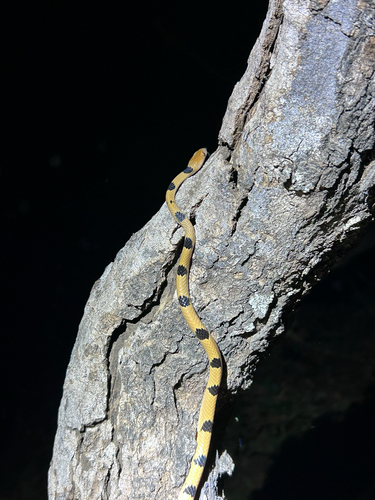 Common Tiger SnakeTelescopus semiannulatus
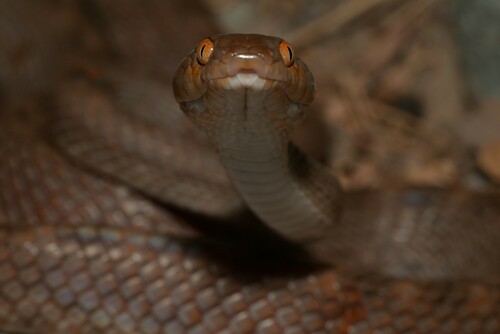 Arabian Cat SnakeTelescopus dhara
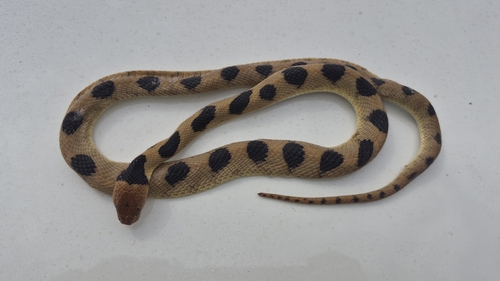 Karoo Tiger SnakeTelescopus beetzi
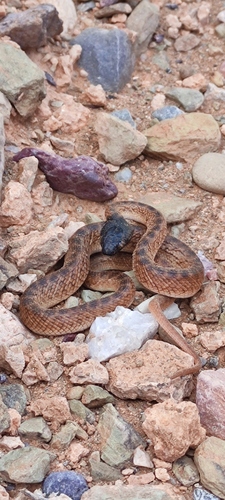 North African CatsnakeTelescopus tripolitanus
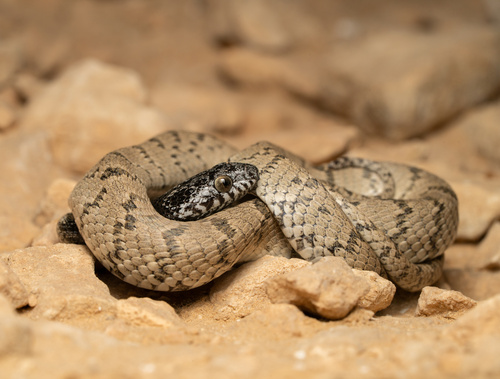 Hoogstraal's catsnakeTelescopus hoogstraali
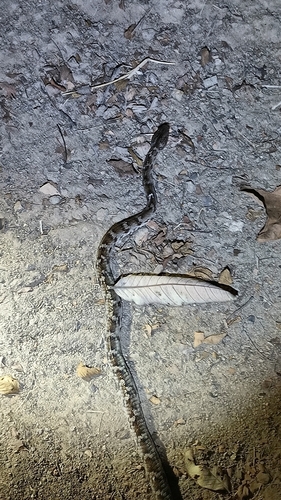 West African Cat SnakeTelescopus variegatus
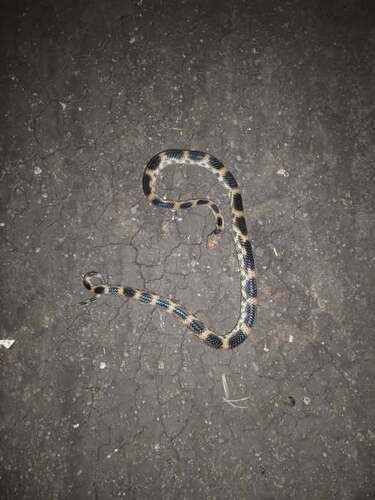 Blue Nile Cat SnakeTelescopus gezirae
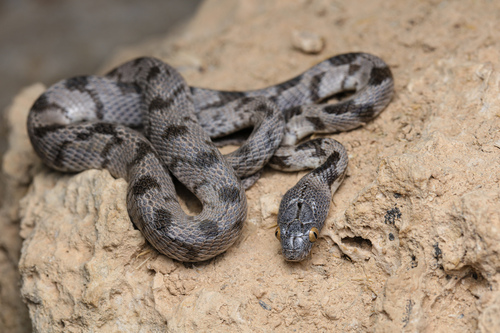 Soosan Tiger SnakeTelescopus tessellatus
Classification
How scientists group this snake, from the broadest category down to the exact species. Each step narrows to its closest relatives.
- OrderThe broad group of scaled reptiles: all snakes and lizards
- Squamata
- FamilyA group of related snakes that share key traits
- Colubridae
- GenusA close-knit group of very similar species
- Telescopus
- SpeciesThis exact snake, named in the two-part scientific name
- Telescopus fallax
Keep learning
- What to Do If You Find a SnakeFound a snake at home or on a trail? Here is how to stay calm, give it space, identify it safely, and know when to call a professional.
- Venomous vs Nonvenomous: How to Tell the DifferenceThe folk rules for telling venomous snakes apart, where each one fails, and why location-based identification beats guessing by sight.
- What Is a Snake? Anatomy and the BasicsA clear overview of what makes a snake a snake: limbless body plan, anatomy, evolution from lizards, species diversity, and why they are ectothermic.
- How to Keep Snakes Out of Your Yard and HomeA practical guide to keeping snakes out of your yard and home using habitat changes that work, plus what to skip and what to do if one shows up.
Distribution from GBIF & iNaturalist. Venom status per CDC. Background: Wikipedia. Informational only. Never handle a snake to identify it.