
Kingsnake / Milksnake
Eastern Milksnake
HarmlessLampropeltis triangulum
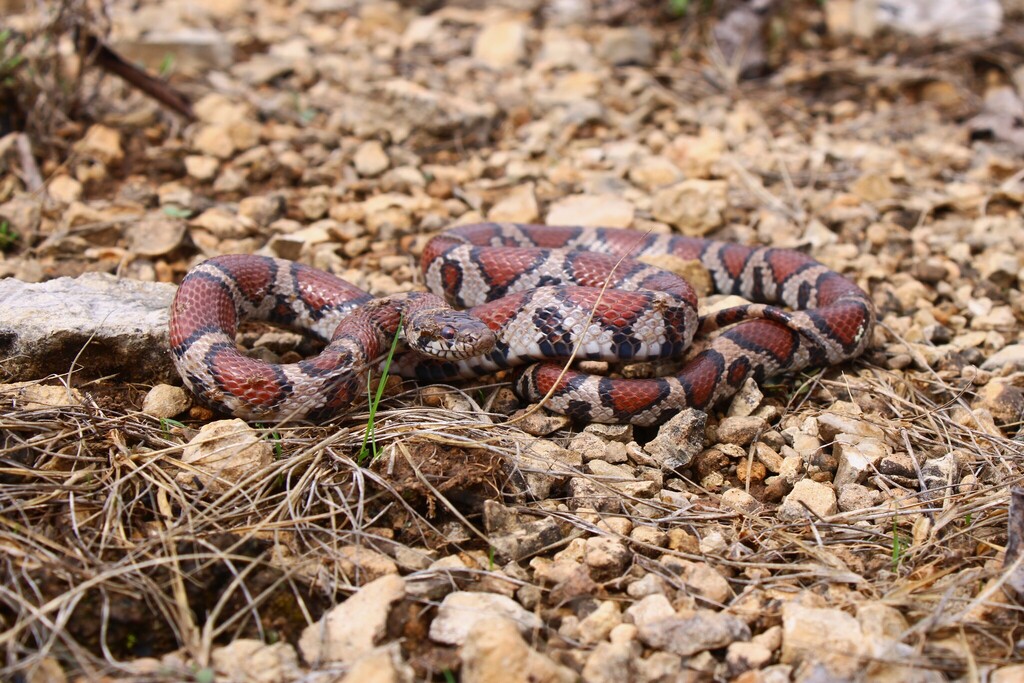
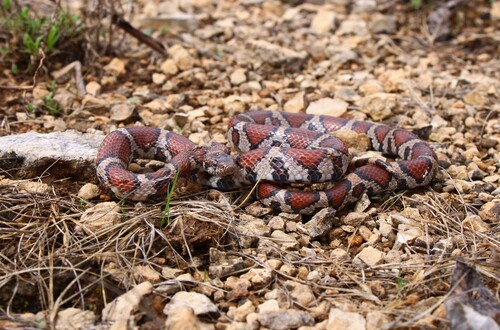
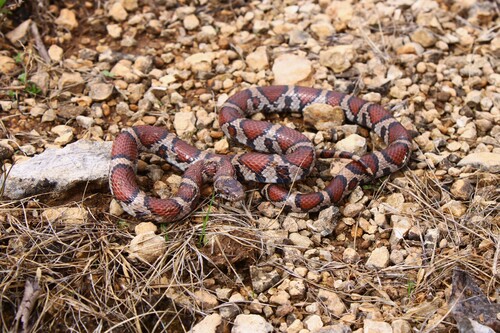
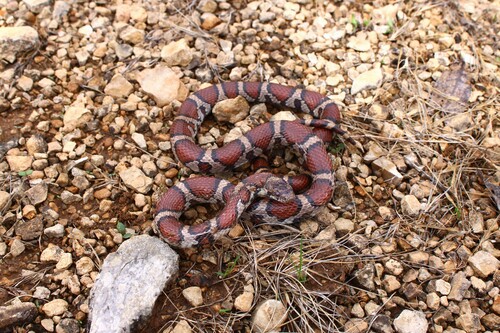
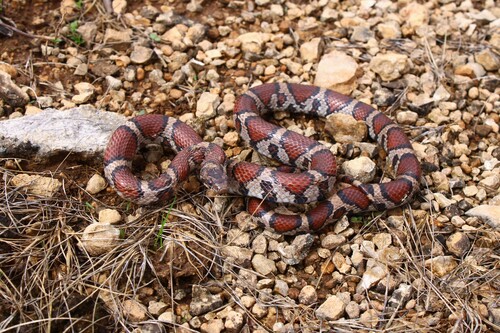
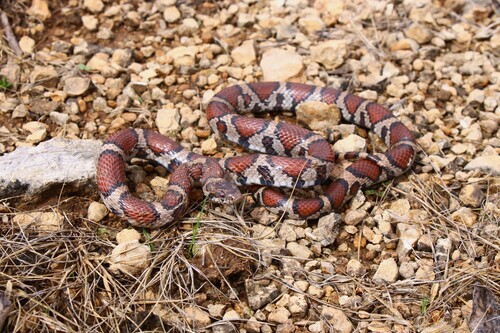
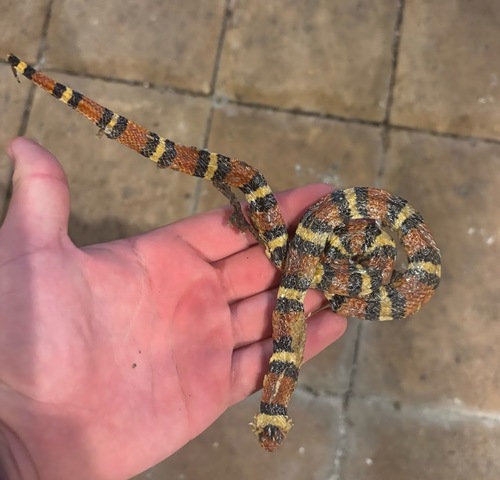
6 photographs of the Eastern Milksnake. © Dominic.
The Eastern Milksnake (Lampropeltis triangulum) is a non-venomous snake in the Colubridae family, recorded in 15 countries.
- Also called
- Kingsnake / Milksnake
- Family
- Colubridae
- Size
- 2–5 ft.
- Habitat
- Forests, farmland, grasslands, and suburbs.
- Behavior
- Powerful constrictors that eat other snakes — including venomous ones; gentle but may musk or vibrate the tail.
- Identify
- Smooth, glossy scales with bold bands or chain-like patterns. Milksnakes mimic coral snakes, but red touches black.
About the Eastern Milksnake
The milk snake or milksnake (Lampropeltis triangulum), is a species of kingsnake; there were once up to 24 subspecies recognized, however fewer are officially recognized today. Lampropeltis elapsoides, the scarlet kingsnake, was formerly classified as a 25th subspecies (L. t. elapsoides), but is now recognized as a distinct species. The previously delineated subspecies have strikingly different appearances, and many of them have their own common names. Morphological and genetic data suggest that this species could be split into several separate species, and it has been by several authorities. Lampropeltis gentilis, Lampropeltis annulata, Lampropeltis abnorma, Lampropeltis polyzona, and Lampropeltis micropholis have been elevated to the species level. Milksnakes are not venomous.
Geographic range
Milk snakes can be found from the southeastern extreme of Ontario, Canada, into southeastern Maine and all the states of the Eastern Seaboard of the United States of America, south to Florida, Alabama, Mississippi; in the midwest, from central Minnesota to Colorado, Nebraska, and the Dakotas; they are found in the foothills of the Appalachian Mountains; and in Georgia, Tennessee, Kentucky, Arkansas, Missouri, Kansas, Oklahoma, Texas and Louisiana. There are further subspecies found in nearly all of Mexico, from the state of Sonora east to the Gulf coast of Tamaulipas and throughout the rest of south and central Mexico; all through Central America and into Colombia and Ecuador.
Habitat
Across the wide range of this species, habitat varies; typically, milk snakes prefer to live in forested regions or areas of open woodland. However, they can also be found in swamps, prairie, farmland, rocky slopes, some semi-arid/chaparral areas, and sand dunes/beaches. In some situations, milk snakes also migrate seasonally; during the winter, they may move to higher/drier habitats for hibernation, and then moister habitats in time for the summer. However, snake migration is often limited due to human-caused habitat destruction and fragmentation. Depending on subspecies, milk snakes enter hibernation from late October or November to mid-April.
Description
There is a significant amount of variation among milk snakes in terms of size. Depending on subspecies, they can be as small as 14 in (36 cm) or as large as 72 in (180 cm) long. Adults in the wild apparently average from 38 to 225 g (1.3 to 7.9 oz) in North America. However, unusually large milk snakes can become rather bulkier than average-sized adults and potentially weigh up to 750 to 1,400 g (1.65 to 3.09 lb), though high weights as such are generally reported from captivity. Males typically are larger than females in maturity, although females can be bulkier than males similar in length as well. Generally more tropical populations, from Mexico and further south, reach larger adult sizes than milk snakes living in the temperate zones.
Adapted from Wikipedia, available under CC BY-SA.
Frequently asked: Eastern Milksnake
- Is the Eastern Milksnake venomous?
- No. The Eastern Milksnake (Lampropeltis triangulum) is non-venomous and is not considered dangerous to humans. Like most snakes, it will retreat rather than bite when given the chance.
- Is the Eastern Milksnake poisonous?
- Snakes are venomous, not poisonous. "Poisonous" means harmful to eat or touch; "venomous" means injecting toxins through a bite. The Eastern Milksnake is neither poisonous nor venomous.
- Is the Eastern Milksnake dangerous?
- The Eastern Milksnake is not dangerous to humans. It has no medically significant venom and bites only defensively if cornered or handled.
- Where does the Eastern Milksnake live?
- The Eastern Milksnake has verified records in 15 countries, including United States of America, Canada, Mexico. See the distribution section below for its full range.
- How do I identify the Eastern Milksnake?
- Smooth, glossy scales with bold bands or chain-like patterns. Milksnakes mimic coral snakes, but red touches black.
- How big does the Eastern Milksnake get?
- 2–5 ft.
- What does the Eastern Milksnake eat?
- Young milk snakes typically eat crickets and other insects, slugs, and earthworms; in the western U.S., juveniles also feed on small lizards and other young snakes. Adults' diet is primarily small mammals (such as voles, mice, and rats), but frequently includes lizards (especially skinks). They are also known to eat birds and their eggs, frogs, fish, and other snakes (including venomous species like coral snakes and rattlesnakes) and their eggs. Milk snakes are much more opportunistic eaters than the fox snake or corn snake.
Where it is found
By U.S. state
Snakes it is confused with
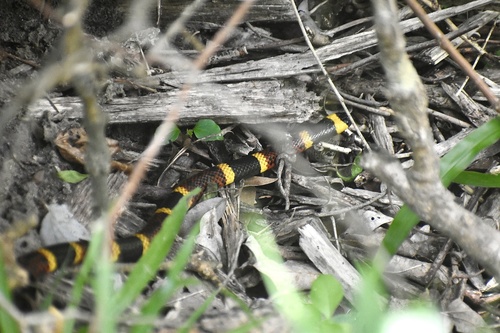 Texas CoralsnakeVenomous
A harmless mimic of the US coral snake. On US coral snakes red bands touch yellow; on these mimics red usually touches black. This color rule is reliable ONLY in the United States — it does not hold for coral snakes elsewhere.
Eastern Milksnake vs Texas Coralsnake→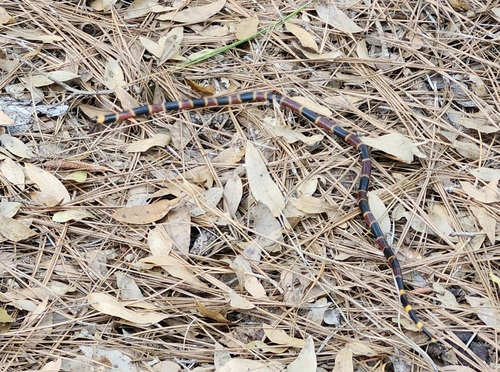
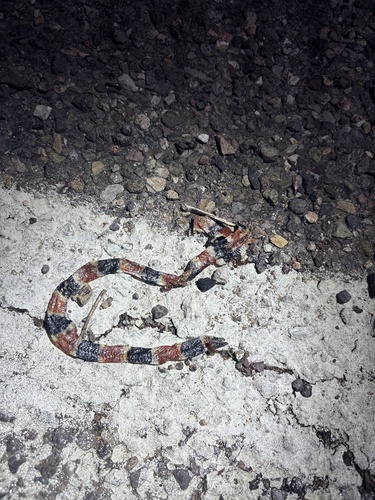
More Colubridae snakes
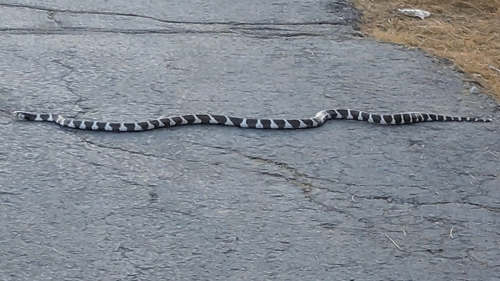 California King SnakeLampropeltis californiae
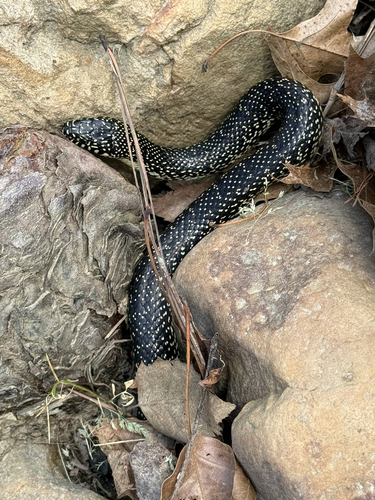 Speckled KingsnakeLampropeltis holbrooki
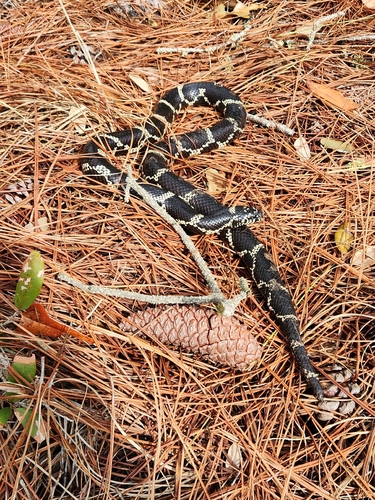 Eastern KingsnakeLampropeltis getula
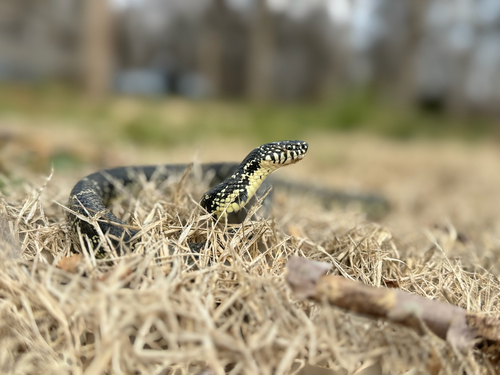 Black KingsnakeLampropeltis nigra
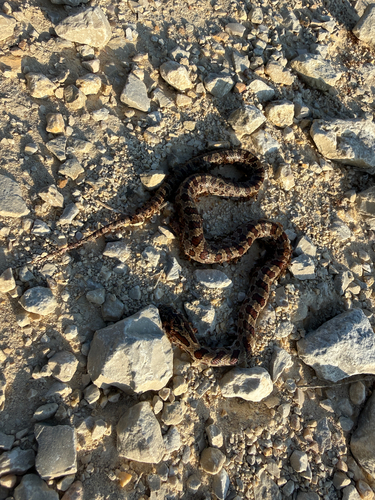 Prairie KingsnakeLampropeltis calligaster
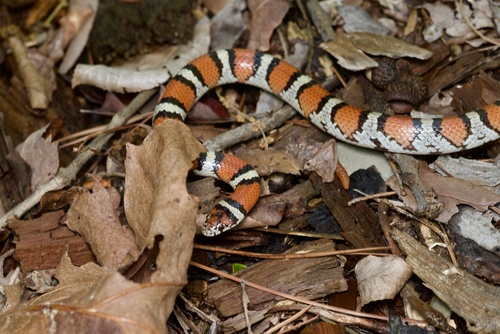 Western MilksnakeLampropeltis gentilis
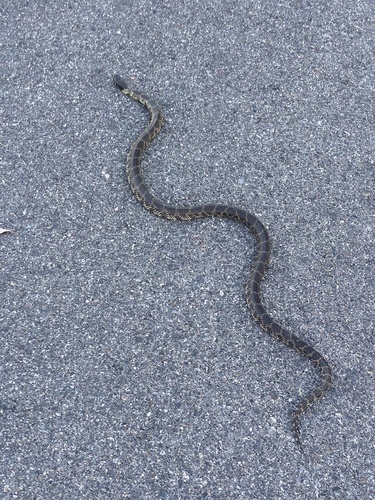 Desert KingsnakeLampropeltis splendida
 Scarlet KingsnakeLampropeltis elapsoides
Classification
How scientists group this snake, from the broadest category down to the exact species. Each step narrows to its closest relatives.
- OrderThe broad group of scaled reptiles: all snakes and lizards
- Squamata
- FamilyA group of related snakes that share key traits
- Colubridae
- GenusA close-knit group of very similar species
- Lampropeltis
- SpeciesThis exact snake, named in the two-part scientific name
- Lampropeltis triangulum
Keep learning
- What to Do If You Find a SnakeFound a snake at home or on a trail? Here is how to stay calm, give it space, identify it safely, and know when to call a professional.
- Venomous vs Nonvenomous: How to Tell the DifferenceThe folk rules for telling venomous snakes apart, where each one fails, and why location-based identification beats guessing by sight.
- What Is a Snake? Anatomy and the BasicsA clear overview of what makes a snake a snake: limbless body plan, anatomy, evolution from lizards, species diversity, and why they are ectothermic.
- How to Keep Snakes Out of Your Yard and HomeA practical guide to keeping snakes out of your yard and home using habitat changes that work, plus what to skip and what to do if one shows up.
Distribution from GBIF & iNaturalist. Venom status per CDC. Background: Wikipedia. Informational only. Never handle a snake to identify it.