
Kingsnake / Milksnake
California King Snake
HarmlessLampropeltis californiae
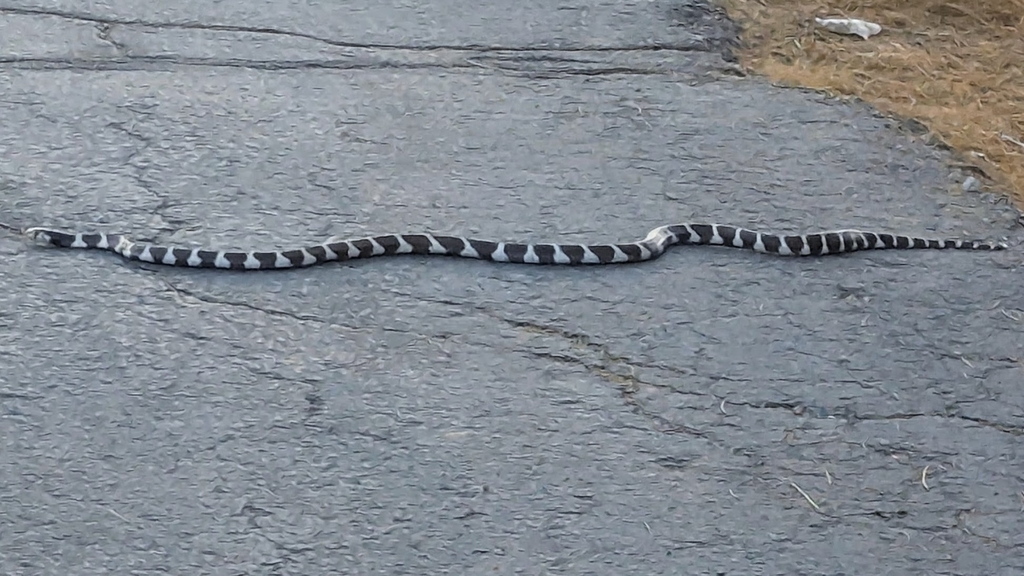
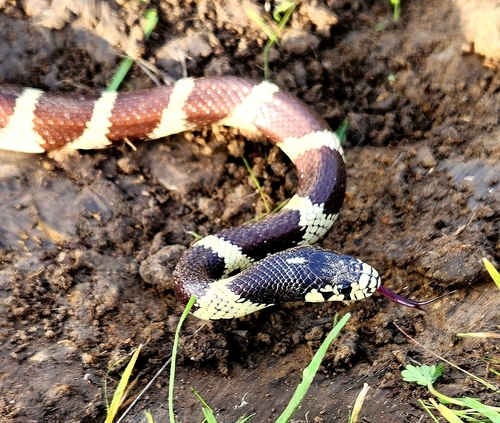
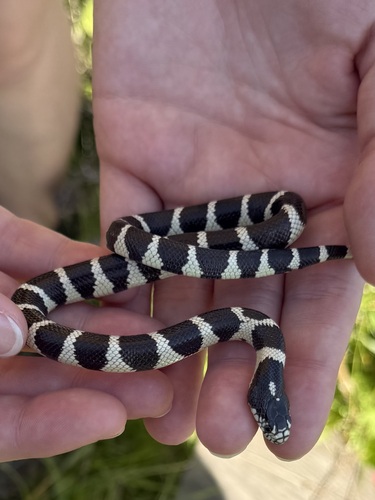
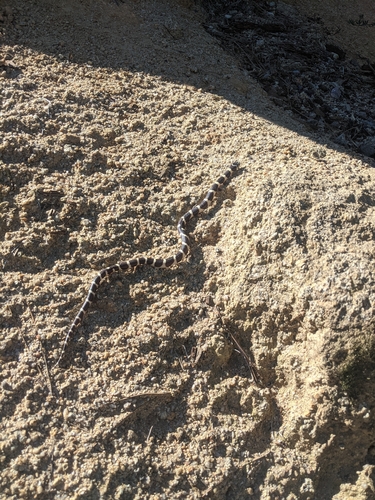
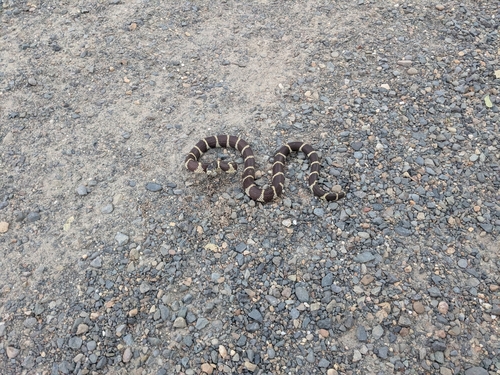
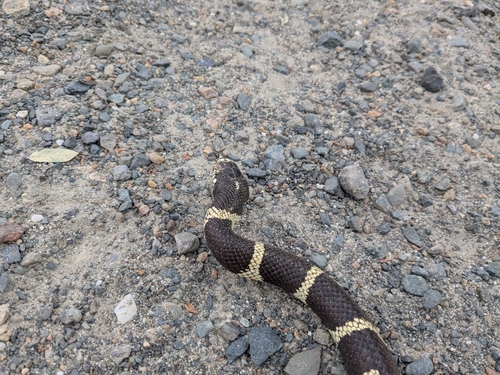
6 photographs of the California King Snake. © Stephanie Taylor.
The California King Snake (Lampropeltis californiae) is a non-venomous snake in the Colubridae family, recorded in 3 countries.
- Also called
- Kingsnake / Milksnake
- Family
- Colubridae
- Size
- 2–5 ft.
- Habitat
- Forests, farmland, grasslands, and suburbs.
- Behavior
- Powerful constrictors that eat other snakes — including venomous ones; gentle but may musk or vibrate the tail.
- Identify
- Smooth, glossy scales with bold bands or chain-like patterns. Milksnakes mimic coral snakes, but red touches black.
About the California King Snake
The California kingsnake (Lampropeltis californiae) is a nonvenomous colubrid snake endemic to the western United States and northern Mexico, and is found in a variety of habitats. Due to ease of care and a wide range of color variations, the California kingsnake is one of the most popular snakes in captivity.
Description
Wild California kingsnakes are typically encountered at a length of 2.5–3.5 feet (76–107 cm), though they can grow larger; California kingsnakes on Isla Ángel de la Guarda, Baja California, Mexico, have been documented growing to 78 inches (2 m). A wide range of color morphs exist in the wild; they are usually found with alternating dark and light bands ranging in color from black and white to brown and cream. Some populations may have longitudinal stripes instead of bands. Most California kingsnakes live to be around ten to fifteen years old, even surpassing twenty if well cared for in captivity.
California kingsnakes stripes and bands are essential to their survival as the patterns camouflage the snakes body to hide from predators. Their predators include hawks, eagles, coyotes, skunks, foxes, bobcats, and other kingsnakes.
Range and habitat
The California kingsnake is widespread along the West Coast of North America to elevations of approximately 6,100 ft (1,900 m) in the Tehachapi Mountains and to over 7,000 ft (2,100 m) in the southeastern Sierra Nevada Mountains. This species lives in a wide variety of habitats, including woodland chaparral, grassland, deserts, marshes, and even suburban areas. These snakes live in Oregon, California, Nevada, Utah, Arizona, southwestern Colorado, northwestern New Mexico, and northwestern Mexico. These snakes thrive in the temperatures between 80–84 °F and a humidity around 35–60%. The optimal environment can differ depending on the biological state of the snake. For instance, during reproduction they prefer even warmer temperatures, and in the process of shedding, they prefer higher humidity. In Arizona, they intergrade with the desert kingsnake (Lampropeltis splendida) and the Mexican black kingsnake (Lampropeltis getula nigrita).
The species has also become invasive on the Spanish island of Gran Canaria. In 2014 the population there had reached an estimated 20,000 individuals. California kingsnakes in Gran Canaria tend to use rocky or stony habitats with good vegetation cover, even frequently using other invasive shrub species such as Opuntia dillenii and Cenchrus setaceus.
Behavior
The California kingsnake is cathemeral; it may be active day or night depending on ambient temperatures. When disturbed, California kingsnakes often coil their bodies into a ball to hide their heads, hiss, and rattle their tails, which can produce a sound somewhat resembling that of a rattlesnake. When they are nervous they tend to twitch their tails. They are considered harmless to humans, but if handled it is common for this species to bite, as well as to excrete musk and fecal contents from their cloaca. It is also common for this musky odor to be excreted when the snake feels threatened. California kingsnakes are considered to be generally solitary, but when mating season or brumation is in process, they group together.
Adapted from Wikipedia, available under CC BY-SA.
Frequently asked: California King Snake
- Is the California King Snake venomous?
- No. The California King Snake (Lampropeltis californiae) is non-venomous and is not considered dangerous to humans. Like most snakes, it will retreat rather than bite when given the chance.
- Is the California King Snake poisonous?
- Snakes are venomous, not poisonous. "Poisonous" means harmful to eat or touch; "venomous" means injecting toxins through a bite. The California King Snake is neither poisonous nor venomous.
- Is the California King Snake dangerous?
- The California King Snake is not dangerous to humans. It has no medically significant venom and bites only defensively if cornered or handled.
- Where does the California King Snake live?
- The California King Snake has verified records in 3 countries, including United States of America, Mexico, Canada. See the distribution section below for its full range.
- How do I identify the California King Snake?
- Smooth, glossy scales with bold bands or chain-like patterns. Milksnakes mimic coral snakes, but red touches black.
- How big does the California King Snake get?
- 2–5 ft.
- What does the California King Snake eat?
- California kingsnakes are opportunistic feeders and common food items include rodents, birds, other reptiles and amphibians. The "king" in their name refers to their propensity to hunt and eat other snakes, including venomous rattlesnakes; California kingsnakes are naturally resistant to the venom of rattlesnakes. California kingsnakes are non-venomous and kill prey by constriction; they are the strongest constrictors proportionate to body size of any snakes.
Where it is found
More Colubridae snakes
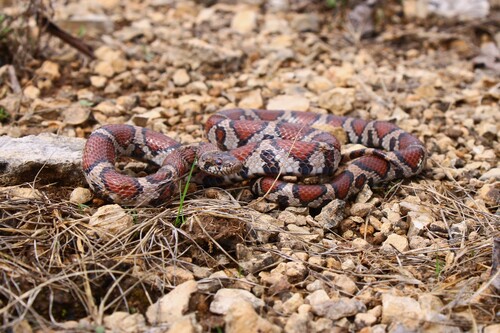 Eastern MilksnakeLampropeltis triangulum
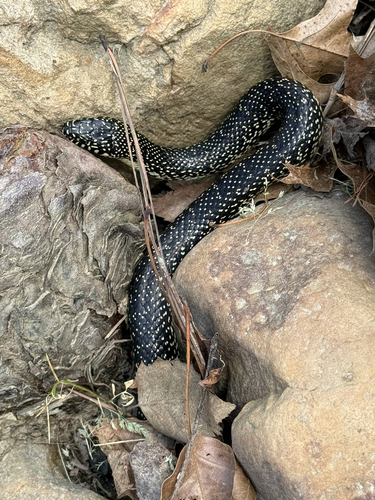 Speckled KingsnakeLampropeltis holbrooki
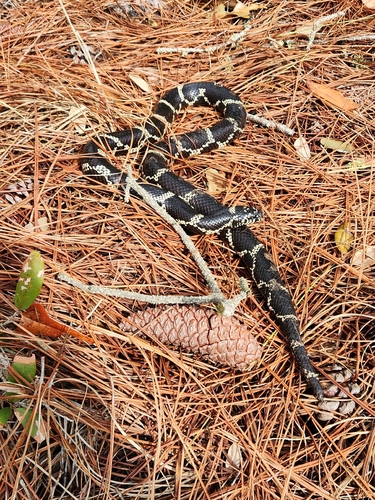 Eastern KingsnakeLampropeltis getula
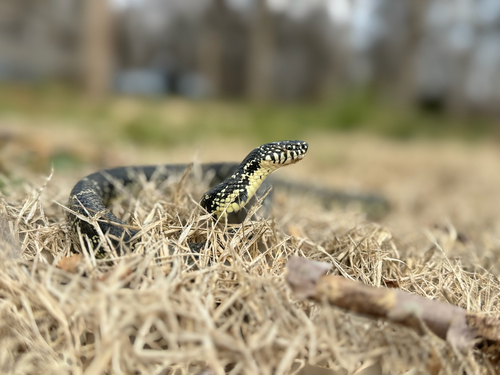 Black KingsnakeLampropeltis nigra
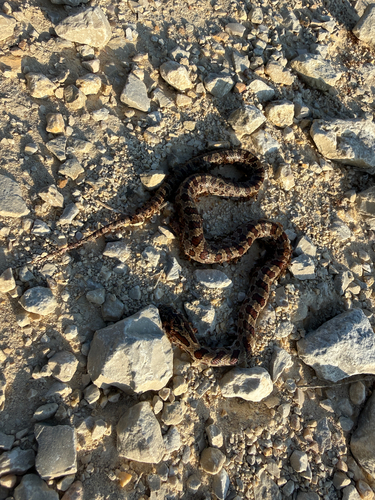 Prairie KingsnakeLampropeltis calligaster
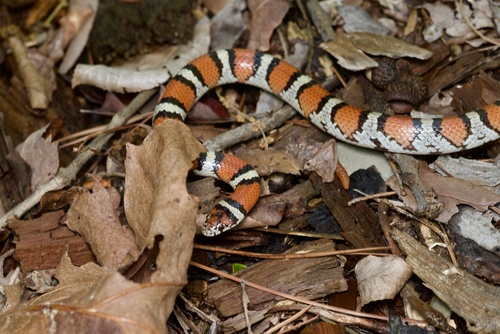 Western MilksnakeLampropeltis gentilis
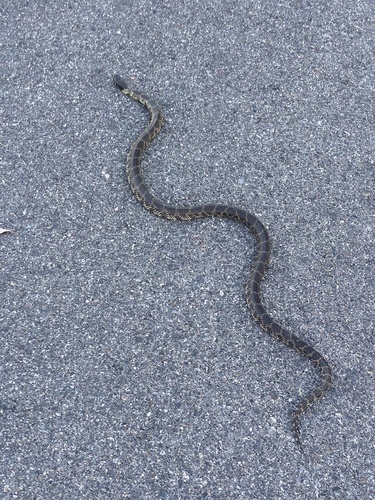 Desert KingsnakeLampropeltis splendida
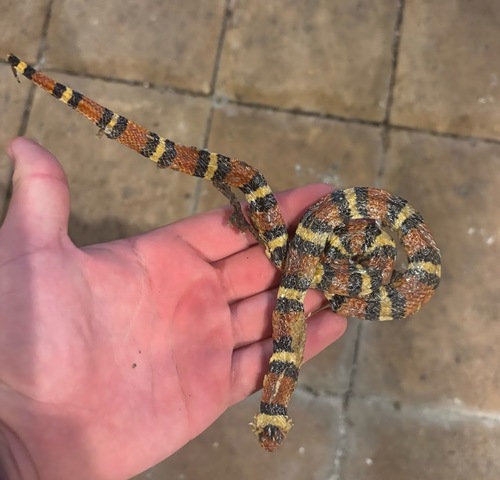 Scarlet KingsnakeLampropeltis elapsoides
Classification
How scientists group this snake, from the broadest category down to the exact species. Each step narrows to its closest relatives.
- OrderThe broad group of scaled reptiles: all snakes and lizards
- Squamata
- FamilyA group of related snakes that share key traits
- Colubridae
- GenusA close-knit group of very similar species
- Lampropeltis
- SpeciesThis exact snake, named in the two-part scientific name
- Lampropeltis californiae
Keep learning
- What to Do If You Find a SnakeFound a snake at home or on a trail? Here is how to stay calm, give it space, identify it safely, and know when to call a professional.
- Venomous vs Nonvenomous: How to Tell the DifferenceThe folk rules for telling venomous snakes apart, where each one fails, and why location-based identification beats guessing by sight.
- What Is a Snake? Anatomy and the BasicsA clear overview of what makes a snake a snake: limbless body plan, anatomy, evolution from lizards, species diversity, and why they are ectothermic.
- How to Keep Snakes Out of Your Yard and HomeA practical guide to keeping snakes out of your yard and home using habitat changes that work, plus what to skip and what to do if one shows up.
Distribution from GBIF & iNaturalist. Venom status per CDC. Background: Wikipedia. Informational only. Never handle a snake to identify it.