
Colubridae
Horseshoe Whip Snake
HarmlessHemorrhois hippocrepis
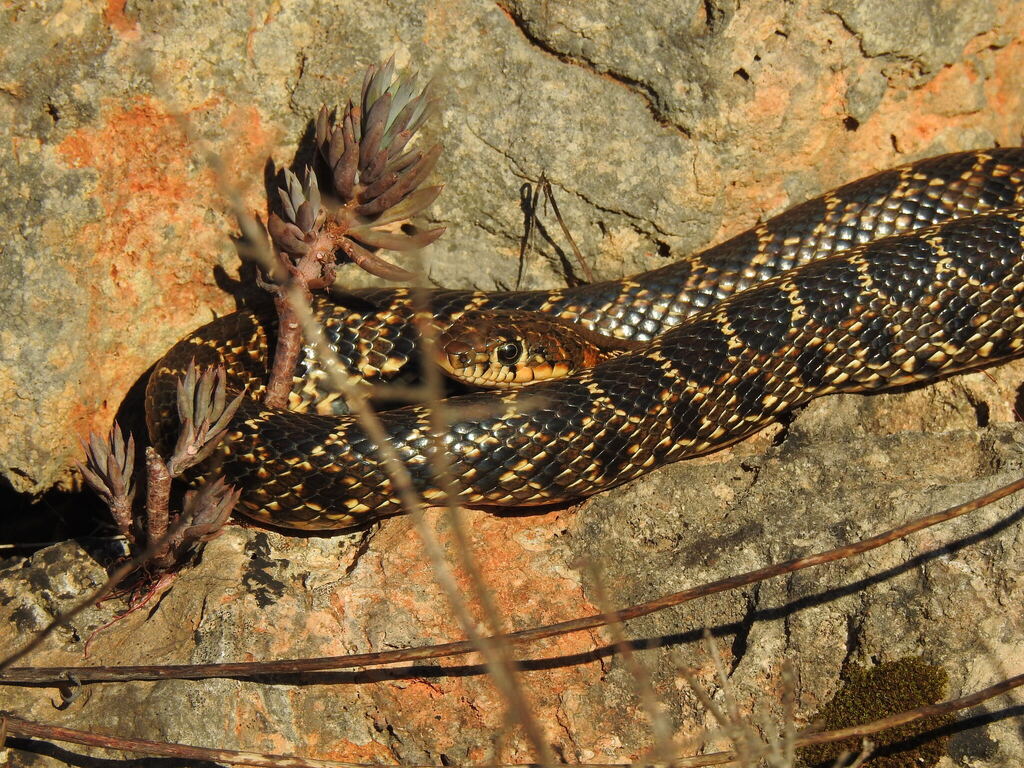
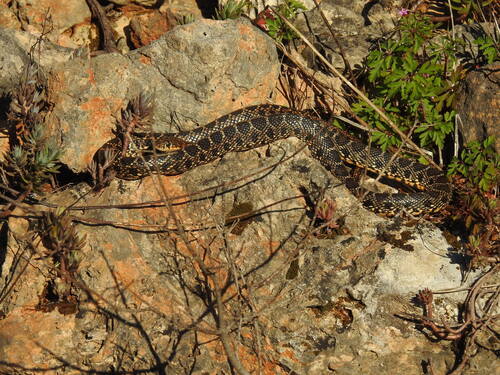
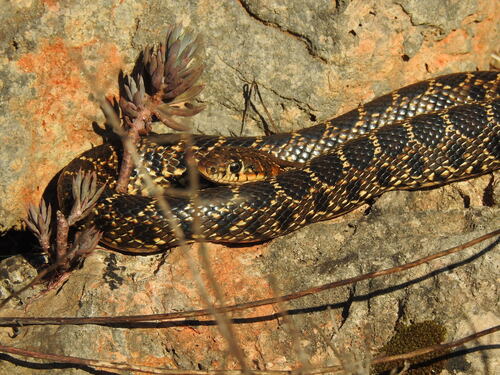
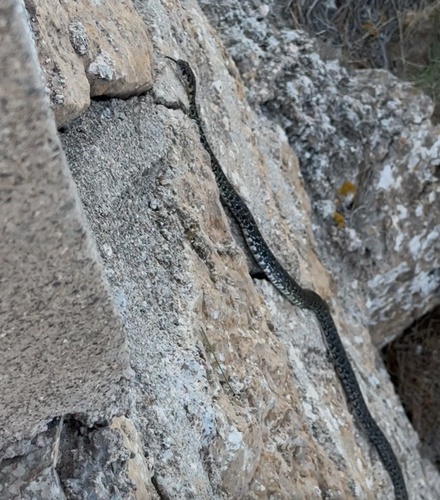
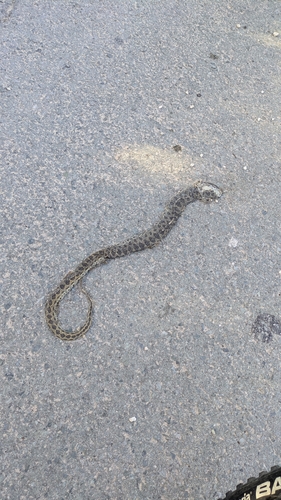
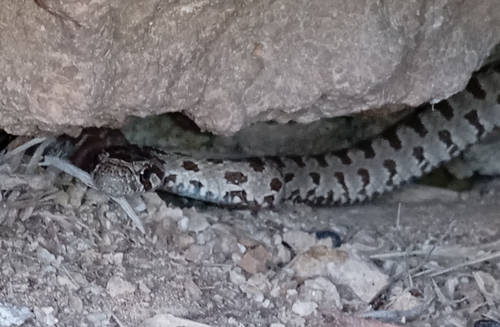
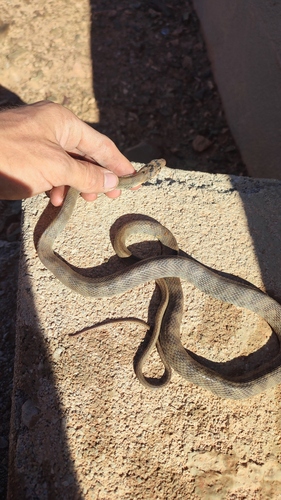
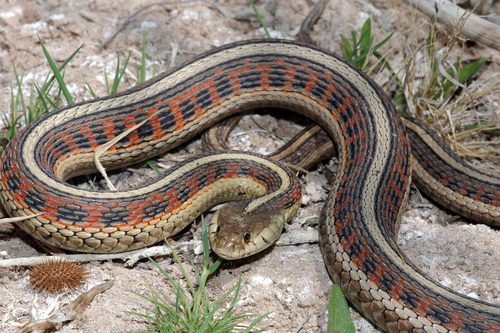
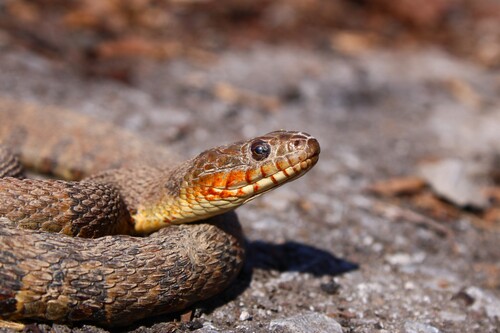
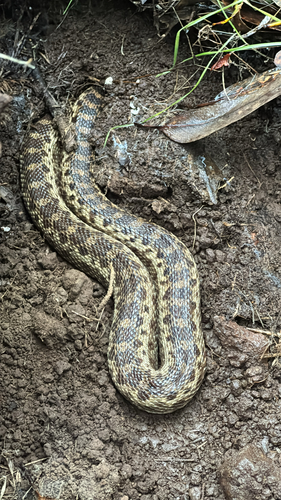
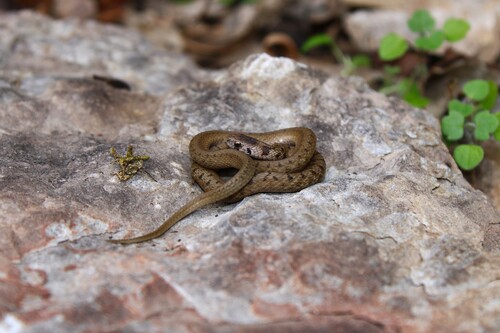
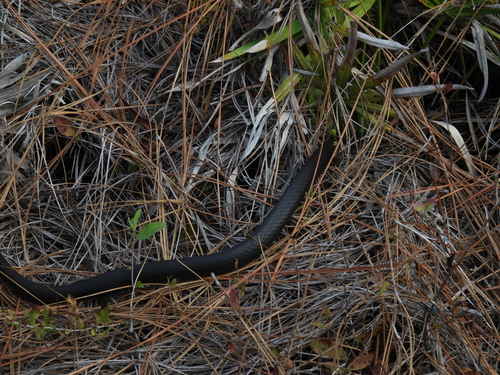
4 photographs of the Horseshoe Whip Snake. © Duarte Frade.
The Horseshoe Whip Snake (Hemorrhois hippocrepis) is a non-venomous snake in the Colubridae family, recorded in 16 countries.
- Family
- Colubridae
About the Horseshoe Whip Snake
The horseshoe whip snake (Hemorrhois hippocrepis) is a species of snake in the family Colubridae. The species is native to southwestern Europe and northwestern Africa.
Description
Adults of H. hippocrepis may attain a total length, including tail, of 1.5 to 1.8 m (5 to 6 feet), with no
sexual dimorphism in body size. Its body is slender the head being wider than the neck. The eye is large, with a round pupil and a row of small scales below it. The smooth dorsal scales are arranged in 25-29 rows, and the ventrals number 220–258. Dorsally, it has a series of large spots which are either blackish or dark brown edged with black. There is a series of alternating smaller dark spots on each side. The lighter ground color between the spots may be yellowish, olive, or reddish. The dark spots are closely spaced, giving the appearance of a dark snake with a light pattern resembling a chain or a series of letters X. There is a light horseshoe-shaped mark on the neck and back of head.
Geographic range
H. hippocrepis is found in Algeria, Morocco and Tunisia in North Africa, in southern and central Portugal, southern, eastern and central Spain, Gibraltar, southern Sardinia and Pantelleria Island in Europe. Since the early 2000s it has been reported in the Balearic Islands of Mallorca, Ibiza and Formentera. It is hypothesized to have been introduced by way of imported olive trees from mainland Spain. The species is thriving there and can grow larger than on the mainland.
Habitat
The natural habitats of H. hippocrepis are Mediterranean-type shrubby vegetation, rocky areas, rocky shores, sandy shores, arable land, pastureland, plantations, rural gardens, and urban areas.
Reproduction
H. hippocrepis is oviparous. Its reproductive cycle is seasonal, with oviposition occurring in early summer and hatching in late summer. Most sexually mature females reproduce once per year. The cycle is relatively fast, with a complete cycle including vitellogenesis, ovulation, shelling and oviposition lasting approximately two months. A 1999 study found the mean clutch size to be 6.8 eggs and a positive correlation between fertility and female body size.
Subspecies
Two subspecies are recognized as being valid, including the nominotypical subspecies.
Hemorrhois hippocrepis hippocrepis (Linnaeus, 1758)
Hemorrhois hippocrepis nigrescens (Cattaneo, 1985) Pantelleria
Nota bene: A trinomial authority in parentheses indicates that the subspecies was originally described in a genus other than Hemorrhois.
Conservation status
The horseshoe whip snake is assessed as being of "Least Concern" by the International Union for Conservation of Nature in its Red List of Threatened Species. Its population trend is thought to be steady, and it is able to adapt to modified habitats. Threats it faces include being run over by traffic, poisoned by agricultural chemicals and being captured for use by local snake charmers.
Adapted from Wikipedia, available under CC BY-SA.
Frequently asked: Horseshoe Whip Snake
- Is the Horseshoe Whip Snake venomous?
- No. The Horseshoe Whip Snake (Hemorrhois hippocrepis) is non-venomous and is not considered dangerous to humans. Like most snakes, it will retreat rather than bite when given the chance.
- Is the Horseshoe Whip Snake poisonous?
- Snakes are venomous, not poisonous. "Poisonous" means harmful to eat or touch; "venomous" means injecting toxins through a bite. The Horseshoe Whip Snake is neither poisonous nor venomous.
- Is the Horseshoe Whip Snake dangerous?
- The Horseshoe Whip Snake is not dangerous to humans. It has no medically significant venom and bites only defensively if cornered or handled.
- Where does the Horseshoe Whip Snake live?
- The Horseshoe Whip Snake has verified records in 16 countries, including Spain, Portugal, Morocco. See the distribution section below for its full range.
Where it is found
More Colubridae snakes
Classification
How scientists group this snake, from the broadest category down to the exact species. Each step narrows to its closest relatives.
- OrderThe broad group of scaled reptiles: all snakes and lizards
- Squamata
- FamilyA group of related snakes that share key traits
- Colubridae
- GenusA close-knit group of very similar species
- Hemorrhois
- SpeciesThis exact snake, named in the two-part scientific name
- Hemorrhois hippocrepis
Keep learning
- What to Do If You Find a SnakeFound a snake at home or on a trail? Here is how to stay calm, give it space, identify it safely, and know when to call a professional.
- Venomous vs Nonvenomous: How to Tell the DifferenceThe folk rules for telling venomous snakes apart, where each one fails, and why location-based identification beats guessing by sight.
- What Is a Snake? Anatomy and the BasicsA clear overview of what makes a snake a snake: limbless body plan, anatomy, evolution from lizards, species diversity, and why they are ectothermic.
- How to Keep Snakes Out of Your Yard and HomeA practical guide to keeping snakes out of your yard and home using habitat changes that work, plus what to skip and what to do if one shows up.
Distribution from GBIF & iNaturalist. Venom status per CDC. Background: Wikipedia. Informational only. Never handle a snake to identify it.