
Viperidae
Desert Horned Viper
VenomousCerastes cerastes
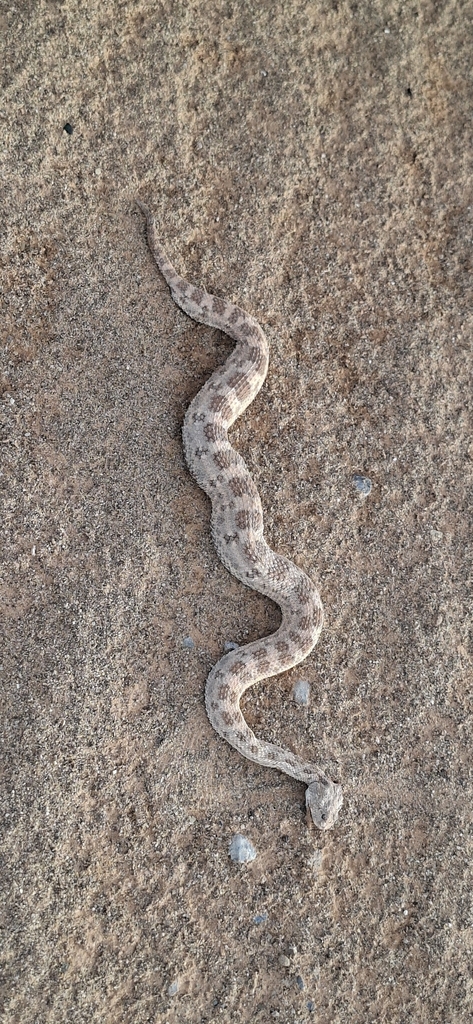
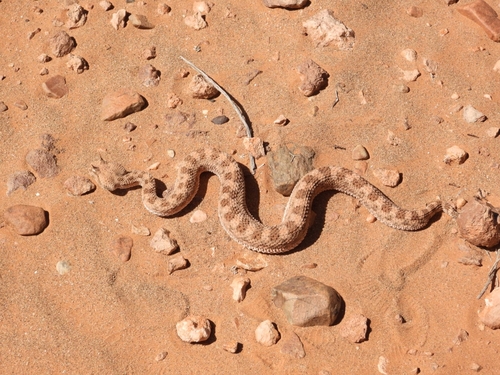
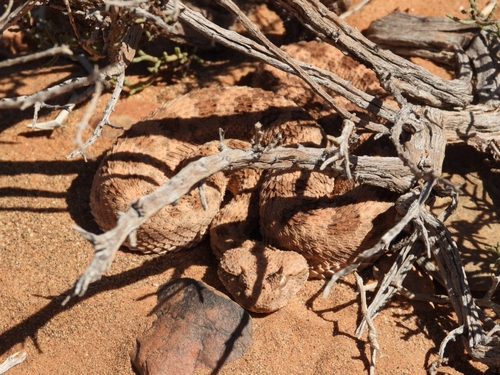
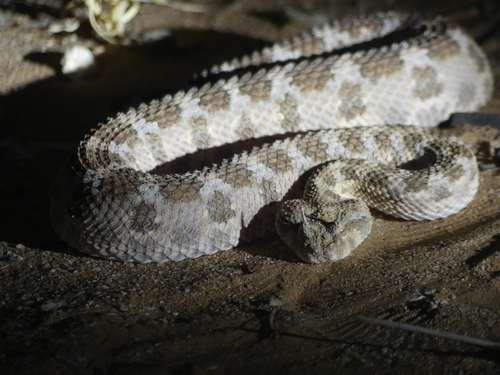
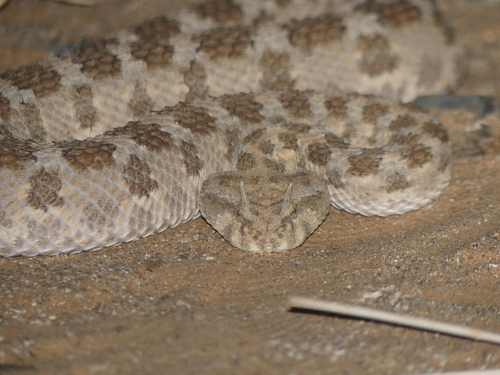
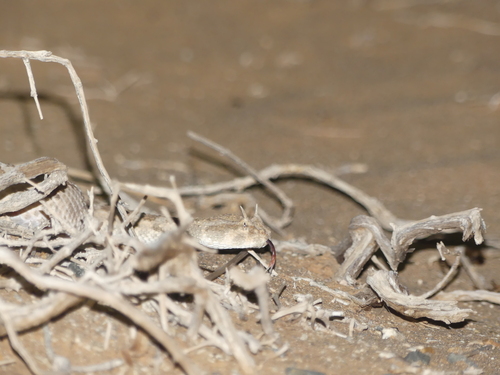
6 photographs of the Desert Horned Viper. © Valentin Moser.
The Desert Horned Viper (Cerastes cerastes) is a venomous snake in the Viperidae family, recorded in 22 countries.
If you are bitten
This is a venomous snake. Treat any bite as a medical emergency: stay calm, keep the bitten limb still and roughly level with the heart, remove rings and tight clothing, and get to emergency care immediately. Do not apply a tourniquet, cut the wound, apply ice, or try to suck out venom. Call your local emergency number or poison center.
- Family
- Viperidae
- Danger
- high
About the Desert Horned Viper
Cerastes cerastes, commonly known as the Saharan horned viper or the desert horned viper, is a species of viper native to the deserts of Northern Africa and parts of the Arabian Peninsula and Levant. It is often easily recognized by the presence of a pair of supraocular "horns", although hornless individuals do occur. Three subspecies have been described.
Description
The average total length (body and tail) of Cerastes cerastes is 30–60 cm (12–24 in), with a maximum total length of 85 cm (33 in). Females are larger than males.
One of the most distinctive characteristics of this species is the presence of supraorbital "horns", one over each eye. However, these may be reduced in size or absent (see genus Cerastes). The eyes are prominent and set on the sides of the head. There is significant sexual dimorphism, with males having larger heads and larger eyes than females. Compared to C. gasperettii, the relative head size of C. cerastes is larger and there is a greater frequency of horned individuals (13% versus 48%, respectively).
The colour pattern consists of a yellowish, pale grey, pinkish, reddish or pale brown ground colour, which almost always matches the substrate colour where the animal is found. Dorsally, a series of dark, semi-rectangular blotches runs the length of the body. These blotches may or may not be fused into crossbars. The belly is white. The tail, which may have a black tip, is usually thin.
Common names
Common names of the species Cerastes cerastes include desert sidewinding horned viper, Saharan horned viper, horned s, Sahara horned viper, desert horned viper, North African horned viper, African desert horned viper, greater cerastes, asp and horned viper. In Egypt, it is called el-ṭorîsha (حية الطريشة); in Libya, it is called um-Goron (ام قرون).
In ancient Egyptian, a hieroglyph depicting horned viper is a phonogram for the letter f (𓆑), as derived through rebus principle from the species name, ft.
Geographic distribution
Cerastes cerastes is common in Iraq but is also found in Syria, Saudi Arabia, Palestine, Yemen, Jordan, Israel, Qatar, Mauritania, Morocco and Kuwait. They can also be found in parts of North Africa including Libya, Egypt, and Sudan.
Originally, the type locality was listed only as "Oriente." However, Flower (1933) proposed "Egypt" by way of clarification.
Habitat
The preferred natural habitat of Cerastes cerastes is dry, sandy areas with sparse rock outcroppings, but it tends to avoid coarse sand. Occasionally it is found around oases, and up to an altitude of 1,500 metres (4,900 ft). Cooler temperatures, with annual averages of 20 °C (68 °F) or less, are preferred.
Behaviour and diet
Cerastes cerastes typically moves by sidewinding, during which it presses its weight into the sand or soil, leaving whole-body impressions. Often, it is even possible to use these impressions to make ventral scale counts. It has a reasonably placid temperament, but if threatened, may assume a C-shaped posture and rapidly rub its coils together. Because it has strongly keeled scales, this rubbing produces a rasping noise, similar to the sound produced by snakes of the genus Echis. In the wild, C. cerastes is typically an ambush predator, lying submerged in sand adjacent to rocks or under vegetation. The diet of this carnivorous species consists primarily of a variety of lizards, especially geckos, small rodents, and birds. It is also known to eat jerboas, yellow wagtails, and chiffchaffs. C. cerastes has been known to travel long distances at night in search of prey. When approached, it strikes very rapidly, holding on to the captured prey until the venom takes effect.
Reproduction
Adapted from Wikipedia, available under CC BY-SA.
Local and regional names
The Desert Horned Viper is known by these names across the regions where it lives:
- Arabic
- أفعى الصحراء المقرنة
- Chinese
- 角蝰
- Czech
- zmije rohatá
- Danish
- Nordafrikansk Hornslange
- Dutch
- Hoornadder
- English
- Saharan horned viper, horned desert viper
- Finnish
- Saharansarvikyy, Sarvikyy
- French
- Vipère à cornes
- German
- Hornviper, Wüsten-Hornviper
- Hebrew
- עכן חרטומים
- Hungarian
- szarvasvipera
- Italian
- Ceraste cornuta, Ceraste cornuta del deserto, Vipera cornuta del deserto, Vipera della sabbia
- Japanese
- ツノスナクサリヘビ
- Polish
- żmija rogata
- Russian
- Рогатая гадюка
- Spanish
- Víbora cornuda
- Swedish
- Hornhuggorm
- Ukrainian
- Рогата гадюка звичайна
Frequently asked: Desert Horned Viper
- Is the Desert Horned Viper venomous?
- Yes. The Desert Horned Viper (Cerastes cerastes) is venomous and belongs to the Viperidae family (viper). Its bite is considered high risk to people. Treat any bite as a medical emergency.
- Is the Desert Horned Viper poisonous?
- Snakes are venomous, not poisonous. "Poisonous" means harmful to eat or touch; "venomous" means injecting toxins through a bite. The Desert Horned Viper is venomous, delivering venom through a bite.
- Is the Desert Horned Viper dangerous?
- This is a venomous snake. Treat any bite as a medical emergency: stay calm, keep the bitten limb still and roughly level with the heart, remove rings and tight clothing, and get to emergency care immediately. Do not apply a tourniquet, cut the wound, apply ice, or try to suck out venom. Call your local emergency number or poison center.
- Where does the Desert Horned Viper live?
- The Desert Horned Viper has verified records in 22 countries, including Israel, Morocco, Egypt. See the distribution section below for its full range.
- What does the Desert Horned Viper eat?
- Cerastes cerastes typically moves by sidewinding, during which it presses its weight into the sand or soil, leaving whole-body impressions. Often, it is even possible to use these impressions to make ventral scale counts. It has a reasonably placid temperament, but if threatened, may assume a C-shaped posture and rapidly rub its coils together. Because it has strongly keeled scales, this rubbing produces a rasping noise, similar to the sound produced by snakes of the genus Echis. In the wild, C.
- Why is it called the Desert Horned Viper?
- Common names of the species Cerastes cerastes include desert sidewinding horned viper, Saharan horned viper, horned s, Sahara horned viper, desert horned viper, North African horned viper, African desert horned viper, greater cerastes, asp and horned viper. In Egypt, it is called el-ṭorîsha (حية الطريشة); in Libya, it is called um-Goron (ام قرون). In ancient Egyptian, a hieroglyph depicting horned viper is a phonogram for the letter f (𓆑), as derived through rebus principle from the species name, ft.
If you are bitten by the Desert Horned Viper
Do
- Get away from the snake and stay calm. Most bites worsen when people panic or try again to handle the snake.
- Call 911 or Poison Control (1-800-222-1222) right away. Antivenom works best when given early.
- Note the time of the bite and, from a safe distance, the snake's color and pattern, a phone photo is enough. Do not chase it.
- Keep the bitten limb still and at roughly heart level. Sit or lie down and limit movement.
- Remove rings, watches, and tight clothing near the bite before swelling starts.
- Gently wash the bite with soap and water and cover it with a clean, dry dressing.
Do not
- Do not cut the wound or try to suck out the venom.
- Do not apply a tourniquet or ice.
- Do not drink alcohol or caffeine.
- Do not take aspirin or ibuprofen, they can worsen bleeding. Acetaminophen is safer for pain.
- Do not try to catch or kill the snake. A dead snake can still bite by reflex.
First-aid guidance adapted from the U.S. Centers for Disease Control and Prevention (CDC NIOSH), Venomous Snakes. Educational only; always follow the instructions of emergency responders.
Where it is found
More Viperidae snakes
Classification
How scientists group this snake, from the broadest category down to the exact species. Each step narrows to its closest relatives.
Keep learning
- Are Snakes Dangerous? The Real Risk, in PerspectiveMost snakes are harmless and avoid people. Here is the honest picture of snakebite risk worldwide and how to lower your own.
- Snakebite First Aid: What to Do (and What Never to Do)A clear, CDC-based guide to snakebite first aid: the steps that help, the popular myths that hurt, and how to tell a serious bite from a minor one.
- Venomous vs Nonvenomous: How to Tell the DifferenceThe folk rules for telling venomous snakes apart, where each one fails, and why location-based identification beats guessing by sight.
- What to Do If You Find a SnakeFound a snake at home or on a trail? Here is how to stay calm, give it space, identify it safely, and know when to call a professional.
Distribution from GBIF & iNaturalist. Venom status per CDC. Background: Wikipedia. Informational only. Never handle a snake to identify it.