
Rattlesnake
Timber Rattlesnake
VenomousCrotalus horridus
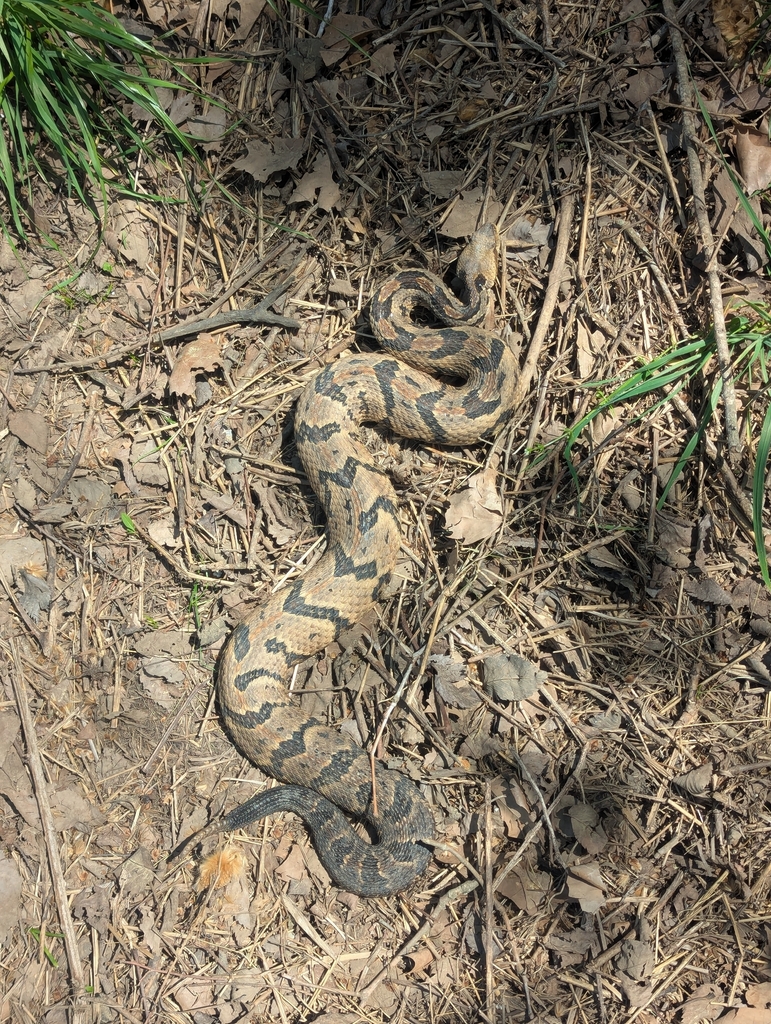
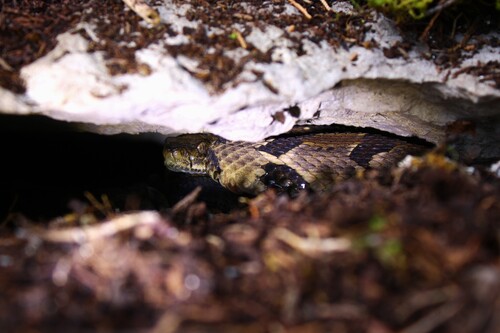
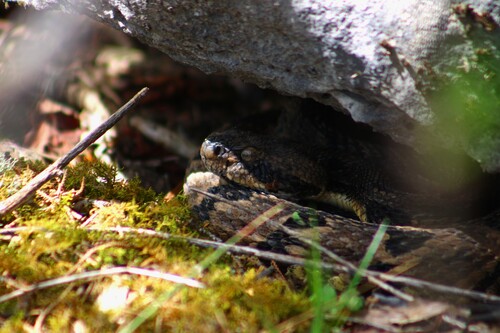
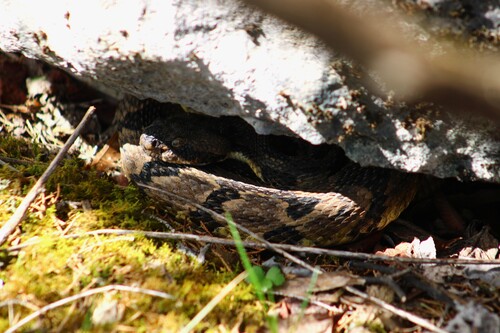
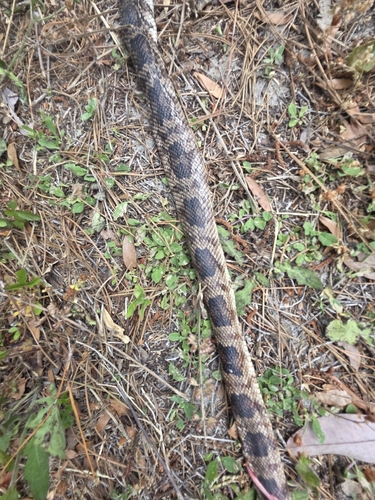
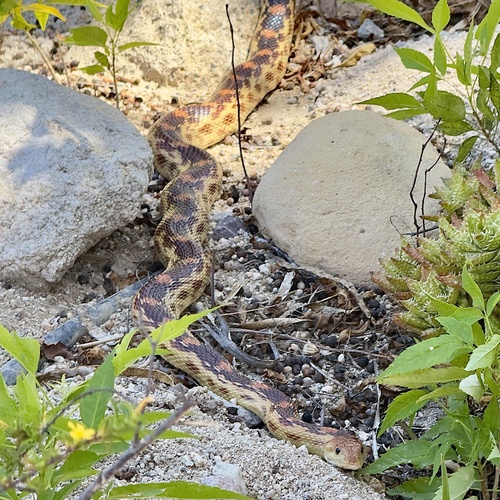
4 photographs of the Timber Rattlesnake. © Etienne Falquet.
The Timber Rattlesnake (Crotalus horridus) is a venomous snake in the Viperidae family, recorded in 5 countries.
If you are bitten
Rattlesnake bites are medically serious. Expect intense pain, rapid swelling, and bruising. Stay calm, keep the bitten limb still and roughly level with the heart, remove rings and tight clothing, and get to an emergency room immediately. Do NOT apply a tourniquet, cut the wound, apply ice, or try to suck out venom. Call Poison Control at 1-800-222-1222 or 911 in the US, or your local emergency number. (Source: CDC.)
- Also called
- Rattlesnake
- Family
- Viperidae
- Size
- Typically 2–5 ft; some species exceed 6 ft.
- Habitat
- Deserts, rocky outcrops, grasslands, and woodland edges, depending on species.
- Behavior
- Ambush predators that buzz the tail as a warning; mostly active in warm months and often crepuscular in summer heat.
- Identify
- Heavy body, broad triangular head, vertical (cat-like) pupils, and a segmented keratin rattle at the tail tip.
- Danger
- high
About the Timber Rattlesnake
The timber rattlesnake (Crotalus horridus), also known commonly as the banded rattlesnake, and the canebrake rattlesnake in southern United States is a species of pit viper in the family Viperidae. The species is native to the eastern United States. Like all other pit vipers, it is venomous, with a very toxic bite. Its venom is extremely potent, and both hemorrhagic and neurotoxic venom are present depending on population and location. C. horridus is the only rattlesnake species in most of the populous Northeastern United States and is second only to its relatives to the west, the prairie rattlesnake, as the most northerly distributed venomous snake in North America. There are no subspecies that are recognized as being valid.
Taxonomy
The timber rattlesnake was one of the many reptile species originally described by Carl Linnaeus in the landmark 1758 10th edition of his Systema Naturae, and still bears its original name Crotalus horridus.
The subspecies C. h. atricaudatus (Latreille in Sonnini and Latreille, 1802), often referred to as the canebrake rattlesnake, is currently considered invalid. Previously, it was recognized by Gloyd (1936) and Klauber (1936). Based on an analysis of geographic variation, Pisani et al. (1972) concluded no subspecies should be recognized. This was rejected by Conant (1975), but followed by Collins and Knight (1980). Brown and Ernst (1986) found evidence for retaining the two subspecies, but stating them apart without having more information than usual is not possible, including adult size, color pattern, the number of dorsal scale rows, and the number of ventral scales. Dundee and Rossman (1989) recognized C. h. atricaudatus, but others take a more neutral point of view.
The timber rattlesnake is one of 36 species in the genus Crotalus. This genus can be distinguished from Sistrurus by the small scales atop the head, rather than nine large scales found on Sistrurus.
Etymology
The name Crotalus is Latin for a rattle or, crŏtălisso to rattle or the sound of the castanet. Horridus is Latin, meaning horrid or dreadful, presumably in reference to its potentially lethal venom. Although southern populations are generally no longer recognized as a valid subspecies, the name canebrake rattlesnake (Crotalus horridus atricaudatus) is occasionally still used and commonly encountered in older literature. Atricaudatus is Latin meaning black-tailed (atri = black, and caudatus = tailed).
Description
Adults usually grow to total length of 91–152 cm (36–60 in). In Pennsylvania, the smallest size females that could produce viable eggs was 72.2 cm (28.4 in). Most adult timber rattlesnakes found measure less than 115 cm (45 in) in total length and weigh between 500 and 1,500 g (1.1 and 3.3 lb), often being towards the lower end of that range. The maximum reported total length is 189.2 cm (74.5 in) (Klauber, 1956). Holt (1924) mentions a large specimen caught in Montgomery County, Alabama, which had a total length of 159 cm (62.5 in) and weighed 2.5 kg (5.5 lb). Large specimens can reportedly weigh as much as 4.5 kg (9.9 lb).
Adapted from Wikipedia, available under CC BY-SA.
Local and regional names
The Timber Rattlesnake is known by these names across the regions where it lives:
- Bulgarian
- Ивичеста гърмяща змия
- Chinese
- 木紋響尾蛇
- Czech
- chřestýš lesní
- Danish
- Skovklapperslange
- Dutch
- Gewone ratelslang, Ratelslang
- English
- Cane-brake Rattlesnake, Canebrake, Canebrake Rattlesnake, Timber Rattlesnake
- French
- crotale des bois
- German
- Wald-Klapperschlange, Waldklapperschlange
- Hebrew
- עכסן מעוצה
- Hungarian
- erdei csörgőkígyó
- Italian
- Crotalo a bande, Crotalo del legno, Crotalo fasciato, Crotalo orrido, Serpente a sonagli a bande, Serpente a sonagli del legno, Serpente a sonagli fasciato, Serpente a sonagli orrido
- Japanese
- シンリンガラガラヘビ
- Polish
- Grzechotnik pospolity
- Portuguese
- Cascavel-da-madeira
- Russian
- Полосатый гремучник
- Spanish
- Cascabel de bandas
- Swedish
- Skogsskallerorm
- Turkish
- Çizgili çıngırak yılanı
- Ukrainian
- Гримучник лісовий
Frequently asked: Timber Rattlesnake
- Is the Timber Rattlesnake venomous?
- Yes. The Timber Rattlesnake (Crotalus horridus) is venomous and belongs to the Viperidae family (rattlesnake). Its bite is considered high risk to people. Treat any bite as a medical emergency.
- Is the Timber Rattlesnake poisonous?
- Snakes are venomous, not poisonous. "Poisonous" means harmful to eat or touch; "venomous" means injecting toxins through a bite. The Timber Rattlesnake is venomous, delivering venom through a bite.
- Is the Timber Rattlesnake dangerous?
- Rattlesnake bites are medically serious. Expect intense pain, rapid swelling, and bruising. Stay calm, keep the bitten limb still and roughly level with the heart, remove rings and tight clothing, and get to an emergency room immediately. Do NOT apply a tourniquet, cut the wound, apply ice, or try to suck out venom. Call Poison Control at 1-800-222-1222 or 911 in the US, or your local emergency number. (Source: CDC.)
- Where does the Timber Rattlesnake live?
- The Timber Rattlesnake has verified records in 5 countries, including United States of America, Canada, Mexico. See the distribution section below for its full range.
- How do I identify the Timber Rattlesnake?
- Heavy body, broad triangular head, vertical (cat-like) pupils, and a segmented keratin rattle at the tail tip.
- How big does the Timber Rattlesnake get?
- Typically 2–5 ft; some species exceed 6 ft.
- What does the Timber Rattlesnake eat?
- The prey of the timber rattlesnake are mainly small mammals, in particular mice, rats, squirrels, and rabbits, but may include small birds, frogs, and other small animals. Like most rattlesnakes, timber rattlesnakes are known to use chemical cues to find sites to ambush their prey and often strike their prey and track them until they can be consumed. Timber rattlesnakes are known to use fallen logs as a waiting site for prey to pass by, giving them an el
- Why is it called the Timber Rattlesnake?
- The name Crotalus is Latin for a rattle or, crŏtălisso to rattle or the sound of the castanet. Horridus is Latin, meaning horrid or dreadful, presumably in reference to its potentially lethal venom. Although southern populations are generally no longer recognized as a valid subspecies, the name canebrake rattlesnake (Crotalus horridus atricaudatus) is occasionally still used and commonly encountered in older literature. Atricaudatus is Latin meaning black-tailed (atri = black, and caudatus = tailed).
If you are bitten by the Timber Rattlesnake
Do
- Get away from the snake and stay calm. Most bites worsen when people panic or try again to handle the snake.
- Call 911 or Poison Control (1-800-222-1222) right away. Antivenom works best when given early.
- Note the time of the bite and, from a safe distance, the snake's color and pattern, a phone photo is enough. Do not chase it.
- Keep the bitten limb still and at roughly heart level. Sit or lie down and limit movement.
- Remove rings, watches, and tight clothing near the bite before swelling starts.
- Gently wash the bite with soap and water and cover it with a clean, dry dressing.
Do not
- Do not cut the wound or try to suck out the venom.
- Do not apply a tourniquet or ice.
- Do not drink alcohol or caffeine.
- Do not take aspirin or ibuprofen, they can worsen bleeding. Acetaminophen is safer for pain.
- Do not try to catch or kill the snake. A dead snake can still bite by reflex.
First-aid guidance adapted from the U.S. Centers for Disease Control and Prevention (CDC NIOSH), Venomous Snakes. Educational only; always follow the instructions of emergency responders.
Where it is found
Snakes it is confused with
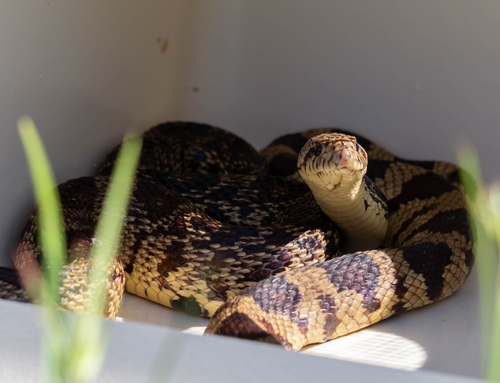
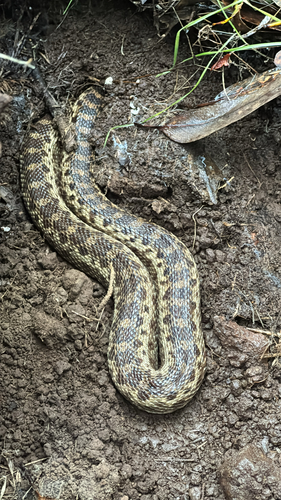 Gopher SnakeHarmless
Rattlesnakes are sometimes confused with harmless gophersnakes/bullsnakes; only rattlesnakes have a true segmented rattle and a facial pit.
Timber Rattlesnake vs Gopher Snake→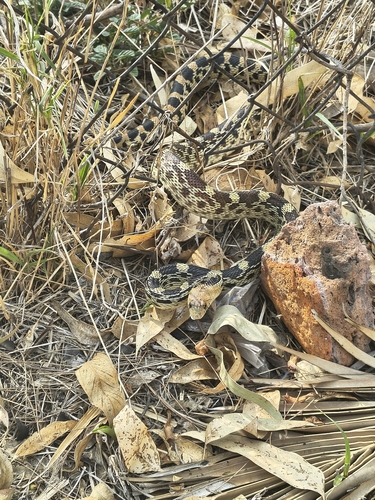
More Viperidae snakes
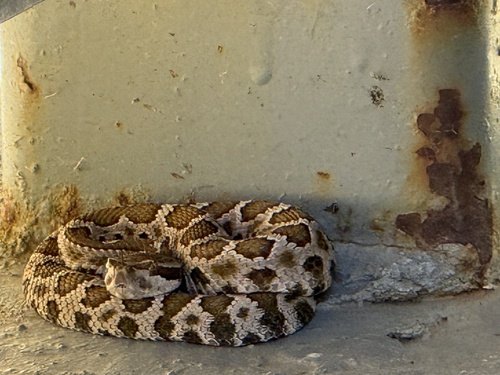 Western RattlesnakeCrotalus oreganus
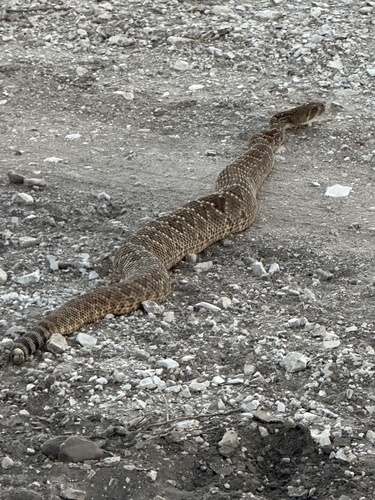 Western Diamond-backed RattlesnakeCrotalus atrox
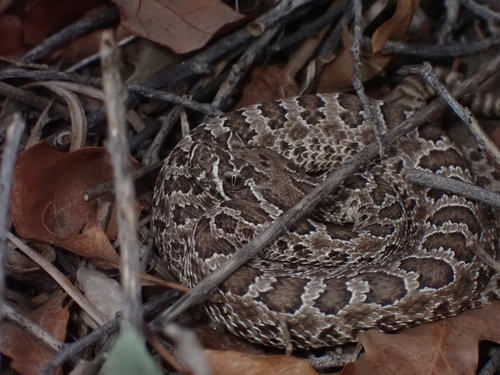 Prairie RattlesnakeCrotalus viridis
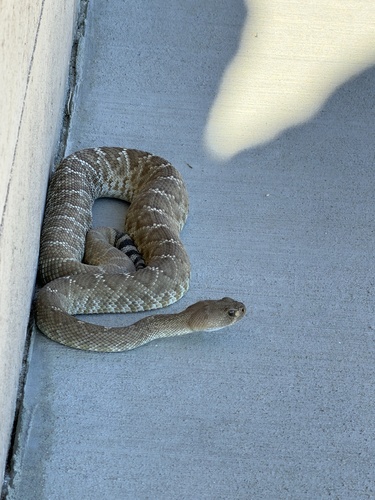 Red Diamond RattlesnakeCrotalus ruber
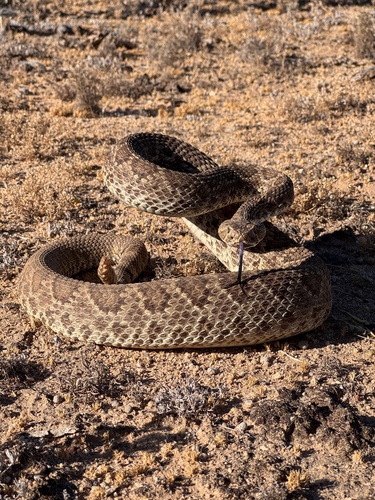 Mojave RattlesnakeCrotalus scutulatus
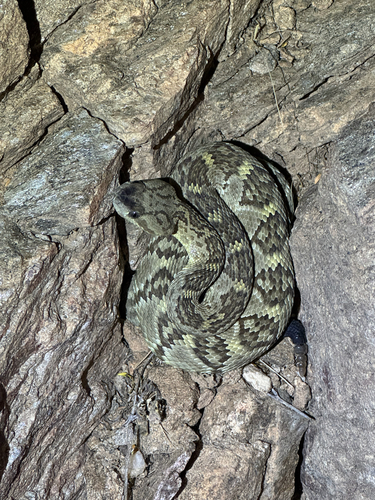 Western Black-tailed RattlesnakeCrotalus molossus
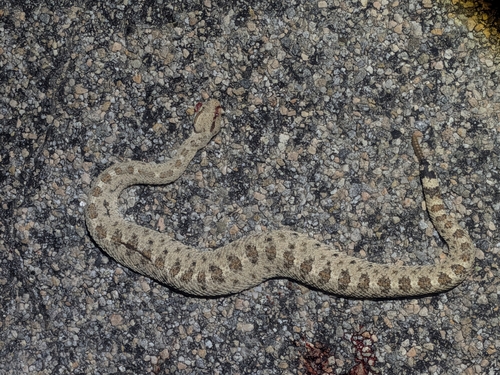 SidewinderCrotalus cerastes
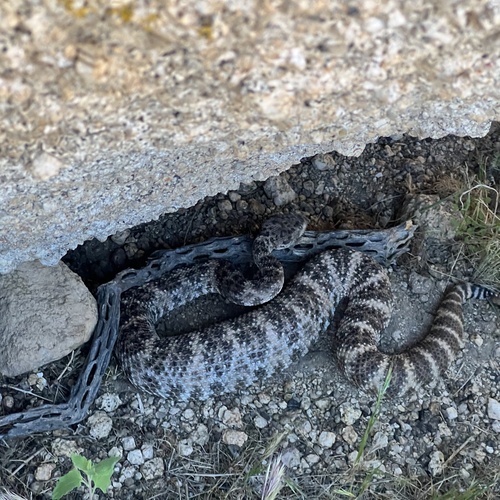 Southwestern Speckled RattlesnakeCrotalus pyrrhus
Classification
How scientists group this snake, from the broadest category down to the exact species. Each step narrows to its closest relatives.
Keep learning
- Are Snakes Dangerous? The Real Risk, in PerspectiveMost snakes are harmless and avoid people. Here is the honest picture of snakebite risk worldwide and how to lower your own.
- Snakebite First Aid: What to Do (and What Never to Do)A clear, CDC-based guide to snakebite first aid: the steps that help, the popular myths that hurt, and how to tell a serious bite from a minor one.
- Venomous vs Nonvenomous: How to Tell the DifferenceThe folk rules for telling venomous snakes apart, where each one fails, and why location-based identification beats guessing by sight.
- What to Do If You Find a SnakeFound a snake at home or on a trail? Here is how to stay calm, give it space, identify it safely, and know when to call a professional.
Distribution from GBIF & iNaturalist. Venom status per CDC. Background: Wikipedia. Informational only. Never handle a snake to identify it.