
Colubridae
Red-tailed Green Ratsnake
HarmlessGonyosoma oxycephalum
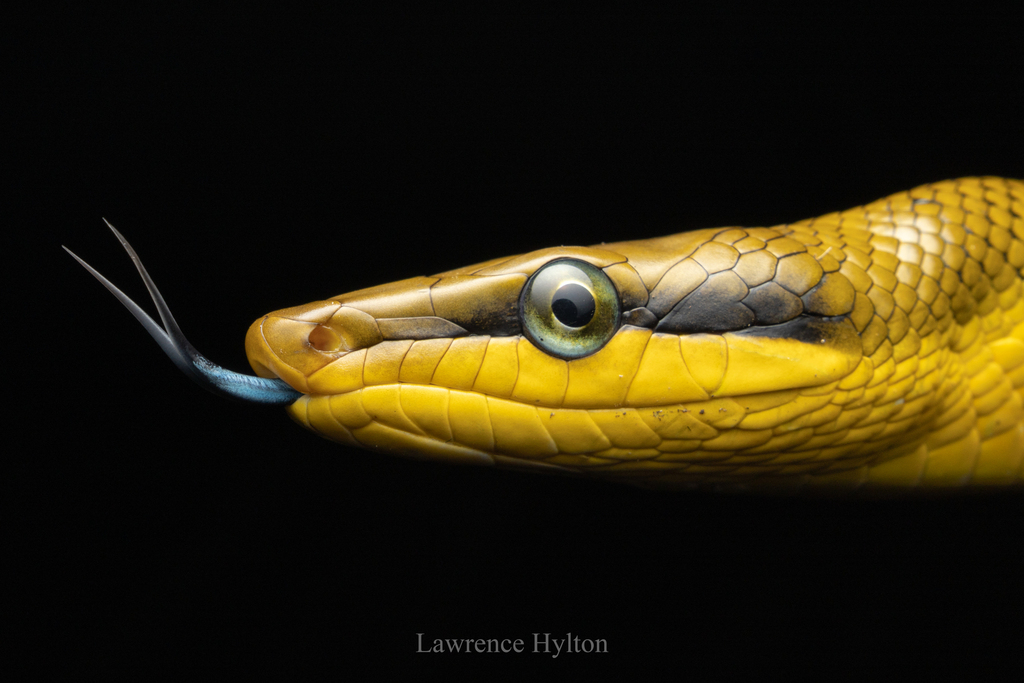
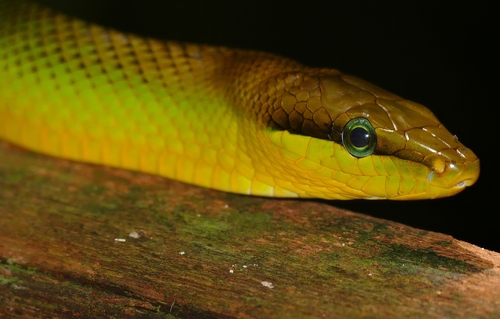
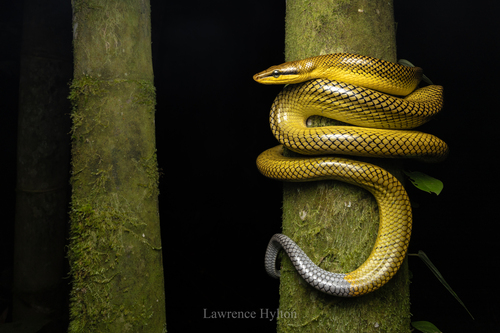
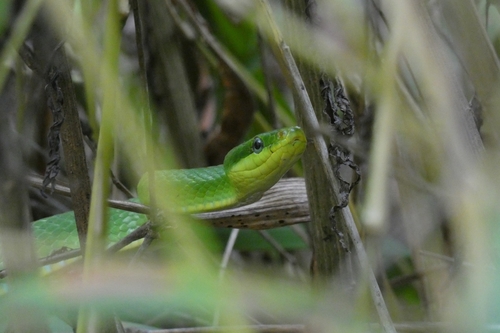
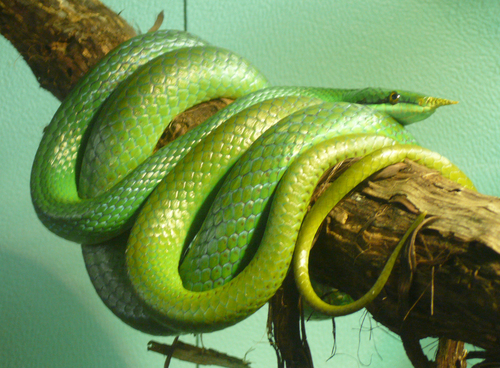
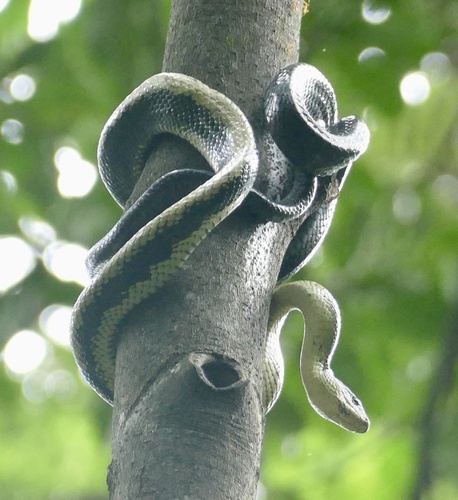
3 photographs of the Red-tailed Green Ratsnake. (c) Lawrence Hylton, some rights reserved (CC BY), uploaded by Lawrence Hylton.
The Red-tailed Green Ratsnake (Gonyosoma oxycephalum) is a non-venomous snake in the Colubridae family, recorded in 18 countries.
- Family
- Colubridae
About the Red-tailed Green Ratsnake
Gonyosoma oxycephalum, known commonly as the arboreal ratsnake, the red-tailed green rat snake, and the red-tailed racer, is a species of snake in the family Colubridae. The species is endemic to Southeast Asia.
It was first described by Friedrich Boie in 1827.
Distribution
G. oxycephalumm is found in
Indonesia (Bangka, Belitung, Java, Kalimantan/Borneo, Karimata, Legundi, Lombok, Mentawai islands, Natuna islands, Nias, Panaitan, Riau archipelago, Sebuku, Sumatra, Tambelan archipelago),
Malaysia (Malaya and East Malaysia, Pulau Tioman ?),
Singapore Island, Penang Island,
India (Andaman Islands),
Myanmar,
Thailand (incl. Phuket), Cambodia, Laos, Vietnam,
Philippine Islands (Balabac, Bohol, Catanduanes, Lubang, Luzon, Negros, Palawan, Sulu Archipelago, Panay).
The type locality is Indonesia: Java (F. Boie, 1827).
Description
G. oxycephalum is a robust powerful snake, with wide smooth scales on its belly that are ideal for climbing trees and across branches. It has smaller, smooth scales on its back, which is usually bright green or light green and may have a black net-like pattern. A gray-colored morph with a yellow head exists in Panay, in the Philippines.
As some of its common names indicate, the snake has a green body with a red tail, but is usually brown. It also has a dark line horizontally across the eye. On the sides of its black tongue there may be brown and blue colour. The top of the head may be dark green, yellow-green, or yellow in colour.
The female can reach a length of up to 2.4 m (almost 8 feet), while the male is generally a little bit smaller but brighter in coloration.
Behavior
The red-tailed green ratsnake lives and spends its life in the trees and in cavities of trees. It seldom descends to the ground. When the snake is stressed, it may inflate a bag of air in its neck, making it appear larger in size.
In captivity, it has quite the "attitude" and may strike at or bite an unwary handler. Its temperament can be unpredictable and may change from time to time but an individual may become tame through proper handling.
Diet
G. oxycephalum feeds almost exclusively on birds, bird eggs, lizards, and bats. It catches them in mid-air while hanging amongst branches. In captivity, it can be trained to feed on rodents such as mice and rats
Reproduction
G. oxycephalum reaches sexually maturity at 4 years of age, and its eggs have a hatching time from 13 to 16 weeks. The female lays on average between 3 and 8 eggs usually between September and January and the hatchlings are about 45 cm (18 inches) long.
Longevity
The average life span of G. oxycephalum in captivity is 20 years.
Population
As of 2015, the red-tailed green ratsnake was categorized as least concern by the IUCN due to its relatively healthy population estimated at 15,000-20,000 individuals across its range. However, recent data as of 2022 indicates a decline in its numbers, with an estimated population of around 10,000-15,000. Despite this decline, it still retains its least status.
Adapted from Wikipedia, available under CC BY-SA.
Frequently asked: Red-tailed Green Ratsnake
- Is the Red-tailed Green Ratsnake venomous?
- No. The Red-tailed Green Ratsnake (Gonyosoma oxycephalum) is non-venomous and is not considered dangerous to humans. Like most snakes, it will retreat rather than bite when given the chance.
- Is the Red-tailed Green Ratsnake poisonous?
- Snakes are venomous, not poisonous. "Poisonous" means harmful to eat or touch; "venomous" means injecting toxins through a bite. The Red-tailed Green Ratsnake is neither poisonous nor venomous.
- Is the Red-tailed Green Ratsnake dangerous?
- The Red-tailed Green Ratsnake is not dangerous to humans. It has no medically significant venom and bites only defensively if cornered or handled.
- Where does the Red-tailed Green Ratsnake live?
- The Red-tailed Green Ratsnake has verified records in 18 countries, including Indonesia, Malaysia, Thailand. See the distribution section below for its full range.
- What does the Red-tailed Green Ratsnake eat?
- G. oxycephalum feeds almost exclusively on birds, bird eggs, lizards, and bats. It catches them in mid-air while hanging amongst branches. In captivity, it can be trained to feed on rodents such as mice and rats
Where it is found
More Colubridae snakes
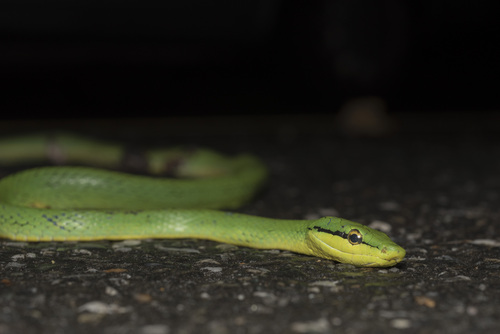 Rein SnakeGonyosoma frenatum
 Blue-eyed Bush Rat SnakeGonyosoma coeruleum
 Rhino Rat SnakeGonyosoma boulengeri
 Celebes Black-Tailed RatsnakeGonyosoma jansenii
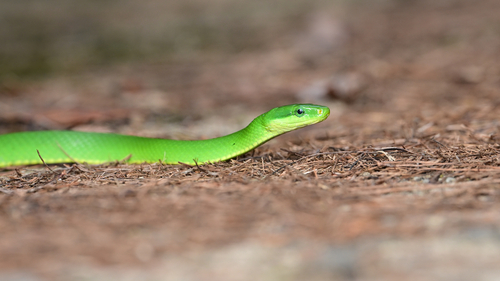 Jade Tree SnakeGonyosoma iadinum
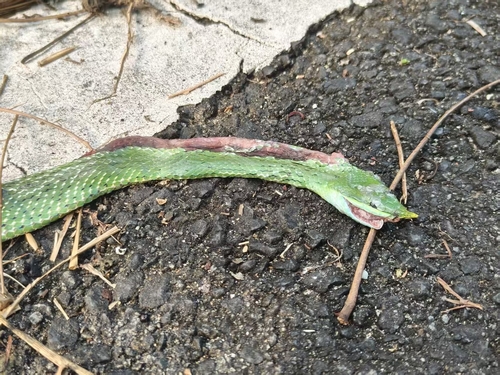 Hainan Rhinoceros SnakeGonyosoma hainanense
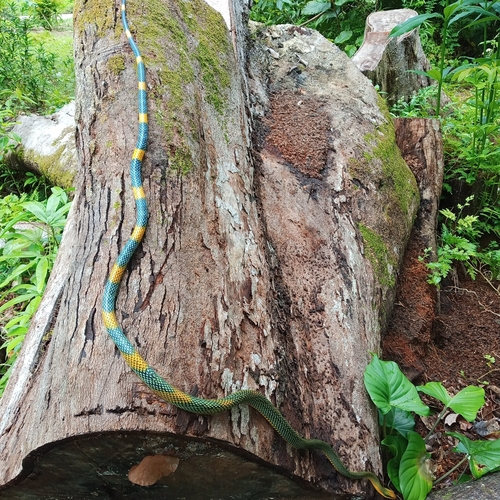 Rainbow Tree SnakeGonyosoma margaritatum
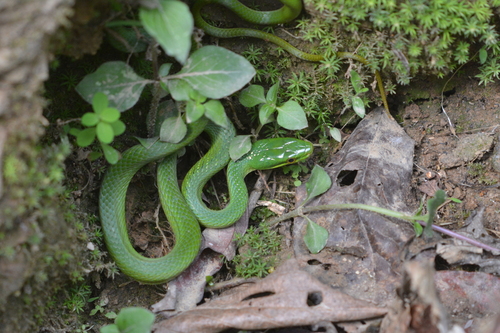 Green Bush Rat SnakeGonyosoma prasinum
Classification
How scientists group this snake, from the broadest category down to the exact species. Each step narrows to its closest relatives.
- OrderThe broad group of scaled reptiles: all snakes and lizards
- Squamata
- FamilyA group of related snakes that share key traits
- Colubridae
- GenusA close-knit group of very similar species
- Gonyosoma
- SpeciesThis exact snake, named in the two-part scientific name
- Gonyosoma oxycephalum
Keep learning
- What to Do If You Find a SnakeFound a snake at home or on a trail? Here is how to stay calm, give it space, identify it safely, and know when to call a professional.
- Venomous vs Nonvenomous: How to Tell the DifferenceThe folk rules for telling venomous snakes apart, where each one fails, and why location-based identification beats guessing by sight.
- What Is a Snake? Anatomy and the BasicsA clear overview of what makes a snake a snake: limbless body plan, anatomy, evolution from lizards, species diversity, and why they are ectothermic.
- How to Keep Snakes Out of Your Yard and HomeA practical guide to keeping snakes out of your yard and home using habitat changes that work, plus what to skip and what to do if one shows up.
Distribution from GBIF & iNaturalist. Venom status per CDC. Background: Wikipedia. Informational only. Never handle a snake to identify it.