
Genus · Colubridae
Gonyosoma
9 species make up the genus Gonyosoma. None are considered dangerous to humans.
About Asian green and rat snakes (Gonyosoma)
Slender, day-active Asian climbers, including the famous Red-tailed Green Ratsnake and the horn-nosed Rhino Rat Snake.
Gonyosoma is a genus of nonvenomous colubrid snakes in the family Colubridae, the largest snake family on Earth and the group that holds most of the world's typical, harmless snakes. Within that family Gonyosoma belongs to the rat snake lineage, an assemblage of slender, agile, primarily tree-climbing constrictors. Our database lists nine species in the genus, including the Red-tailed Green Ratsnake, the Rein Snake, the Blue-eyed Bush Rat Snake, and the striking Rhino Rat Snake.
These snakes live in South, Southeast, and East Asia. Their range runs across regions such as India, southern China, mainland Southeast Asia, and the islands of Indonesia and the Philippines. They are strongly associated with forest: tropical and subtropical rainforest, bamboo stands, riverside vegetation, and forest edges. As skilled climbers they spend much of their lives off the ground in trees, shrubs, and tangled growth, which is why several members carry the word bush or tree in their common names.
Members of Gonyosoma are usually recognized by a long, narrow body built for climbing, a distinct head, and large eyes that signal a day-active, visually hunting animal. Many species are vivid green, sometimes with contrasting markings or a differently colored tail, as in the Red-tailed Green Ratsnake. Others are brown or duller. The Rhino Rat Snake is unmistakable thanks to the soft, pointed scaled projection on the tip of its snout, a feature that gives it its name. Color alone is not a reliable identifier across the whole genus, so range and habitat matter for placing a given animal.
On safety, these are nonvenomous colubrids. They subdue prey by gripping and constriction rather than by injecting venom, and they pose no medically significant venom threat to people. As with any wild snake, a cornered individual may flatten its body, gape, or bite in defense, and any bite can break skin and should be cleaned to prevent ordinary infection. The genus is best treated as harmless wildlife to be observed and left alone rather than handled. If a person is ever bitten by a snake they cannot confidently identify, treat it as a medical situation and contact emergency services or US Poison Control at 1-800-222-1222.
Ecologically, Gonyosoma snakes are active predators of warm-blooded prey and other small vertebrates. The rat snake name reflects a diet that commonly includes rodents, birds, and bird eggs, with some species also taking lizards, frogs, or bats, all captured by stalking and constriction. They are egg-laying snakes, producing clutches that hatch into independent young. Behavior tends toward alert and arboreal: quick to climb, prone to bluff displays when threatened, and reliant on green coloration and stillness for camouflage among foliage.
Gonyosoma belongs to the Colubridae family (Colubrids). The largest snake family, and the one most snakes you meet belong to. Typically round pupils, a head only slightly wider than the neck, and no heat-sensing facial pit or rattle. Scales may be smooth and glossy or keeled and matte depending on the species.
Danger: Almost all colubrids are harmless. A small number are rear-fanged with medically significant venom, the boomslang and the twig (vine) snakes of Africa being the dangerous exceptions. Most colubrids will flee or bluff rather than bite.
All species (9)
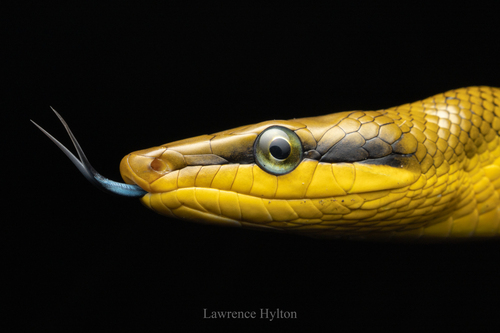 Red-tailed Green RatsnakeGonyosoma oxycephalumHarmless
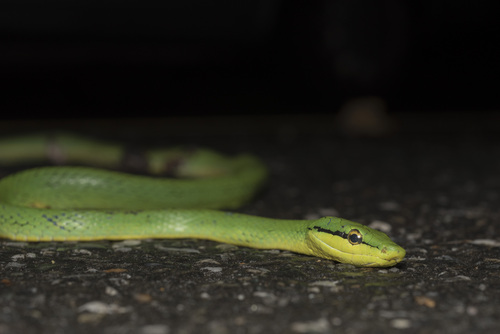 Rein SnakeGonyosoma frenatumHarmless
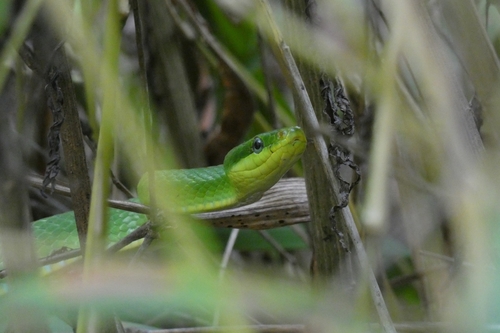 Blue-eyed Bush Rat SnakeGonyosoma coeruleumHarmless
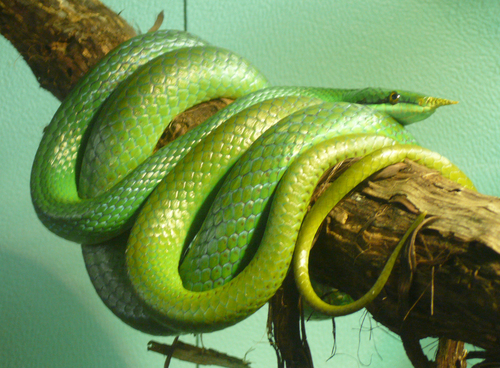 Rhino Rat SnakeGonyosoma boulengeriHarmless
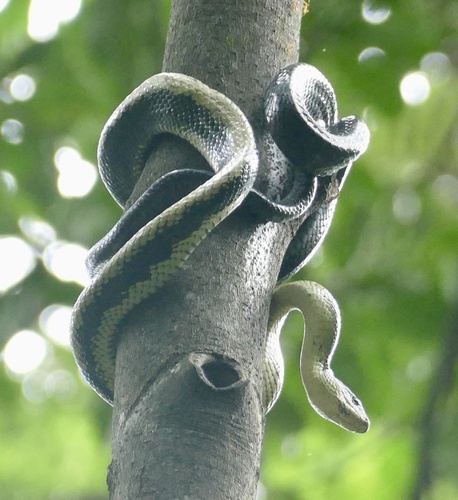 Celebes Black-Tailed RatsnakeGonyosoma janseniiHarmless
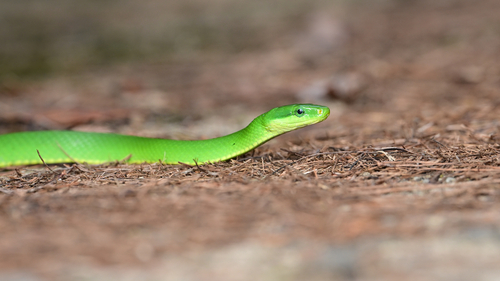 Jade Tree SnakeGonyosoma iadinumHarmless
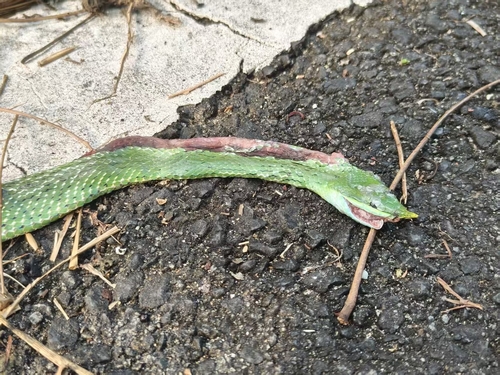 Hainan Rhinoceros SnakeGonyosoma hainanenseHarmless
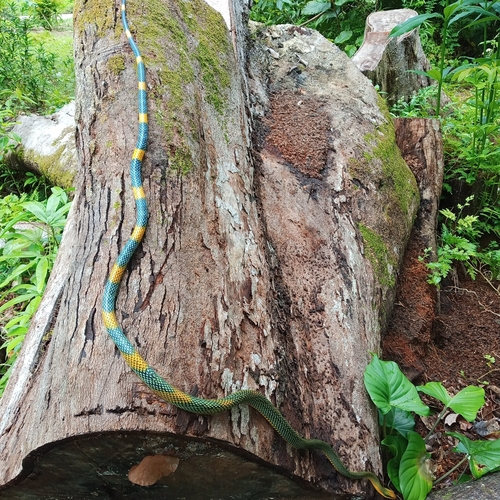 Rainbow Tree SnakeGonyosoma margaritatumHarmless
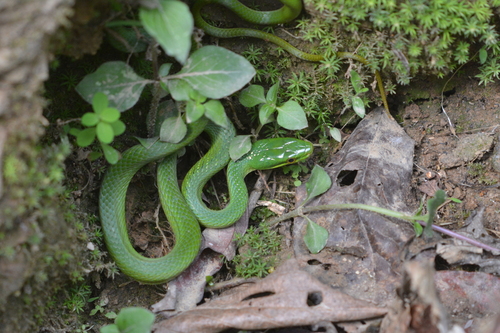 Green Bush Rat SnakeGonyosoma prasinumHarmless
Keep learning
- What Is a Snake? Anatomy and the BasicsA clear overview of what makes a snake a snake: limbless body plan, anatomy, evolution from lizards, species diversity, and why they are ectothermic.
- How Snakes Move, Hunt, and EatHow snakes move without legs, hunt as ambushers or active foragers, kill by constriction or venom, and swallow prey wider than their head.
- What Do Snakes Eat?All snakes are carnivores. Learn what snakes eat, how diet changes with size and age, how often they feed, and how they hunt and swallow prey.
- Venomous vs Nonvenomous: How to Tell the DifferenceThe folk rules for telling venomous snakes apart, where each one fails, and why location-based identification beats guessing by sight.