
Colubridae
Rhino Rat Snake
HarmlessGonyosoma boulengeri
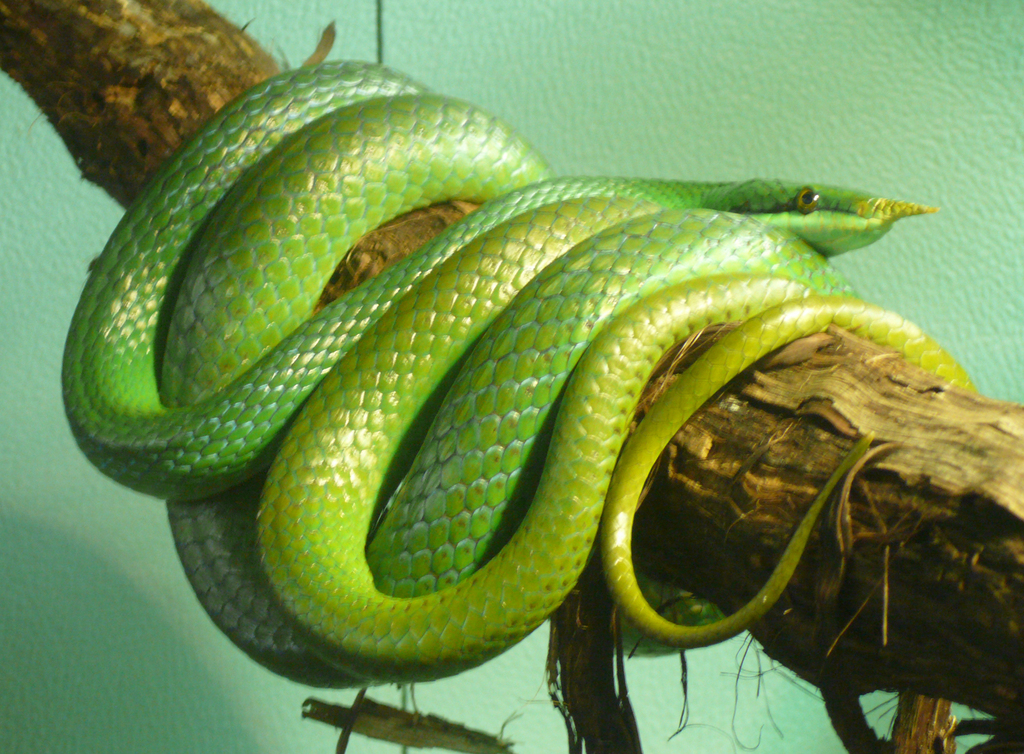
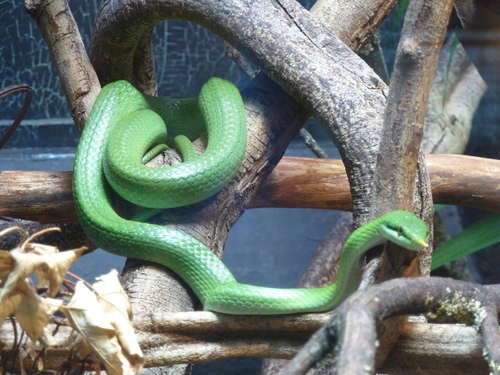
2 photographs of the Rhino Rat Snake. TimVickers, no known copyright restrictions (public domain).
The Rhino Rat Snake (Gonyosoma boulengeri) is a non-venomous snake in the Colubridae family, recorded in 3 countries.
- Family
- Colubridae
About the Rhino Rat Snake
The rhinoceros ratsnake (Gonyosoma boulengeri), also known commonly as the rhinoceros snake, rhino rat snake, and Vietnamese longnose snake, is a species of nonvenomous ratsnake in the family Colubridae. The species is found from northern Vietnam to southern China. It has a prominent, distinctive, scaled protrusion on the front of its snout, which has led to its common naming after a rhinoceros.
Etymology
The specific name, boulengeri, is in honor of Belgian-British biologist George Albert Boulenger.
Geographic range
G. boulengeri is found in northern Vietnam including Tam Dao, and in southern China. During a 2001 survey, 10 specimens were observed in Yên Bái Province, northern Vietnam.
Description
The adult size of G. boulengeri is 100–160 cm (39–63 in) in total length (including tail). Its scale count includes 19 rows of dorsals at midbody.
Natural history
The rhinoceros ratsnake inhabits subtropical rainforests at elevations between 300 and 1,100 m (980 and 3,610 ft), particularly valleys with streams. It is generally arboreal, and mostly diurnal, hunting small mice and other rodents, birds, and perhaps other vertebrate prey. Oviparous, its mating season from April to May may produce five to 10 eggs in a clutch. After 60 days' incubation, hatchlings are 30–35 cm (12–14 in) total length, brownish grey with dark edges on several dorsal scales. As they mature, rhinoceros ratsnakes change color to steel grey at about 12–14 months, then to a bluish green or green adult hue at about 24 months. However, a rare few individuals maintain their steel grey subadult color and do not pass into ordinarily mature color phase. Studies conducted by Bangor University have suggested that the nasal protrusion is used for mating displays in which the males may 'fence' off rivals. Other studies have found little correlation between the use of the nasal protrusion and courtship displays, which may suggest the true function is still unknown.
Adapted from Wikipedia, available under CC BY-SA.
Frequently asked: Rhino Rat Snake
- Is the Rhino Rat Snake venomous?
- No. The Rhino Rat Snake (Gonyosoma boulengeri) is non-venomous and is not considered dangerous to humans. Like most snakes, it will retreat rather than bite when given the chance.
- Is the Rhino Rat Snake poisonous?
- Snakes are venomous, not poisonous. "Poisonous" means harmful to eat or touch; "venomous" means injecting toxins through a bite. The Rhino Rat Snake is neither poisonous nor venomous.
- Is the Rhino Rat Snake dangerous?
- The Rhino Rat Snake is not dangerous to humans. It has no medically significant venom and bites only defensively if cornered or handled.
- Where does the Rhino Rat Snake live?
- The Rhino Rat Snake has verified records in 3 countries, including Viet Nam, China, United States of America. See the distribution section below for its full range.
- Why is it called the Rhino Rat Snake?
- The specific name, boulengeri, is in honor of Belgian-British biologist George Albert Boulenger.
Where it is found
More Colubridae snakes
 Red-tailed Green RatsnakeGonyosoma oxycephalum
 Rein SnakeGonyosoma frenatum
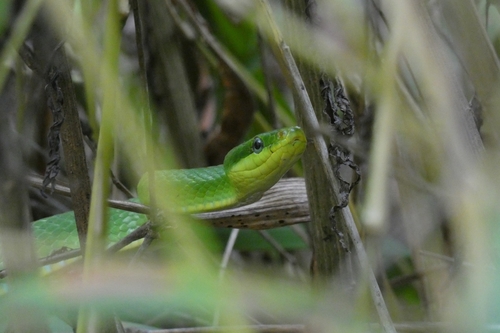 Blue-eyed Bush Rat SnakeGonyosoma coeruleum
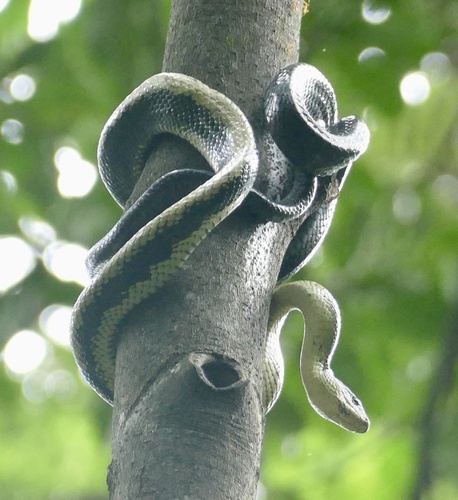 Celebes Black-Tailed RatsnakeGonyosoma jansenii
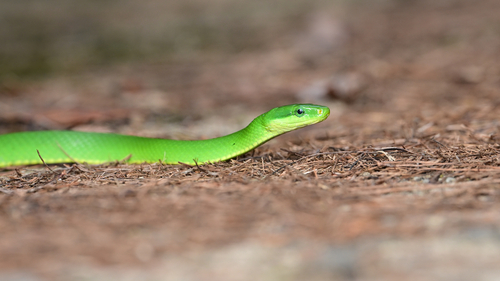 Jade Tree SnakeGonyosoma iadinum
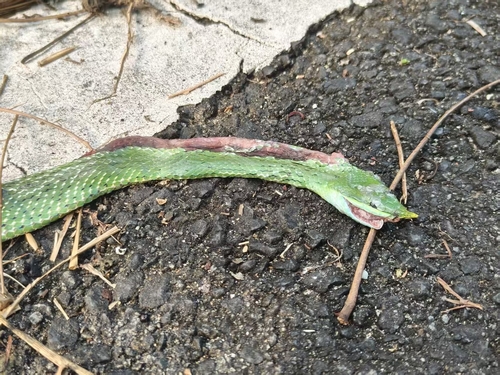 Hainan Rhinoceros SnakeGonyosoma hainanense
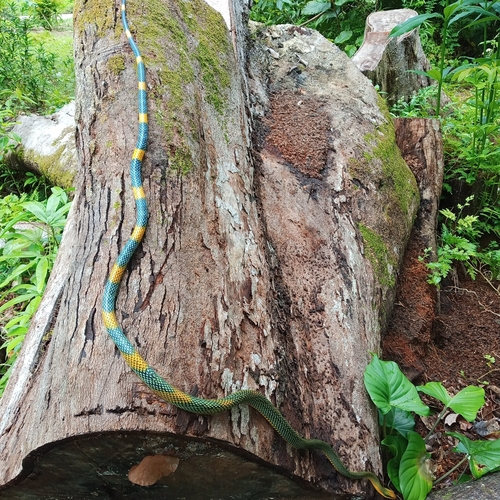 Rainbow Tree SnakeGonyosoma margaritatum
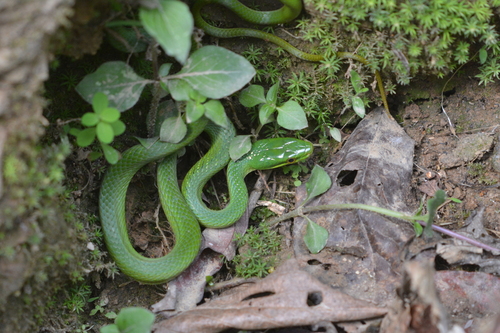 Green Bush Rat SnakeGonyosoma prasinum
Classification
How scientists group this snake, from the broadest category down to the exact species. Each step narrows to its closest relatives.
- OrderThe broad group of scaled reptiles: all snakes and lizards
- Squamata
- FamilyA group of related snakes that share key traits
- Colubridae
- GenusA close-knit group of very similar species
- Gonyosoma
- SpeciesThis exact snake, named in the two-part scientific name
- Gonyosoma boulengeri
Keep learning
- What to Do If You Find a SnakeFound a snake at home or on a trail? Here is how to stay calm, give it space, identify it safely, and know when to call a professional.
- Venomous vs Nonvenomous: How to Tell the DifferenceThe folk rules for telling venomous snakes apart, where each one fails, and why location-based identification beats guessing by sight.
- What Is a Snake? Anatomy and the BasicsA clear overview of what makes a snake a snake: limbless body plan, anatomy, evolution from lizards, species diversity, and why they are ectothermic.
- How to Keep Snakes Out of Your Yard and HomeA practical guide to keeping snakes out of your yard and home using habitat changes that work, plus what to skip and what to do if one shows up.
Distribution from GBIF & iNaturalist. Venom status per CDC. Background: Wikipedia. Informational only. Never handle a snake to identify it.