
Colubridae
Rein Snake
HarmlessGonyosoma frenatum
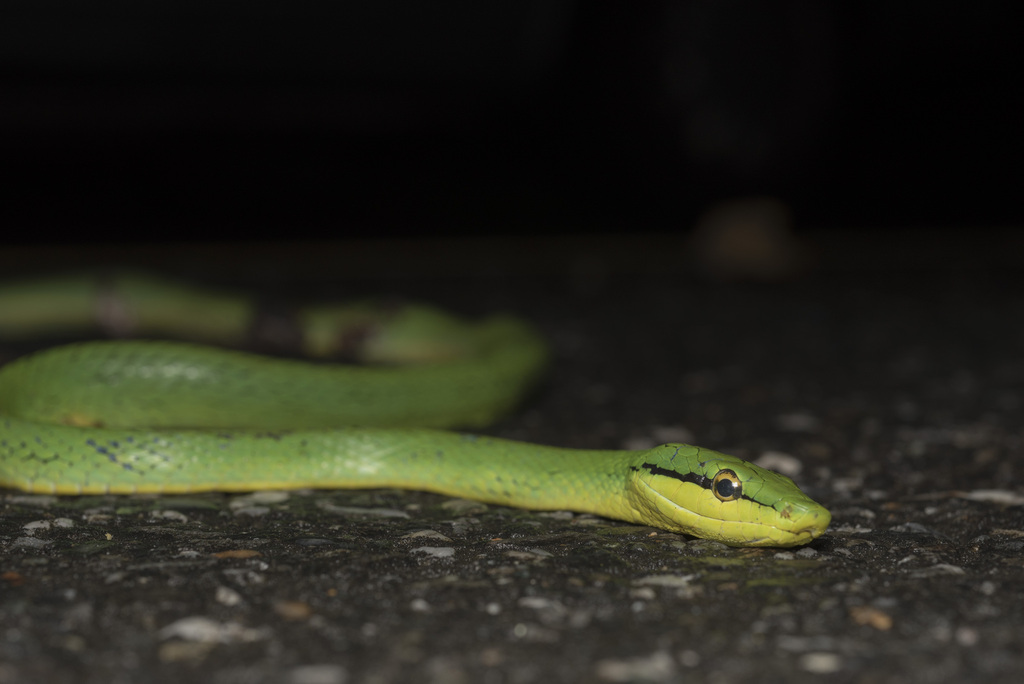
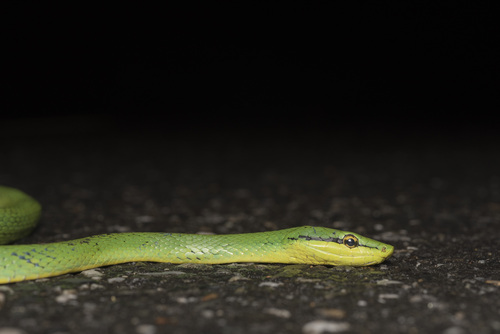
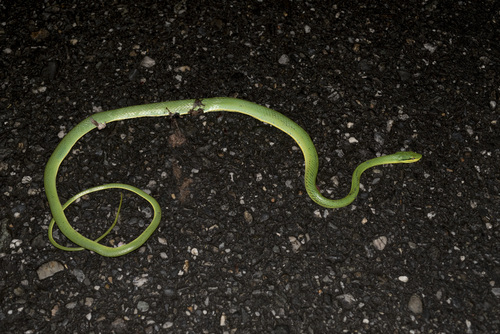
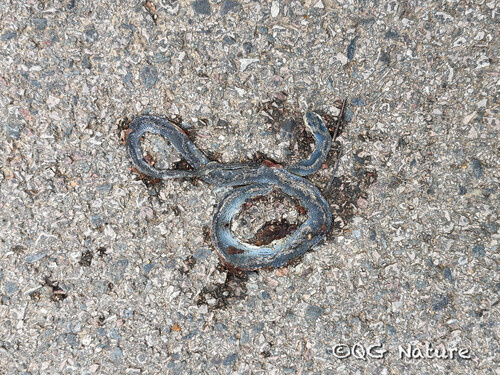
4 photographs of the Rein Snake. © Licheng Shih.
The Rein Snake (Gonyosoma frenatum) is a non-venomous snake in the Colubridae family, recorded in 7 countries.
- Family
- Colubridae
About the Rein Snake
Gonyosoma frenatum, common name Khasi Hills trinket snake, is a species of colubrid snake found in north-eastern India, southern China, Taiwan, and Vietnam.
Description
Gonyosoma frenatum reaches roughly 84 cm (2 feet 9 inches) in body length, with a 24 cm (9.5 inch) tail. They are uniform bright green above with a black streak along each side of the head, passing through the eye. The upper lip and lower parts are pale green and they have a whitish ventral keel.
They have a subacuminate snout twice as long as its eye, obliquely truncated and projecting. Its rostral is a little broader than deep and hardly visible from above. The suture between the internasals is much shorter than that between the prefrontals. The frontal is as long as its distance from the end of the snout, shorter than the parietals, with no loreal. The prefrontal is in contact with the labials. It has one large preocular, two post-oculars with temporals 2+2 or 2+3 and 9 (or 8) upper labials, fourth, fifth, and sixth entering the eye. Five lower labials are in contact with the anterior chin-shields, which are as long as the posterior. Scales are in 19 rows, dorsals faintly keeled. Ventrals have a lateral keel, 203–204, anal divided; subcaudals 120–121.
Distribution
NE India (Assam, Arunachal Pradesh)
S China (to SW Sichuan; Fujian, Guangdong, Anhui, Guangxi, Guizhou, Zhejiang)
Taiwan
North Vietnam
Type locality: India: Khasi Hills (Gray, 1853)
Adapted from Wikipedia, available under CC BY-SA.
Frequently asked: Rein Snake
- Is the Rein Snake venomous?
- No. The Rein Snake (Gonyosoma frenatum) is non-venomous and is not considered dangerous to humans. Like most snakes, it will retreat rather than bite when given the chance.
- Is the Rein Snake poisonous?
- Snakes are venomous, not poisonous. "Poisonous" means harmful to eat or touch; "venomous" means injecting toxins through a bite. The Rein Snake is neither poisonous nor venomous.
- Is the Rein Snake dangerous?
- The Rein Snake is not dangerous to humans. It has no medically significant venom and bites only defensively if cornered or handled.
- Where does the Rein Snake live?
- The Rein Snake has verified records in 7 countries, including China, Chinese Taipei, Viet Nam. See the distribution section below for its full range.
Where it is found
More Colubridae snakes
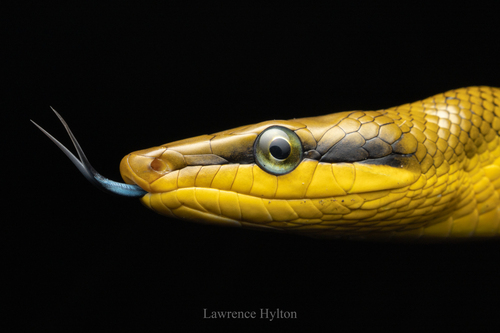 Red-tailed Green RatsnakeGonyosoma oxycephalum
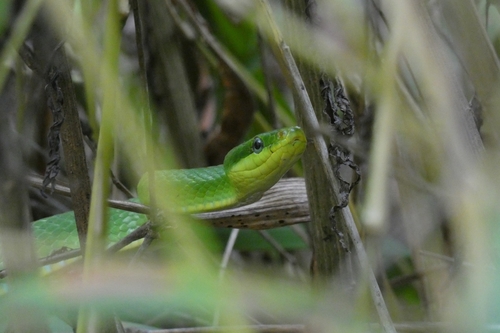 Blue-eyed Bush Rat SnakeGonyosoma coeruleum
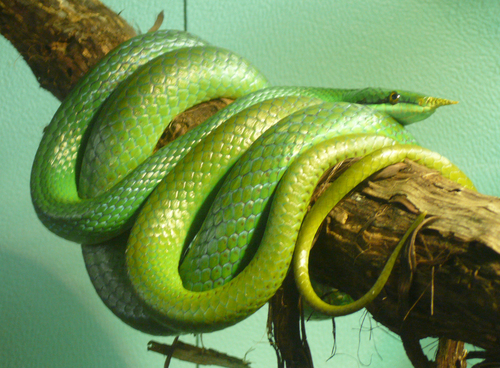 Rhino Rat SnakeGonyosoma boulengeri
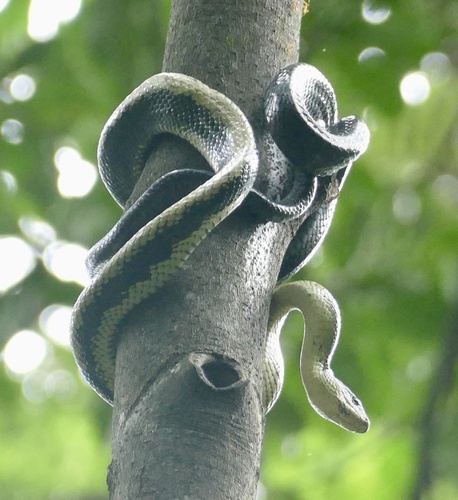 Celebes Black-Tailed RatsnakeGonyosoma jansenii
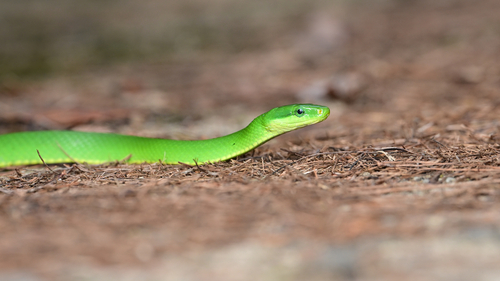 Jade Tree SnakeGonyosoma iadinum
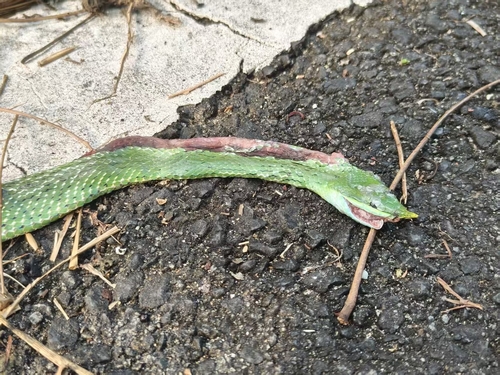 Hainan Rhinoceros SnakeGonyosoma hainanense
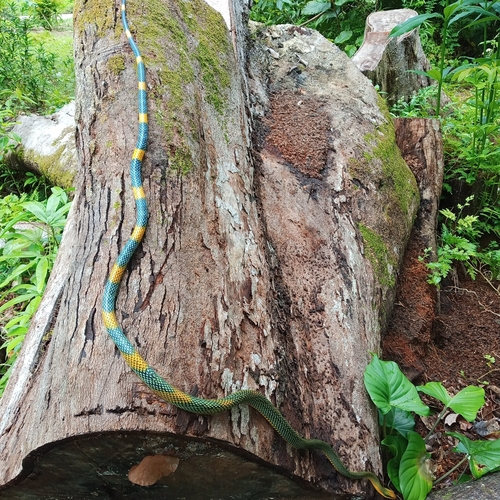 Rainbow Tree SnakeGonyosoma margaritatum
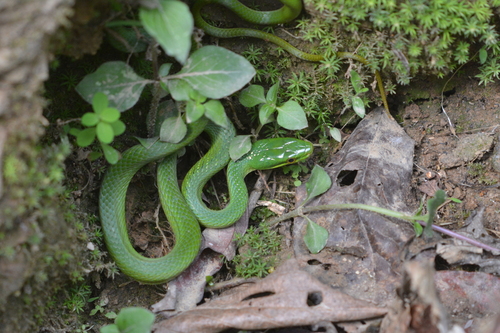 Green Bush Rat SnakeGonyosoma prasinum
Classification
How scientists group this snake, from the broadest category down to the exact species. Each step narrows to its closest relatives.
- OrderThe broad group of scaled reptiles: all snakes and lizards
- Squamata
- FamilyA group of related snakes that share key traits
- Colubridae
- GenusA close-knit group of very similar species
- Gonyosoma
- SpeciesThis exact snake, named in the two-part scientific name
- Gonyosoma frenatum
Keep learning
- What to Do If You Find a SnakeFound a snake at home or on a trail? Here is how to stay calm, give it space, identify it safely, and know when to call a professional.
- Venomous vs Nonvenomous: How to Tell the DifferenceThe folk rules for telling venomous snakes apart, where each one fails, and why location-based identification beats guessing by sight.
- What Is a Snake? Anatomy and the BasicsA clear overview of what makes a snake a snake: limbless body plan, anatomy, evolution from lizards, species diversity, and why they are ectothermic.
- How to Keep Snakes Out of Your Yard and HomeA practical guide to keeping snakes out of your yard and home using habitat changes that work, plus what to skip and what to do if one shows up.
Distribution from GBIF & iNaturalist. Venom status per CDC. Background: Wikipedia. Informational only. Never handle a snake to identify it.