
Elapidae
Northern King Cobra
VenomousOphiophagus hannah
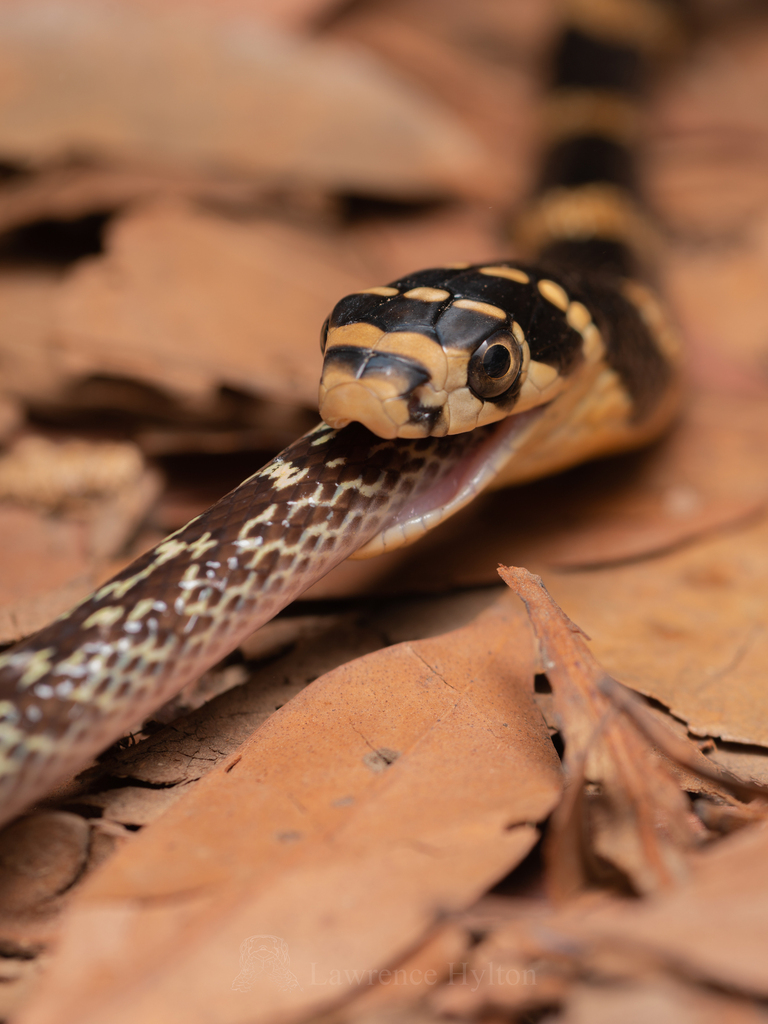
The Northern King Cobra (Ophiophagus hannah) is a venomous snake in the Elapidae family, recorded in 17 countries.
If you are bitten
This is a venomous snake. Treat any bite as a medical emergency: stay calm, keep the bitten limb still and roughly level with the heart, remove rings and tight clothing, and get to emergency care immediately. Do not apply a tourniquet, cut the wound, apply ice, or try to suck out venom. Call your local emergency number or poison center.
- Family
- Elapidae
- Danger
- high
About the Northern King Cobra
The king cobra (Ophiophagus hannah) is a species complex of snakes endemic to Asia. With an average length of 3.18 to 4 m (10.4 to 13.1 ft) and a record length of 5.85 m (19.2 ft), it is the world's longest venomous snake and among the heaviest. Under the genus Ophiophagus, it is not phylogenetically a true cobra despite its common name and some resemblance. Spanning from the Indian subcontinent through Southeastern Asia to Southern China, the king cobra is widely distributed albeit not commonly seen.
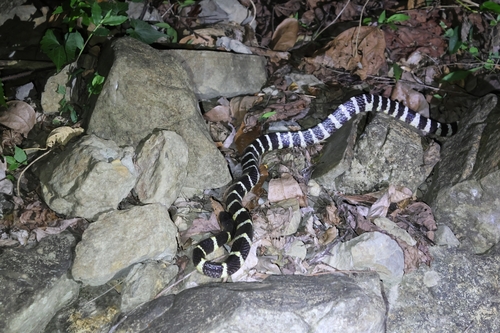
Individuals have diversified colouration across its habitats, from black with white strips to unbroken brownish grey, although after taxonomic re-evaluation, it is no longer the sole member of its genus but is now a species complex; these differences in pattern and other aspects may cause the genus to be split into at least four species, spread across its large geographic range.
It chiefly hunts other snakes, including those of its own kind, although other lizards and rodents are occasional prey items. This is the only ophidian that constructs an above-ground nest for its eggs, which are purposefully and meticulously gathered and protected by the female throughout the incubation period. Typical threat display of this elapid includes neck-flap spreading, head raising, hissing and sometimes charging. Capable of striking at a considerable range and height with an immense venom yield, envenomation from this species may induce rapid onset of neurotoxic and cytotoxic symptoms, requiring prompt antivenom administration. Despite the fearsome reputation, aggression toward humans usually only arises from an individual inadvertently exposing itself or being cornered; encounters happen through chance, including negative interactions.
Threatened by habitat destruction, it has been listed as Vulnerable on the IUCN Red List since 2010. Regarded as the national reptile of India, it has an eminent position in the mythology and folk traditions of India, Bangladesh, Sri Lanka and Myanmar.
Etymology
The king cobra is also referred to by the common name "hamadryad", especially in older literature. Hamadryas hannah was the scientific name used by Danish naturalist Theodore Edward Cantor in 1836 who described four king cobra specimens, three captured in the Sundarbans and one in the vicinity of Kolkata. The origin of the species name hannah was not specified during description and has long been uncertain, but may potentially refer to Hannah Sarah Wallich, the eldest daughter of Cantor's uncle, botanist Nathaniel Wallich, who hosted Cantor during his studies in India.
Taxonomy
The genus Ophiophagus was proposed by Günther in 1864 in place of Hamadryas, as the genus Hamadryas was already used for the cracker butterflies. The name is derived from its propensity to eat snakes. Ophiophagus hannah was accepted as the valid name for the king cobra by Charles Mitchill Bogert in 1945 who argued that it differs significantly from Naja species.
Adapted from Wikipedia, available under CC BY-SA.
Local and regional names
The Northern King Cobra is known by these names across the regions where it lives:
- Afrikaans
- Koningkobra
- Arabic
- ملك الكوبرا
- Bengali
- কিং কোবরা, পদ্ম গোখরা, রাজ গোখরা, শঙ্খচূড়, ৰাজফেঁটী সাপ
- Bulgarian
- кралска кобра
- Catalan
- cobra reial
- Chinese
- 眼鏡王蛇屬, 眼镜王蛇
- Croatian
- Kraljevska kobra
- Czech
- kobra královská
- Dutch
- koningscobra
- English
- Hamadryad, King Cobra, King Cobra/Hamadryad, tu mama e maraka
- Finnish
- Kuningaskobra
- French
- Cobra royal
- German
- Königskobra, Nördliche Königskobra
- Hebrew
- קוברה מלכותית, רב-פתן מלכותי
- Hungarian
- királykobra
- Indonesian
- Ular anang, Ular lanang
- Italian
- Cobra reale
- Japanese
- キングコブラ
- Kannada
- ಕಾಳಿಂಗ ಸರ್ಪ, ಕಾಳಿಂಗ ಸರ್ಪೆ
- Khmer
- ពស់វែករនាម
- Korean
- 킹코브라
- Malay
- Ular Tedung Selar
- Malayalam
- രാജവെമ്പാല
- Marathi
- गिम, दिवड नागीण, नागराज, वडलो
- Nepali
- Kenwata, राज गोमन
- Persian
- شاه کبرا
- Polish
- Kobra królewska
- Portuguese
- Cobra-real
- Romanian
- Cobra regală
- Russian
- Гамадриад, Королевская кобра, Королевские кобры
- Serbian
- Краљевска кобра
- Spanish
- Cobra real
- Swedish
- Kungskobra, Kungskobran
- Tamil
- இராச நாகம், இராஜ நாகம், கருநாகம்
- Telugu
- కింగ్ కోబ్రా, నల్ల త్రాచు, రాచనాగు
- Thai
- งูจงอาง, จงอาง
- Turkish
- Kral kobra
- Ukrainian
- Королівська кобра
- Vietnamese
- Rắn hổ chúa, Rắn hổ chúa phương Bắc, Rắn hổ mang chúa, Rắn hổ mây
Frequently asked: Northern King Cobra
- Is the Northern King Cobra venomous?
- Yes. The Northern King Cobra (Ophiophagus hannah) is venomous and belongs to the Elapidae family (cobra, mamba, coral or sea snake). Its bite is considered high risk to people. Treat any bite as a medical emergency.
- Is the Northern King Cobra poisonous?
- Snakes are venomous, not poisonous. "Poisonous" means harmful to eat or touch; "venomous" means injecting toxins through a bite. The Northern King Cobra is venomous, delivering venom through a bite.
- Is the Northern King Cobra dangerous?
- This is a venomous snake. Treat any bite as a medical emergency: stay calm, keep the bitten limb still and roughly level with the heart, remove rings and tight clothing, and get to emergency care immediately. Do not apply a tourniquet, cut the wound, apply ice, or try to suck out venom. Call your local emergency number or poison center.
- Where does the Northern King Cobra live?
- The Northern King Cobra has verified records in 17 countries, including India, Thailand, China. See the distribution section below for its full range.
- Why is it called the Northern King Cobra?
- The king cobra is also referred to by the common name "hamadryad", especially in older literature. Hamadryas hannah was the scientific name used by Danish naturalist Theodore Edward Cantor in 1836 who described four king cobra specimens, three captured in the Sundarbans and one in the vicinity of Kolkata. The origin of the species name hannah was not specified during description and has long been uncertain, but may potentially refer to Hannah Sarah Wallich, the eldest daughter of Cantor's uncle, botanist Nathaniel Wallich, who hosted Cantor during his studies in India.
If you are bitten by the Northern King Cobra
Do
- Get away from the snake and stay calm. Most bites worsen when people panic or try again to handle the snake.
- Call 911 or Poison Control (1-800-222-1222) right away. Antivenom works best when given early.
- Note the time of the bite and, from a safe distance, the snake's color and pattern, a phone photo is enough. Do not chase it.
- Keep the bitten limb still and at roughly heart level. Sit or lie down and limit movement.
- Remove rings, watches, and tight clothing near the bite before swelling starts.
- Gently wash the bite with soap and water and cover it with a clean, dry dressing.
Do not
- Do not cut the wound or try to suck out the venom.
- Do not apply a tourniquet or ice.
- Do not drink alcohol or caffeine.
- Do not take aspirin or ibuprofen, they can worsen bleeding. Acetaminophen is safer for pain.
- Do not try to catch or kill the snake. A dead snake can still bite by reflex.
First-aid guidance adapted from the U.S. Centers for Disease Control and Prevention (CDC NIOSH), Venomous Snakes. Educational only; always follow the instructions of emergency responders.
Where it is found
More Elapidae snakes
Classification
How scientists group this snake, from the broadest category down to the exact species. Each step narrows to its closest relatives.
- OrderThe broad group of scaled reptiles: all snakes and lizards
- Squamata
- FamilyA group of related snakes that share key traits
- Elapidae
- GenusA close-knit group of very similar species
- Ophiophagus
- SpeciesThis exact snake, named in the two-part scientific name
- Ophiophagus hannah
Keep learning
- Are Snakes Dangerous? The Real Risk, in PerspectiveMost snakes are harmless and avoid people. Here is the honest picture of snakebite risk worldwide and how to lower your own.
- Snakebite First Aid: What to Do (and What Never to Do)A clear, CDC-based guide to snakebite first aid: the steps that help, the popular myths that hurt, and how to tell a serious bite from a minor one.
- Venomous vs Nonvenomous: How to Tell the DifferenceThe folk rules for telling venomous snakes apart, where each one fails, and why location-based identification beats guessing by sight.
- What to Do If You Find a SnakeFound a snake at home or on a trail? Here is how to stay calm, give it space, identify it safely, and know when to call a professional.
Distribution from GBIF & iNaturalist. Venom status per CDC. Background: Wikipedia. Informational only. Never handle a snake to identify it.