
Elapidae
Monocled Cobra
VenomousNaja kaouthia
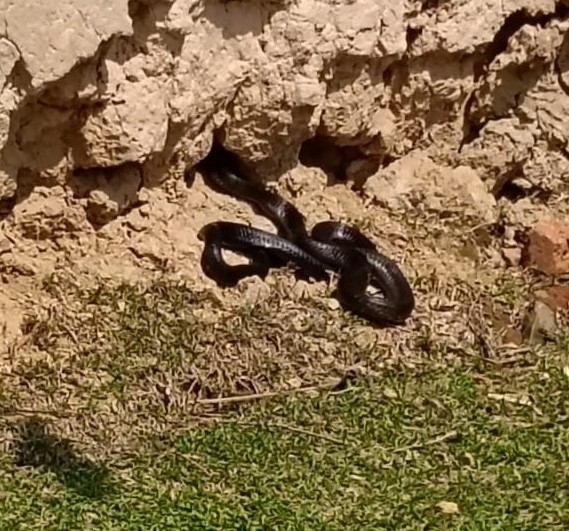
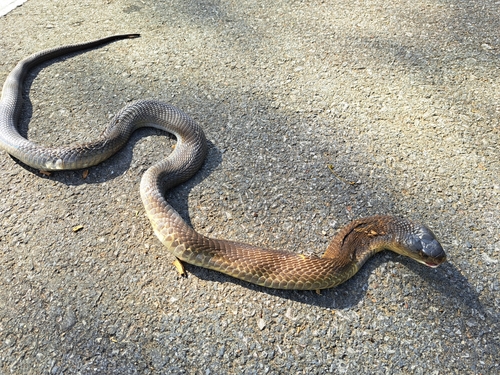
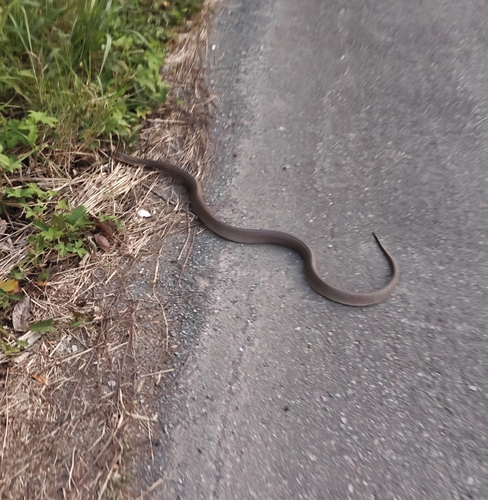
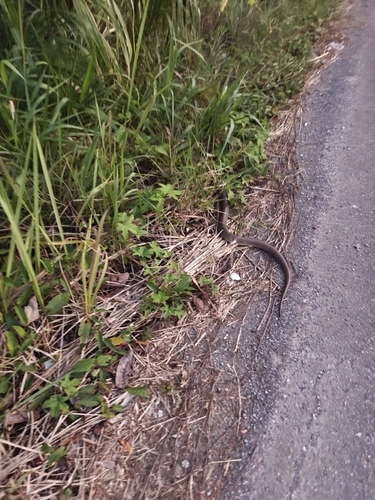
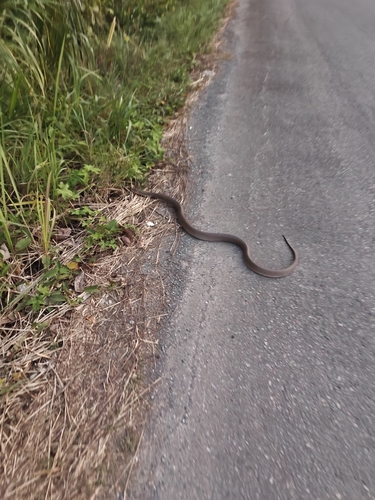
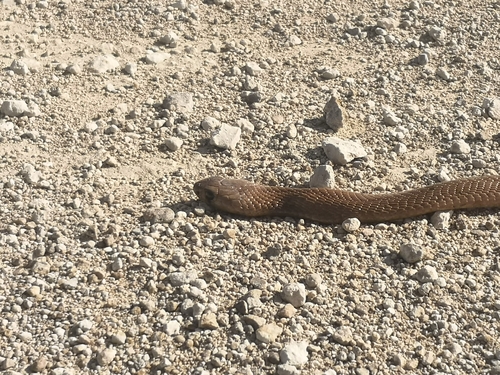
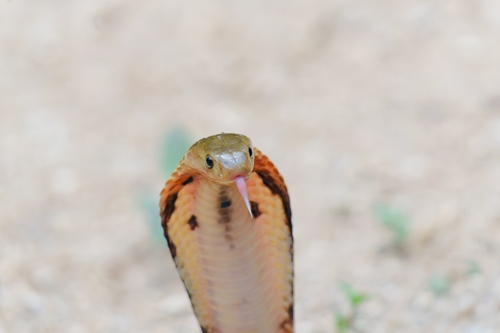
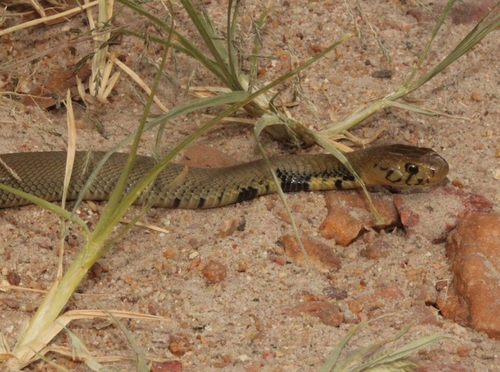
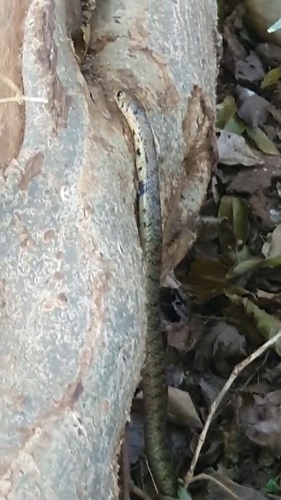
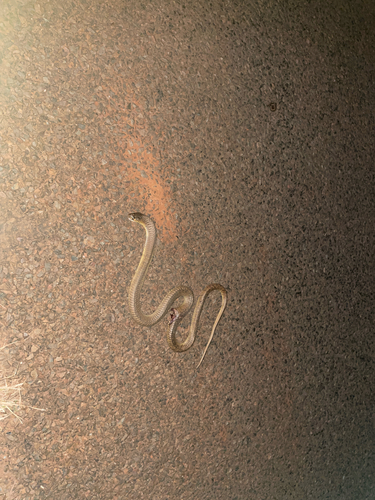
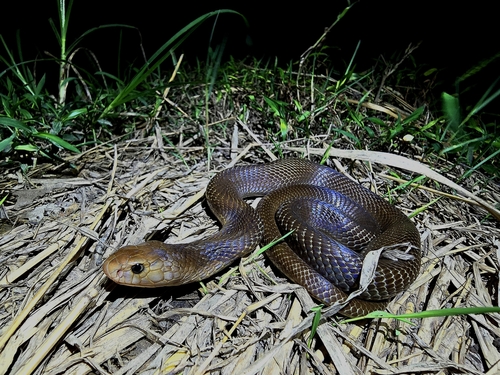
6 photographs of the Monocled Cobra. © Ankur Nandi.
The Monocled Cobra (Naja kaouthia) is a venomous snake in the Elapidae family, recorded in 16 countries.
If you are bitten
This is a venomous snake. Treat any bite as a medical emergency: stay calm, keep the bitten limb still and roughly level with the heart, remove rings and tight clothing, and get to emergency care immediately. Do not apply a tourniquet, cut the wound, apply ice, or try to suck out venom. Call your local emergency number or poison center.
- Family
- Elapidae
- Danger
- high
About the Monocled Cobra
The monocled cobra (Naja kaouthia), also called monocellate cobra and Indian spitting cobra, is a venomous cobra species widespread across South and Southeast Asia. It is characterized by a distinctive circular or "monocle"-shaped marking on the hood, though the pattern can be highly variable or even absent in some individuals. It occupies a wide range of habitats, including forests, agricultural land, and areas near human settlements. It is responsible for a significant proportion of snakebite incidents and fatalities in its range, due to its potent neurotoxic venom and frequent proximity to human settlements. Some populations of the monocled cobra have the ability to spit venom with notable accuracy, though not all individuals exhibit this behavior.
Taxonomy
The scientific name Naja kaouthia was proposed by René Lesson in 1831, when he described the monocled cobra as a beautiful snake that is distinct from the spectacled cobra, with 188 ventral scales and 53 pairs of caudal scales.
Since then, several monocled cobras were described under different scientific names:
In 1834, John Edward Gray published Thomas Hardwicke's first illustration of a monocled cobra under the trinomial Naja tripudians var. fasciata.
In 1839, Theodore Edward Cantor described a brownish monocled cobra with numerous faint yellow transverse stripes and a hood marked with a white ring under the binomial Naja larvata, found in Bombay, Calcutta, and Assam.
Several varieties of monocled cobras were described under the binomial Naja tripudians between 1895 and 1913:
N. j. var. scopinucha 1895
N. j. var. unicolor 1876
N. j. var. viridis 1913
N. j. var. sagittifera 1913
In 1940, Malcolm Arthur Smith classified the monocled cobra as a subspecies of the spectacled cobra under the trinomial Naja naja kaouthia. Reclassification in the 1990s further distinguished Naja kaouthia from Naja siamensis, a name commonly used in older toxinological research.
Phylogenetic studies of Naja kaouthia in Thailand have demonstrated surprising variation, with one population resulting in the species becoming paraphyletic with other Asiatic cobras.
Description
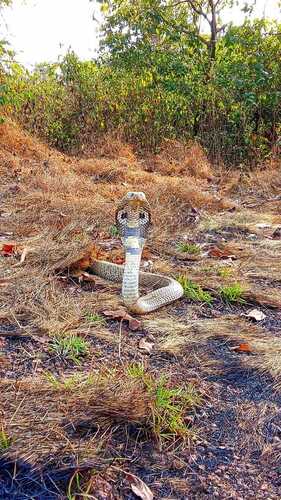
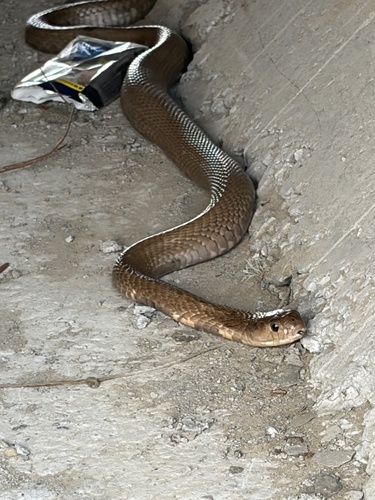
The monocled cobra has an O-shaped, or monocellate hood pattern, unlike that of the Indian cobra, which has the "spectacle" pattern (two circular ocelli connected by a curved line) on the rear of its hood. The elongated nuchal ribs enable a cobra to expand the anterior of the neck into a "hood". Coloration in the young is more constant. The dorsal surface may be yellow, brown, gray, or blackish, with or without ragged or clearly defined cross bands. It can be olivaceous or brownish to black above with or without a yellow or orange-colored, O-shaped mark on the hood. It has a black spot on the lower surface of the hood on either side, and one or two black cross-bars on the belly behind it. The rest of the belly is usually the same color as the back, but paler. As age advances, the snake becomes paler, wherein the adult is brownish or olivaceous. A pair of fixed anterior fangs is present. The largest fang recorded measured 6.78 mm (0.678 cm). Fangs are moderately adapted for spitting.
Adapted from Wikipedia, available under CC BY-SA.
Local and regional names
The Monocled Cobra is known by these names across the regions where it lives:
- Chinese
- 孟加拉眼镜蛇
- English
- Cibra monocelada, Monocellate Cibra, Monocled Cobra/Monocellate Cobra
- French
- Monocellate Cibra
- German
- Monokelkobra
- Khmer
- ពស់វែកក្របី
Frequently asked: Monocled Cobra
- Is the Monocled Cobra venomous?
- Yes. The Monocled Cobra (Naja kaouthia) is venomous and belongs to the Elapidae family (cobra, mamba, coral or sea snake). Its bite is considered high risk to people. Treat any bite as a medical emergency.
- Is the Monocled Cobra poisonous?
- Snakes are venomous, not poisonous. "Poisonous" means harmful to eat or touch; "venomous" means injecting toxins through a bite. The Monocled Cobra is venomous, delivering venom through a bite.
- Is the Monocled Cobra dangerous?
- This is a venomous snake. Treat any bite as a medical emergency: stay calm, keep the bitten limb still and roughly level with the heart, remove rings and tight clothing, and get to emergency care immediately. Do not apply a tourniquet, cut the wound, apply ice, or try to suck out venom. Call your local emergency number or poison center.
- Where does the Monocled Cobra live?
- The Monocled Cobra has verified records in 16 countries, including Thailand, India, Myanmar. See the distribution section below for its full range.
If you are bitten by the Monocled Cobra
Do
- Get away from the snake and stay calm. Most bites worsen when people panic or try again to handle the snake.
- Call 911 or Poison Control (1-800-222-1222) right away. Antivenom works best when given early.
- Note the time of the bite and, from a safe distance, the snake's color and pattern, a phone photo is enough. Do not chase it.
- Keep the bitten limb still and at roughly heart level. Sit or lie down and limit movement.
- Remove rings, watches, and tight clothing near the bite before swelling starts.
- Gently wash the bite with soap and water and cover it with a clean, dry dressing.
Do not
- Do not cut the wound or try to suck out the venom.
- Do not apply a tourniquet or ice.
- Do not drink alcohol or caffeine.
- Do not take aspirin or ibuprofen, they can worsen bleeding. Acetaminophen is safer for pain.
- Do not try to catch or kill the snake. A dead snake can still bite by reflex.
First-aid guidance adapted from the U.S. Centers for Disease Control and Prevention (CDC NIOSH), Venomous Snakes. Educational only; always follow the instructions of emergency responders.
Where it is found
More Elapidae snakes
Classification
How scientists group this snake, from the broadest category down to the exact species. Each step narrows to its closest relatives.
Keep learning
- Are Snakes Dangerous? The Real Risk, in PerspectiveMost snakes are harmless and avoid people. Here is the honest picture of snakebite risk worldwide and how to lower your own.
- Snakebite First Aid: What to Do (and What Never to Do)A clear, CDC-based guide to snakebite first aid: the steps that help, the popular myths that hurt, and how to tell a serious bite from a minor one.
- Venomous vs Nonvenomous: How to Tell the DifferenceThe folk rules for telling venomous snakes apart, where each one fails, and why location-based identification beats guessing by sight.
- What to Do If You Find a SnakeFound a snake at home or on a trail? Here is how to stay calm, give it space, identify it safely, and know when to call a professional.
Distribution from GBIF & iNaturalist. Venom status per CDC. Background: Wikipedia. Informational only. Never handle a snake to identify it.