
Colubridae
False Smooth Snake
HarmlessMacroprotodon cucullatus
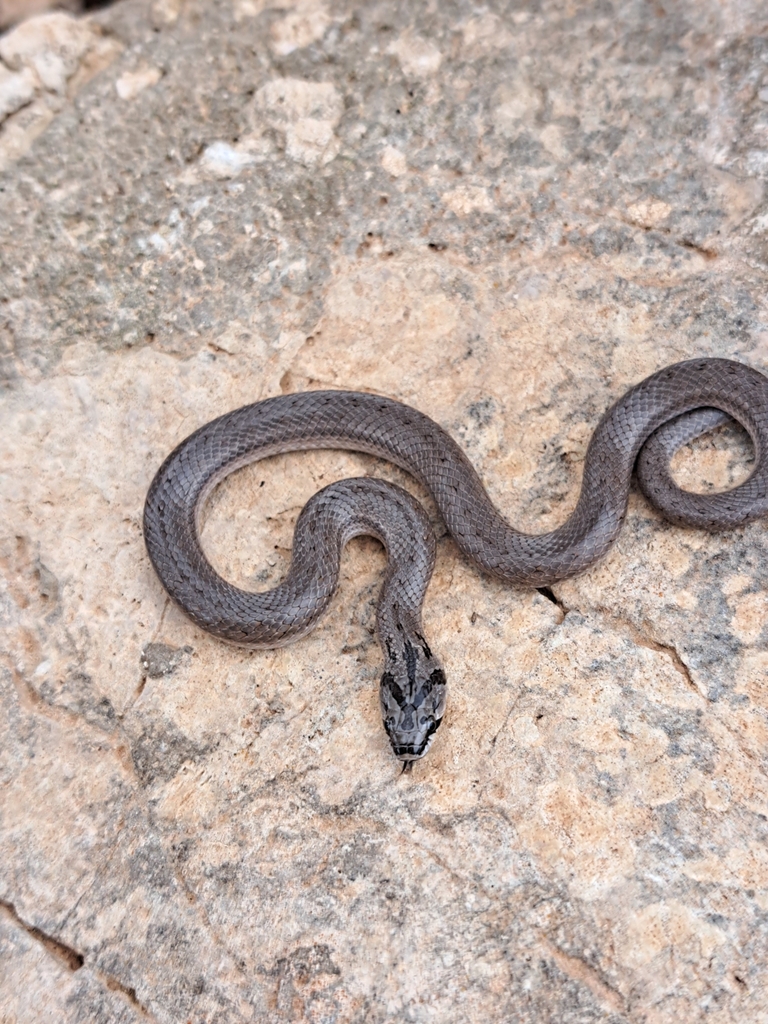
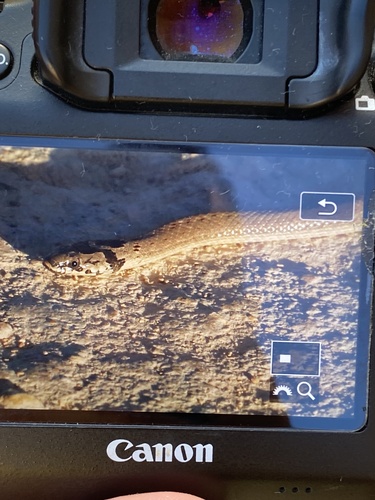
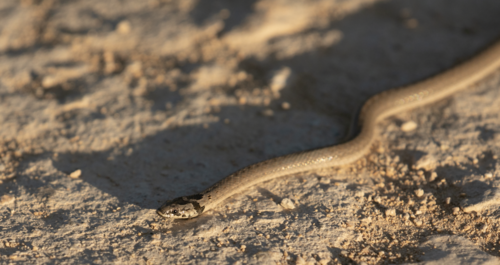
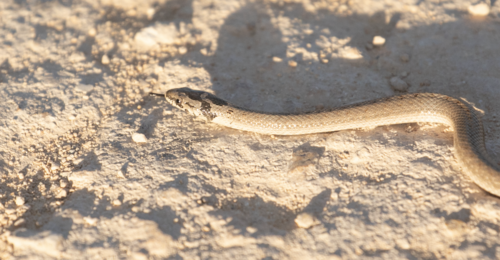
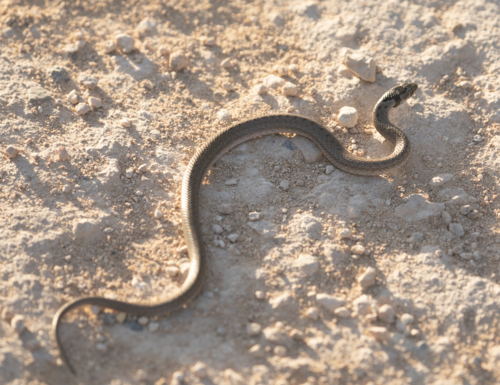
5 photographs of the False Smooth Snake. © Leonardo Ancillotto.
The False Smooth Snake (Macroprotodon cucullatus) is a non-venomous snake in the Colubridae family, recorded in 16 countries.
- Family
- Colubridae
About the False Smooth Snake
Macroprotodon cucullatus, commonly known as the false smooth snake, is a species of mildly venomous colubrid snake endemic to the Mediterranean Basin.
Geographic distribution
M. cucullatus is found in Algeria, Egypt, Israel, Italy, Libya, Morocco, Palestinian Territories, Portugal, Spain, and Tunisia.
Description
Macroprotodon cucullatus is a small snake, usually not exceeding 55 cm (21+3⁄4 in) in total length (including tail). As the common name implies, the dorsal scales are smooth, and are arranged in 19-23 rows. Dorsally it is tan or gray, with small brown spots, or with darker and lighter streaks. Ventrally it is yellow to coral-red, uniform or spotted with black, the spots sometimes confluent at the midline. It has a blackish collar which may extend to the top of the head. There is usually a dark streak from the nostril to the corner of the mouth, passing under or through the eye. The eye is rather small, and the pupil, when seen contracted in bright light, is oval. The snout is flattened, and the rostral is wide and low, barely visible from above. The 6th upper labial extends upward and contacts the parietal. There is usually one anterior temporal.
Habitat
The natural habitats of M. cucullatus are temperate forests, temperate shrubland, subtropical or tropical dry shrubland, Mediterranean-type shrubby vegetation, freshwater spring, rocky areas, sandy shores, arable land, pastureland, plantations, rural gardens, and urban areas.
Behaviour
The false smooth snake is nocturnal in some parts of its range but mainly diurnal in the Balearic Islands.
Diet
M. cucullatus preys upon small lizards such as geckos and lizards of the genus Lacerta. Small mammals and nestling birds are also eaten.
Reproduction
Females of M. cucullatus may breed in alternate years. Two to six eggs are laid in a damp spot under a stone, buried in the soil or hidden in dense vegetation. They hatch in about eight weeks into juveniles with a snout-to-vent length of 12 to 16 cm (4.7 to 6.3 in).
Venom
M. cucullatus possesses a mild venom, which is delivered by means of enlarged grooved teeth in the upper jaw. Although the venom is effective on lizards, this snake is not harmful to humans due to its small size.
Conservation status
The IUCN has listed the false smooth snake as being of "Least Concern". This is because it has a wide distribution and a large population, seems to be tolerant of some habitat modification and its population is unlikely to be declining fast enough to qualify it for listing in a more threatened category.
Adapted from Wikipedia, available under CC BY-SA.
Frequently asked: False Smooth Snake
- Is the False Smooth Snake venomous?
- No. The False Smooth Snake (Macroprotodon cucullatus) is non-venomous and is not considered dangerous to humans. Like most snakes, it will retreat rather than bite when given the chance.
- Is the False Smooth Snake poisonous?
- Snakes are venomous, not poisonous. "Poisonous" means harmful to eat or touch; "venomous" means injecting toxins through a bite. The False Smooth Snake is neither poisonous nor venomous.
- Is the False Smooth Snake dangerous?
- The False Smooth Snake is not dangerous to humans. It has no medically significant venom and bites only defensively if cornered or handled.
- Where does the False Smooth Snake live?
- The False Smooth Snake has verified records in 16 countries, including Portugal, Morocco, Spain. See the distribution section below for its full range.
- What does the False Smooth Snake eat?
- M. cucullatus preys upon small lizards such as geckos and lizards of the genus Lacerta. Small mammals and nestling birds are also eaten.
Where it is found
More Colubridae snakes
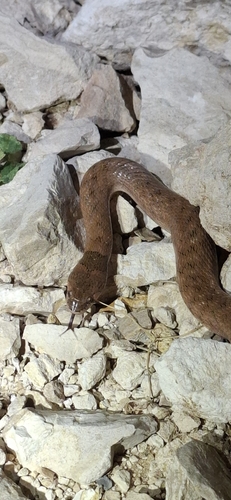 Iberian False Smooth SnakeMacroprotodon brevis
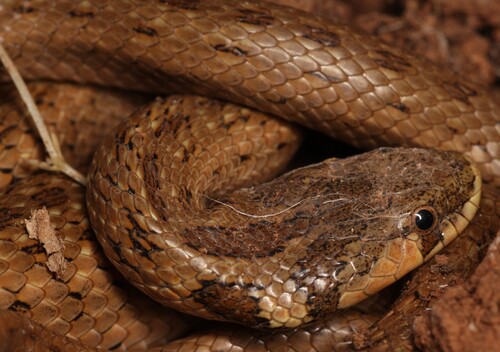 False Smooth SnakeMacroprotodon mauritanicus
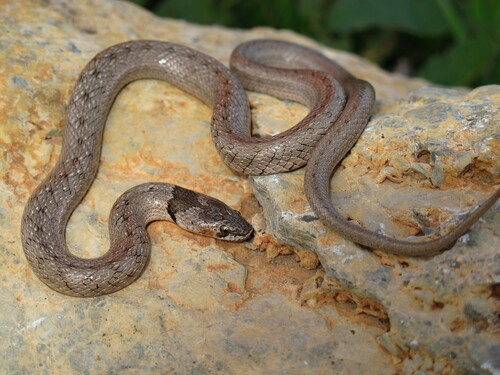 Macroprotodon abubakeriMacroprotodon abubakeri
 Common Garter SnakeThamnophis sirtalis
 Common WatersnakeNerodia sipedon
 Gopher SnakePituophis catenifer
 DeKay's BrownsnakeStoreria dekayi
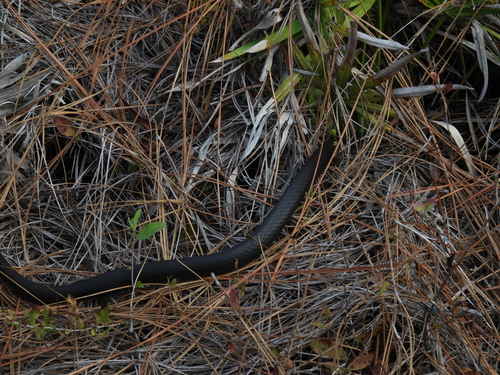 North American RacerColuber constrictor
Classification
How scientists group this snake, from the broadest category down to the exact species. Each step narrows to its closest relatives.
- OrderThe broad group of scaled reptiles: all snakes and lizards
- Squamata
- FamilyA group of related snakes that share key traits
- Colubridae
- GenusA close-knit group of very similar species
- Macroprotodon
- SpeciesThis exact snake, named in the two-part scientific name
- Macroprotodon cucullatus
Keep learning
- What to Do If You Find a SnakeFound a snake at home or on a trail? Here is how to stay calm, give it space, identify it safely, and know when to call a professional.
- Venomous vs Nonvenomous: How to Tell the DifferenceThe folk rules for telling venomous snakes apart, where each one fails, and why location-based identification beats guessing by sight.
- What Is a Snake? Anatomy and the BasicsA clear overview of what makes a snake a snake: limbless body plan, anatomy, evolution from lizards, species diversity, and why they are ectothermic.
- How to Keep Snakes Out of Your Yard and HomeA practical guide to keeping snakes out of your yard and home using habitat changes that work, plus what to skip and what to do if one shows up.
Distribution from GBIF & iNaturalist. Venom status per CDC. Background: Wikipedia. Informational only. Never handle a snake to identify it.