
Viperidae
Central American Eyelash-Viper
VenomousBothriechis nigroadspersus
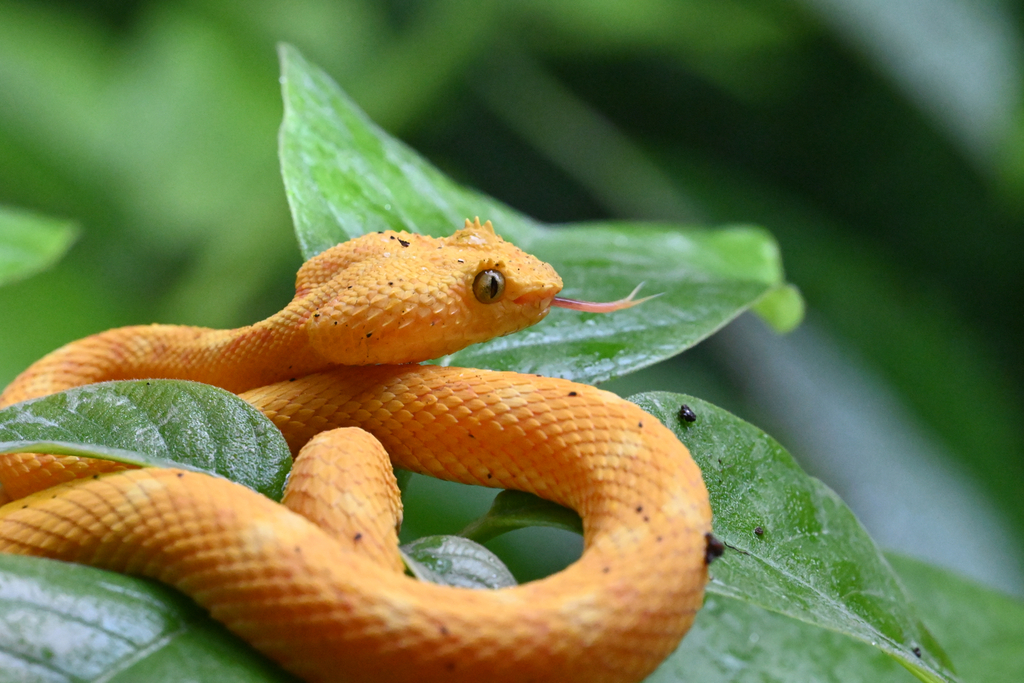
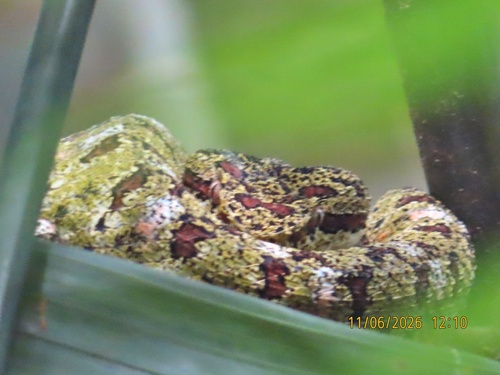
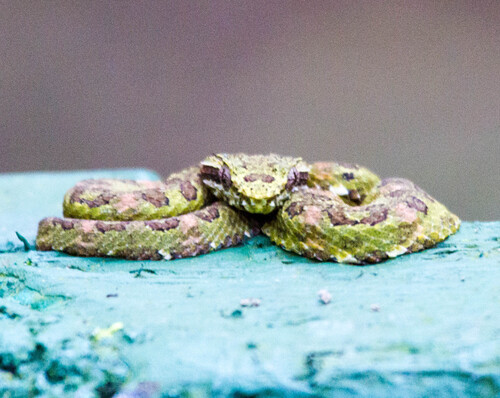
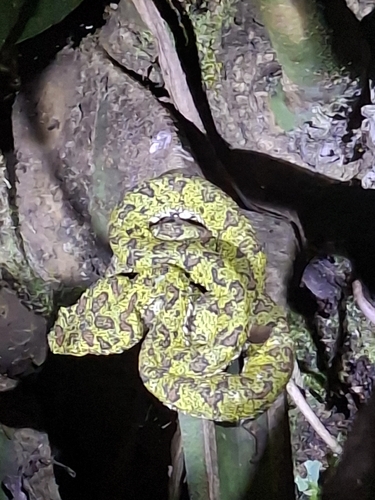
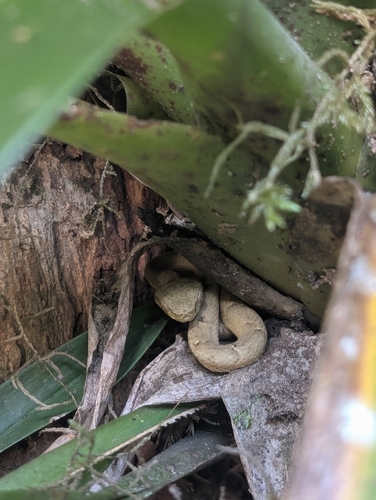
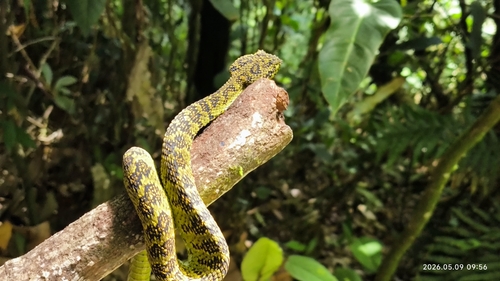
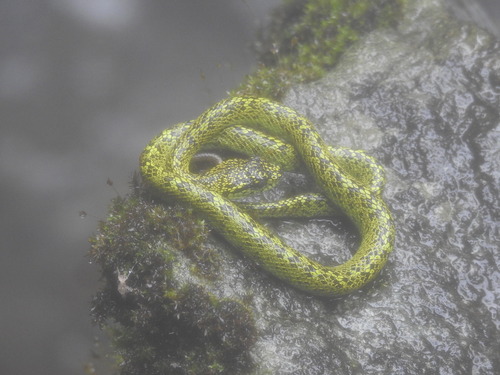
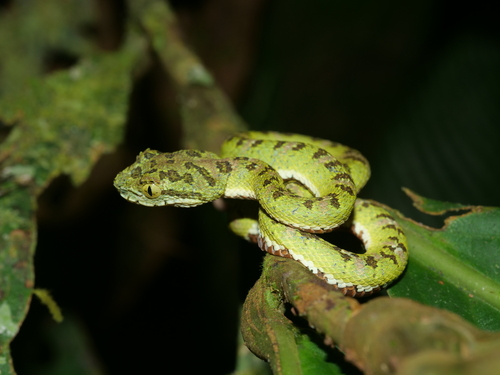
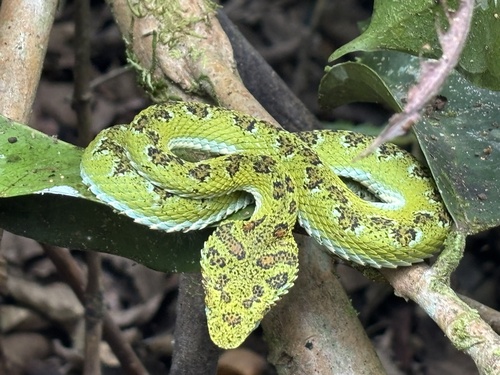
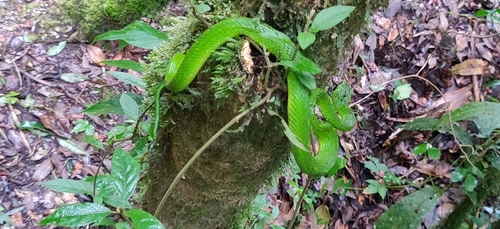
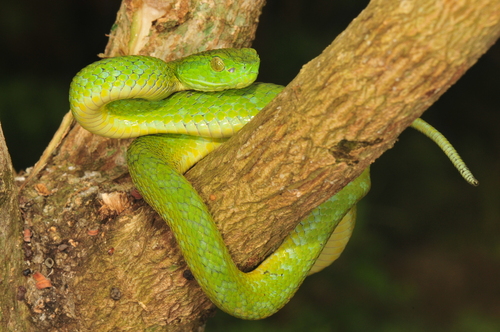
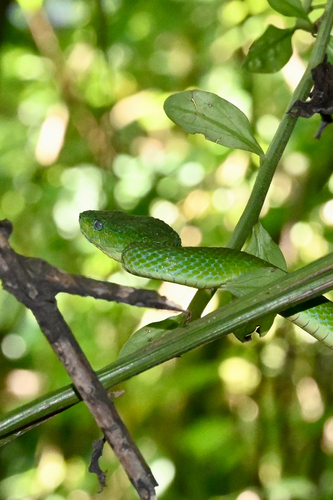
4 photographs of the Central American Eyelash-Viper. (c) Arabella Willing, some rights reserved (CC BY).
The Central American Eyelash-Viper (Bothriechis nigroadspersus) is a venomous snake in the Viperidae family, recorded in 14 countries.
If you are bitten
This is a venomous snake. Treat any bite as a medical emergency: stay calm, keep the bitten limb still and roughly level with the heart, remove rings and tight clothing, and get to emergency care immediately. Do not apply a tourniquet, cut the wound, apply ice, or try to suck out venom. Call your local emergency number or poison center.
- Family
- Viperidae
- Danger
- high
About the Central American Eyelash-Viper
The Central American eyelash-pitviper (Bothriechis nigroadspersus) (from Latin, nigrum, meaning "black", and adspersus meaning "sprinkled") is a species of pit viper.
Although once listed as a synonym of Bothriechis schlegelii, it was revalidated in a 2024 revision of the latter species.
Range
This species is widely distributed. It ranges across much of Mesoamerica, from as far north as the isthmus of Tehuantepec in Mexico to as far south as extreme northwestern Colombia (Cerro Tacarcuna) along the border with Panama.
Near Panama, the range of B. nigroadspersus slightly overlaps with that of B. supraciliaris.
The species has been recorded at elevations 0–1,434 m above sea level.
Habitat
This arboreal species occurs in evergreen lowland/foothill forests, plantations, and rural gardens. They can be found in low shrubby vegetation but also in 32-35 metre high tree canopies.
Biology
The species is mostly nocturnal. 70.2% of individuals relocate to a different perch each night, and only 6.4% remained at the same daytime perch site for more than two days. However, individuals may occasionally reside in the same perch for up to 14 days.
During the day, most individuals remain in hunting posture on or close to their night perches, although some may hide inside bromeliads, or remain active, moving at ground level or on vegetation.
It has been reported being hunted by great black hawks, laughing falcons and the black mussurana (Clelia clelia).
The species has been reported to live up to 20 years in captivity.
Diet
Although primarily ambush predators, they also forage actively for food.
Captive juveniles are known to feed on frogs, attracting them by means of moving their bright yellow tails as a lure. Wild adults are known to feed on frogs (primarily treefrogs and rainfrogs), lizards (anoles, whiptails, and geckos), birds (including hummingbirds), and mammals (bats, mice, and mouse opossums).
Reproduction
The species gives birth to live young. Breeding possibly coincides with the rainy season. Females become sexually mature at an age of less than three years and can produce more than one litter per year.
The gestation period is 150–166 days (~5 months), resulting in litters of 6–23 neonates that measure 16–22.5 cm in total length at birth.
The species is capable of storing sperm after mating; a female from Costa Rica produced a litter after presumably storing sperm for no less than ~35 months (slightly under three years). Similarly, a specimen from Lago Yojoa, Honduras, kept at Centro El Ocotal, produced a litter of four eggs and one live young after being kept in a terrarium without a male for 18 years.
Venom
In Costa Rica, 90-100 bites from this species occur per year, of which up to 6% of bites result in death. In 1979, 18.9% of snake bites in the country were attributable to this species.
Adapted from Wikipedia, available under CC BY-SA.
Local and regional names
The Central American Eyelash-Viper is known by these names across the regions where it lives:
- Chinese
- 棕櫚蝮屬
- Danish
- Palmelanseslanger
- English
- Palm Pitvipers, Palm Vipers
- German
- Palmlanzenottern
- Italian
- Vipera delle palme
- Japanese
- ヤシハブ属
- Russian
- Ботропсы
- Spanish
- Nauyacas arborícolas
Frequently asked: Central American Eyelash-Viper
- Is the Central American Eyelash-Viper venomous?
- Yes. The Central American Eyelash-Viper (Bothriechis nigroadspersus) is venomous and belongs to the Viperidae family (viper). Its bite is considered high risk to people. Treat any bite as a medical emergency.
- Is the Central American Eyelash-Viper poisonous?
- Snakes are venomous, not poisonous. "Poisonous" means harmful to eat or touch; "venomous" means injecting toxins through a bite. The Central American Eyelash-Viper is venomous, delivering venom through a bite.
- Is the Central American Eyelash-Viper dangerous?
- This is a venomous snake. Treat any bite as a medical emergency: stay calm, keep the bitten limb still and roughly level with the heart, remove rings and tight clothing, and get to emergency care immediately. Do not apply a tourniquet, cut the wound, apply ice, or try to suck out venom. Call your local emergency number or poison center.
- Where does the Central American Eyelash-Viper live?
- The Central American Eyelash-Viper has verified records in 14 countries, including Costa Rica, Colombia, Honduras. See the distribution section below for its full range.
- What does the Central American Eyelash-Viper eat?
- Although primarily ambush predators, they also forage actively for food. Captive juveniles are known to feed on frogs, attracting them by means of moving their bright yellow tails as a lure. Wild adults are known to feed on frogs (primarily treefrogs and rainfrogs), lizards (anoles, whiptails, and geckos), birds (including hummingbirds), and mammals (bats, mice, and mouse opossums).
If you are bitten by the Central American Eyelash-Viper
Do
- Get away from the snake and stay calm. Most bites worsen when people panic or try again to handle the snake.
- Call 911 or Poison Control (1-800-222-1222) right away. Antivenom works best when given early.
- Note the time of the bite and, from a safe distance, the snake's color and pattern, a phone photo is enough. Do not chase it.
- Keep the bitten limb still and at roughly heart level. Sit or lie down and limit movement.
- Remove rings, watches, and tight clothing near the bite before swelling starts.
- Gently wash the bite with soap and water and cover it with a clean, dry dressing.
Do not
- Do not cut the wound or try to suck out the venom.
- Do not apply a tourniquet or ice.
- Do not drink alcohol or caffeine.
- Do not take aspirin or ibuprofen, they can worsen bleeding. Acetaminophen is safer for pain.
- Do not try to catch or kill the snake. A dead snake can still bite by reflex.
First-aid guidance adapted from the U.S. Centers for Disease Control and Prevention (CDC NIOSH), Venomous Snakes. Educational only; always follow the instructions of emergency responders.
Where it is found
More Viperidae snakes
 Side-striped palm pit viperBothriechis lateralis
 Highland Eyelash-PitviperBothriechis schlegelii
 Black-speckled Palm Pit ViperBothriechis nigroviridis
 Ecuadorian Eyelash-ViperBothriechis nitidus
 Blotched Palm-pitviperBothriechis supraciliaris
 Yellow-blotched Palm Pit ViperBothriechis aurifer
 March's Palm Pit ViperBothriechis marchi
 Guatemala Palm Pit ViperBothriechis bicolor
Classification
How scientists group this snake, from the broadest category down to the exact species. Each step narrows to its closest relatives.
- OrderThe broad group of scaled reptiles: all snakes and lizards
- Squamata
- FamilyA group of related snakes that share key traits
- Viperidae
- GenusA close-knit group of very similar species
- Bothriechis
- SpeciesThis exact snake, named in the two-part scientific name
- Bothriechis nigroadspersus
Keep learning
- Are Snakes Dangerous? The Real Risk, in PerspectiveMost snakes are harmless and avoid people. Here is the honest picture of snakebite risk worldwide and how to lower your own.
- Snakebite First Aid: What to Do (and What Never to Do)A clear, CDC-based guide to snakebite first aid: the steps that help, the popular myths that hurt, and how to tell a serious bite from a minor one.
- Venomous vs Nonvenomous: How to Tell the DifferenceThe folk rules for telling venomous snakes apart, where each one fails, and why location-based identification beats guessing by sight.
- What to Do If You Find a SnakeFound a snake at home or on a trail? Here is how to stay calm, give it space, identify it safely, and know when to call a professional.
Distribution from GBIF & iNaturalist. Venom status per CDC. Background: Wikipedia. Informational only. Never handle a snake to identify it.