
Elapidae
Banded Krait
VenomousBungarus fasciatus
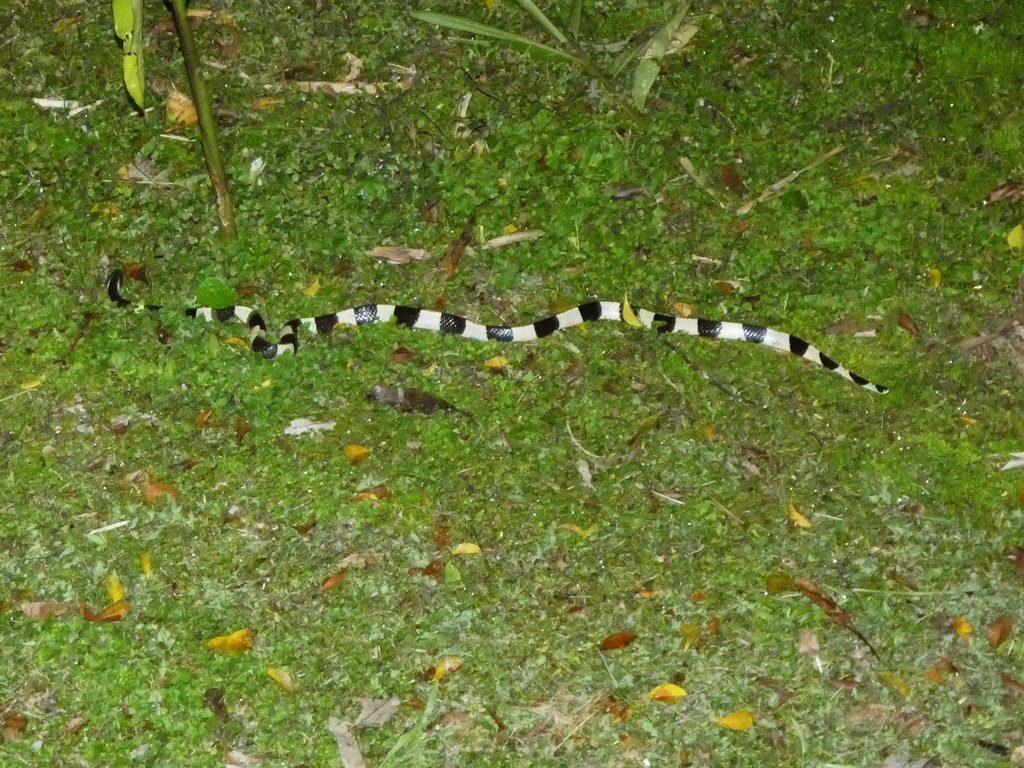
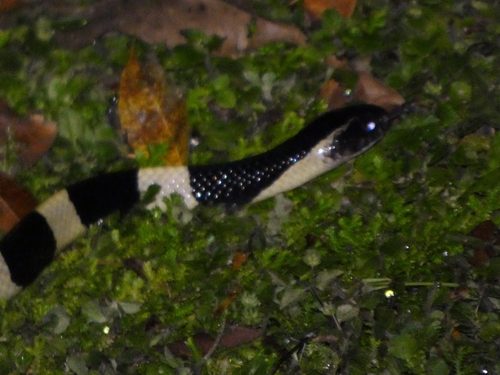
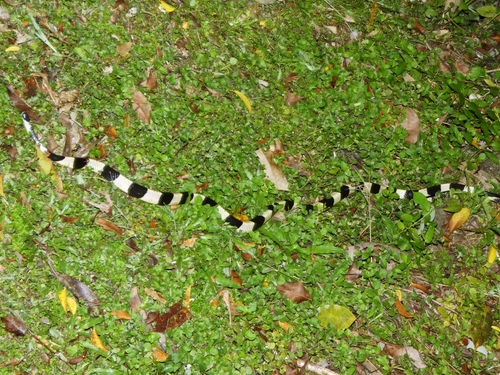
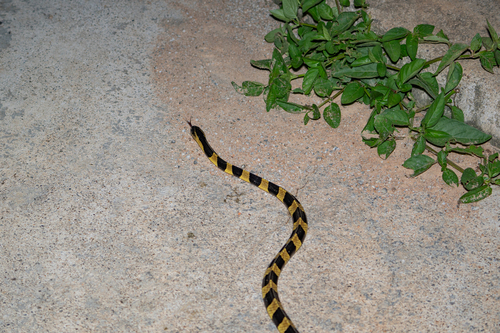
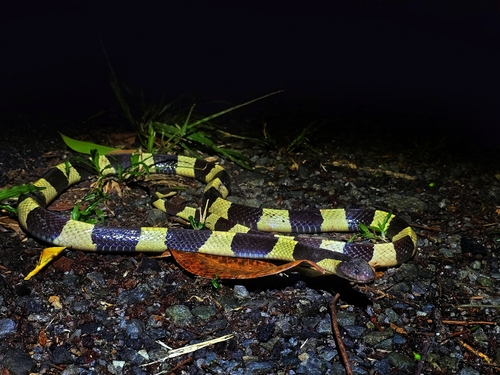
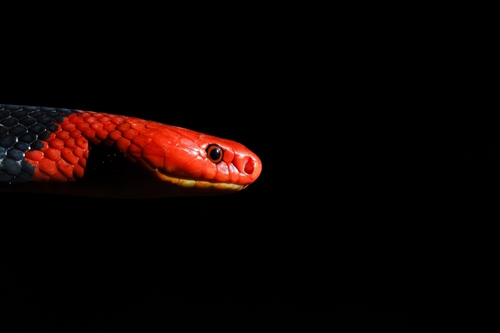
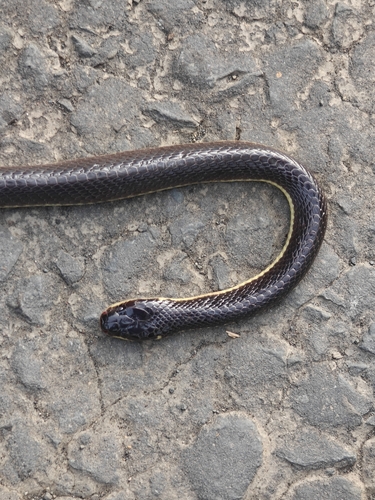
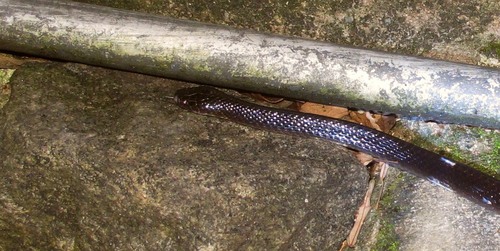
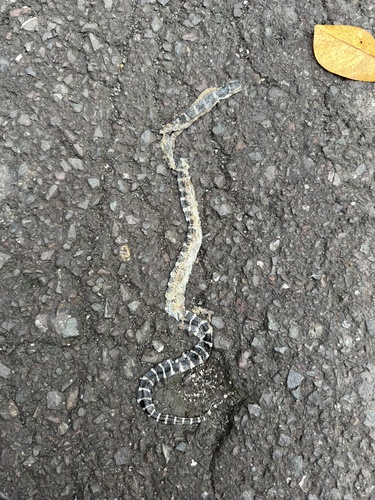
5 photographs of the Banded Krait. © Kai Squires.
The Banded Krait (Bungarus fasciatus) is a venomous snake in the Elapidae family, recorded in 18 countries.
If you are bitten
This is a venomous snake. Treat any bite as a medical emergency: stay calm, keep the bitten limb still and roughly level with the heart, remove rings and tight clothing, and get to emergency care immediately. Do not apply a tourniquet, cut the wound, apply ice, or try to suck out venom. Call your local emergency number or poison center.
- Family
- Elapidae
- Danger
- high
About the Banded Krait
The banded krait (Bungarus fasciatus) is a venomous species of elapid endemic to Asia, from Indian subcontinent through Southeast Asia to Southern China. With a maximum length exceeding 2 m (6 ft 7 in), it is the longest krait with a distinguishable gold and black pattern. While this species is generally considered timid and docile, resembling other members of the genus, its venom is highly neurotoxic which is lethal to humans. Although toxicity of the banded krait based upon murine LD50 experiments is lower than that of many other kraits, its venom yield is the highest due to its size.
Description
The banded krait is easily identified by its alternate black and yellow crossbands all of which encircle the body. The head is broad and depressed and it is not distinct from the neck. The eyes are black. It has arrowhead-like yellow markings on its otherwise black head and has yellow lips, lores, chin, and throat. The tail is relatively small, about one-tenth the length of the snake.
The longest banded krait measured was 2.25 m (7 ft 5 in) long, but normally the length encountered is 1.8 m (5 ft 11 in).
Scalation: 15 dorsal scale rows at midbody; sub-caudal scutes undivided throughout, 23–39; middorsal row of scales (vertebrals) hexagonal and strongly enlarged, as broad as or broader than long; anal plate undivided. tail end blunt; distinct vertebral ridge down the back formed by the neural processes of the vertebrae; ventrals 200–234.
Bungarum Pamah was the name recorded by Patrick Russell of a specimen from "Mansoor Cottah", he also received specimens from Bengal. The scientific name of the genus is derived from bangarum in Telugu (also in Kannada), meaning "gold", referring to the yellow rings around its body.
Distribution and habitat
The banded krait occurs in the whole of the Indo-Chinese subregion, the Malay Peninsula and Indonesian archipelago, and southern China. The species is common in the states of West Bengal, Odisha, Mizoram, Assam, Manipur, Bihar and Tripura of India, Nepal and Bangladesh, but becomes progressively uncommon westwards in India.
It has been recorded eastwards from central India through Nepal, Bangladesh, Myanmar, Cambodia, Thailand, Laos, Vietnam, and southern China (including Hainan and Hong Kong), Malaysia and the main Indonesian islands of Borneo (Java and Sumatra), as well as Singapore.
In India, it has been recorded from Andhra Pradesh, Bihar, Chhattisgarh, Jharkhand, Madhya Pradesh, Maharashtra, Northeast India, Odisha, Tamil Nadu, Kerala and West Bengal. It has recently been recorded from Hassan District in Karnataka, Chalkari, Bokaro District, Jharkhand, Trivandrum, Kerala and Amalapadu, Srikakulam District, Andhra Pradesh Supaul distric,bihar.
Adapted from Wikipedia, available under CC BY-SA.
Local and regional names
The Banded Krait is known by these names across the regions where it lives:
- Bengali
- শাঁখামুটি
- Chinese
- 金环蛇, 金環蛇, 金腳帶
- Czech
- bungar kroužkovaný
- Danish
- Bredbåndet Krait
- English
- Shankhini shap
- French
- Bongare annelé, Bongare fascié, Bungare
- German
- Gelbgebänderter Krait
- Hungarian
- gyűrűszalagos krait
- Indonesian
- Ular Welang, Ular belang, Welang
- Italian
- Bungaro fasciato, Krait fasciato
- Japanese
- マルオアマガサ
- Khmer
- ពស់ក្រាយ បង្កងលឿងខ្មៅ, ពស់ក្រាយខ្លួនជ្រុងវែង
- Marathi
- पट्टेरी मण्यार
- Nepali
- Kanthmala, Laxmisarp
- Polish
- niemrawiec pospolity
- Portuguese
- Krait-de-faixas
- Russian
- Ленточный крайт
- Spanish
- krait rayado
- Thai
- งูสามเหลี่ยม
- Turkish
- Pama
- Vietnamese
- Rắn cạp nong
Frequently asked: Banded Krait
- Is the Banded Krait venomous?
- Yes. The Banded Krait (Bungarus fasciatus) is venomous and belongs to the Elapidae family (cobra, mamba, coral or sea snake). Its bite is considered high risk to people. Treat any bite as a medical emergency.
- Is the Banded Krait poisonous?
- Snakes are venomous, not poisonous. "Poisonous" means harmful to eat or touch; "venomous" means injecting toxins through a bite. The Banded Krait is venomous, delivering venom through a bite.
- Is the Banded Krait dangerous?
- This is a venomous snake. Treat any bite as a medical emergency: stay calm, keep the bitten limb still and roughly level with the heart, remove rings and tight clothing, and get to emergency care immediately. Do not apply a tourniquet, cut the wound, apply ice, or try to suck out venom. Call your local emergency number or poison center.
- Where does the Banded Krait live?
- The Banded Krait has verified records in 18 countries, including Indonesia, Thailand, China. See the distribution section below for its full range.
- Why is it called the Banded Krait?
- Manipuri language – linkhak Mizo language – chawnglei, tiangsir Kannada – kattige haavu (ಕಟ್ಟಿಗೆ ಹಾವು) Karbi language – maipam, rui-teron Assamese language – xokha (শখা), xongkhosur (শংখচোৰ), gowala (গোৱালা), bandphora Bengali – shankhini (শঙ্খিনী), shankhamooti shaanp (শাঁখামুঠি) and rajsap (king snake) in Birbhum District কুসাপা (রাজবংশি ভাষায়) Burmese – ငန်းတော်ကျား ngān taw kyā Hindi – ahiraaj saamp Indonesian – welang Ho – Sakombiń Malayalam – manjavarayan (മഞ്ഞവരയൻ)
If you are bitten by the Banded Krait
Do
- Get away from the snake and stay calm. Most bites worsen when people panic or try again to handle the snake.
- Call 911 or Poison Control (1-800-222-1222) right away. Antivenom works best when given early.
- Note the time of the bite and, from a safe distance, the snake's color and pattern, a phone photo is enough. Do not chase it.
- Keep the bitten limb still and at roughly heart level. Sit or lie down and limit movement.
- Remove rings, watches, and tight clothing near the bite before swelling starts.
- Gently wash the bite with soap and water and cover it with a clean, dry dressing.
Do not
- Do not cut the wound or try to suck out the venom.
- Do not apply a tourniquet or ice.
- Do not drink alcohol or caffeine.
- Do not take aspirin or ibuprofen, they can worsen bleeding. Acetaminophen is safer for pain.
- Do not try to catch or kill the snake. A dead snake can still bite by reflex.
First-aid guidance adapted from the U.S. Centers for Disease Control and Prevention (CDC NIOSH), Venomous Snakes. Educational only; always follow the instructions of emergency responders.
Where it is found
More Elapidae snakes

Classification
How scientists group this snake, from the broadest category down to the exact species. Each step narrows to its closest relatives.
Keep learning
- Are Snakes Dangerous? The Real Risk, in PerspectiveMost snakes are harmless and avoid people. Here is the honest picture of snakebite risk worldwide and how to lower your own.
- Snakebite First Aid: What to Do (and What Never to Do)A clear, CDC-based guide to snakebite first aid: the steps that help, the popular myths that hurt, and how to tell a serious bite from a minor one.
- Venomous vs Nonvenomous: How to Tell the DifferenceThe folk rules for telling venomous snakes apart, where each one fails, and why location-based identification beats guessing by sight.
- What to Do If You Find a SnakeFound a snake at home or on a trail? Here is how to stay calm, give it space, identify it safely, and know when to call a professional.
Distribution from GBIF & iNaturalist. Venom status per CDC. Background: Wikipedia. Informational only. Never handle a snake to identify it.