
Elapidae
Common Krait
VenomousBungarus caeruleus
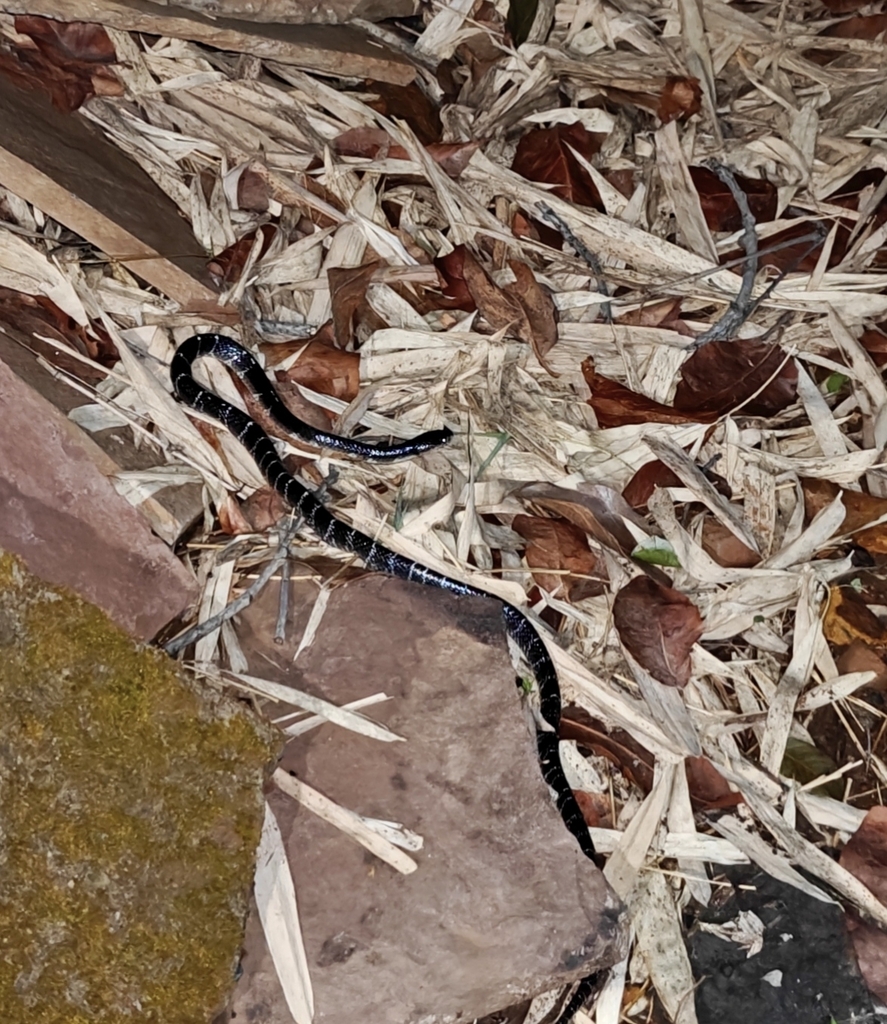
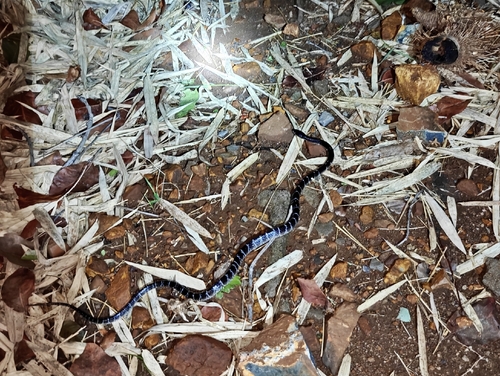
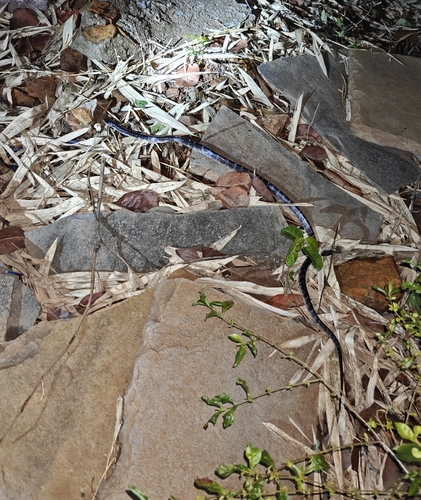
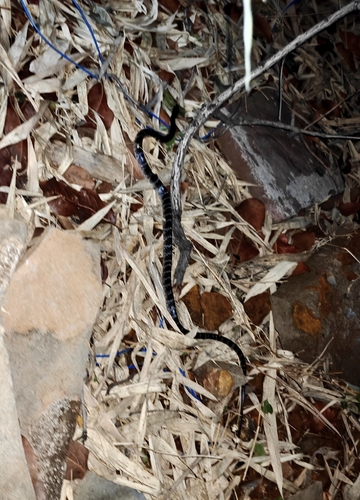
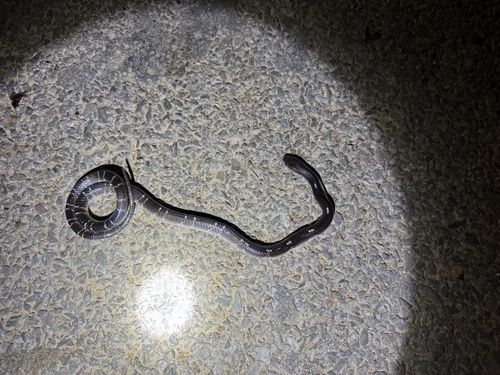
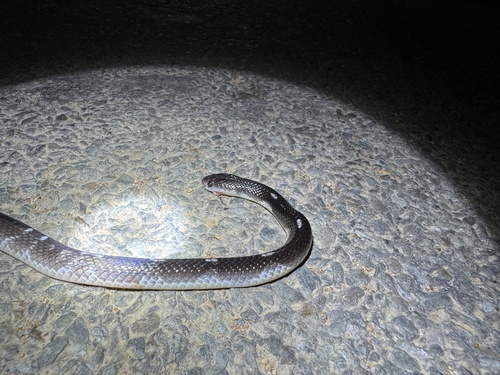
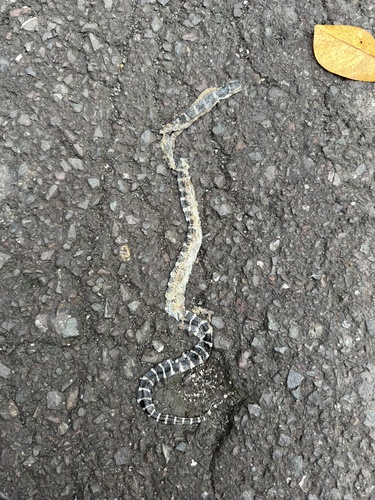
6 photographs of the Common Krait. © Harshjeet Singh Bal.
The Common Krait (Bungarus caeruleus) is a venomous snake in the Elapidae family, recorded in 9 countries.
If you are bitten
This is a venomous snake. Treat any bite as a medical emergency: stay calm, keep the bitten limb still and roughly level with the heart, remove rings and tight clothing, and get to emergency care immediately. Do not apply a tourniquet, cut the wound, apply ice, or try to suck out venom. Call your local emergency number or poison center.
- Family
- Elapidae
- Danger
- high
About the Common Krait
The common krait (Bungarus caeruleus) is a highly venomous snake species belonging to the genus Bungarus in the family Elapidae. Native to South Asia, it is widely distributed across India, Pakistan, Bangladesh, Sri Lanka, and Nepal, inhabiting diverse environments such as grasslands, agricultural fields, and human settlements. The species is nocturnal and is characterized by its black or bluish-black body with narrow white crossbands, typically reaching lengths of 3 to 4 feet (0.9 to 1.2 m). Known for its potent neurotoxic venom, the common krait is one of the "Big Four" snake species responsible for the majority of medically significant snakebites in South Asia.
Description
The average length of the common krait is 0.9 m (2 ft 11 in), but it can grow to 1.75 m (5 ft 9 in). Males are longer than females, with proportionately longer tails. The head is flat and the neck is hardly visible. The body is cylindrical, tapering towards the tail. The tail is short and rounded. The eyes are rather small, with rounded pupils, indistinguishable in life. The head shields are normal, with no loreals; four shields occur along the margin of the lower lip; the third and fourth supraoculars touch the eye. The scales are highly polished, in 15–17 rows; the vertebral row is distinctly enlarged and hexagonal. Ventrals number 185–225 and caudals 37–50, and are entirely intact.
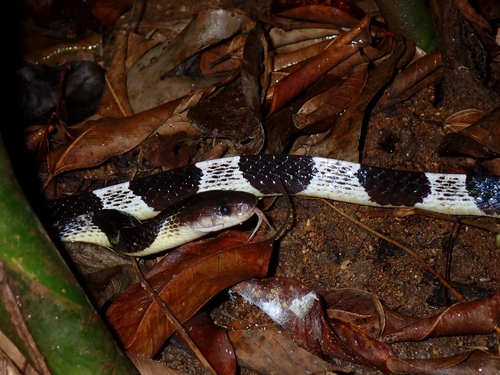
Their coloration is generally black or bluish-black, with about 40 thin, white crossbars, which may be indistinct or absent anteriorly. Albino specimens can be found, although such cases are extremely rare. The pattern, however, is complete and well-defined in the young, which are marked with conspicuous crossbars even anteriorly; in old individuals, the narrow white lines may be found as a series of connected spots, with a prominent spot on the vertebral region. A white preocular spot may be present; the upper lips and belly are white.
Distribution and habitat
The common krait is widely distributed across South Asia, including India, Pakistan, Bangladesh, Sri Lanka, Nepal and possibly Bhutan. Its range extends westward into Afghanistan and potentially parts of Iran. Within India, it is found throughout the country including the Andaman and Nicobar Islands.
This snake inhabits a diverse range of environments, including scrub jungles, grasslands, agricultural fields, semi-desert areas, rocky terrains, and suburban gardens. It is frequently found in human-modified landscapes such as plantations and cultivated lands. The common krait often takes refuge in termite mounds, rat burrows, or under debris. It is particularly associated with areas near water sources, such as streams, canals, and ponds.
Adapted from Wikipedia, available under CC BY-SA.
Local and regional names
The Common Krait is known by these names across the regions where it lives:
- Bengali
- Kal Keutey
- Chinese
- 青環蛇
- Czech
- bungar modravý
- English
- Common Indian krait, Common/Indian Krait, Indian Krait, Kal keotey
- Finnish
- Intiankraitti
- French
- Bongare indien
- German
- Indischer Krait
- Gujarati
- કાળોતરો
- Hungarian
- közönséges krait
- Italian
- Bungaro comune, Krait comune
- Japanese
- インドアマガサ
- Marathi
- मण्यार
- Odia
- ଚିତି
- Polish
- niemrawiec indyjski
- Russian
- Голубой бунгарус, Индийский крайт
- Sinhala
- තෙල් කරවලා, මග මරුවා
- Spanish
- Krait Común
- Tamil
- கட்டுவிரியன்
Frequently asked: Common Krait
- Is the Common Krait venomous?
- Yes. The Common Krait (Bungarus caeruleus) is venomous and belongs to the Elapidae family (cobra, mamba, coral or sea snake). Its bite is considered high risk to people. Treat any bite as a medical emergency.
- Is the Common Krait poisonous?
- Snakes are venomous, not poisonous. "Poisonous" means harmful to eat or touch; "venomous" means injecting toxins through a bite. The Common Krait is venomous, delivering venom through a bite.
- Is the Common Krait dangerous?
- This is a venomous snake. Treat any bite as a medical emergency: stay calm, keep the bitten limb still and roughly level with the heart, remove rings and tight clothing, and get to emergency care immediately. Do not apply a tourniquet, cut the wound, apply ice, or try to suck out venom. Call your local emergency number or poison center.
- Where does the Common Krait live?
- The Common Krait has verified records in 9 countries, including India, Pakistan, Sri Lanka. See the distribution section below for its full range.
- What does the Common Krait eat?
- The common krait feeds primarily on other snakes, including venomous snakes like other kraits and vipers. It also feeds on small rodents, lizards, birds and frogs. Cannibalism and scavenging are known in this species. The young are known to prey on arthropods and the blind snakes of the family Typhlopidae.
If you are bitten by the Common Krait
Do
- Get away from the snake and stay calm. Most bites worsen when people panic or try again to handle the snake.
- Call 911 or Poison Control (1-800-222-1222) right away. Antivenom works best when given early.
- Note the time of the bite and, from a safe distance, the snake's color and pattern, a phone photo is enough. Do not chase it.
- Keep the bitten limb still and at roughly heart level. Sit or lie down and limit movement.
- Remove rings, watches, and tight clothing near the bite before swelling starts.
- Gently wash the bite with soap and water and cover it with a clean, dry dressing.
Do not
- Do not cut the wound or try to suck out the venom.
- Do not apply a tourniquet or ice.
- Do not drink alcohol or caffeine.
- Do not take aspirin or ibuprofen, they can worsen bleeding. Acetaminophen is safer for pain.
- Do not try to catch or kill the snake. A dead snake can still bite by reflex.
First-aid guidance adapted from the U.S. Centers for Disease Control and Prevention (CDC NIOSH), Venomous Snakes. Educational only; always follow the instructions of emergency responders.
Where it is found
More Elapidae snakes

Classification
How scientists group this snake, from the broadest category down to the exact species. Each step narrows to its closest relatives.
Keep learning
- Are Snakes Dangerous? The Real Risk, in PerspectiveMost snakes are harmless and avoid people. Here is the honest picture of snakebite risk worldwide and how to lower your own.
- Snakebite First Aid: What to Do (and What Never to Do)A clear, CDC-based guide to snakebite first aid: the steps that help, the popular myths that hurt, and how to tell a serious bite from a minor one.
- Venomous vs Nonvenomous: How to Tell the DifferenceThe folk rules for telling venomous snakes apart, where each one fails, and why location-based identification beats guessing by sight.
- What to Do If You Find a SnakeFound a snake at home or on a trail? Here is how to stay calm, give it space, identify it safely, and know when to call a professional.
Distribution from GBIF & iNaturalist. Venom status per CDC. Background: Wikipedia. Informational only. Never handle a snake to identify it.