
Regional field guide
Snakes in Texas
75+ snake species have verified records in Texas, including 15 venomous. Pick your county below to see exactly which snakes live near you.
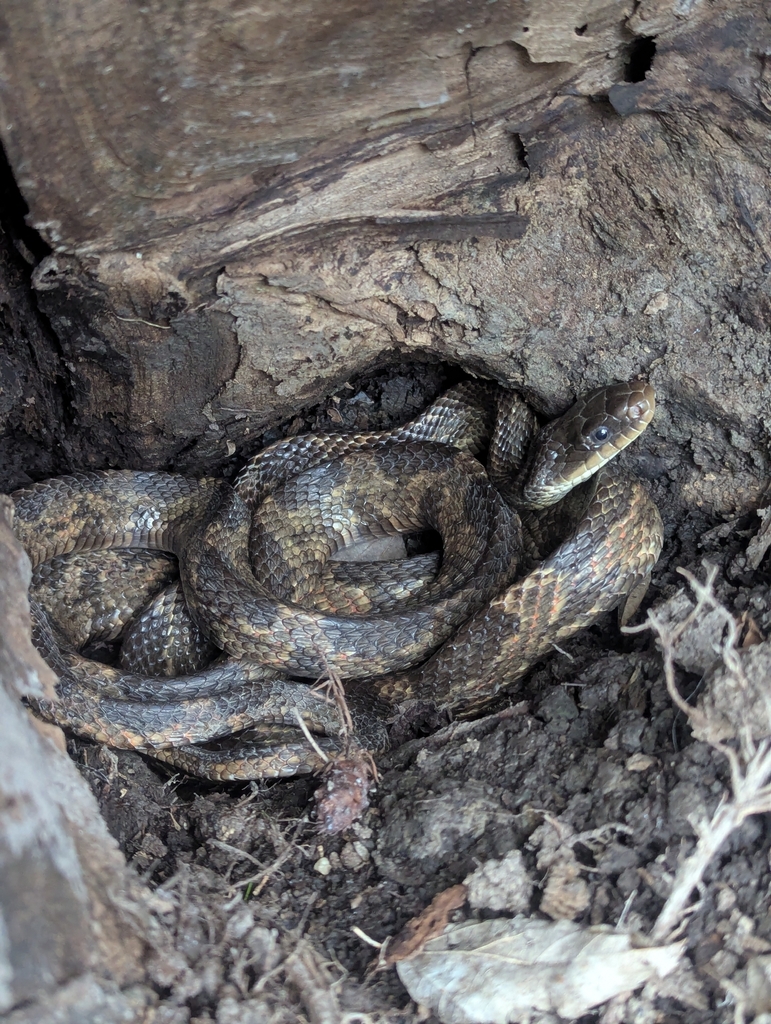
Snakes of Texas
Texas has one of the largest snake faunas of any US state, with about 100+ species and subspecies recorded inside its borders. Of those, only 15 are venomous, so even in a state this snake-rich the great majority of species are harmless. Texas is a true rattlesnake capital: more than half of its venomous snakes are rattlesnakes, and the Western Diamond-backed Rattlesnake in particular is an icon of the state's brush country. Sightings are common across yards, ranches, trails, and roadsides, and most of what you meet poses no danger.
That huge species count comes straight from the range of landscapes packed into one state. The Piney Woods of East Texas are humid southern forest, the Gulf coast adds marshes and barrier-island habitats, the central Hill Country is limestone canyons and oak-juniper slopes, and far West Texas drops into the Chihuahuan desert with its mountains and dry basins. The Rio Grande valley brings in subtropical species found nowhere else in the country. Each of these regions supports its own set of snakes, and because Texas straddles eastern, western, southern, and desert faunas at once, the lists overlap and stack up.
The venomous picture is dominated by rattlesnakes. Beyond the Western Diamond-backed, Texas records the Timber, Prairie, Mojave, Rock, Western and Eastern Black-tailed, and Pygmy rattlesnakes, plus the Western and Eastern Massasauga. The Mojave Rattlesnake stands out because its venom is strongly neurotoxic, making it a snake to treat with particular respect in the western deserts. The wetter, woodsy east of the state holds the Eastern and Broad-banded Copperheads and the Northern Cottonmouth, the dark semi-aquatic pit viper of swamps, sloughs, and river edges. The Texas Coralsnake and Eastern Coralsnake are the outliers: secretive, brightly banded elapids that spend most of their time hidden in leaf litter and burrows. The old red-and-yellow color rhymes are only a rough guide in the US and should never be your method for identifying a snake.
Most snakes Texans actually see are non-venomous workhorses. Bullsnakes and gophersnakes hiss and bluff convincingly but are harmless, Texas ratsnakes climb into barns and trees after rodents, and coachwhips race across open ground at high speed. Kingsnakes are especially valuable because some of them hunt and eat rattlesnakes, and patch-nosed snakes, hognose snakes (famous for playing dead), nightsnakes, and a long list of harmless desert colubrids round out the cast. These are the snakes doing quiet pest control, and most are killed only because they are mistaken for something dangerous.
Honest safety matters in a state this snake-dense: Texas sees more snakebites than almost anywhere in the country, simply because there are so many people and so many snakes sharing the same ground. Even so, deaths are very rare when bites get prompt antivenom and modern medical care. The pattern behind most serious bites is consistent: they happen when people try to handle, harass, photograph up close, or kill a snake. Give any snake room and it will almost always leave. Never assume a wild snake is safe to handle, no matter how calm it looks. If a bite happens, call Poison Control at 1-800-222-1222 or 911 right away.
Venomous snakes in Texas
- Western Diamond-backed RattlesnakeCrotalus atrox Venomous
- Northern CottonmouthAgkistrodon piscivorus Venomous
- Eastern CopperheadAgkistrodon contortrix Venomous
- Broad-banded CopperheadAgkistrodon laticinctus Venomous
- Texas CoralsnakeMicrurus tener Venomous
- Eastern Black-tailed RattlesnakeCrotalus ornatus Venomous
- Prairie RattlesnakeCrotalus viridis Venomous
- Mojave RattlesnakeCrotalus scutulatus Venomous
- Rock RattlesnakeCrotalus lepidus Venomous
- Timber RattlesnakeCrotalus horridus Venomous
- Western MassasaugaSistrurus tergeminus Venomous
- Western Black-tailed RattlesnakeCrotalus molossus Venomous
- Pygmy RattlesnakeSistrurus miliarius Venomous
- Eastern MassasaugaSistrurus catenatus Venomous
- Eastern CoralsnakeMicrurus fulvius Venomous
Most commonly seen
- Western RatsnakeCommonly seen
- Western Ribbon SnakeCommonly seen
- Plain-bellied WatersnakeCommonly seen
- Western Diamond-backed RattlesnakeCommonly seen
- Diamondback WatersnakeCommonly seen
- Rough EarthsnakeCommonly seen
- Northern CottonmouthCommonly seen
- Common CoachwhipCommonly seen
- Checkered Garter SnakeCommonly seen
- DeKay's BrownsnakeCommonly seen
- Rough GreensnakeCommonly seen
- Eastern CopperheadCommonly seen
Counties in Texas
254 listed- Anderson25
- Andrews17
- Angelina23
- Aransas31
- Archer31
- Armstrong9
- Atascosa31
- Austin26
- Bailey9
- Bandera32
- Bastrop27
- Baylor18
- Bee20
- Bell27
- Bexar40
- Blanco26
- Borden20
- Bosque29
- Bowie23
- Brazoria28
- Brazos30
- Brewster47
- Briscoe18
- Brooks15
- Brown22
- Burleson23
- Burnet30
- Caldwell27
- Calhoun28
- Callahan21
- Cameron28
- Camp6
- Carson10
- Cass19
- Castro6
- Chambers25
- Cherokee20
- Childress11
- Clay28
- Cochran11
- Coke22
- Coleman21
- Collin25
- Collingsworth7
- Colorado25
- Comal26
- Comanche15
- Concho30
- Cooke26
- Coryell22
- Cottle25
- Crane10
- Crockett37
- Crosby23
- Culberson29
- Dallam7
- Dallas32
- Dawson13
- Deaf Smith7
- Delta10
- Denton30
- Dewitt23
- Dickens20
- Dimmit20
- Donley13
- Duval27
- Eastland21
- Ector12
- Edwards35
- El Paso32
- Ellis25
- Erath23
- Falls15
- Fannin16
- Fayette21
- Fisher18
- Floyd8
- Foard16
- Fort Bend25
- Franklin10
- Freestone18
- Frio21
- Gaines9
- Galveston22
- Garza17
- Gillespie29
- Glasscock9
- Goliad19
- Gonzales24
- Gray6
- Grayson27
- Gregg15
- Grimes24
- Guadalupe28
- Hale3
- Hall13
- Hamilton14
- Hansford7
- Hardeman14
- Hardin26
- Harris32
- Harrison27
- Hartley12
- Haskell10
- Hays31
- Hemphill23
- Henderson21
- Hidalgo32
- Hill20
- Hockley14
- Hood26
- Hopkins16
- Houston18
- Howard14
- Hudspeth30
- Hunt19
- Hutchinson23
- Irion22
- Jack17
- Jackson23
- Jasper22
- Jeff Davis39
- Jefferson22
- Jim Hogg26
- Jim Wells22
- Johnson24
- Jones20
- Karnes18
- Kaufman19
- Kendall30
- Kenedy18
- Kent11
- Kerr33
- Kimble25
- King16
- Kinney26
- Kleberg24
- Knox14
- La Salle23
- Lamar16
- Lamb10
- Lampasas19
- Lavaca21
- Lee22
- Leon19
- Liberty22
- Limestone14
- Lipscomb9
- Live Oak21
- Llano28
- Loving8
- Lubbock23
- Lynn8
- Madison14
- Marion23
- Martin10
- Mason28
- Matagorda25
- Maverick21
- McCulloch31
- McLennan30
- McMullen24
- Medina32
- Menard21
- Midland14
- Milam21
- Mills16
- Mitchell16
- Montague29
- Montgomery24
- Moore7
- Morris14
- Motley18
- Nacogdoches21
- Navarro14
- Newton20
- Nolan15
- Nueces28
- Ochiltree8
- Oldham14
- Orange18
- Palo Pinto33
- Panola14
- Parker33
- Parmer7
- Pecos39
- Polk19
- Potter25
- Presidio34
- Rains12
- Randall26
- Reagan12
- Real26
- Red River17
- Reeves24
- Refugio26
- Roberts12
- Robertson21
- Rockwall13
- Runnels17
- Rusk19
- Sabine18
- San Augustine16
- San Jacinto17
- San Patricio29
- San Saba27
- Schleicher19
- Scurry15
- Shackelford26
- Shelby15
- Sherman5
- Smith22
- Somervell19
- Starr26
- Stephens17
- Sterling5
- Stonewall14
- Sutton18
- Swisher9
- Tarrant30
- Taylor23
- Terrell39
- Terry4
- Throckmorton20
- Titus17
- Tom Green34
- Travis38
- Trinity18
- Tyler21
- Upshur15
- Upton17
- Uvalde32
- Val Verde44
- Van Zandt16
- Victoria29
- Walker20
- Waller21
- Ward15
- Washington19
- Webb25
- Wharton17
- Wheeler12
- Wichita28
- Wilbarger14
- Willacy22
- Williamson29
- Wilson26
- Winkler14
- Wise25
- Wood21
- Yoakum4
- Young15
- Zapata19
- Zavala14
Snakes in Texas: FAQ
- Are there venomous snakes in Texas?
- Yes. 15 venomous snake species have verified records in Texas, including Western Diamond-backed Rattlesnake, Northern Cottonmouth, Eastern Copperhead, Broad-banded Copperhead. Most snakes in Texas, however, are harmless.
- How many snake species live in Texas?
- 75+ snake species have verified records in Texas, of which 15 are venomous.
- What is the most commonly seen snake in Texas?
- The Western Ratsnake is the most frequently reported snake in Texas, based on verified wildlife observations.
- What should I do if I see a venomous snake in Texas?
- Keep your distance and do not try to catch or kill it. Most bites happen when people handle or corner a snake. If someone is bitten, contact local emergency services or poison control immediately.