
Garter / Ribbon snake
Checkered Garter Snake
HarmlessThamnophis marcianus
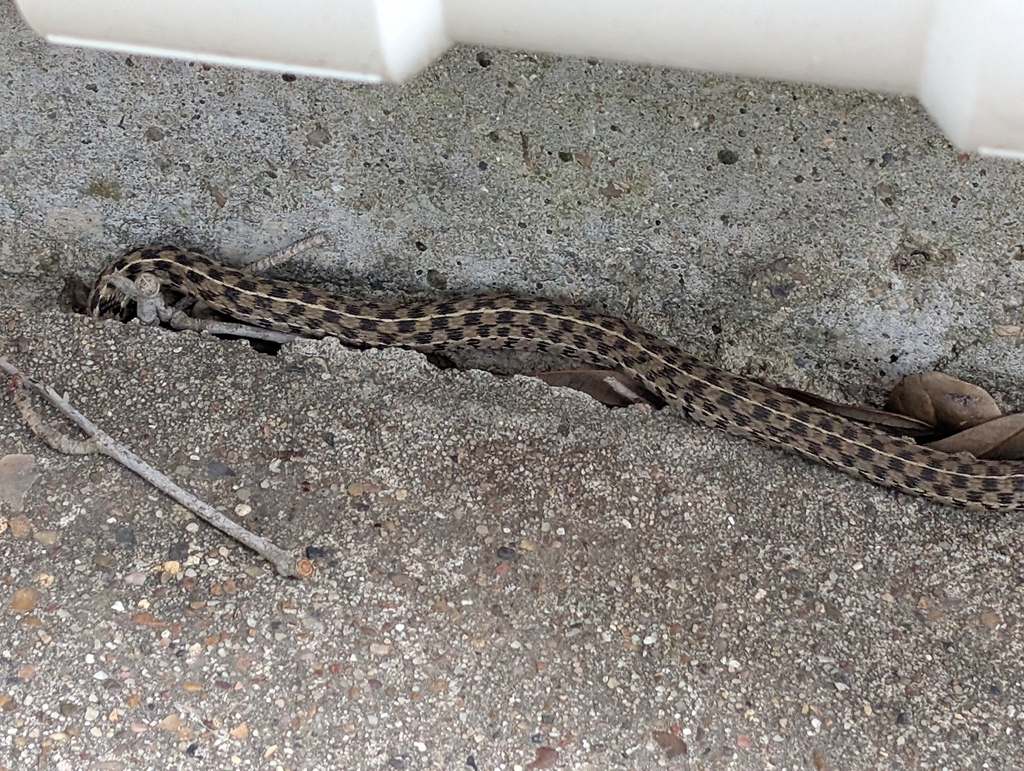
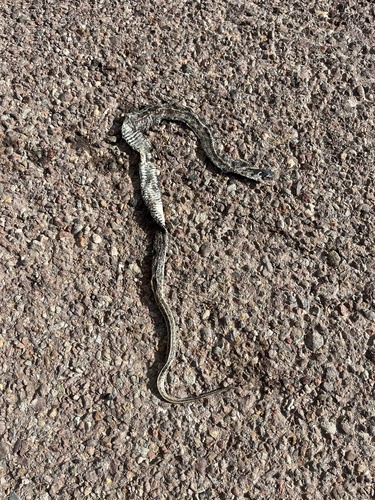
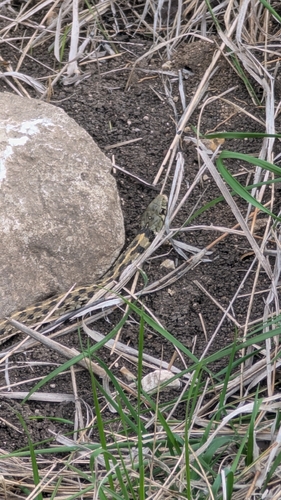
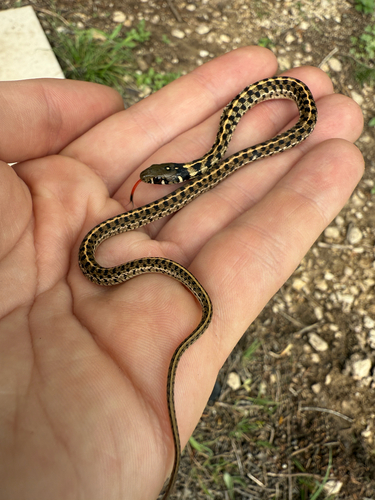
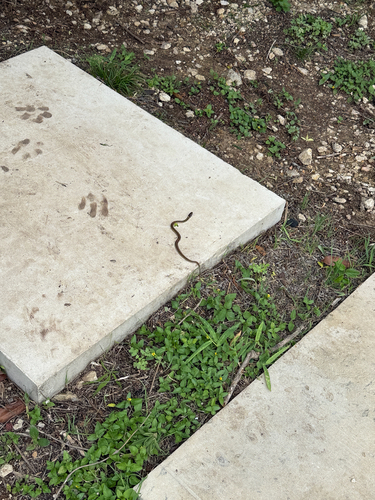
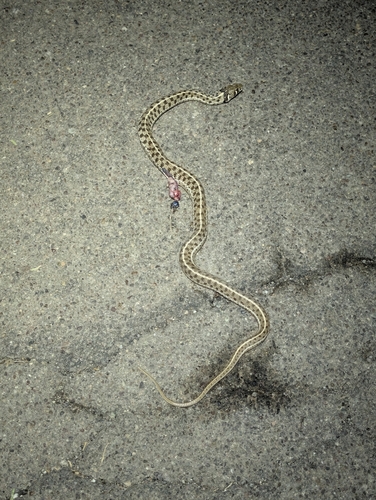
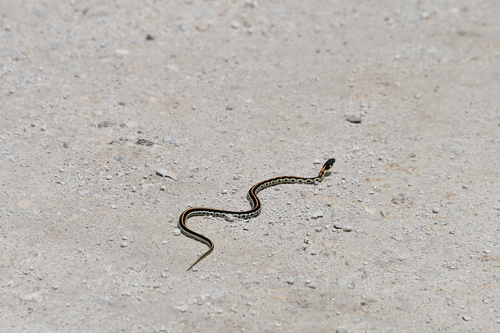
6 photographs of the Checkered Garter Snake. © dhasdf.
The Checkered Garter Snake (Thamnophis marcianus) is a non-venomous snake in the Colubridae family, recorded in 7 countries.
- Also called
- Garter / Ribbon snake
- Family
- Colubridae
- Size
- Slender, 1.5–3 ft.
- Habitat
- Almost anywhere with moisture — gardens, fields, wetlands, and streamsides.
- Behavior
- Harmless and active by day; may release musk if handled. The most commonly seen snakes across most of the U.S.
- Identify
- Slender body with three light stripes running the length of a darker back.
About the Checkered Garter Snake
The checkered garter snake (Thamnophis marcianus) is a species of garter snake in the subfamily Natricinae of the family Colubridae. The species is native to the southwestern United States, Mexico, and Central America. There are two recognized subspecies.
Etymology
The specific epithet marcianus is in honor of American Brigadier General Randolph B. Marcy, who led surveying expeditions to the frontier areas in the mid-19th century.
Description
The checkered garter snake is typically greenish in color, with a distinct, black checkerboard pattern down its back. It is capable of growing to a total length (tail included) of 42 inches (107 cm), but is usually 18 to 24 inches (46 to 61 cm).
Habitat
The preferred natural habitats of Thamnophis marcianus are desert, grassland, shrubland, and forest, usually close to water, at altitudes from sea level to 2,200 m (7,200 ft).
Diet
The diet of Thamnophis marcianus includes small frogs, toads, small fish, and earthworms. If kept as a pet, it can be trained on live or freeze-thawed mice, but even so, it is a fussy eater and can suddenly start to refuse mice at any point.
Behavior
Unlike most garter snakes, the checkered garter snake is partially nocturnal.
Defensive behavior
Thamnophis marcianus will strike and bite if provoked. It will also release a foul-smelling liquid from its cloaca onto attackers.
Reproduction
Thamnophis marcianus is ovoviviparous and may be parthenogenetic.
Venom
Thamnophis marcianus was long thought to be nonvenomous, but recent discoveries have revealed that it does in fact produce a mild neurotoxic venom. T. marcianus cannot kill humans with the small amount of venom it produces, which is comparatively mild, and it also lacks an effective means of delivering it. It does have enlarged teeth in the back of the mouth, but its gums are significantly larger. The Duvernoy's gland of a garter snake is posterior to (to the rear of) the snake's eye. The mild venom is spread into wounds through a chewing action.
Subspecies
Two subspecies of Thamnophis marcianus are recognized as being valid, including the nominotypical subspecies.
T. m. marcianus (Baird & Girard, 1853)
T. m. praeocularis (Bocourt, 1892)
Nota bene: A trinomial authority in parentheses indicates that the subspecies was originally described in a genus other than Thamnophis.
In captivity
The checkered garter snake is one of the easiest garter snakes to tame. Even a wild-caught one can become tame in a few days if handled carefully. The checkered garter snake is frequently available in the exotic pet trade, and makes a hardy captive animal. It can be trained to accept mice or fish fillets as food. Captive breeding, while not common, is done, and albino variants are being produced.
Adapted from Wikipedia, available under CC BY-SA.
Frequently asked: Checkered Garter Snake
- Is the Checkered Garter Snake venomous?
- No. The Checkered Garter Snake (Thamnophis marcianus) is non-venomous and is not considered dangerous to humans. Like most snakes, it will retreat rather than bite when given the chance.
- Is the Checkered Garter Snake poisonous?
- Snakes are venomous, not poisonous. "Poisonous" means harmful to eat or touch; "venomous" means injecting toxins through a bite. The Checkered Garter Snake is neither poisonous nor venomous.
- Is the Checkered Garter Snake dangerous?
- The Checkered Garter Snake is not dangerous to humans. It has no medically significant venom and bites only defensively if cornered or handled.
- Where does the Checkered Garter Snake live?
- The Checkered Garter Snake has verified records in 7 countries, including United States of America, Mexico, Nicaragua. See the distribution section below for its full range.
- How do I identify the Checkered Garter Snake?
- Slender body with three light stripes running the length of a darker back.
- How big does the Checkered Garter Snake get?
- Slender, 1.5–3 ft.
- What does the Checkered Garter Snake eat?
- The diet of Thamnophis marcianus includes small frogs, toads, small fish, and earthworms. If kept as a pet, it can be trained on live or freeze-thawed mice, but even so, it is a fussy eater and can suddenly start to refuse mice at any point.
- Why is it called the Checkered Garter Snake?
- The specific epithet marcianus is in honor of American Brigadier General Randolph B. Marcy, who led surveying expeditions to the frontier areas in the mid-19th century.
Where it is found
By U.S. state
More Colubridae snakes
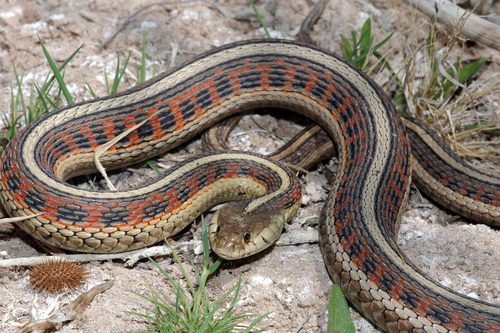 Common Garter SnakeThamnophis sirtalis
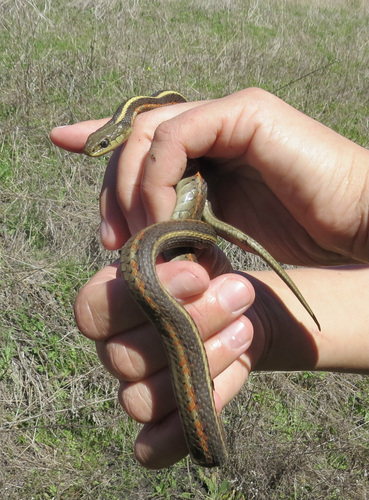 Western Terrestrial Garter SnakeThamnophis elegans
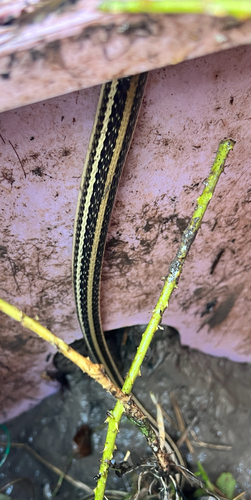 Western Ribbon SnakeThamnophis proximus
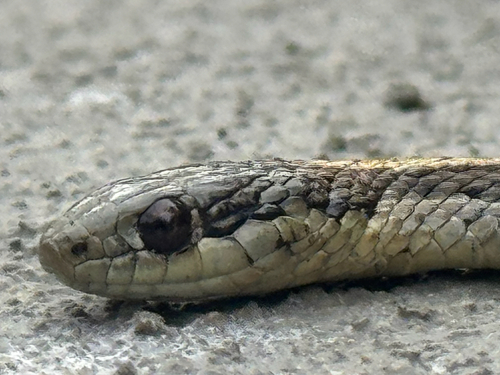 Northwestern Garter SnakeThamnophis ordinoides
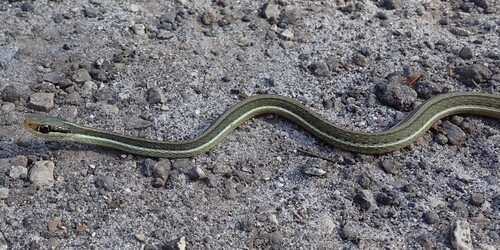 Common Ribbon SnakeThamnophis saurita
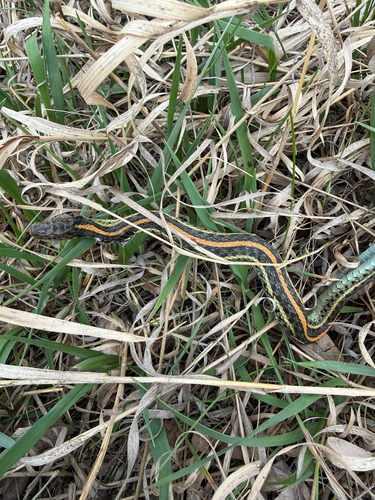 Plains Garter SnakeThamnophis radix
 Black-necked Garter SnakeThamnophis cyrtopsis
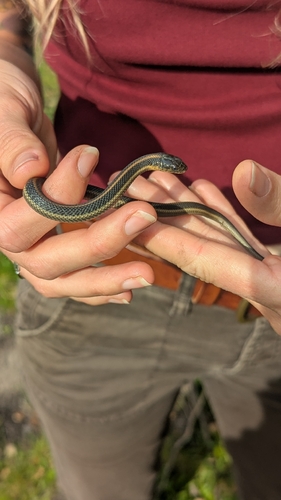 Aquatic Garter SnakeThamnophis atratus
Classification
How scientists group this snake, from the broadest category down to the exact species. Each step narrows to its closest relatives.
- OrderThe broad group of scaled reptiles: all snakes and lizards
- Squamata
- FamilyA group of related snakes that share key traits
- Colubridae
- GenusA close-knit group of very similar species
- Thamnophis
- SpeciesThis exact snake, named in the two-part scientific name
- Thamnophis marcianus
Keep learning
- What to Do If You Find a SnakeFound a snake at home or on a trail? Here is how to stay calm, give it space, identify it safely, and know when to call a professional.
- Venomous vs Nonvenomous: How to Tell the DifferenceThe folk rules for telling venomous snakes apart, where each one fails, and why location-based identification beats guessing by sight.
- What Is a Snake? Anatomy and the BasicsA clear overview of what makes a snake a snake: limbless body plan, anatomy, evolution from lizards, species diversity, and why they are ectothermic.
- How to Keep Snakes Out of Your Yard and HomeA practical guide to keeping snakes out of your yard and home using habitat changes that work, plus what to skip and what to do if one shows up.
Distribution from GBIF & iNaturalist. Venom status per CDC. Background: Wikipedia. Informational only. Never handle a snake to identify it.