
Greensnake
Rough Greensnake
HarmlessOpheodrys aestivus
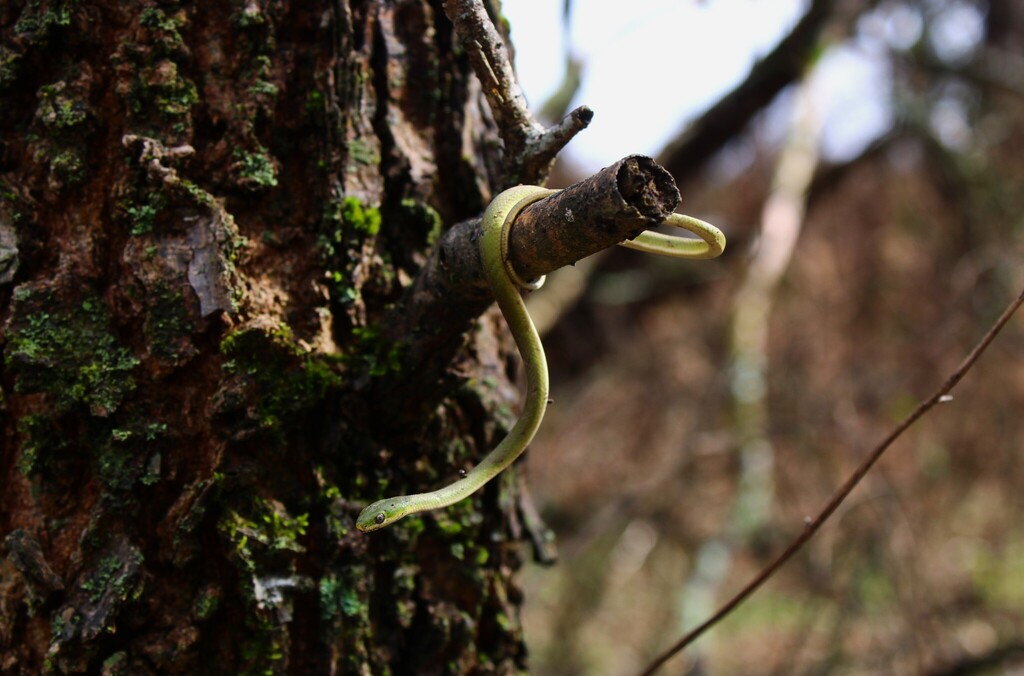
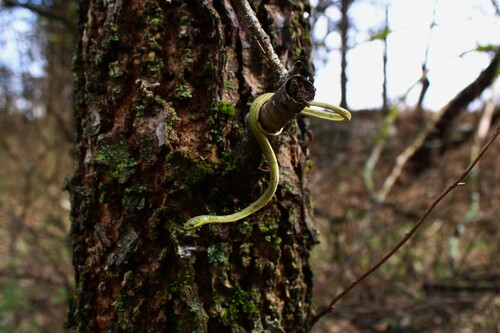
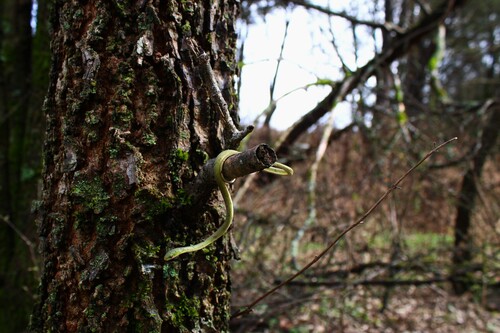
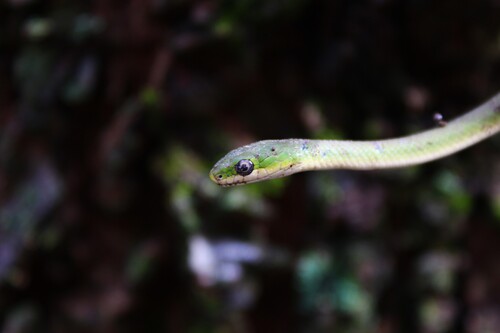
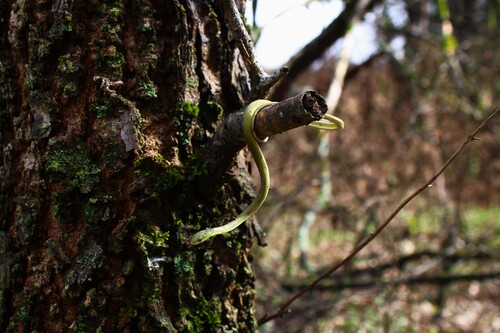
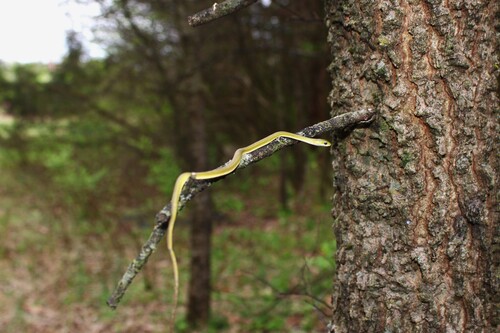
6 photographs of the Rough Greensnake. © Dominic.
The Rough Greensnake (Opheodrys aestivus) is a non-venomous snake in the Colubridae family, recorded in 4 countries.
- Also called
- Greensnake
- Family
- Colubridae
- Size
- Slender, 1.5–3 ft.
- Habitat
- Meadows, shrubs, and vine tangles.
- Behavior
- Day-active insect-eaters; superbly camouflaged.
- Identify
- Bright green above with a plain pale belly.
About the Rough Greensnake
Opheodrys aestivus, commonly known as the rough green snake, is a species of nonvenomous North American snake in the subfamily Colubrinae of the family Colubridae. The species is sometimes called grass snake or green grass snake, but these names are more commonly applied to the smooth green snake (Opheodrys vernalis). The European colubrid called grass snake (Natrix natrix) is not closely related. The rough green snake is docile, often allowing close approach by humans, and rarely bites. Even when bites occur, they have no venom and are harmless.
Description
The rough green snake (Opheodrys aestivus) is bright green above and has a yellowish belly, affording it excellent camouflage in green vegetation and making it difficult to see in the wild even though it is relatively common in its habitat. It has keeled dorsal scales, which are arranged in 17 rows at mid-body. It grows up to 116 cm (45+3⁄4 in) in total length (tail included) and is very thin.
Etymology
The specific name, aestivus, is Latin for "summer" in reference to the species' green dorsal color. The generic name, Opheodrys, is derived from Greek ophios, meaning "serpent", and drys, "tree".
Geographic range
The rough green snake ranges throughout the Southeastern United States, from Florida, north to Southern New Jersey, Indiana, and west to Central Texas. At the edge of the species' population, in states such as New Jersey, Indiana, and Kansas, it is often isolated and dependent on locally humid microclimates. The snake is commonly found in the Piedmont and Atlantic coastal plain, but is not found in the higher elevations of the Appalachian Mountains. It is also found in northeastern Mexico, including the state of Tamaulipas and eastern Nuevo León.
Habitat and behavior
The preferred natural habitat of Opheodrys aestivus is moist meadows and woodlands, typically near water. It is highly arboreal, and prefers a narrow arboreal microhabitat of dense brush in edge situations. This microhabitat is found in a variety of habitats, such as lakeshores, streambanks, and upland ravines. The rough green snake also commonly uses disturbed edge habitats alongside roads for thermoregulation and refuge. If kept in captivity it is recommended that it be in a taller enclosure with plenty of cover and climbing opportunities. It is frequently found climbing in low vegetation, and is also a good swimmer. However, it is often found on the ground as well. Unlike many snakes, it is largely diurnal. At night it is found coiled in the branches of trees. Preference is given to perches based upon distance from the shoreline, height of branches, and thickness of the individual branch.
Diet
Opheodrys aestivus is a dietary specialist, preying on insects and other arthropods. The diet of O. aestivus consists mostly of insects and other terrestrial arthropods, but some snails and tree frogs are also eaten. This snake is not a constrictor; most prey are grabbed and overpowered by its jaws which are unusually strong for a snake. O. aestivus has been shown to rely heavily on visual cues for prey detection and to prefer living prey items. As foraging activity increases, the tongue evolves greater elongation and deeper forking, and the abundance of chemoreceptors rises in the vomeronasal organs, the chemosensory responsiveness is adjusted to match diet. Orthopterans constitute 16.9% and all arthropods about 98% of dietary volume of the rough green snake. The rough green snake exhibits greater chemosensory investigation of chemical cues from its insect prey than from representatives of other taxa because of the linked importance of insects to its diet. It is able to live away from standing water by sucking droplets of dew from leaves.
As prey
Adapted from Wikipedia, available under CC BY-SA.
Frequently asked: Rough Greensnake
- Is the Rough Greensnake venomous?
- No. The Rough Greensnake (Opheodrys aestivus) is non-venomous and is not considered dangerous to humans. Like most snakes, it will retreat rather than bite when given the chance.
- Is the Rough Greensnake poisonous?
- Snakes are venomous, not poisonous. "Poisonous" means harmful to eat or touch; "venomous" means injecting toxins through a bite. The Rough Greensnake is neither poisonous nor venomous.
- Is the Rough Greensnake dangerous?
- The Rough Greensnake is not dangerous to humans. It has no medically significant venom and bites only defensively if cornered or handled.
- Where does the Rough Greensnake live?
- The Rough Greensnake has verified records in 4 countries, including United States of America, Mexico, Canada. See the distribution section below for its full range.
- How do I identify the Rough Greensnake?
- Bright green above with a plain pale belly.
- How big does the Rough Greensnake get?
- Slender, 1.5–3 ft.
- What does the Rough Greensnake eat?
- Opheodrys aestivus is a dietary specialist, preying on insects and other arthropods. The diet of O. aestivus consists mostly of insects and other terrestrial arthropods, but some snails and tree frogs are also eaten. This snake is not a constrictor; most prey are grabbed and overpowered by its jaws which are unusually strong for a snake. O. aestivus has been shown to rely heavily on visual cues for prey detection and to prefer living prey items.
- Why is it called the Rough Greensnake?
- The specific name, aestivus, is Latin for "summer" in reference to the species' green dorsal color. The generic name, Opheodrys, is derived from Greek ophios, meaning "serpent", and drys, "tree".
Where it is found
More Colubridae snakes
Classification
How scientists group this snake, from the broadest category down to the exact species. Each step narrows to its closest relatives.
- OrderThe broad group of scaled reptiles: all snakes and lizards
- Squamata
- FamilyA group of related snakes that share key traits
- Colubridae
- GenusA close-knit group of very similar species
- Opheodrys
- SpeciesThis exact snake, named in the two-part scientific name
- Opheodrys aestivus
Keep learning
- What to Do If You Find a SnakeFound a snake at home or on a trail? Here is how to stay calm, give it space, identify it safely, and know when to call a professional.
- Venomous vs Nonvenomous: How to Tell the DifferenceThe folk rules for telling venomous snakes apart, where each one fails, and why location-based identification beats guessing by sight.
- What Is a Snake? Anatomy and the BasicsA clear overview of what makes a snake a snake: limbless body plan, anatomy, evolution from lizards, species diversity, and why they are ectothermic.
- How to Keep Snakes Out of Your Yard and HomeA practical guide to keeping snakes out of your yard and home using habitat changes that work, plus what to skip and what to do if one shows up.
Distribution from GBIF & iNaturalist. Venom status per CDC. Background: Wikipedia. Informational only. Never handle a snake to identify it.