
Viperidae
South American Bushmaster
VenomousLachesis muta
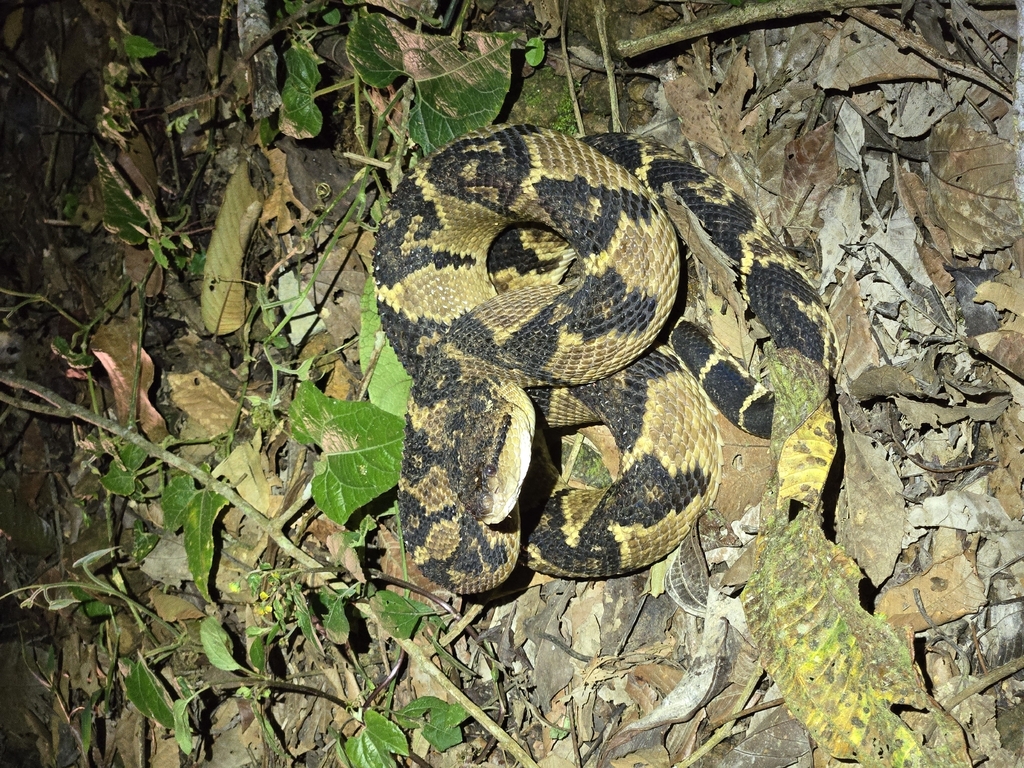
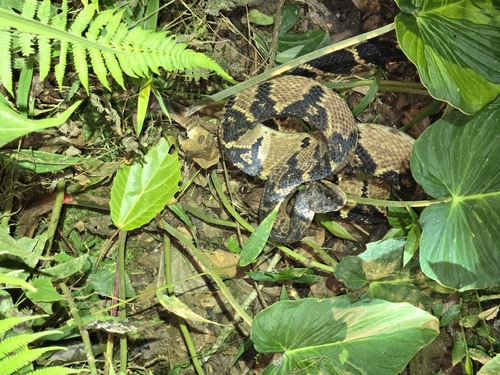
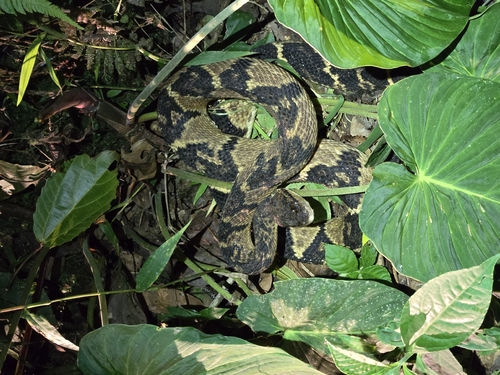
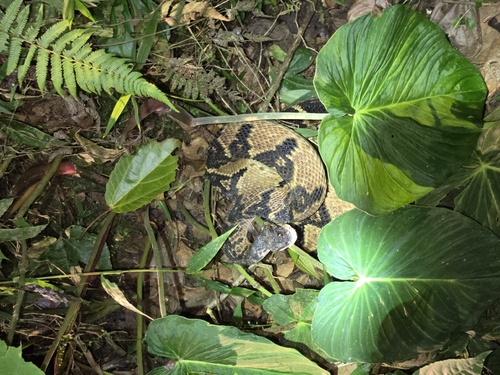
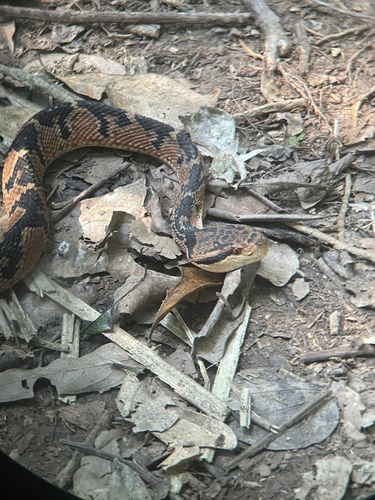
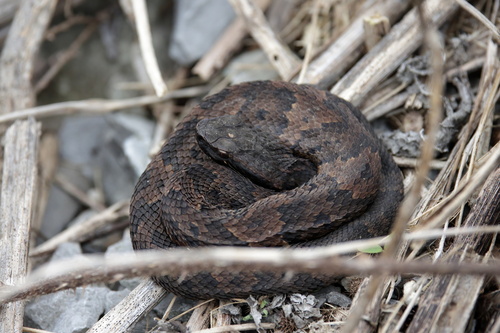
5 photographs of the South American Bushmaster. © Cen_Bamper.
The South American Bushmaster (Lachesis muta) is a venomous snake in the Viperidae family, recorded in 17 countries.
If you are bitten
This is a venomous snake. Treat any bite as a medical emergency: stay calm, keep the bitten limb still and roughly level with the heart, remove rings and tight clothing, and get to emergency care immediately. Do not apply a tourniquet, cut the wound, apply ice, or try to suck out venom. Call your local emergency number or poison center.
- Family
- Viperidae
- Danger
- high
About the South American Bushmaster
Lachesis muta, also known as the Southern American bushmaster or Atlantic bushmaster, is a pit viper species found in South America, as well as the island of Trinidad in the Caribbean. Two subspecies are currently recognized, including the nominate subspecies described here.
Taxonomy
Two additional subspecies, L. m. melanocephala and L. m. stenophrys, had earlier been recognized. However, both were elevated to species level by Zamudio and Green in 1997 (see L. melanocephala and L. stenophrys).
Subspecies
Description
Adults grow to an average of 2 to 2.5 m (6½-8 feet), although 3 m (10 feet) is not too unusual. The largest recorded specimen was 3.65 m (12 feet) long, making the species the longest of all vipers and the longest venomous snake in the Western Hemisphere. Lachesis muta is the third longest venomous snake in the world, exceeded in length only by the king cobra and the black mamba. Weight in this species is estimated at an average of 3 to 5 kg (6.6 to 11.0 lb), somewhat less than the heaviest rattlesnakes (like the eastern diamondback rattlesnake) or Bitis vipers (such as the Gaboon viper and rhinoceros viper).
The head is broad and distinct from the narrow neck. The snout is broadly rounded. There is no canthus. A pair of small internasals is present, separated by small scales. The supraoculars are narrow. Other parts of the crown are covered with very small scales. Laterally, the second supralabial forms the anterior border of the loreal pit, while the third is very large. The eye is separated from the supralabials by 4-5 rows of small scales.
The body is cylindrical, tapered and moderately stout. Midbody there are 31-37 nonoblique rows of dorsal scales which are heavily keeled with bulbous tubercles and feebly imbricate. There are 200-230 ventral scales. The tail is short with 32-50 mainly paired subcaudals, followed by 13-17 rows of small spines and a terminal spine. Like most New World pit vipers, Lachesis muta exhibits defensive tail vibration behavior in response to potential predatory threats
The color pattern consists of a yellowish, reddish or grey-brown ground color, overlaid with a series of dark brown or black dorsal blotches that form lateral inverted triangles of the same color. The lateral pattern may be precisely or indistinctly defined, normally pale at the center.
Venom
Some reports suggest that this species produces a large amount of venom that is weak compared to some other vipers. Others, however, suggest that such conclusions are not accurate. These animals are badly affected by stress and rarely live long in captivity. This makes it difficult to obtain venom in useful quantities and good condition for study purposes. For example, Bolaños (1972) observed that venom yield from his specimens fell from 233 mg to 64 mg while they remained in his care. As the stress of being milked regularly has this effect on venom yield, it is reasoned that it may also affect venom toxicity. This may explain the disparity described by Hardy and Haad (1998) between the low laboratory toxicity of the venom and the high mortality rate of bite victims.
Adapted from Wikipedia, available under CC BY-SA.
Local and regional names
The South American Bushmaster is known by these names across the regions where it lives:
- Afrikaans
- Bosadder
- Chinese
- 南美巨蝮
- Czech
- křovinář němý
- Danish
- Sydamerikansk Bushmaster
- Dutch
- Bosmeester
- English
- Bushmaster
- French
- Grage grands carreaux, Grage grands carreaux, Maître de brousse, Lachésis muet, Maître de la brousse
- German
- Südamerikanischer Buschmeister
- Hungarian
- némacsörgőkígyó
- Japanese
- ブッシュマスター
- Polish
- groźnica niema
- Portuguese
- Bico-de-Jaca, Cobra-Topete, Cuiama-Pina, Daya, Pico-de-Jaca, Surucucu, Surucucu-Bico-de-Jaca, Surucucu-Cospe-Fogo, Surucucu-Pico-de-Jaca, Surucucu-Rabo-de-Mucura, Surucucu-de-Fogo, Surucucutinga, Surucutinga, Verrugosa
- Russian
- Бушмейстер, Сурукуку
- Spanish
- Cuaima; Guayma concha de piña, Surucucú, shushupe
Frequently asked: South American Bushmaster
- Is the South American Bushmaster venomous?
- Yes. The South American Bushmaster (Lachesis muta) is venomous and belongs to the Viperidae family (viper). Its bite is considered high risk to people. Treat any bite as a medical emergency.
- Is the South American Bushmaster poisonous?
- Snakes are venomous, not poisonous. "Poisonous" means harmful to eat or touch; "venomous" means injecting toxins through a bite. The South American Bushmaster is venomous, delivering venom through a bite.
- Is the South American Bushmaster dangerous?
- This is a venomous snake. Treat any bite as a medical emergency: stay calm, keep the bitten limb still and roughly level with the heart, remove rings and tight clothing, and get to emergency care immediately. Do not apply a tourniquet, cut the wound, apply ice, or try to suck out venom. Call your local emergency number or poison center.
- Where does the South American Bushmaster live?
- The South American Bushmaster has verified records in 17 countries, including Brazil, Peru, Colombia. See the distribution section below for its full range.
- What does the South American Bushmaster eat?
- Bushmasters prey primarily on rats and mice. Birds and reptiles may occasionally be eaten. Spiny rats are favored prey items in Costa Rica. Rice rats and agoutis are other favored prey. Other prey items include porcupines, squirrels, opossums, squirrel monkeys, and frogs.
- Why is it called the South American Bushmaster?
- Lachesis is one of the three Fates in Greek mythology and was supposed to assign to man his term of life—something this species is certainly capable of doing. The species is similar in appearance to rattlesnakes and vibrates its tail vigorously when alarmed, but has no rattle and was therefore called mutus (later muta), which is Latin for "dumb" or "mute". However, when in the undergrowth, the tail actually makes quite a loud rustling noise.
If you are bitten by the South American Bushmaster
Do
- Get away from the snake and stay calm. Most bites worsen when people panic or try again to handle the snake.
- Call 911 or Poison Control (1-800-222-1222) right away. Antivenom works best when given early.
- Note the time of the bite and, from a safe distance, the snake's color and pattern, a phone photo is enough. Do not chase it.
- Keep the bitten limb still and at roughly heart level. Sit or lie down and limit movement.
- Remove rings, watches, and tight clothing near the bite before swelling starts.
- Gently wash the bite with soap and water and cover it with a clean, dry dressing.
Do not
- Do not cut the wound or try to suck out the venom.
- Do not apply a tourniquet or ice.
- Do not drink alcohol or caffeine.
- Do not take aspirin or ibuprofen, they can worsen bleeding. Acetaminophen is safer for pain.
- Do not try to catch or kill the snake. A dead snake can still bite by reflex.
First-aid guidance adapted from the U.S. Centers for Disease Control and Prevention (CDC NIOSH), Venomous Snakes. Educational only; always follow the instructions of emergency responders.
Where it is found
More Viperidae snakes
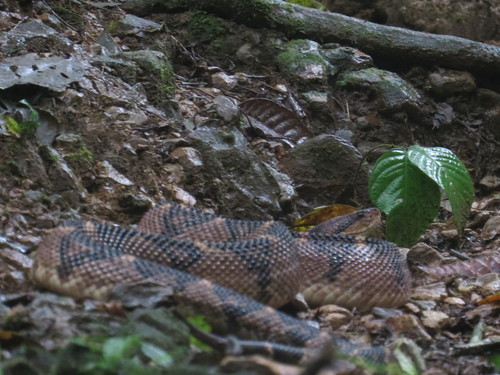 Chocoan bushmasterLachesis acrochorda
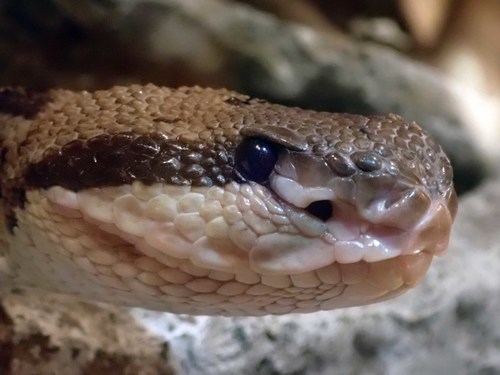 Central American BushmasterLachesis stenophrys
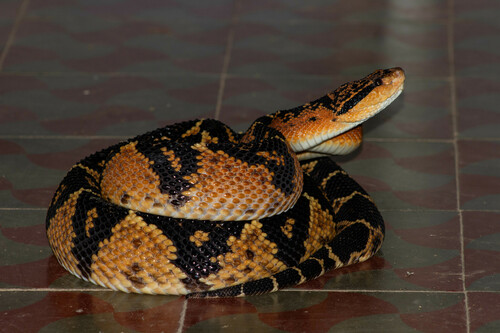 Atlantic Forest bushmasterLachesis rhombeata
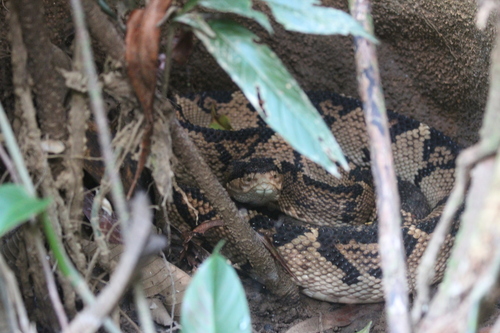 Black-headed BushmasterLachesis melanocephala
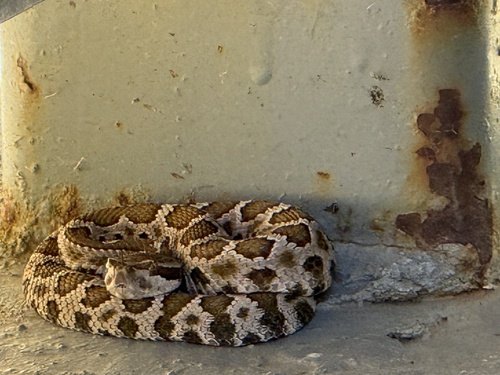 Western RattlesnakeCrotalus oreganus
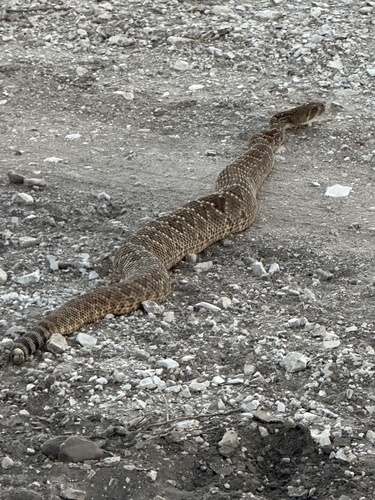 Western Diamond-backed RattlesnakeCrotalus atrox
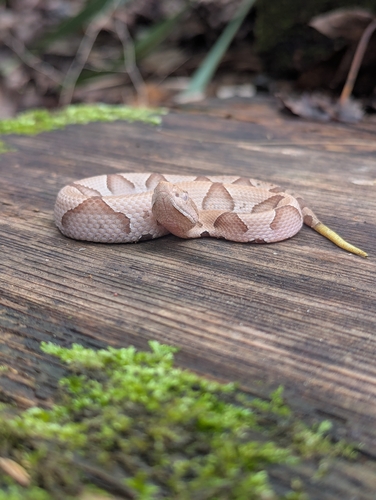 Eastern CopperheadAgkistrodon contortrix
 Northern CottonmouthAgkistrodon piscivorus
Classification
How scientists group this snake, from the broadest category down to the exact species. Each step narrows to its closest relatives.
Keep learning
- Are Snakes Dangerous? The Real Risk, in PerspectiveMost snakes are harmless and avoid people. Here is the honest picture of snakebite risk worldwide and how to lower your own.
- Snakebite First Aid: What to Do (and What Never to Do)A clear, CDC-based guide to snakebite first aid: the steps that help, the popular myths that hurt, and how to tell a serious bite from a minor one.
- Venomous vs Nonvenomous: How to Tell the DifferenceThe folk rules for telling venomous snakes apart, where each one fails, and why location-based identification beats guessing by sight.
- What to Do If You Find a SnakeFound a snake at home or on a trail? Here is how to stay calm, give it space, identify it safely, and know when to call a professional.
Distribution from GBIF & iNaturalist. Venom status per CDC. Background: Wikipedia. Informational only. Never handle a snake to identify it.