
Colubridae
Green Vine Snake
HarmlessOxybelis fulgidus
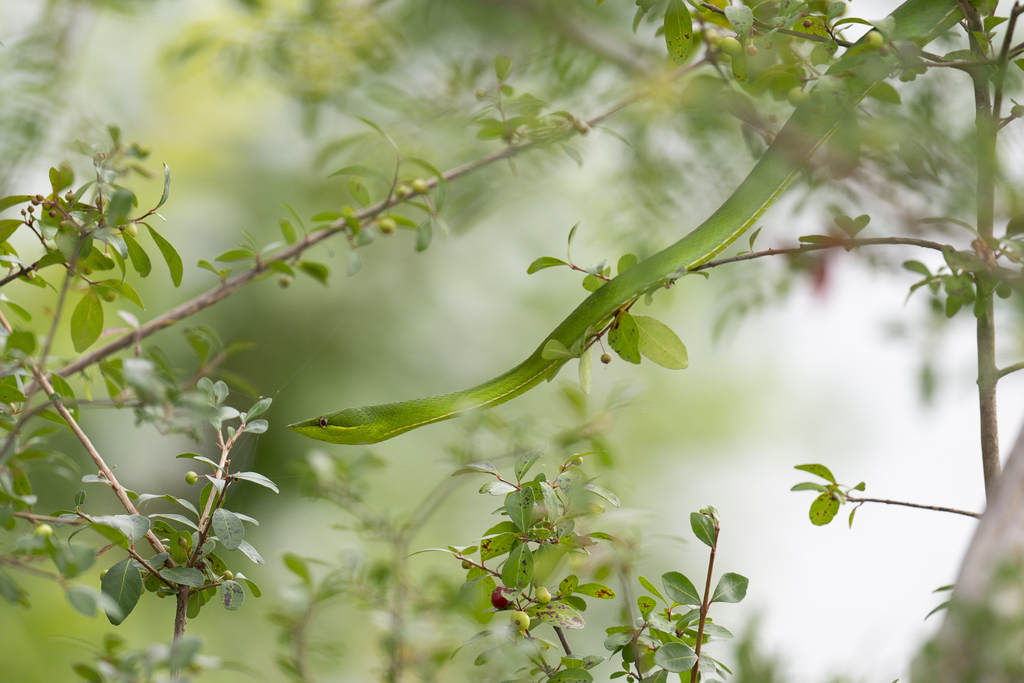
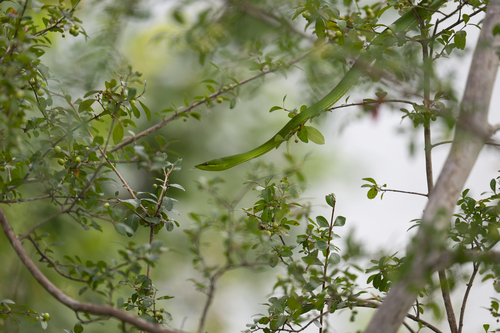
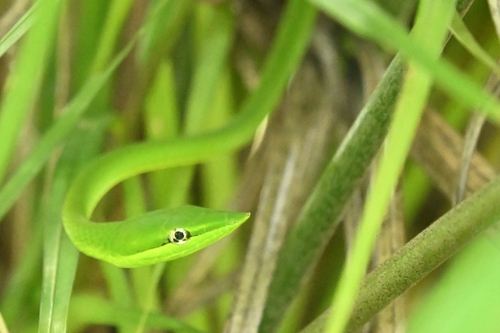
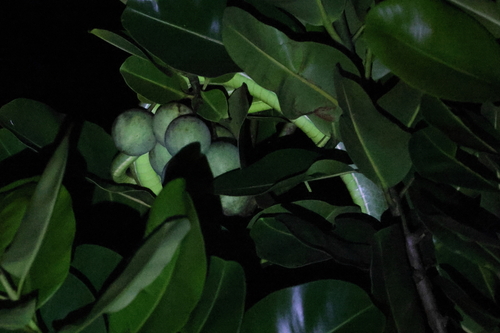
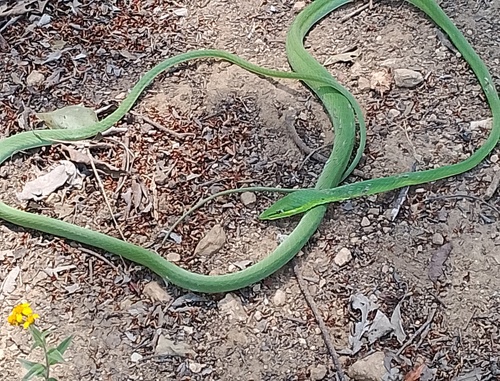
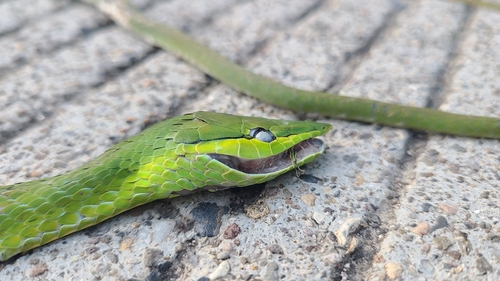
6 photographs of the Green Vine Snake. © Charlotte Kirchner.
The Green Vine Snake (Oxybelis fulgidus) is a rear-fanged, mildly venomous snake in the Colubridae family, recorded in 18 countries.
- Family
- Colubridae
About the Green Vine Snake
Oxybelis fulgidus, commonly known as the green vine snake, is a species of slender, arboreal, opisthoglyphous ('rear-fanged') colubrid serpent which is endemic to Central America and northern South America.
Common names
Common names used in South America for this species include bejuca lora, bejuquilla verde, cobra-cipó, and cobra-bicuda.
Geographic range
Oxybelis fulgidus is found in mainland Latin America, primarily in Belize, Bolivia, Brazil, Colombia, Costa Rica, Ecuador, El Salvador, French Guiana, Guatemala, Guyana, Honduras, Mexico, Nicaragua, Panama, Peru, Suriname and Venezuela.
Description
This snake is very slender, roughly 2 cm (0.79 in) thick, and may attain a total length of about 1.5–2 m (59–79 in). The tail is long and very delicate, but mostly used to hold on while reaching for prey. The head is aerodynamically shaped and very pointy, the mouth is very large and extends almost the whole length of the head. The tongue is long and green; when in use it is kept outside the mouth and moved up and down. This behavior is reflected in other species of vine snake and it is believed that they are using their tongues as sights the way a cat uses its whiskers, as they move very quickly through branches and brush.
It is bright green dorsally, and yellowish green ventrally and on the upper lip. There is a narrow yellowish-white stripe along each side of the belly and tail.
Snout very prominent, about three times as long as the diameter of the eye. No loreal, prefrontal contacting 2 or 3 upper labials. 9–10 upper labials, 4th, 5th, and 6th (or 5th, 6th, and 7th) entering the eye. Temporals very large, 1 + 2.
Dorsal scales weakly keeled, arranged in 17 rows at midbody. Ventrals 198–217; anal plate divided; subcaudals 139–165, also divided.
Catching prey
An almost exclusively arboreal (tree-dwelling) species, the green vine snake remains high above the ground on tree branches, staring down awaiting any passing small animals. When an appropriately-sized rodent, lizard, frog, bird, or other small animal is spotted, the snake follows it for a short distance, carefully analyzing the smells of the potential prey, and surrounding area, with its tongue. If the snake has successfully stalked its desired quarry, it will attack, usually by biting into the head or back of the neck before lifting the prey 20–40 cm (8–15.5 in) off of the ground. The snake will also typically coil around its prey, albeit not in a constrictor-like fashion, to further subdue and control it.
The vine snake is an opisthoglyphous (or "rear-fanged") species that possesses two larger, but blunted, peg-like teeth at the upper back of the mouth, which are slightly grooved on the sides to allow for delivery of a toxic salival fluid. Designed to quickly immobilize small animals, this salival fluid ensures the sufficient dispatching of prey and prevents the animal from retaliating and potentially wounding, or even killing, the snake. Then it is quickly swallowed. Once the prey is completely swallowed within the vine snake's body, it typically searches for a new resting place, usually at the highest point of a tree.
Adapted from Wikipedia, available under CC BY-SA.
Frequently asked: Green Vine Snake
- Is the Green Vine Snake venomous?
- The Green Vine Snake (Oxybelis fulgidus) is rear-fanged and only mildly venomous. It is not considered dangerous to humans (its venom is weak and its fangs sit at the back of the mouth) but a bite can cause local swelling or irritation, so it should not be handled.
- Is the Green Vine Snake poisonous?
- Snakes are venomous, not poisonous. "Poisonous" means harmful to eat or touch; "venomous" means injecting toxins through a bite. The Green Vine Snake is neither poisonous nor venomous.
- Is the Green Vine Snake dangerous?
- The Green Vine Snake is not dangerous to humans. It has no medically significant venom and bites only defensively if cornered or handled.
- Where does the Green Vine Snake live?
- The Green Vine Snake has verified records in 18 countries, including Brazil, Mexico, Costa Rica. See the distribution section below for its full range.
- What does the Green Vine Snake eat?
- An almost exclusively arboreal (tree-dwelling) species, the green vine snake remains high above the ground on tree branches, staring down awaiting any passing small animals. When an appropriately-sized rodent, lizard, frog, bird, or other small animal is spotted, the snake follows it for a short distance, carefully analyzing the smells of the potential prey, and surrounding area, with its tongue. If the snake has successfully stalked its desired quarry, it will attack, usually by biting into the head or back of the neck before lifting the prey 20–40 cm (8–15.5 in) off of the ground.
- Why is it called the Green Vine Snake?
- Common names used in South America for this species include bejuca lora, bejuquilla verde, cobra-cipó, and cobra-bicuda.
Where it is found
More Colubridae snakes
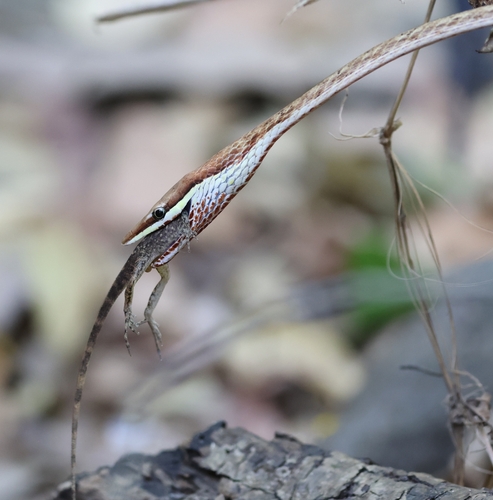 Köhler’s Vine SnakeOxybelis koehleri
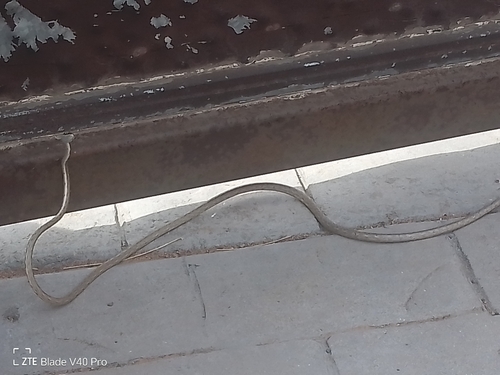 Thornscrub Vine SnakeOxybelis microphthalmus
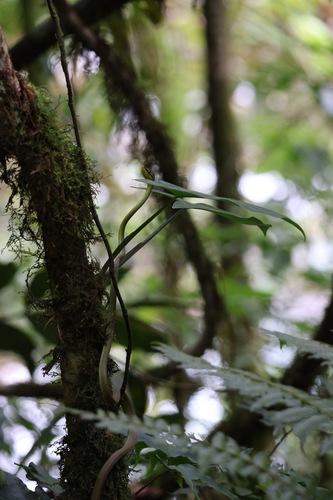 Cope's Vine SnakeOxybelis brevirostris
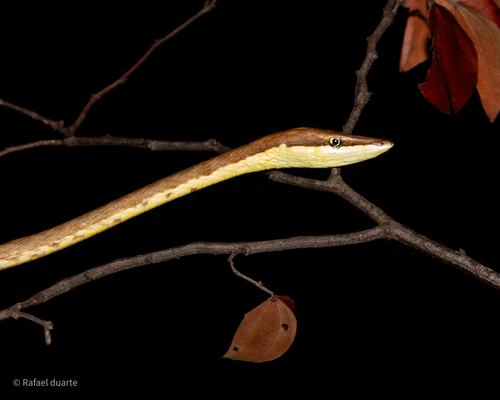 Brown VinesnakeOxybelis aeneus
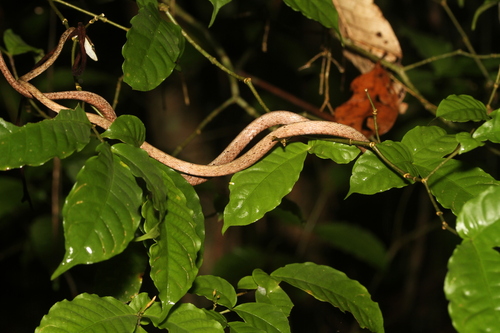 Rutherford's Vine SnakeOxybelis rutherfordi
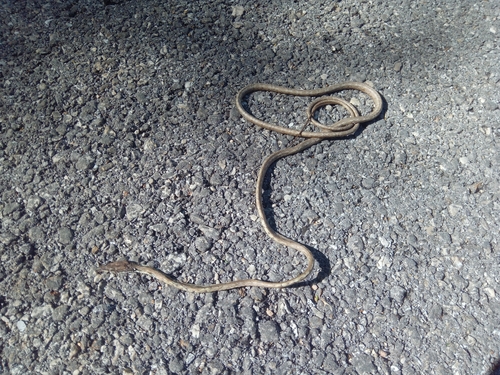 Gulf Coast Vine SnakeOxybelis potosiensis
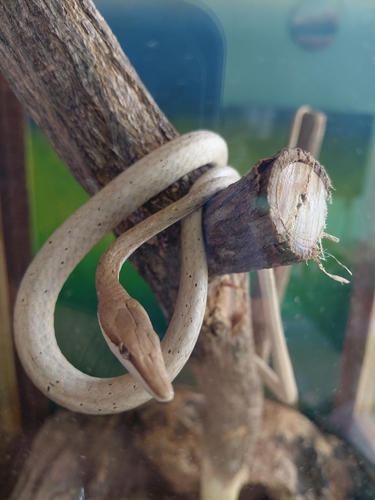 Striped Vine SnakeOxybelis vittatus
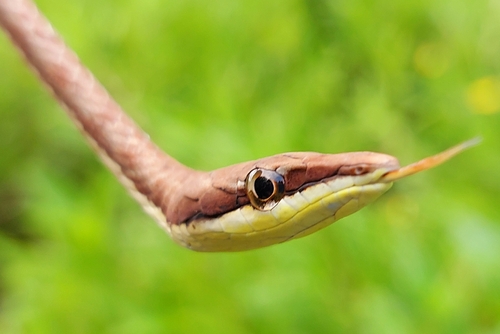 Oxybelis transandinusOxybelis transandinus
Classification
How scientists group this snake, from the broadest category down to the exact species. Each step narrows to its closest relatives.
- OrderThe broad group of scaled reptiles: all snakes and lizards
- Squamata
- FamilyA group of related snakes that share key traits
- Colubridae
- GenusA close-knit group of very similar species
- Oxybelis
- SpeciesThis exact snake, named in the two-part scientific name
- Oxybelis fulgidus
Keep learning
- What to Do If You Find a SnakeFound a snake at home or on a trail? Here is how to stay calm, give it space, identify it safely, and know when to call a professional.
- Venomous vs Nonvenomous: How to Tell the DifferenceThe folk rules for telling venomous snakes apart, where each one fails, and why location-based identification beats guessing by sight.
- What Is a Snake? Anatomy and the BasicsA clear overview of what makes a snake a snake: limbless body plan, anatomy, evolution from lizards, species diversity, and why they are ectothermic.
- How to Keep Snakes Out of Your Yard and HomeA practical guide to keeping snakes out of your yard and home using habitat changes that work, plus what to skip and what to do if one shows up.
Distribution from GBIF & iNaturalist. Venom status per CDC. Background: Wikipedia. Informational only. Never handle a snake to identify it.