
Boidae
Desert Sand Boa
HarmlessEryx miliaris
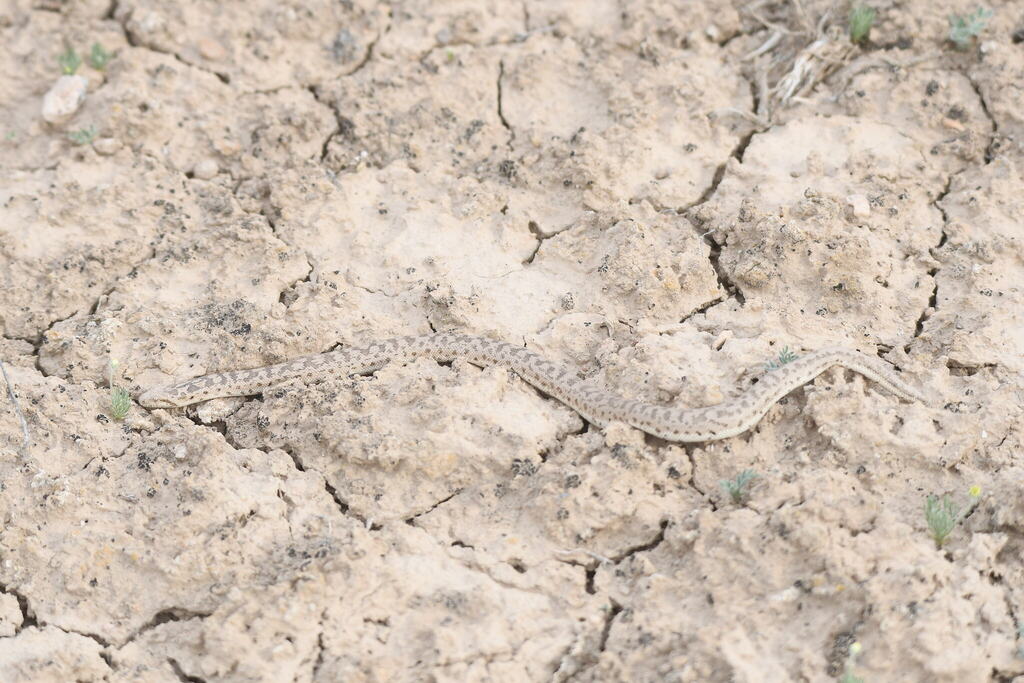
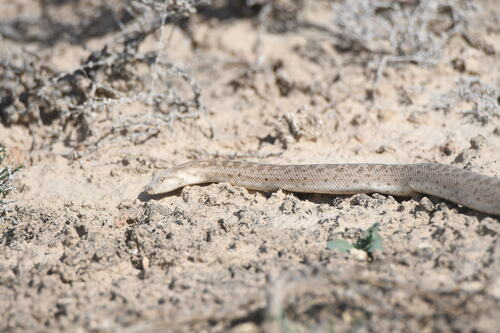
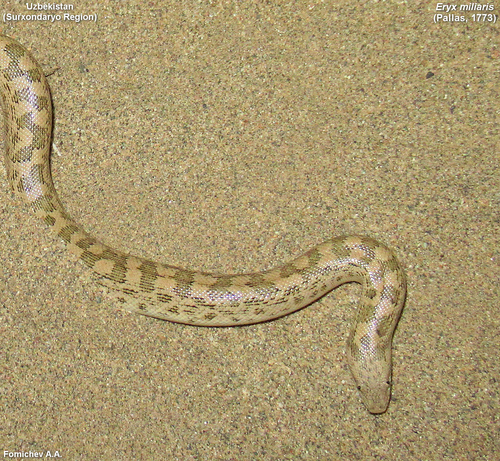

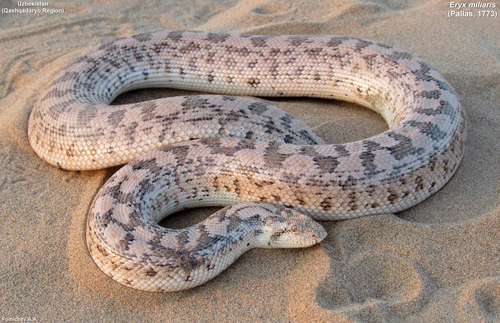
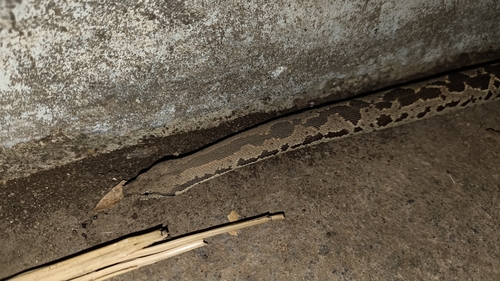
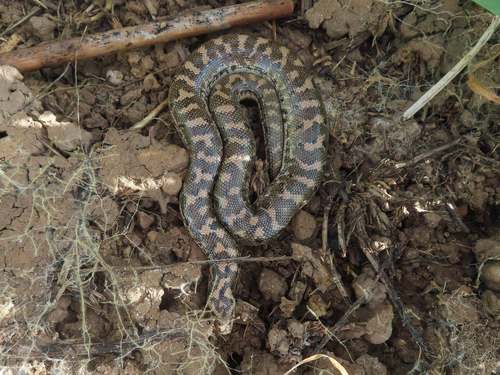
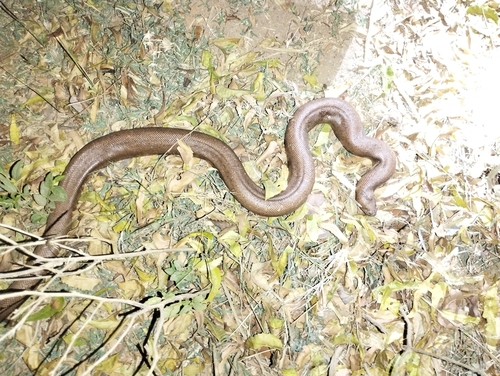
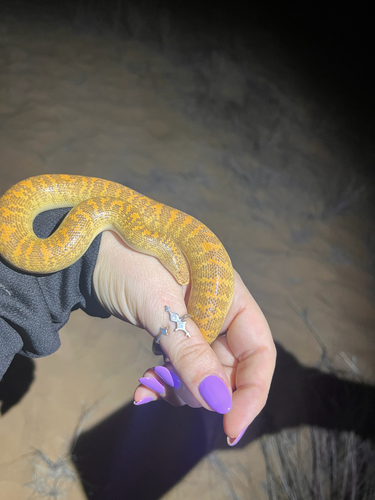
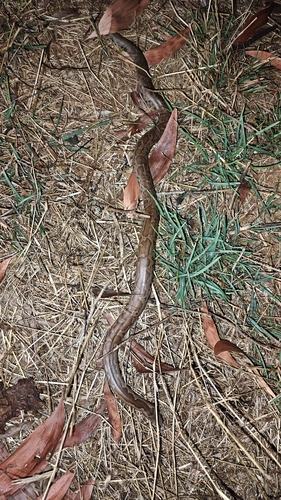
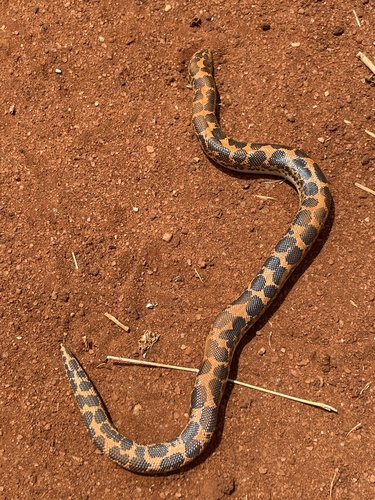
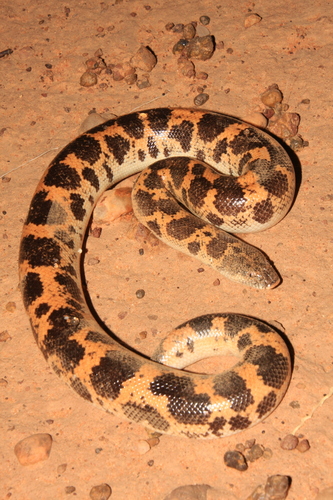
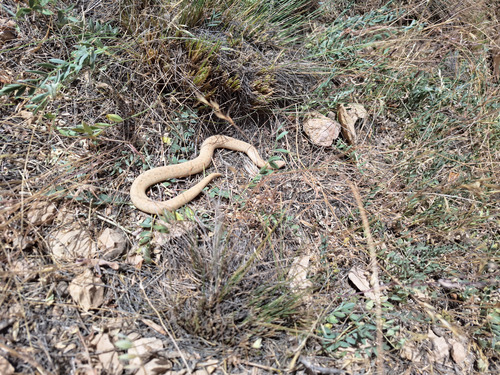
5 photographs of the Desert Sand Boa. © kirinzi.
The Desert Sand Boa (Eryx miliaris) is a non-venomous snake in the Boidae family, recorded in 12 countries.
- Family
- Boidae
About the Desert Sand Boa
Eryx miliaris, known as the dwarf sand boa, desert sand boa, and if formally synonymised with Eryx tataricus, as Tartar sand boa, is a widely distributed, largely Asian species of snake of the Boidae (boa, Erycidae) family. On behalf of the International Union for Conservation of Nature (IUCN), scientists assessed the populations of E. miliaris/tataricus across its range of habitats for the IUCN Red List of Threatened Species in April 2016, assigning them the status of "Least Concern".
The IUCN, the Reptile Database (RBD), and other contributing sources paint a relatively consistent picture of the distribution of these and other synonymous species, ranging from Iraq and Iran in the west, along the western shore of the Caspian Sea through all of central Asia, south into Afghanistan and Pakistan, and north and east into southern Russia, Mongolia, and Inner Mongolia in northern China.
The species may be the inspiration for a cryptid of legend, the Mongolian death worm.
Description
Phylogeny, naming, synonymy
Eryx miliaris (deemed synonymous with E. tataricus based on mtDNA and morphologic analyses) is commonly known as the dwarf sand boa and desert sand boa (and via E. tataricus, the Tartar sand boa), and is a species of snake in the Boidae (Erycinae, Erycidae, boa) family. Formal subspecies—sometimes termed direct children—include E. miliaris miliaris [Pallas 1773] and E. miliaris nogaiorum [Nikolsky 1910]. Common names that E. miliaris is reportedly known by are the mountain sand boa, and various geographical names including Russian and Turkmen sand boas. As well, the various subspecies have sometimes been given distinct common names, e.f., E. miliaris nogaiorum as the black sand boa.
General physical description
The appearance of E. miliaris is described by WCH-University of Adelaide as usually having an adult length of 30 centimeters, extending to a maximum of approximately 90 centimeters.
Other sources highlight that, as with most other sand boas, females are larger than males, and that E. tataricus (Tartar sand boa specimens) are the larger variants (the comparison presuming the E. miliaris-E. tataricus synonymy); these sources note that adult Tartar sand boa males rarely reach 75 centimeters in length, while adult females can reach 120 centimeters.
E. miliaris, per se, is reliably described as being, relative to other snakes:Small in length, [and] cylindrical... [a] stout bodied snake with a very short blunt tail... [Its h]ead is indistinct from [its] neck. [Its s]nout is rounded when viewed from above and pointed and projecting when viewed from the side. [Its e]yes are small in size, located dorsally with vertically elliptical pupils. [Its d]orsal scales are smooth to weakly keeled.
Adapted from Wikipedia, available under CC BY-SA.
Frequently asked: Desert Sand Boa
- Is the Desert Sand Boa venomous?
- No. The Desert Sand Boa (Eryx miliaris) is non-venomous and is not considered dangerous to humans. Like most snakes, it will retreat rather than bite when given the chance.
- Is the Desert Sand Boa poisonous?
- Snakes are venomous, not poisonous. "Poisonous" means harmful to eat or touch; "venomous" means injecting toxins through a bite. The Desert Sand Boa is neither poisonous nor venomous.
- Is the Desert Sand Boa dangerous?
- The Desert Sand Boa is not dangerous to humans. It has no medically significant venom and bites only defensively if cornered or handled.
- Where does the Desert Sand Boa live?
- The Desert Sand Boa has verified records in 12 countries, including Kazakhstan, Russian Federation, China. See the distribution section below for its full range.
- What does the Desert Sand Boa eat?
- The WCH-University of Adelaide describe E. miliaris as "[t]errestrial and mainly diurnal... with nocturnal tendencies in [its habitat's] hottest months". The IUCN description of the species, which specifically refers to E. miliaris (distinctly, from E. tataricus and E. speciosus), presents it as "nocturnal during the hot part of the year", indicates that it is "common on the surface in spring", and states that it is active from "March to October over most of its range" (and the more proscribed April to September in Kazakhstan and the eastern Ciscaucasia).
- Why is it called the Desert Sand Boa?
- Eryx miliaris (deemed synonymous with E. tataricus based on mtDNA and morphologic analyses) is commonly known as the dwarf sand boa and desert sand boa (and via E. tataricus, the Tartar sand boa), and is a species of snake in the Boidae (Erycinae, Erycidae, boa) family. Formal subspecies—sometimes termed direct children—include E. miliaris miliaris [Pallas 1773] and E. miliaris nogaiorum [Nikolsky 1910]. Common names that E. miliaris is reportedly known by are the mountain sand boa, and various geographical names including Russian and Turkmen sand boas.
Where it is found
More Boidae snakes
Classification
How scientists group this snake, from the broadest category down to the exact species. Each step narrows to its closest relatives.
Keep learning
- What to Do If You Find a SnakeFound a snake at home or on a trail? Here is how to stay calm, give it space, identify it safely, and know when to call a professional.
- Venomous vs Nonvenomous: How to Tell the DifferenceThe folk rules for telling venomous snakes apart, where each one fails, and why location-based identification beats guessing by sight.
- What Is a Snake? Anatomy and the BasicsA clear overview of what makes a snake a snake: limbless body plan, anatomy, evolution from lizards, species diversity, and why they are ectothermic.
- How to Keep Snakes Out of Your Yard and HomeA practical guide to keeping snakes out of your yard and home using habitat changes that work, plus what to skip and what to do if one shows up.
Distribution from GBIF & iNaturalist. Venom status per CDC. Background: Wikipedia. Informational only. Never handle a snake to identify it.