
Homalopsidae
Asian Bockadam
HarmlessCerberus rynchops
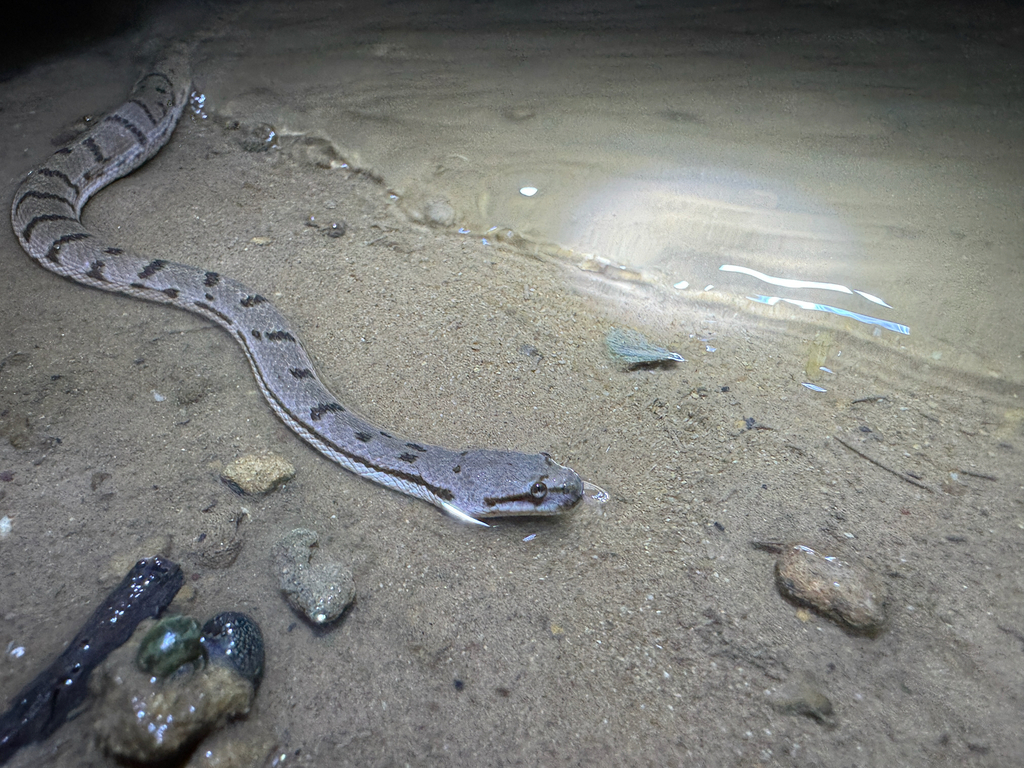
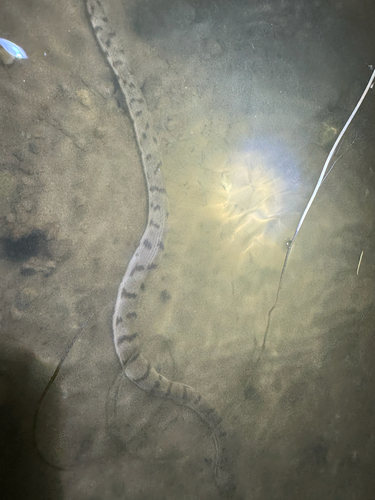
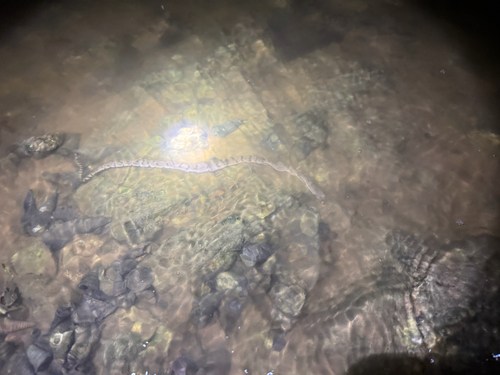
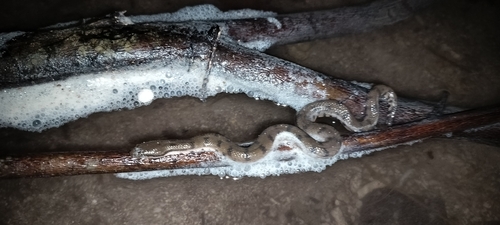
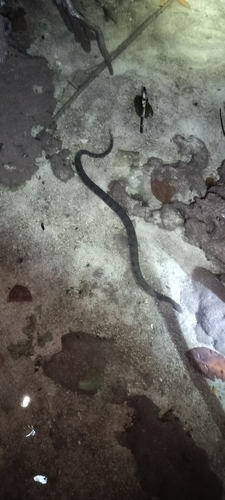
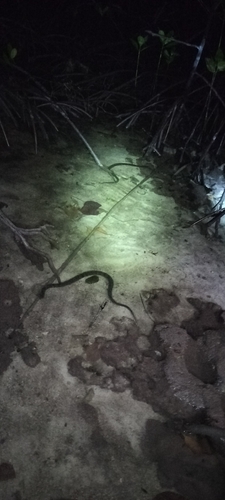
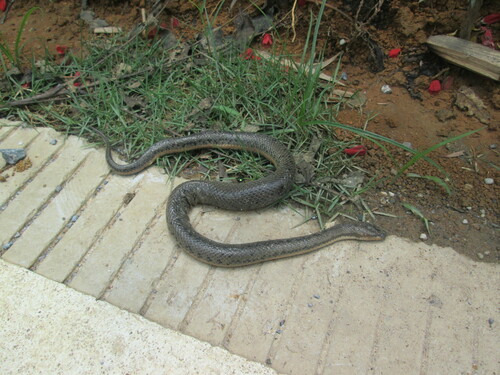
6 photographs of the Asian Bockadam. © Teja Yantrapalli.
The Asian Bockadam (Cerberus rynchops) is a non-venomous snake in the Homalopsidae family, recorded in 20 countries.
- Family
- Homalopsidae
About the Asian Bockadam
Cerberus rynchops, also known as the New Guinea bockadam, South Asian bockadam, bockadam snake, or dog-faced water snake, is a mildly venomous species of a snake in the family Homalopsidae. It is native to coastal waters of South and Southeast Asia. The species was re-delimited in 2012, allocating populations east and south of the west coast of Thailand to other species.
Ecology and behaviour
It is commonly found in mangroves, mudflats, streams, ponds, tidal pools, on algae patches, and has even been found burrowing into the mud. It is rear-fanged and is mildly venomous. An aquatic and nocturnal snake, it feeds mainly on fish and is known to consume gobies (including Oxudercidae), apogonids, siganids, catfish, mullet, and eels, as well as crustaceans and frogs.
In captivity, it is observed to move in a sidewinding direction on land. In the BBC series 'Life in Cold Blood' it was filmed adapting this sidewinding technique to jump across a mudflat in Singapore; up until then, no snakes were considered able to truly jump. It also has a prehensile tail that would suggest it could climb mangrove trees. It is now known to give birth to live young, numbering from 8 to 30, either in water or on land.
It is a quite docile, mild-tempered and a hardy snake; in recent years it has become a welcome addition to snake hobbyists in the Philippines. It also owes its popularity to its bright yellow to orange belly coloring, mostly of females. In the Philippines, particularly in the Central Visayas area, this snake is commonly known as the "tangkig".
Description
The visibility of upper jaw, giving it a dog-like appearance. Head long and distinct from neck. Eyes small and beady, with rounded pupils. Dorsum dark gray, with faint dark blotches and a dark line along the sides of the head, across the eyes. Center cream with two distinct rows of large, diffuse dark gray spots.
Scales are distinctly keeled. Midbody scale rows 21–25. Ventrals 132–160. Subcaudals 49–72.
Distribution and habitat
This is a saltwater-tolerant species found in India (including Andaman and Nicobar Islands), Bangladesh, Myanmar, Thailand, and northwestern Malaysia. The eastern limit of its distribution with Cerberus schneiderii is uncertain.
Adapted from Wikipedia, available under CC BY-SA.
Frequently asked: Asian Bockadam
- Is the Asian Bockadam venomous?
- No. The Asian Bockadam (Cerberus rynchops) is non-venomous and is not considered dangerous to humans. Like most snakes, it will retreat rather than bite when given the chance.
- Is the Asian Bockadam poisonous?
- Snakes are venomous, not poisonous. "Poisonous" means harmful to eat or touch; "venomous" means injecting toxins through a bite. The Asian Bockadam is neither poisonous nor venomous.
- Is the Asian Bockadam dangerous?
- The Asian Bockadam is not dangerous to humans. It has no medically significant venom and bites only defensively if cornered or handled.
- Where does the Asian Bockadam live?
- The Asian Bockadam has verified records in 20 countries, including Philippines, India, Myanmar. See the distribution section below for its full range.
Where it is found
More Homalopsidae snakes
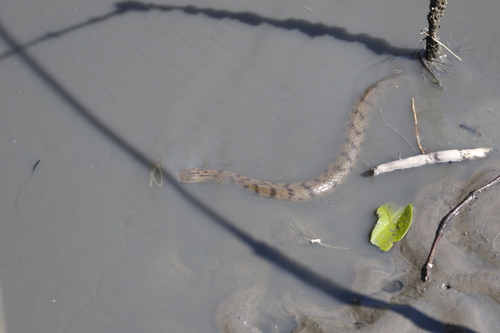 Southeast Asian BockadamCerberus schneiderii
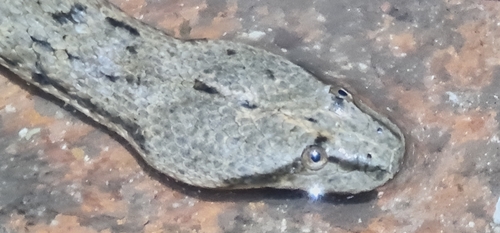 Australian BockadamCerberus australis
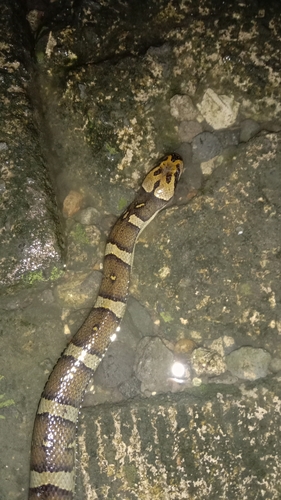 Puff-faced Water SnakeHomalopsis buccata
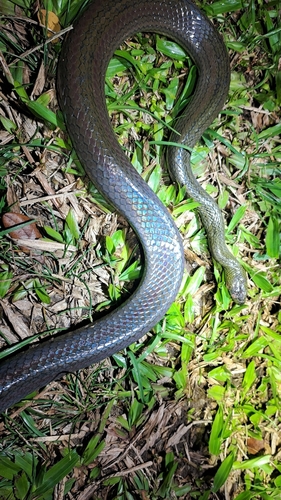 Rainbow Mud SnakeEnhydris enhydris
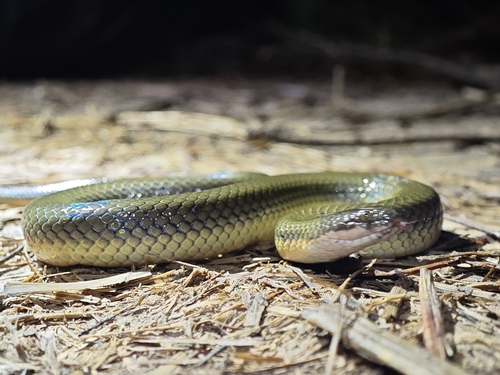 Murphy's Mud SnakeHypsiscopus murphyi
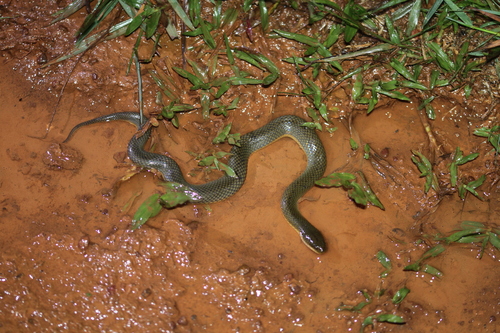 Rice Paddy SnakeHypsiscopus plumbeus
 Chinese Water SnakeMyrrophis chinensis
- No photoPalau Dog-faced Mud SnakeCerberus dunsoni
Classification
How scientists group this snake, from the broadest category down to the exact species. Each step narrows to its closest relatives.
- OrderThe broad group of scaled reptiles: all snakes and lizards
- Squamata
- FamilyA group of related snakes that share key traits
- Homalopsidae
- GenusA close-knit group of very similar species
- Cerberus
- SpeciesThis exact snake, named in the two-part scientific name
- Cerberus rynchops
Keep learning
- What to Do If You Find a SnakeFound a snake at home or on a trail? Here is how to stay calm, give it space, identify it safely, and know when to call a professional.
- Venomous vs Nonvenomous: How to Tell the DifferenceThe folk rules for telling venomous snakes apart, where each one fails, and why location-based identification beats guessing by sight.
- What Is a Snake? Anatomy and the BasicsA clear overview of what makes a snake a snake: limbless body plan, anatomy, evolution from lizards, species diversity, and why they are ectothermic.
- How to Keep Snakes Out of Your Yard and HomeA practical guide to keeping snakes out of your yard and home using habitat changes that work, plus what to skip and what to do if one shows up.
Distribution from GBIF & iNaturalist. Venom status per CDC. Background: Wikipedia. Informational only. Never handle a snake to identify it.