
Elapidae
Beaked Sea Snake
VenomousHydrophis schistosus
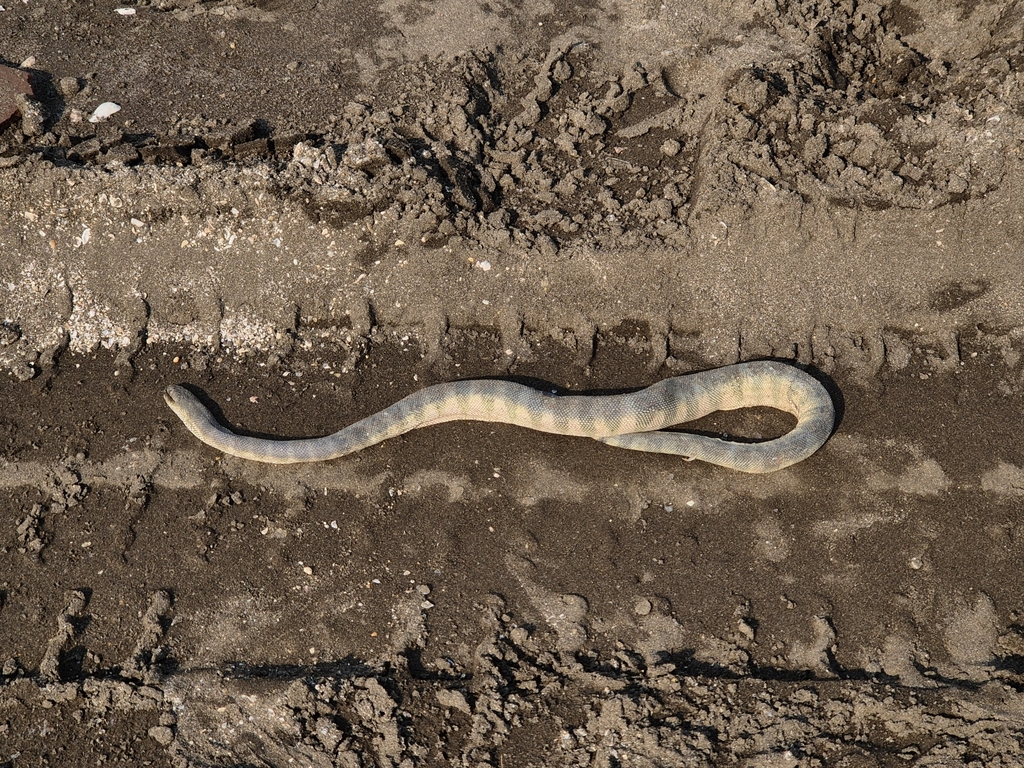
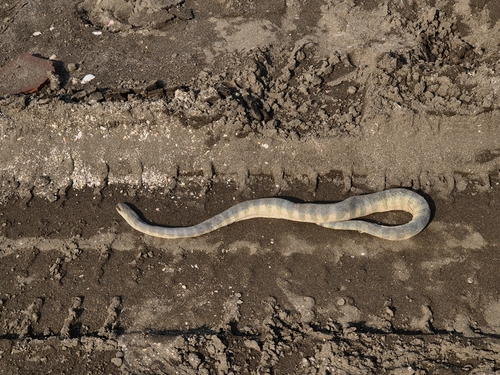
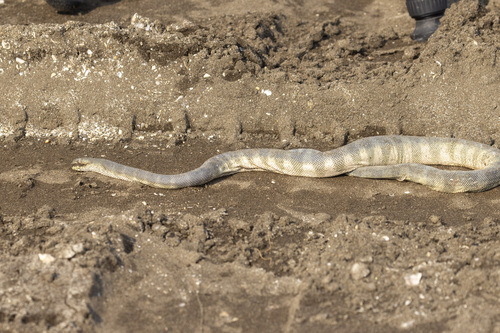
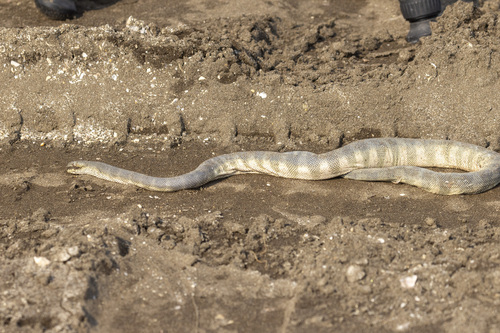
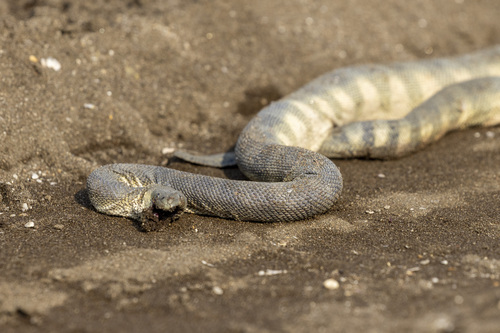
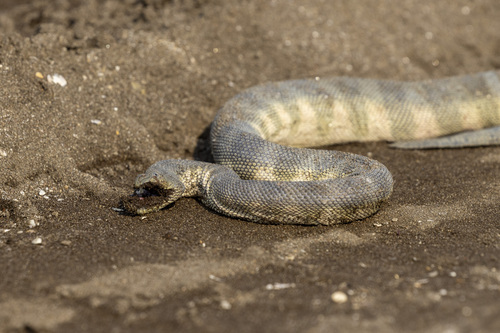
6 photographs of the Beaked Sea Snake. © Ramesh Shenai Jr..
The Beaked Sea Snake (Hydrophis schistosus) is a venomous snake in the Elapidae family, recorded in 16 countries.
If you are bitten
This is a venomous snake. Treat any bite as a medical emergency: stay calm, keep the bitten limb still and roughly level with the heart, remove rings and tight clothing, and get to emergency care immediately. Do not apply a tourniquet, cut the wound, apply ice, or try to suck out venom. Call your local emergency number or poison center.
- Family
- Elapidae
- Danger
- high
About the Beaked Sea Snake
Hydrophis schistosus, commonly known as the beaked sea snake, hook-nosed sea snake, common sea snake, or the Valakadeyan sea snake, is a highly venomous species of sea snake common throughout the tropical Indo-Pacific. This species is implicated in more than 50% of all bites caused by sea snakes, as well as the majority of envenomings and fatalities.
Description
The rostral scale is longer than broad, and is in contact with four shields; frontal more long than broad, shorter than the parietals; nasals in contact with the two anterior labials; sometimes partially divided; one pre- and one or two postoculars; temporals l–3; seven or eight upper labials, fourth or third and fourth entering the eye, the last sometimes divided; anterior chin-shields rather indistinct, separated. Scales with a tubercle or keel, in 50–70 rows; ventrals 230–314, slightly enlarged. The snake is usually uniformly dark grey above; sides and lower parts whitish. Young specimens olive or grey with black transverse bands, broadest in the middle. Length of head and body 1110 mm; tail 190 mm.
The name Vala Kadiyan is from the Tamil word and valakadyn in Malayalam meaning net biter.
Distribution
It is found in the Arabian Sea and Persian Gulf (Bahrain, Iran, Iraq, Kuwait, Oman, Qatar, Saudi Arabia and United Arab Emirates), south of the Seychelles and Madagascar, the seas off South Asia (Pakistan, India (coasts from Gujarat to West Bengal and Andaman & Nicobar Island), Sri Lanka and Bangladesh), Southeast Asia (Myanmar, Thailand, Vietnam).
Snakes from Australia (Northern Territory and Queensland) and New Guinea are now provisionally identified as Enhydrina zweifeli, due to DNA tests that have shown they are not related to Enhydrina schistosa.
Habitat and behavior
These snakes are generally found in the coast and coastal islands of India. They are amongst the most common of the 20 kinds of sea snakes found in that region.
They are active both during the day and at night. They are able to dive up to 100 m and stay underwater for a maximum of five hours before resurfacing. Sea snakes are equipped with glands to eliminate excess salt. They are venomous and notably aggressive, with some herpetologists describing them as "cantankerous and savage". About 1.5 milligrams of its venom is estimated to be lethal.
Their principal food is fish.
Venom
The venom of this species is made up of highly potent neurotoxins and myotoxins. This widespread species is responsible for the vast majority of deaths from sea snake bites (up to 90% of all sea snake bites). The LD50 value is 0.1125 mg/kg based on toxicology studies. The average venom yield per bite is approximately 7.9–9.0 mg, while the lethal human dose is estimated to be 1.5 mg.
Adapted from Wikipedia, available under CC BY-SA.
Local and regional names
The Beaked Sea Snake is known by these names across the regions where it lives:
- Arabic
- الافعى البحرية المنقارية
- English
- Beaked Seasnake, Common Seasnake, Common or beaked seasnake, Hook-nosed Sea Snake
- French
- Enhydrine ardoisee
Frequently asked: Beaked Sea Snake
- Is the Beaked Sea Snake venomous?
- Yes. The Beaked Sea Snake (Hydrophis schistosus) is venomous and belongs to the Elapidae family (cobra, mamba, coral or sea snake). Its bite is considered high risk to people. Treat any bite as a medical emergency.
- Is the Beaked Sea Snake poisonous?
- Snakes are venomous, not poisonous. "Poisonous" means harmful to eat or touch; "venomous" means injecting toxins through a bite. The Beaked Sea Snake is venomous, delivering venom through a bite.
- Is the Beaked Sea Snake dangerous?
- This is a venomous snake. Treat any bite as a medical emergency: stay calm, keep the bitten limb still and roughly level with the heart, remove rings and tight clothing, and get to emergency care immediately. Do not apply a tourniquet, cut the wound, apply ice, or try to suck out venom. Call your local emergency number or poison center.
- Where does the Beaked Sea Snake live?
- The Beaked Sea Snake has verified records in 16 countries, including Malaysia, India, Australia. See the distribution section below for its full range.
If you are bitten by the Beaked Sea Snake
Do
- Get away from the snake and stay calm. Most bites worsen when people panic or try again to handle the snake.
- Call 911 or Poison Control (1-800-222-1222) right away. Antivenom works best when given early.
- Note the time of the bite and, from a safe distance, the snake's color and pattern, a phone photo is enough. Do not chase it.
- Keep the bitten limb still and at roughly heart level. Sit or lie down and limit movement.
- Remove rings, watches, and tight clothing near the bite before swelling starts.
- Gently wash the bite with soap and water and cover it with a clean, dry dressing.
Do not
- Do not cut the wound or try to suck out the venom.
- Do not apply a tourniquet or ice.
- Do not drink alcohol or caffeine.
- Do not take aspirin or ibuprofen, they can worsen bleeding. Acetaminophen is safer for pain.
- Do not try to catch or kill the snake. A dead snake can still bite by reflex.
First-aid guidance adapted from the U.S. Centers for Disease Control and Prevention (CDC NIOSH), Venomous Snakes. Educational only; always follow the instructions of emergency responders.
Where it is found
More Elapidae snakes
 Yellow-bellied Sea SnakeHydrophis platurus
 Olive-headed Sea SnakeHydrophis major
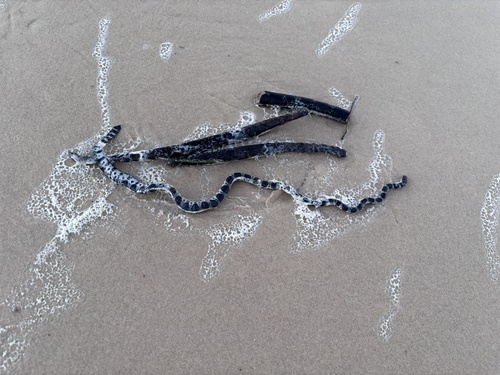 Elegant Sea SnakeHydrophis elegans
 Slender-necked Sea SnakeHydrophis coggeri
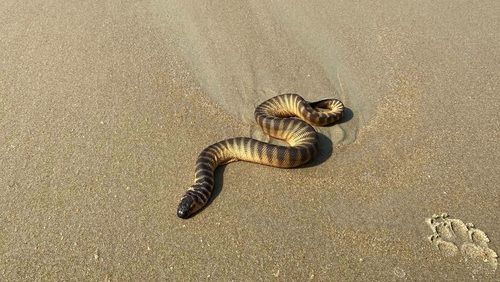 Spine-bellied Sea SnakeHydrophis curtus
 Horned Sea SnakeHydrophis peronii
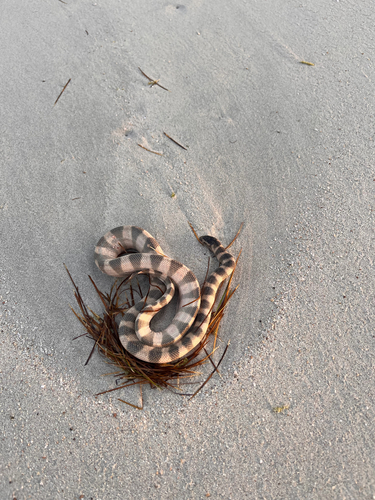 Persian Gulf Sea SnakeHydrophis lapemoides
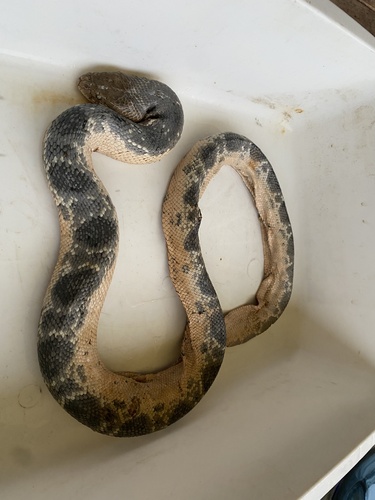 Stokes' Sea SnakeHydrophis stokesii
Classification
How scientists group this snake, from the broadest category down to the exact species. Each step narrows to its closest relatives.
Keep learning
- Are Snakes Dangerous? The Real Risk, in PerspectiveMost snakes are harmless and avoid people. Here is the honest picture of snakebite risk worldwide and how to lower your own.
- Snakebite First Aid: What to Do (and What Never to Do)A clear, CDC-based guide to snakebite first aid: the steps that help, the popular myths that hurt, and how to tell a serious bite from a minor one.
- Venomous vs Nonvenomous: How to Tell the DifferenceThe folk rules for telling venomous snakes apart, where each one fails, and why location-based identification beats guessing by sight.
- What to Do If You Find a SnakeFound a snake at home or on a trail? Here is how to stay calm, give it space, identify it safely, and know when to call a professional.
Distribution from GBIF & iNaturalist. Venom status per CDC. Background: Wikipedia. Informational only. Never handle a snake to identify it.