
Colubridae
Speckled Racer
HarmlessDrymobius margaritiferus
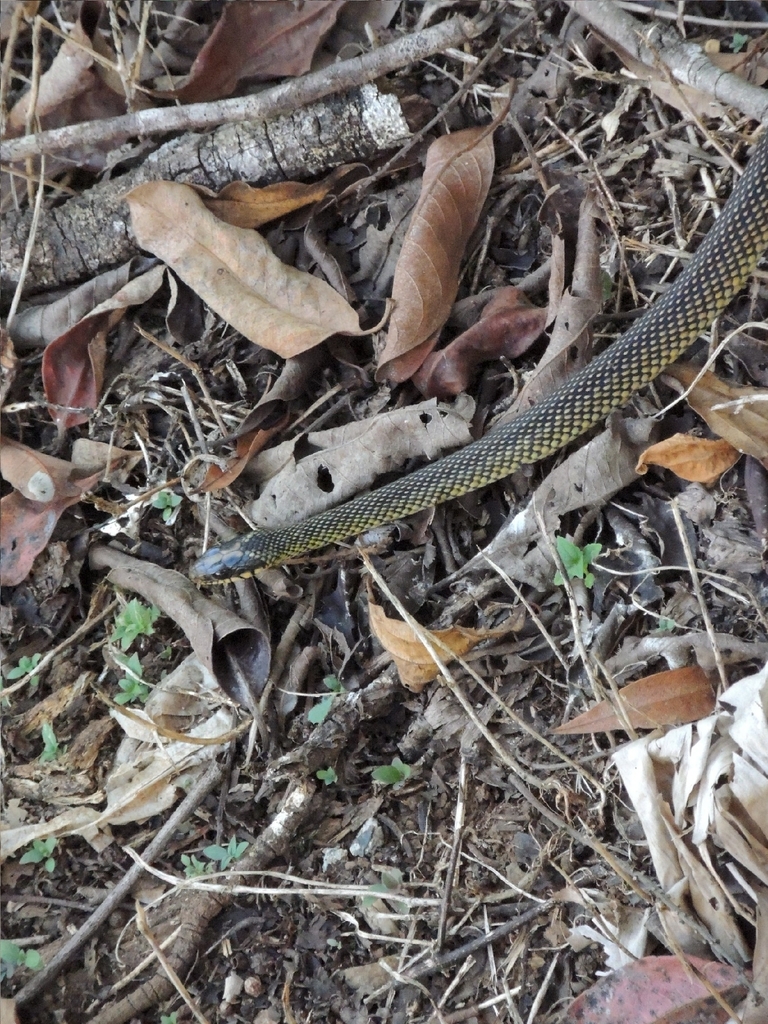
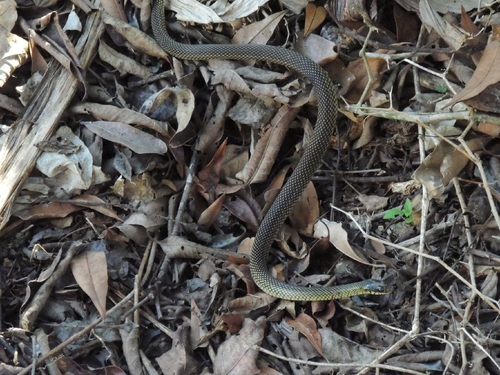
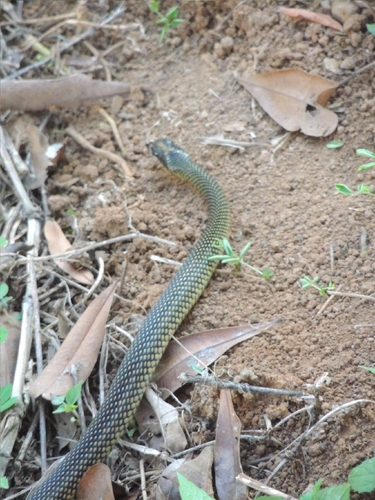
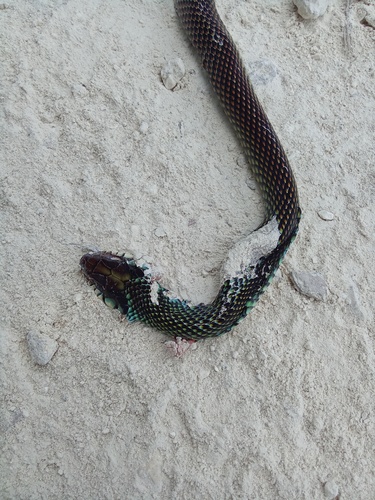
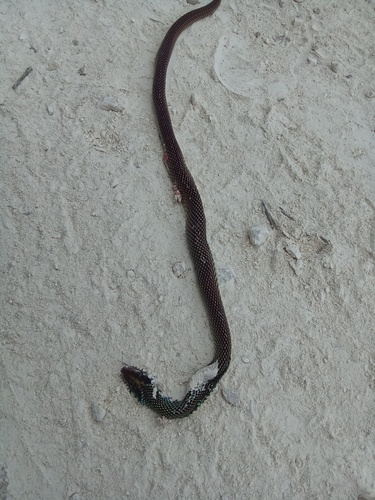
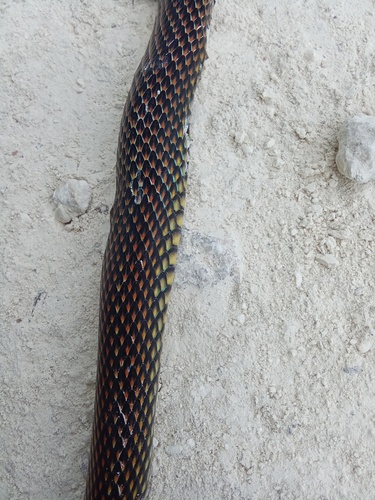
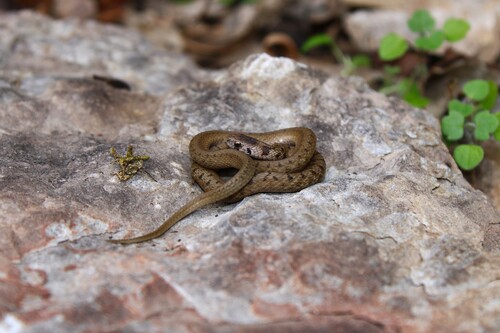
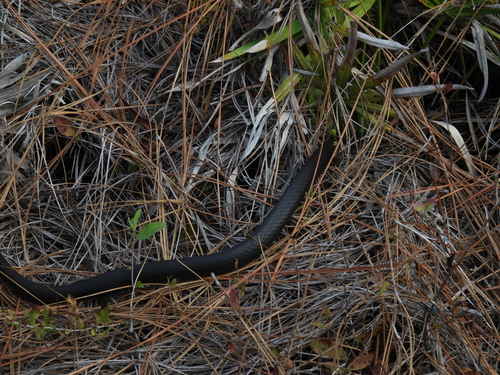
6 photographs of the Speckled Racer. © Anthony Mora Aguilar.
The Speckled Racer (Drymobius margaritiferus) is a non-venomous snake in the Colubridae family, recorded in 13 countries.
- Family
- Colubridae
About the Speckled Racer
Drymobius margaritiferus, commonly known as the speckled racer, is a species of nonvenomous colubrid snake native to the Americas. The specific name, margaritiferus, means "pearl-bearing" in Latin, referring to the pearl-like spots on the dorsal scales.
Geographic range and habitat
This species ranges throughout Central America from the Isthmus of Tehuantepec and Yucatán Peninsula, southward to Panama and adjacent areas of northwest Colombia, occurring at elevations from sea level up to 4,750 feet (1,453 m). Northward, it is found in the coastal lowlands and lower exterior slopes of the Sierra Madres of Mexico, up the west coast to Sonora, and up the east coast to northern Tamaulipas. The northern limit of its distribution ranges into extreme south Texas, USA, where it is uncommon to rare in a few of the southernmost counties of the state.
Speckled racers occur in a wide variety of habitats, including: forest, forest edges and clearings, secondary growth, riparian zones, savannahs, marshlands, pastures, and roadsides. It is often said to favor humid and wet areas with permanent water sources. However, these snakes have been found in areas where no water was apparent, and habitats include tropical dry forests and tropical arid forests. In Costa Rica, it is described as "ubiquitous in all but the most humid lowland and pre-montane zones," including dry lowland forests.
Description
The speckled racer is typically black in color, with distinctive yellow and blue spotting, and one light-colored spot on each scale, which gives the snake an overall greenish hue. The labials are yellow, with black sutures. The underside is typically yellow to green. They average 30–40 in. (76–102 cm) in length, with a record specimen documented at 50 in. (127 cm).
The dorsal scales, which are feebly keeled middorsally, but smooth on the flanks, are arranged in 17 rows. The ventrals number 142–168; the subcaudals, 85–126.
Natural history
As the name "racer" implies, it is a fast and agile species that is predominantly diurnal. It has been described as a nervous species, and will not hesitate to bite in self-defense when restrained or handled.
Death feigning behavior, or thanatosis, was reported for two out of seven (28.5%) specimens that were caught and handled during field surveys conducted in Tamaulipas, Mexico.
They will consume a wide variety of prey, but primarily feed on frogs and toads. One study of 36 Guatemalan and Mexican specimens with food items in their stomachs found 86% had anurans (predominantly Eleutherodactylus), 8% lizards, 4% reptile eggs, and 2% small mammals. Juveniles are known to eat insects.
They are oviparous, typically laying eggs in the spring, although in southern areas, the species is known to deposit eggs as early as February and March. Clutch sizes range from two to eight eggs that are usually 1.5 inches (3.8 cm) in length. Incubation is typically eight to nine weeks, with hatchlings measuring 6 to 10½ inches (15.2–27.6 cm) long.
Subspecies
Adapted from Wikipedia, available under CC BY-SA.
Frequently asked: Speckled Racer
- Is the Speckled Racer venomous?
- No. The Speckled Racer (Drymobius margaritiferus) is non-venomous and is not considered dangerous to humans. Like most snakes, it will retreat rather than bite when given the chance.
- Is the Speckled Racer poisonous?
- Snakes are venomous, not poisonous. "Poisonous" means harmful to eat or touch; "venomous" means injecting toxins through a bite. The Speckled Racer is neither poisonous nor venomous.
- Is the Speckled Racer dangerous?
- The Speckled Racer is not dangerous to humans. It has no medically significant venom and bites only defensively if cornered or handled.
- Where does the Speckled Racer live?
- The Speckled Racer has verified records in 13 countries, including Mexico, Guatemala, Costa Rica. See the distribution section below for its full range.
Where it is found
By U.S. state
More Colubridae snakes
Classification
How scientists group this snake, from the broadest category down to the exact species. Each step narrows to its closest relatives.
- OrderThe broad group of scaled reptiles: all snakes and lizards
- Squamata
- FamilyA group of related snakes that share key traits
- Colubridae
- GenusA close-knit group of very similar species
- Drymobius
- SpeciesThis exact snake, named in the two-part scientific name
- Drymobius margaritiferus
Keep learning
- What to Do If You Find a SnakeFound a snake at home or on a trail? Here is how to stay calm, give it space, identify it safely, and know when to call a professional.
- Venomous vs Nonvenomous: How to Tell the DifferenceThe folk rules for telling venomous snakes apart, where each one fails, and why location-based identification beats guessing by sight.
- What Is a Snake? Anatomy and the BasicsA clear overview of what makes a snake a snake: limbless body plan, anatomy, evolution from lizards, species diversity, and why they are ectothermic.
- How to Keep Snakes Out of Your Yard and HomeA practical guide to keeping snakes out of your yard and home using habitat changes that work, plus what to skip and what to do if one shows up.
Distribution from GBIF & iNaturalist. Venom status per CDC. Background: Wikipedia. Informational only. Never handle a snake to identify it.