
Genus · Colubridae
Types of racers
4 species make up the genus Drymobius, the snakes commonly called racers. None are considered dangerous to humans.
About Neotropical racers
Fast, slender, daytime hunters that streak across the forest floor from Texas to South America.
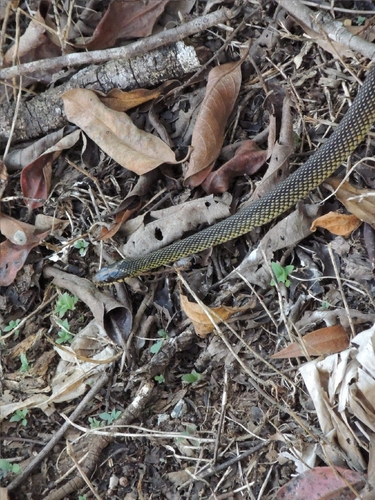
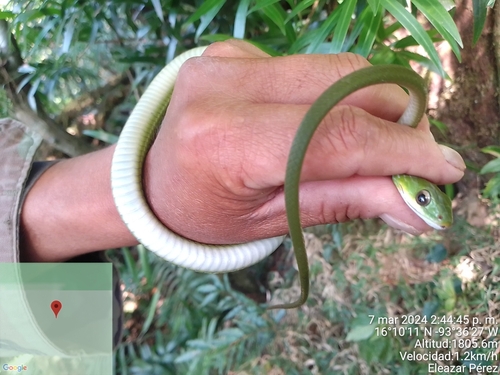
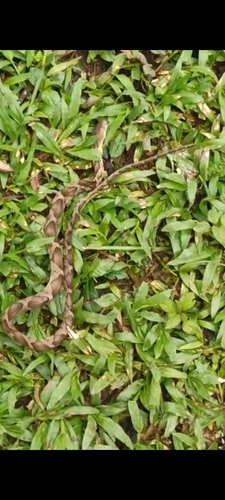
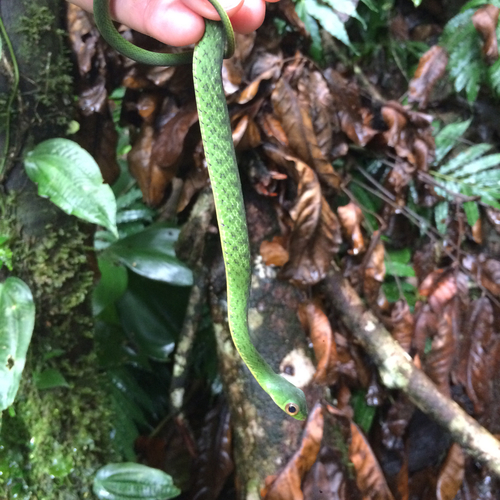
Drymobius is a small genus of slender, fast-moving snakes in the family Colubridae, the largest snake family on Earth. They are commonly called Neotropical racers, a name that reflects both their speedy, ground-hunting habits and their range across the warmer parts of the Americas. The genus holds a handful of species, four of which appear in our database: the Speckled Racer, the Green Highland Racer, the Esmerald Racer, and the Lower-montane Green Racer.
These snakes live across a wide neotropical band. The best-known member, the Speckled Racer, ranges from the lower Rio Grande Valley of southern Texas through Mexico and Central America into northern South America, while the green-bodied members tend to occupy more humid forest and highland habitats farther south. Typical habitats include moist lowland and montane forest, forest edges, brushy clearings, stream banks, and the leaf litter of damp ground, often near water where prey is plentiful.
In general terms, you can recognize a Drymobius racer by its slim, agile build, large alert eyes, smooth body, and long tapering tail. Adults are modest in size, commonly roughly 1 to 4 feet long, with the Speckled Racer often falling near the smaller end of that range. Coloration is the genus calling card: the Speckled Racer is dark with a striking pattern of pale and yellow speckling that can look iridescent in sunlight, while several other members are largely uniform green, a camouflage that suits leafy, humid forest.
Drymobius racers are harmless to people. They are not part of the venomous front-fanged groups, and they pose no medical danger through a bite. Like many colubrids they will flee quickly, and if cornered may flatten the body, gape, or deliver a defensive nip, but this is a nuisance rather than a hazard. As with any wild animal, the responsible approach is to observe and leave them alone rather than handle them. If anyone is ever bitten by a snake they cannot confidently identify, treat it as a medical matter and contact emergency services or US Poison Control at 1-800-222-1222.
Ecologically these are active, diurnal foragers. They hunt by sight and movement during the day, and their diet centers on small cold-blooded prey such as frogs, toads, lizards, and similar creatures of the forest floor, with smaller items taken by juveniles. Like the great majority of colubrids, Drymobius species are egg-layers, producing clutches of eggs rather than live young. Their quick, nervous behavior and reliance on speed and concealment make them more often glimpsed than caught, a fitting trait for snakes named for their pace.
Drymobius belongs to the Colubridae family (Colubrids). The largest snake family, and the one most snakes you meet belong to. Typically round pupils, a head only slightly wider than the neck, and no heat-sensing facial pit or rattle. Scales may be smooth and glossy or keeled and matte depending on the species.
Danger: Almost all colubrids are harmless. A small number are rear-fanged with medically significant venom, the boomslang and the twig (vine) snakes of Africa being the dangerous exceptions. Most colubrids will flee or bluff rather than bite.
All species (4)
Keep learning
- What Is a Snake? Anatomy and the BasicsA clear overview of what makes a snake a snake: limbless body plan, anatomy, evolution from lizards, species diversity, and why they are ectothermic.
- How Snakes Move, Hunt, and EatHow snakes move without legs, hunt as ambushers or active foragers, kill by constriction or venom, and swallow prey wider than their head.
- What Do Snakes Eat?All snakes are carnivores. Learn what snakes eat, how diet changes with size and age, how often they feed, and how they hunt and swallow prey.
- Venomous vs Nonvenomous: How to Tell the DifferenceThe folk rules for telling venomous snakes apart, where each one fails, and why location-based identification beats guessing by sight.