
Colubridae
Common Cat Snake
HarmlessBoiga trigonata
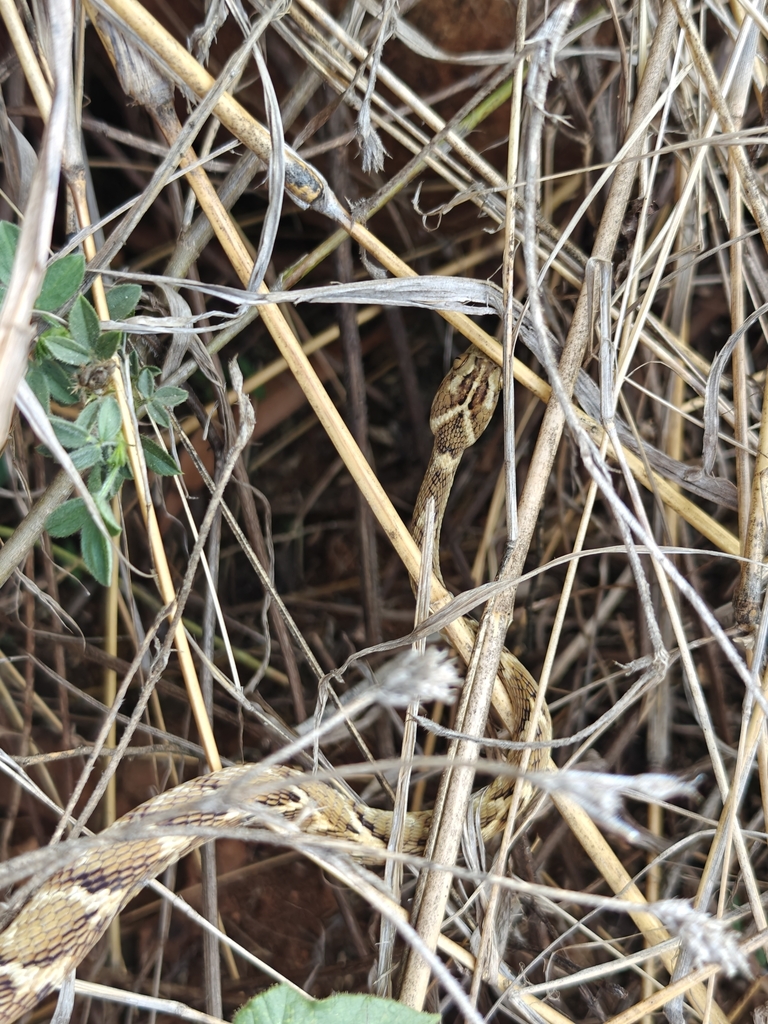
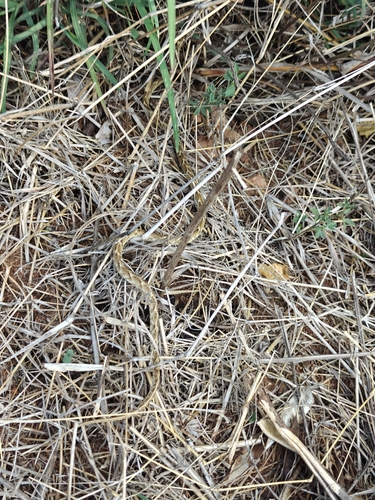
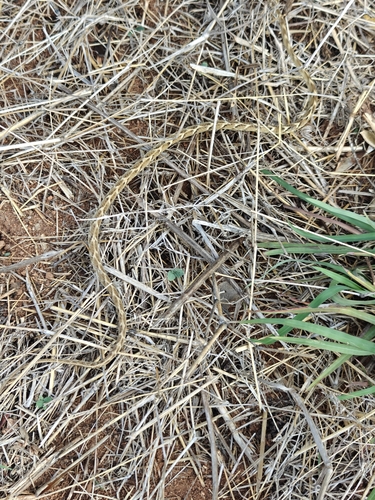
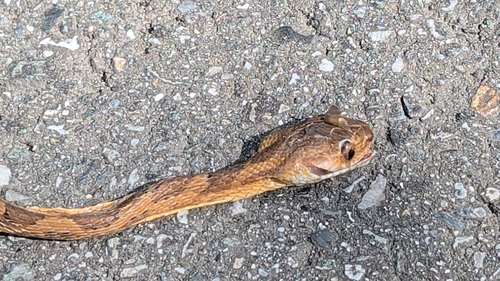
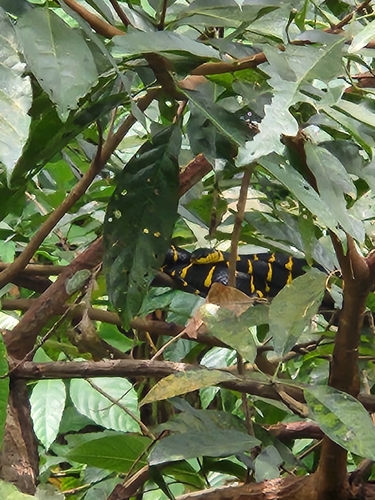
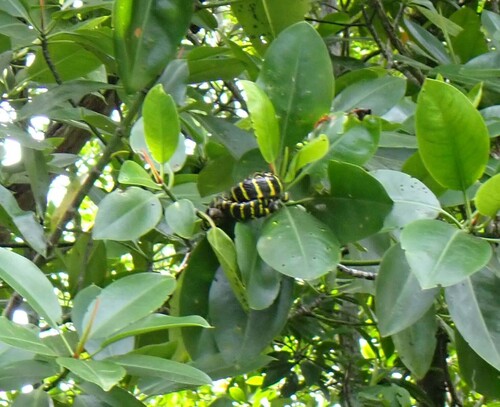
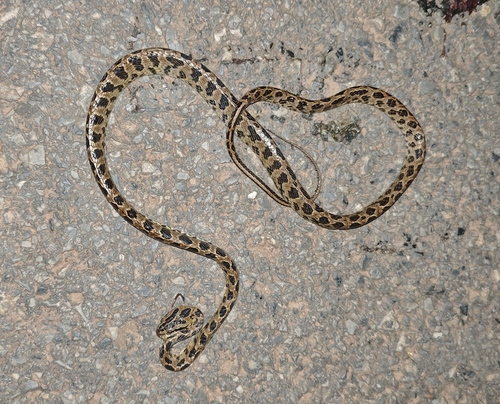
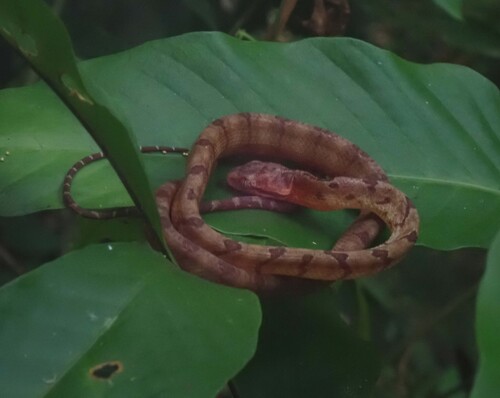
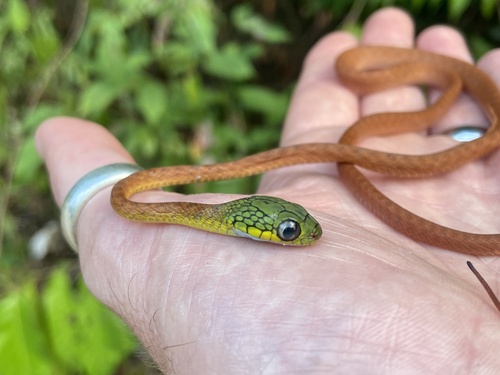
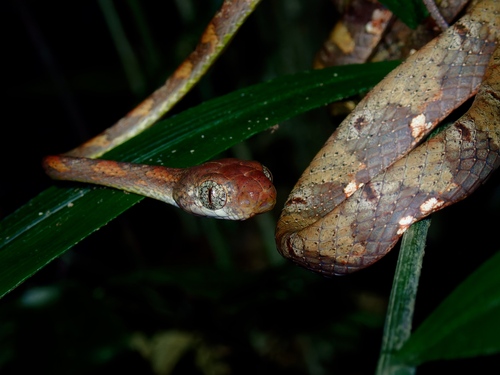
3 photographs of the Common Cat Snake. © Ashwin Viswanathan.
The Common Cat Snake (Boiga trigonata) is a rear-fanged, mildly venomous snake in the Colubridae family, recorded in 13 countries.
- Family
- Colubridae
About the Common Cat Snake
Boiga trigonata, commonly known as the Indian gamma snake or common cat snake, is a species of rear-fanged colubrid endemic to South Asia.
Description
See snake scales for terms used
Boiga trigonata has anterior palatine and mandibular teeth scarcely larger than the posterior. Its eyes are as long as the distance from its nostril, large and has vertical pupil; the rostral is broader than deep with the internasal scales shorter than the prefrontal scales. The frontal scales are longer than their distance from the end of the snout and shorter than the parietal scales. The loreals are as long as they are deep, or, they can be deeper than they are long. B. trigonata's one preocular does not extend to the upper surface of the head. The species has two postoculars, temporals 2+3, and 8 upper labials, with the third, fourth, and fifth entering the eye. They can have 4 or 5 lower labials in contact with the anterior chin-shields, which are about as long as the posterior. B. trigonata's body is moderately laterally compressed with smooth dorsal scales in 21 (or rarely 19) rows, with apical pits, disposed obliquely, with the vertebrals very feebly enlarged. There are 229–269 ventral scales, 79–92 divided subcaudal scales, and a single anal scale.
Boiga trigonata has a yellowish-olive or pale grey colour along the back and a white black-edged zigzag markings which may be connected. Top of head has a distinct, pale Y shaped mark, which is sometimes black-edged. Scales on top of head large, smooth, and of different shapes. The belly is white or tan and can have a series of small brown spots along each side.
The total length is around 3 feet (91 cm) with a 7-inch (18 cm) tail.
Geographic range
Boiga trigonata type locality is the Perso-Baluchistan frontier.
It is distributed throughout Sri Lanka, India, Pakistan, Nepal, Bangladesh, Afghanistan (Leviton 1959: 461), southern Turkmenistan, southern Uzbekistan, southeastern Tajikistan, and Iran.
The race melanocephala is found in Pakistan; this form is variously considered as a subspecies, color variant, or full species.
Mimicry
Boiga trigonata strongly resembles venomous Echis carinatus in coloration and shape. Also, in India, these two species have almost identical geographic ranges.
Diet and behavior
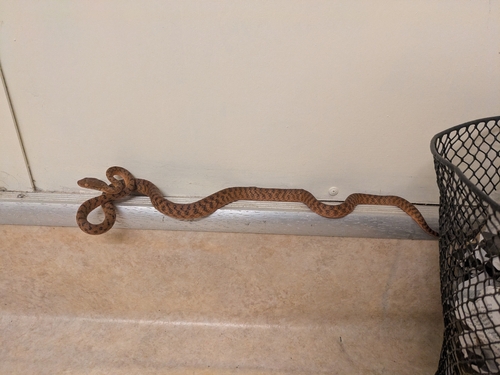
It is nocturnal and spends the day coiled up in palmyra fronds, among bushes, in thatched roofs, under tree bark or stones. Is an excellent climber. Common in many areas, often in houses, but, like other nocturnal snakes, it is rarely seen.
Rear-fanged. Mild venom can paralyze small prey (lizards, mice, and small birds). When disturbed, may coil tightly, strike repeatedly, and vibrate tail.
Adapted from Wikipedia, available under CC BY-SA.
Frequently asked: Common Cat Snake
- Is the Common Cat Snake venomous?
- The Common Cat Snake (Boiga trigonata) is rear-fanged and only mildly venomous. It is not considered dangerous to humans (its venom is weak and its fangs sit at the back of the mouth) but a bite can cause local swelling or irritation, so it should not be handled.
- Is the Common Cat Snake poisonous?
- Snakes are venomous, not poisonous. "Poisonous" means harmful to eat or touch; "venomous" means injecting toxins through a bite. The Common Cat Snake is neither poisonous nor venomous.
- Is the Common Cat Snake dangerous?
- The Common Cat Snake is not dangerous to humans. It has no medically significant venom and bites only defensively if cornered or handled.
- Where does the Common Cat Snake live?
- The Common Cat Snake has verified records in 13 countries, including India, Pakistan, Sri Lanka. See the distribution section below for its full range.
- What does the Common Cat Snake eat?
- It is nocturnal and spends the day coiled up in palmyra fronds, among bushes, in thatched roofs, under tree bark or stones. Is an excellent climber. Common in many areas, often in houses, but, like other nocturnal snakes, it is rarely seen. Rear-fanged. Mild venom can paralyze small prey (lizards, mice, and small birds). When disturbed, may coil tightly, strike repeatedly, and vibrate tail.
Where it is found
More Colubridae snakes
Classification
How scientists group this snake, from the broadest category down to the exact species. Each step narrows to its closest relatives.
- OrderThe broad group of scaled reptiles: all snakes and lizards
- Squamata
- FamilyA group of related snakes that share key traits
- Colubridae
- GenusA close-knit group of very similar species
- Boiga
- SpeciesThis exact snake, named in the two-part scientific name
- Boiga trigonata
Keep learning
- What to Do If You Find a SnakeFound a snake at home or on a trail? Here is how to stay calm, give it space, identify it safely, and know when to call a professional.
- Venomous vs Nonvenomous: How to Tell the DifferenceThe folk rules for telling venomous snakes apart, where each one fails, and why location-based identification beats guessing by sight.
- What Is a Snake? Anatomy and the BasicsA clear overview of what makes a snake a snake: limbless body plan, anatomy, evolution from lizards, species diversity, and why they are ectothermic.
- How to Keep Snakes Out of Your Yard and HomeA practical guide to keeping snakes out of your yard and home using habitat changes that work, plus what to skip and what to do if one shows up.
Distribution from GBIF & iNaturalist. Venom status per CDC. Background: Wikipedia. Informational only. Never handle a snake to identify it.